Now that DOMINICA is finished I hope to continue the occasional series I had previously begun here and elsewhere. While you’re herePLEASE SIGN UP to this blog if you’d like to hear more – the box is at the top of the post on the right – Let’s keep in touch!I do not post often, perhaps fortnightly, so posts are easy to miss. {I had been building my followers since 2011 – and had around 640 when an unfortunate technical issue meant that I lost ALL of these followers contacts – and need to start again – so please do join to keep in touch}
To find the Introduction and PART 1 and PART 2CLICK HERE then just scroll down to the first post – and then read your way up through the eras.
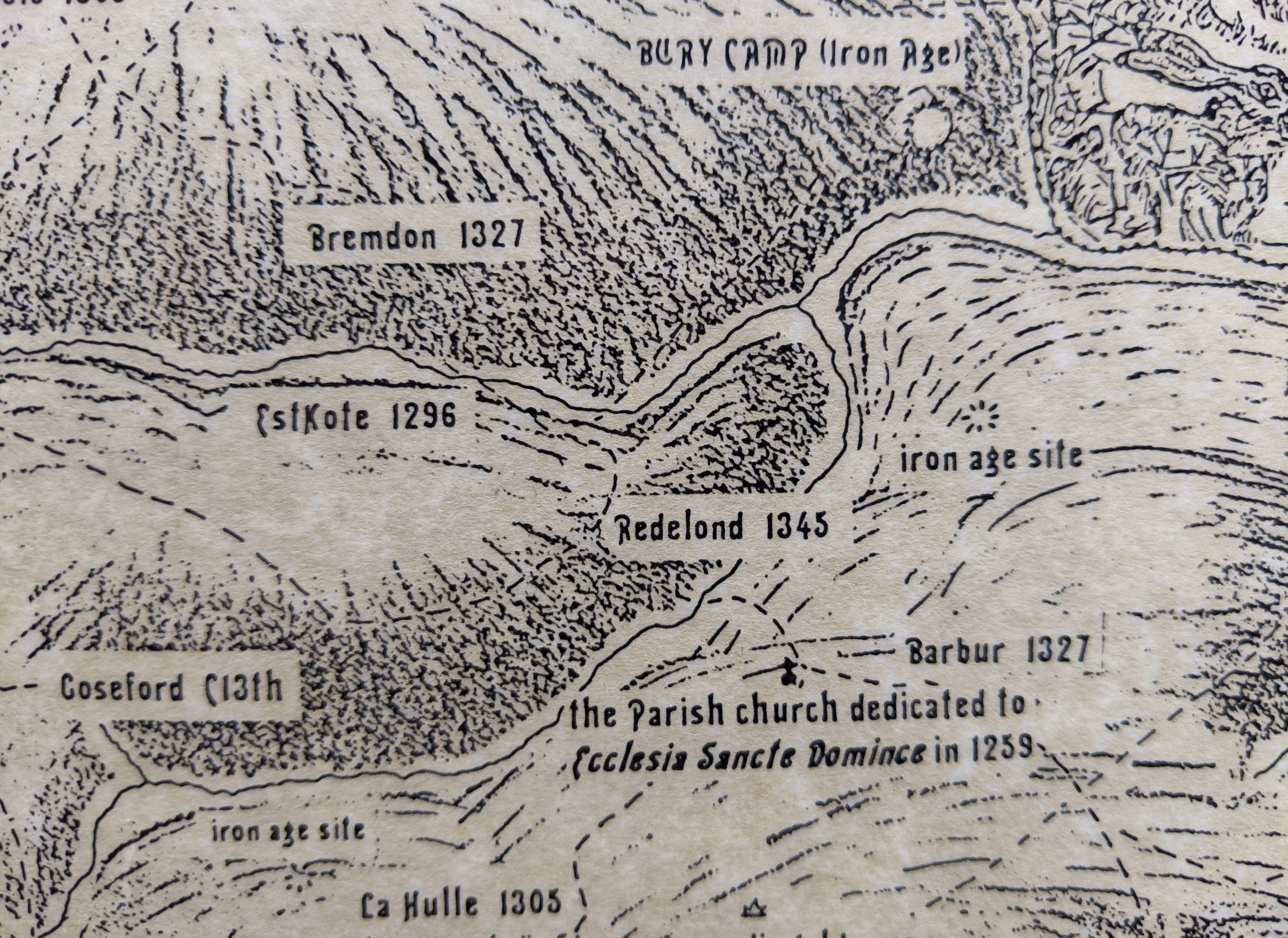
The Iron Age (800 BC – AD 43) left more marks than the Bronze Age upon the landscape of the St. Dominick parish area. The most notable of these being at Berry Farm. See section of map below:
The change of name from ‘Bury Farm’ (with unrelated connotations as to its meaning) to ‘Berry’ could be relatively recent – though it was written as Berry on the Tithe map (1841) it was still written as ‘Bury’ on the 1892 – 1914 OS map. Use the Reference (1) at the end of this post, to link into a side-by-side view showing the 1892 – 1914 Ordnance Survey map A ‘Bury’ is the name given to a ditch and bank ‘fortification’ created during the Iron Age – and are sometime referred to as ‘rounds’ or ‘camps’ when of this smaller nature.
The listing for the ‘Round at Berry Farm’ (Reference: (2), St. Dominick from Historic England reads:
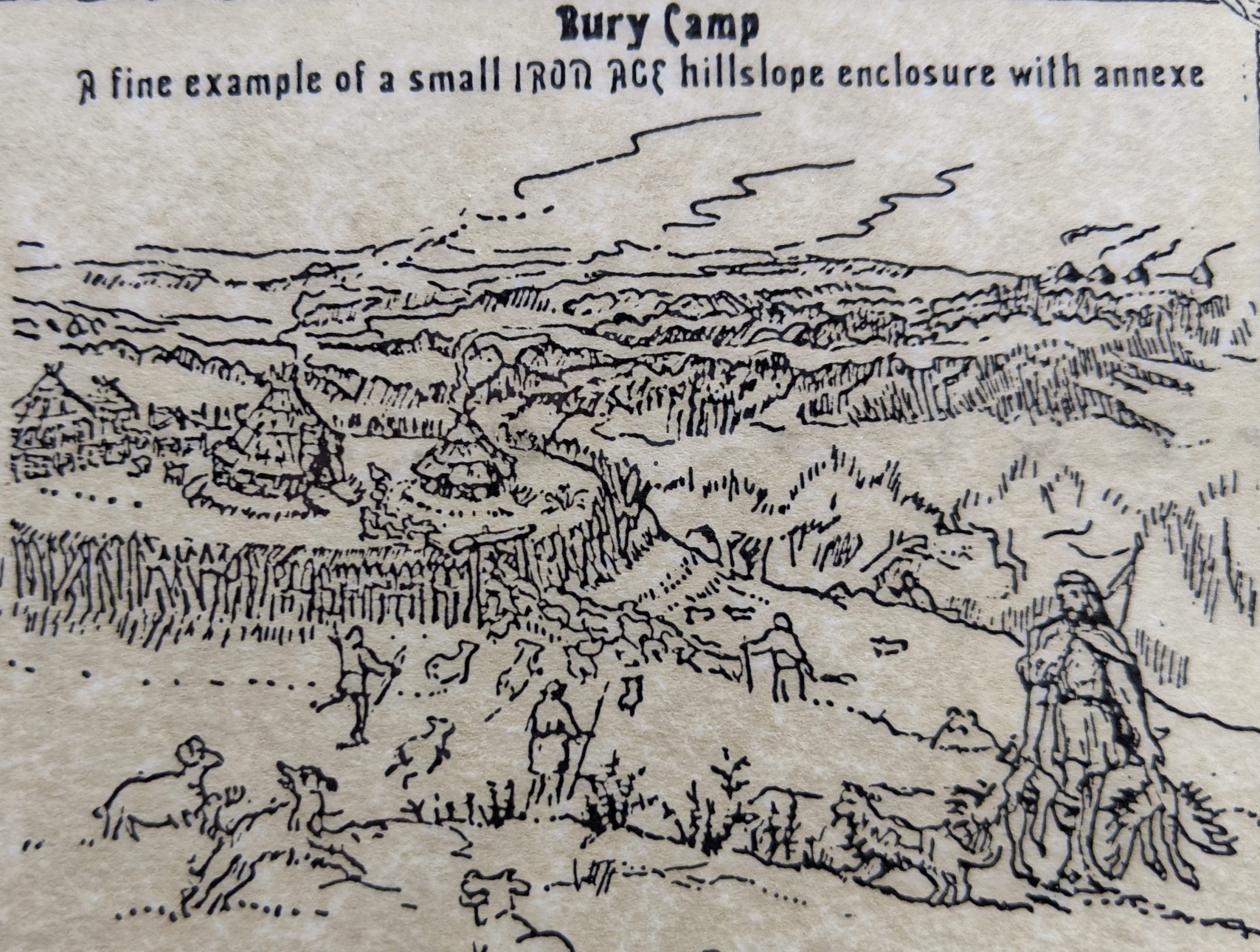
“The monument includes a round, situated on the east-facing summit of a spur, overlooking the steep valley of a tributary to the River Tamar. The round survives as a roughly-circular enclosure defined by a rampart and largely buried outer ditch with a similarly defined annexe to the north west. The main enclosure measures approximately 65m in diameter internally. The rampart survives differentially, but reaches a width of up to 10m and an external height of 0.8m up to 2m to the north and west. To the south it has been incorporated into an existing field boundary. The annexe rampart has been partially fossilised within existing field banks, although to the north the rampart stands to a height of 1.7m above the accompanying ditch which is some 7m wide and 0.3m deep. Elsewhere it has been cut by farm buildings or is preserved as buried features” (1) (noted as a legacy record – first listed 1957)
The difference between the designation of a ‘Round’ and a ‘Hillfort’ is one of magnitude firstly. Locally we can easily see the difference between Cadsonbury just outside Callington (a Hillfort, on the top of a steep-sided hill, defended by a deep ditch (still 1.3m) and a high bank (still 2m internally) and the ‘Round at Berry Farm’ which is on the slope of a hill, at a point that makes a promontory over the stream valley, with steep sides only on the stream side. It too has a ditch and bank but was probably never as substantial as that of Cadsonbury, and encloses a much smaller area though with annexe attached (a squarish enclosure) which, it is thought, animals could be herded into if under attack. There is also a ‘captured-spring’ well house (much degraded) beside the lane that passes the Round at Berry, on the higher side, and only about a 100m away from it.
There wasn’t much room for a large collection of houses within the space of a Round like at Berry, and it is possible that it was mainly the homestead of the local leader, a sort of clan chief, and his retinue, but also a refuge should the people under their protection be under attack. The people, mainly farmers would therefore live outside this enclosure on their own land, but paying tribute to the chief (who, in that culture, could be male or female) and both seeking refuge with them and fighting with them should their area be under attack from other clans.
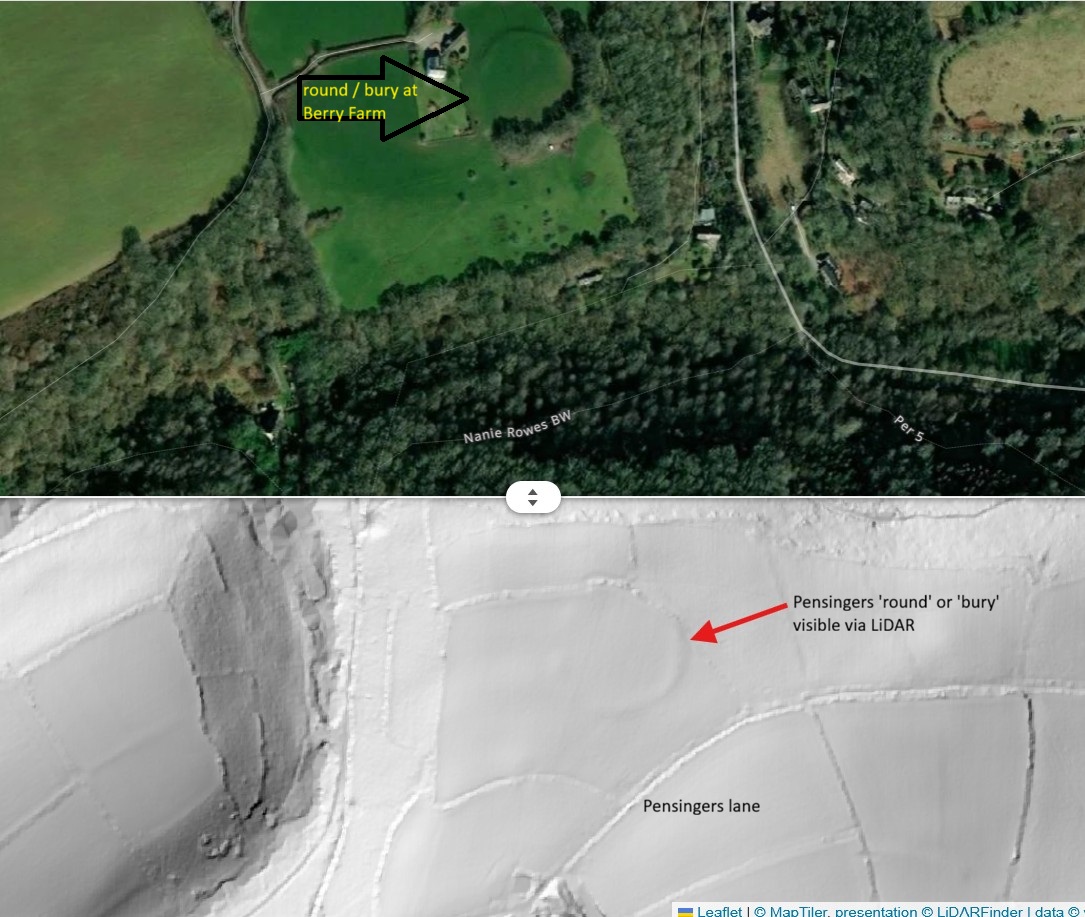
In 1994, whilst we were researching the History of St. Dominick for the parish map project – the Cornwall Archaeology department happened to send a team to do a ‘walking survey’ of St. Dominick, and we were fortunate that they reported before we completed and sent us a copy. From this we were able to put in some of the other details they believed should be there – though now almost lost through agricultural process. This suggested that there was another iron-age bury at one time, across the stream from the Round at Berry. This would have been on the promontory, with a steep drop to the stream-side, below Pensingers Lane. The field shapes in that area, even now, show as curved and it isn’t too hard to imagine an enclosure here.
More recently LiDAR {Light Detection and Ranging} surveys have shown this to be the case – with the outline of this second bury showing on the village side of the valley. See the LiDAR finder picture below.
Harder to imagine is the iron age enclosure the Archaeological walking team suggested they saw in topographical evidence for down below Trehill farm, overlooking the same stream, but when still very small so with not such steep sides. The area suggested does show as having its own spring source, however, a good sign for a settlement of sorts.
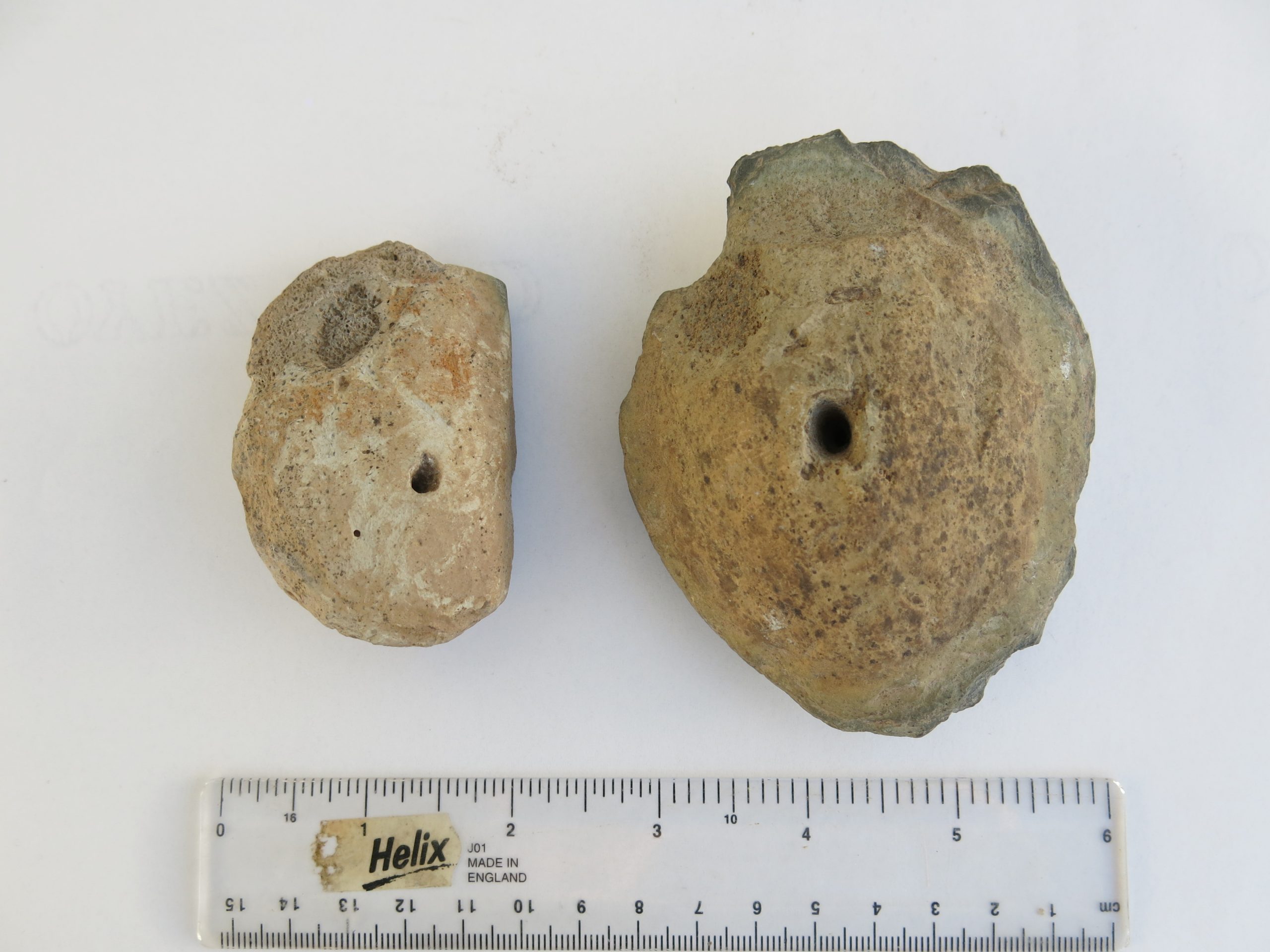
A couple of items*, dug up from over a foot down when post-holes were being made for a fruit-cage just above Radland Farm, may also come from this era. Made of slate and with, what appears to be, baked clay either side, they look like loom weights and show wear from where warp thread would have been attached. The warp thread would be hanging from a frame and weighted with something like these and the weft woven into it. *[neither age not use has been confirmed at this point]
References: (2)Listing for Round at Berry farm, St. Dominick
Remember – reviews of books are a great way to say ‘thank you’ to an author if you like what they write, Thank You
Questions or Comments on this post welcome!! Xx Ann
ps If you are reading this on email and would like to comment just click onto the title and it will take you to the actual blog – so you can comment there.
If it is the first time you have written a comment don’t worry if it doesn’t appear immediately, your first comment has to be verified (to keep the spam-bots out) and I do this personally – so I am sure to see your comment – thanks for reading – Ann
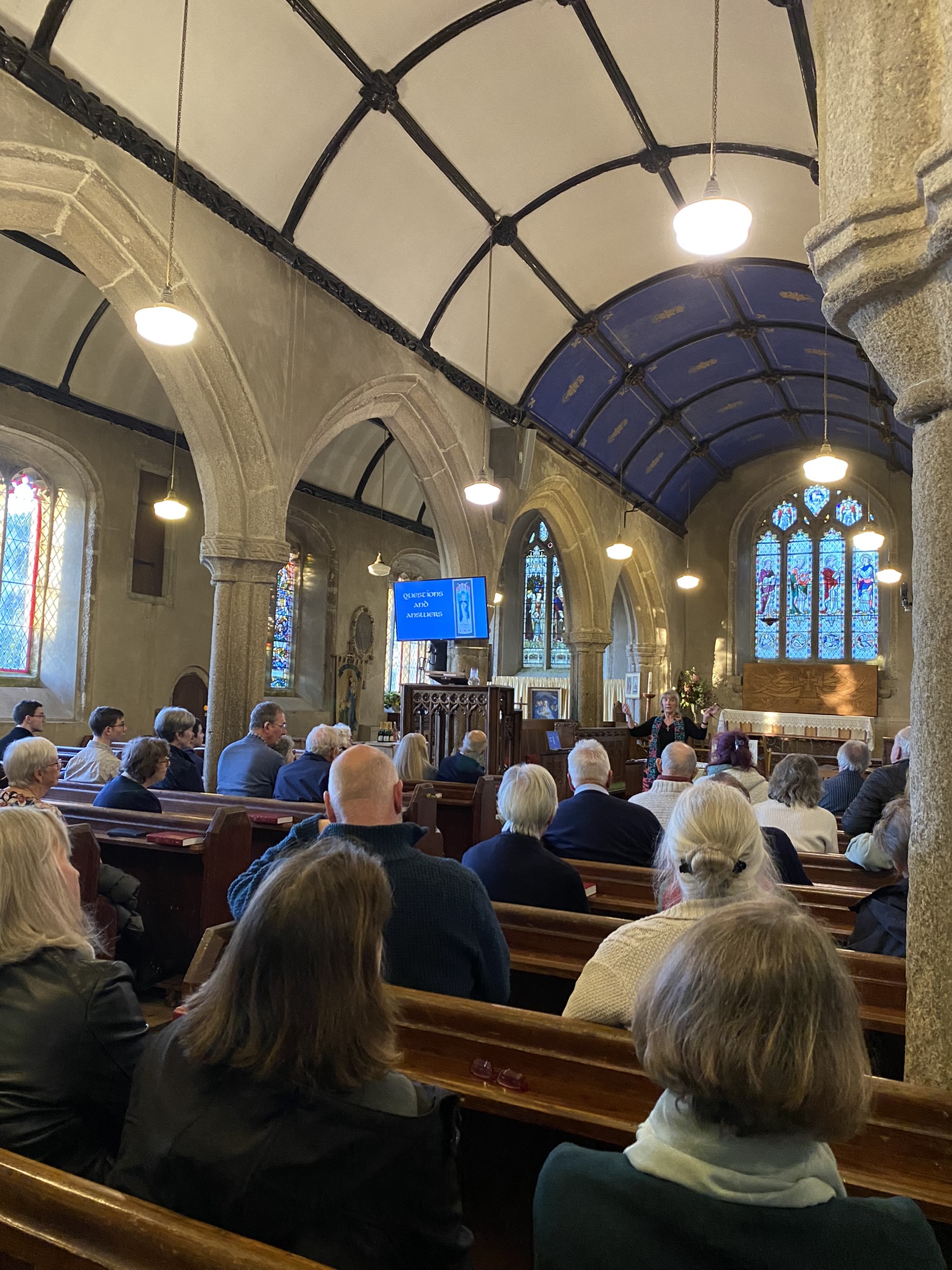
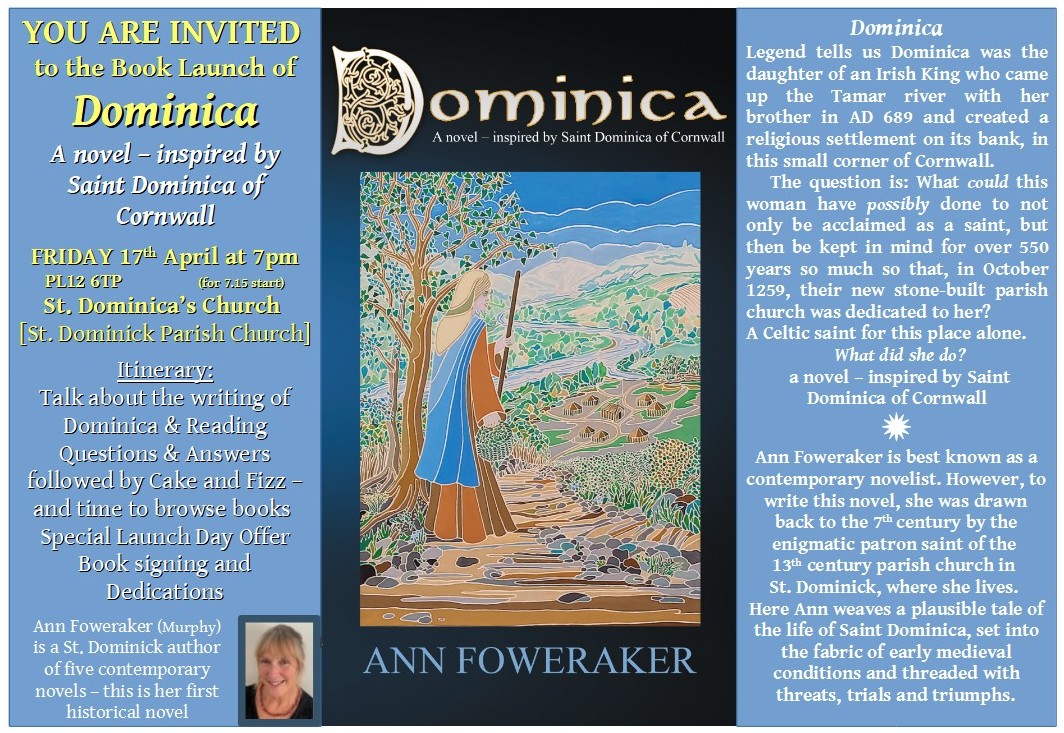
Not everyone could get to the launch – some were away – some too far away – but still nearly fifty people made the event feel well supported – and I was delighted. Delighted that the novel – Dominica – a novel inspired by Saint Dominica of Cornwall was getting released to the world in the very church that was named after her – and where the original inspiration hit me.
So, here for everybody – is the (pruned) transcript of my talk about the WHY and HOW I went about writing Dominica in the first place …
My WHY for writing this novel goes back to about 2010. And I am going to describe it to you – as it was, a bit extraordinary, as an experience.
It was a late Saturday afternoon and I had just finished doing the sacristan duty, which entailed setting up the altar and the bread and wine ready for the Holy Communion service the next morning in this church – the church of St. Dominica – the Parish church of St. Dominick. As usual I completed my time in the church with a little reflection and prayer at the chancel step.
The sun was coming in through the window to one side of the tower behind me, shining through the leaves that flickered in the breeze, and painting the interior of the church with moving patterns of coloured light from the stained glass window it shone through – see below.
and lighting up the pillars and parts of the floor around me. And it is in this, I hesitate to say magical, light-effect that I was reflecting and praying. The type of prayer that has no words, that is just resting in God and waiting to know what you need to pray for. ….. and then, into this reverie came the thought, loud and clear: ‘What did she do? and I knew it referred to Dominica.
Now, I already knew the time-line – so the question instantly became ‘what did Dominica do for the people that they remembered her for over 550 years? So much so that when they built their new stone church, in the middle of the 1200s, they named it after her? St. Dominica – a saint known only to them in this little piece of Cornwall beside the Tamar,’
And then this thought: ‘You could write her story’ came in. My immediate reaction was – Oh no! I do not write historical novels! For one thing, they are way too hard, for two, I have no idea what she could have done and for three, I was in the middle of writing a very contemporary novel, at that time – The Angel Bug – let’s just say it was a book involving dna / genome mapping and the Eden Project – to see how far away it was from this historical idea.
After about nine years of trying to ignore this idea of writing Dominica’s story, while finishing The Angel Bug, writing A Respectable Life and a non-fiction plus editing two other books (and going through my parents’ passing and breast cancer) – I felt she was still nagging me to write it. So I finally gave in and bumped it up my ‘book ideas list’ from number nine to number six.
And so we come to the HOW I went about it. I began by researching whenever I could. Firstly the legends – there are a few versions, but only one involves both Dominica and our area.
We, in this place, have the Legend“Indract and Dominica, son and daughter of an Irish King, came up the Tamar in a coracle to this place and made a religious settlement here.”
And there are other relevant interlinking legends too – one from Tamerton (Foliot) One from Glastonbury and two very local ones, only known in this parish. All of which I tried to weave into the tale.
The legends are in the section Author Notes at the end of the book. However I need to issue a ‘spoiler alert!’ if you do not already know of the legend involving Saint Indract and Glastonbury – I suggest you DO NOT read the legends until afteryou have read this story.
We have some facts too – but from a later date – We know that this church, though it was smaller than this at the time, was dedicated to Dominica in October 1259 when Bishop Walter de Bronescome did a tour of Cornwall dedicating churches
– and we know Dominica’s original saint’s day date was the 30th of August, from documentation requesting the change of date in 1445. Stating that it was then on ‘the day after the decollation of St. John the Baptist’ decollation is the beheading (which is the 29th of August) and asking for it to be moved to the day after St. Indract’s as it was ‘inconveniently in the middle of harvest’. Where it remains to this day as the 9th of May.
Then I began researching the times and what I could find out about life in Cornwall, in particular, at the time the legend puts her here – from AD 689. AD 689!
This was hard! This is deep in the Early Middle Ages, the time that used to be called ‘the Dark Ages’ mainly because of how little was known of those times.
There are few proper relevant records, not even a lot of helpful archaeology and it was a time of flux – especially on the borderlands of Saxon Wessex and Dumnonia, as the Celtic kingdom covering what is now Devon and Cornwall was then known.
Earlier, in the reign of King Centwine of Wessex, AD 676 – 685, the Saxons had invaded Dumnonia and then ruled the area right down to and including what we know as Exeter – but had then lost much of that area again during a time of instability in Wessex. So by the time this story arrives in Britannia, the old British kingdom of Dumnonia stretched roughly from Land’s End to a line lying roughly along the border of today’s counties of Somerset and Dorset with Devon.
The Saxon Kingdom of Wessex had, from AD 688, King Ina (also written as Ine and Ini) at its head. (but as it would be pronounced InA – I have used this version.
King Ina comes into the legends – so I researched him and his influence where it concerned Glastonbury and Cornwall.
When looking at my main characters’ origins, I also researched what being an Irish King of that era actually meant, again because the legend says Indract and Dominica were the son and daughter of an Irish King.
Then I delved into what is known about early medieval monasteries, both Irish and British, as our protagonists would come from the former type, and set up similar in Dumnonia.
The first thing I found out, very quickly, was that I had to forget everything that I thought I knew about medieval monasteries – for everything I knew was really about an entity and life-style that only came into being a few hundred years later than the date this book is set at.
I have always had a fascination for history, vernacular history in particular, yet I found I actually knew nothing actually relevant to this time. The monasteries we hear most about, in school for instance, are those of the High to Late Medieval period, with the latter eventually dissolved under Henry VIII, and as such would have been virtually unrecognisable to the people of Dominica’s time – and, most certainly in Cornwall, where things were different again to more eastern areas of Britain.
I spent a couple of years researching the history of the time, from a vast array of resources including published books, serious internet-based history platforms and up-to-date theses for PhD and Masters qualifications.
I also delved into scientific analysis of the ingredients of the herbal mixtures, poultices and potions probably used, and their actual effects on bacteria, viruses and well-being – combining this with the nature of diseases and ailments verified to that specific era and their usual outcomes.
I was even able to look into the weather! How amazing is it to be able to find out notable weather events and trends that were relevant to the dates and areas that Dominica’s story is set in?
Eventually I began to form an idea of what she could, possibly, have done … and sketched these out to make a proper storyline. In doing this, I sometimes had to pick and choose between competing narratives on the same scraps of information. And, as this is a novel, I chose the path that made it a better story.
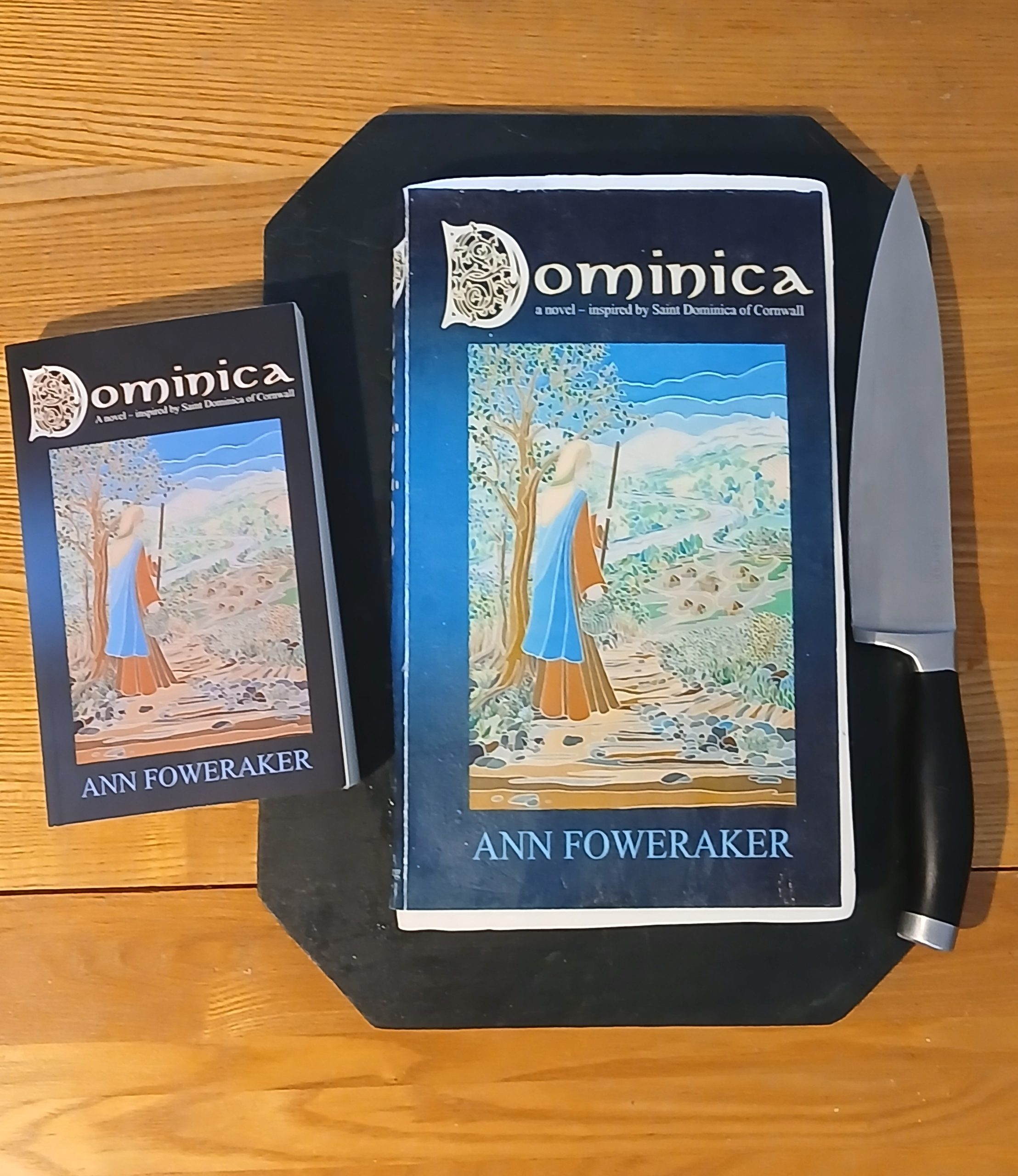
After the talk – and a reading from the first chapter – we then cut the cake (see below – with a real book alongside) and all partook of nibbles, cake and fizz to celebrate the launch in the proper way!
Thank You to everyone who came along – and to all who bought books – not only Dominica – but some of my others too!! Many thanks to to the family team, especially the grandsons who served said drinks and cake and acted as cashier for me – wonderful boys!
PLEASE SIGN UP to this blog if you’d like to hear more – the box is at the top of the post on the right – Let’s keep in touch!
{I had been building my followers since 2011 – and had around 640 when an unfortunate technical issue meant that I lost ALL of these followers contacts – and need to start again – do join to keep in touch}
ps If you are reading this on email and would like to comment just click onto the title and it will take you to the actual blog – so you can comment there. If it is the first time you have written a comment don’t worry if it doesn’t appear immediately, your first comment has to be verified (to keep the spam-bots out) and I do this personally – so I am sure to see your comment – thanks for reading – Ann
At last! After six (or more) long years of researching, writing, more researching, more writing – Dominica A novel – inspired by Saint Dominica of Cornwall – is ready to face the world!!
I have been almost shy of reporting much on this journey – sometimes I wondered if I would get it finished, sometimes I wondered if I should have ever attempted it in the first place.
However, it was a wild ride – I HAVE LEARNT SO MUCH – about early medieval histories (and other interesting side-notes) on the way to the finishing line.
And I have been privileged to be able to commission / buy paintings from two local artists to help create my cover Marion Kemp Pack for my front cover, showing Dominica over looking the river loop that gives the settlement its name. And David Thomas, who was just getting going in his chosen art-form when he happened to do a rendering of the Dominica window (in the tower window of St. Dominick Parish Church) which I noticed on his instagram page – and was able to purchase as a promise to myself that I would actually write the novel
For those of you too far away to come to my book launch – she is available both on Amazon and to order from bookshops – see info below ISBN: 978-1-909936-33-1 Dominica A novel – inspired by Saint Dominica of Cornwall – by Ann Foweraker
More info to come in a new post!!
Speak soon, Xx Ann 🥰
ps If you are reading this on email and would like to comment just click onto the title and it will take you to the actual blog – so you can comment there. If it is the first time you have written a comment don’t worry if it doesn’t appear immediately, your first comment has to be verified (to keep the spam-bots out) and I do this personally – so I am sure to see your comment – thanks for reading – Ann
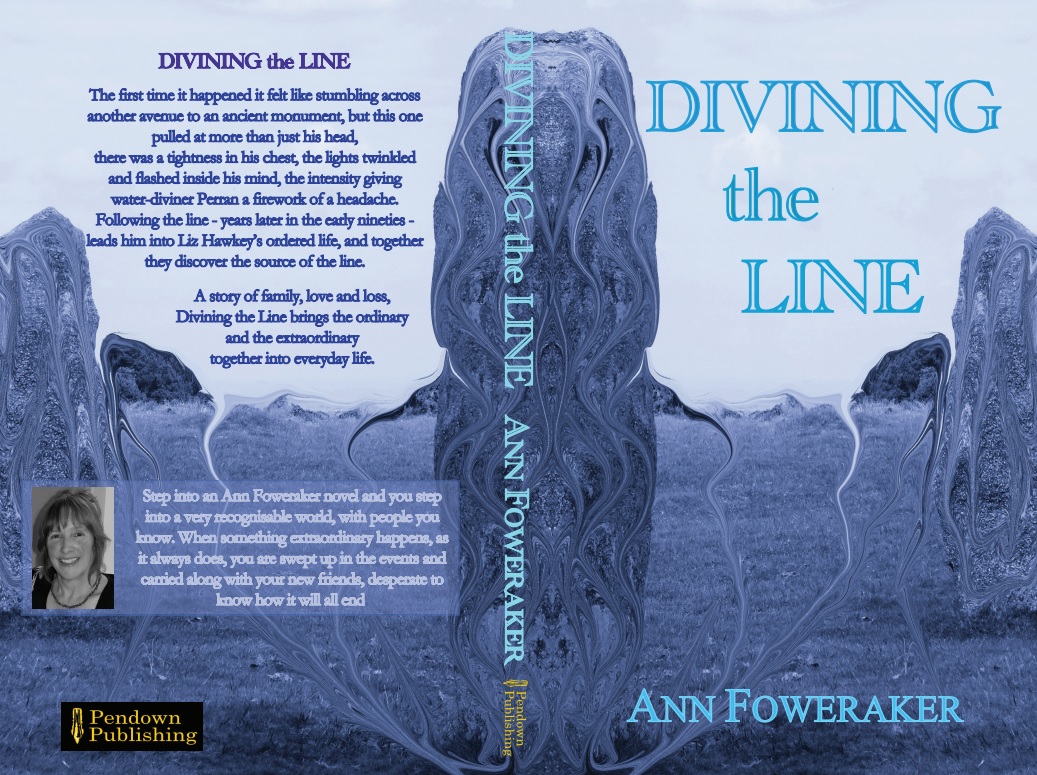
Not sure why this has taken so long. Divining the Line was one of my earlier novels, but has languished on the back burner as an ebook up until now.
I knew that it was good – my readers had told me so. I knew that there were some people who had read all my other books in print – but not being ‘techy’ AT ALL – had not read Divining the Line, and wanted to. Yet, somehow, it always got put on the back burner.
At the end of last month I eventually got the cover redesigned – based on the cover that it sold under as an ebook previously – but with a more stylised design. Hope you like it?
He smiled to himself at the enormous fuss that his elderly aunts made about him going off. It was as if he was a little boy staying away from home the first time, and they each felt they should take on the mantle of his parents. Truth was they loved to fuss round, and by going off for a walking holiday, no addresses available in advance, he’d made himself a target for their concern. He flicked his pack on his back and left the cottage that had been his home from birth, locking the door behind him, sliding the key deep into his pocket. As he sat on the train taking him up to Bristol, he thought of Nan Towans. She alone of the women folk had made no fuss, but then she seldom did. She had a wonderful capacity for understanding and though twice widowed and childless somehow she’d become known as Nan Towans by everyone. True to form she asked no questions when he’d popped in to say good-bye and it was not until he turned to leave that he saw anything but a smile in her eyes. ‘Take care m’ansum,’ she’d said, the smile gone for a second. ‘Good luck.’ As if she knew what was in his mind. Luck was what he needed. He was going on a pilgrimage to a place he didn’t know, just following the stars in his head. He wasn’t too sure that he’d even be gone very long. There were times when he could easily forget the feelings that had assailed him, times when he thought it all pure fantasy. Yet it had nagged at him since his return to England, all through his sorrow it had been there, like a siren voice, calling. He’d put it off, this quest, years ago when he’d escaped to the other side of the world. Now the longer he tried to leave it the more insistent the urge to follow up the strange sensation had become. With life just about under control he felt he could take some time out to find out what it was about, once and for all. ** Wednesday was Liz’s evening at Keep Fit, just as Monday would find her at a local history society and Friday at her paints with the town art group. It was her social life, carefully mapped out, time to see different people to those she met at work, time to express her long-term interests, history and art. When the summer came and the classes and societies took a break it disturbed Liz’s routine; disturbed her life. Things were on an even keel, just as she’d aimed for, just as she’d striven for over all the years that the children were growing up. Yet every so often she found herself feeling so disappointed with her life. In a rut of her own making, so deep, so hedged in that she wasn’t sure she could see any way out. As a child she’d always been careful and orderly. Her elderly parents had always cautioned her, kept her from danger. As a child she could seldom remember running or shouting. All, in memory at least, was muffled and actions carried out with some kind of deeply ingrained secretiveness. To be noticed would be terrible in some undefined way. Never said, just absorbed into her being, creating a quiet, polite, careful child. Is it any wonder that the adolescent rebelled? ** The pull had been strong, the ‘power’ line that he was following had led him right up through this sprawling estate of sixties housing, some small sectors had obviously once been council only, and were now mixed, others were always owner occupied, but some social engineer had interleaved them in curling cul-de-sacs and sweeping ‘ways’, so that, though the line held true, he had wandered and been thwarted and had to retrace his steps. It was a hot, arid day, the type of day that reminded him of Australia. The sun wafted its heat down upon him, beat it back up from the pavement, as he trudged up yet another curve lined with match-box houses. The line was strong. It, whatever it was, had to be somewhere near. As he reached the crest of the hill the ‘stars’ in his head almost completed the circle, danced and creased his forehead. He looked around for some clue. On both sides the houses seemed similar, only the one across the road retained a hedge where most had lost theirs to make way for a parking bay. The traffic buzzed lazily as it moved around the estate. Perran crossed the road to take a closer look at the house behind the neat privet hedge. He was disappointed. It was identical to its neighbours on each side. He turned his back on the gate and gazed away into the distance, through the opposite houses. Could this position have had some significance? Would the sun rise, or set over a point in the distance? Was it that simple? Finding no obvious signs on the horizon he reasoned that the line may merely pass through this point, and set off to circuit the line of houses and to take up from the other side. Twenty minutes later he returned to the same point on the road, certain now that there was something very important about that spot. Something that he could not define, something distinctly different to the types of power lines he was used to. ‘Can I help you?’ A voice from behind him cut into his thoughts. He turned. A tall attractive woman stood at the gate of the hedged house. Her tone was one of warning, but he smiled and stepped just one pace towards her. Suddenly she looked a little flustered. ‘Only you were standing out there a while back, and er, you’re back.’ ‘Yes, sorry,’ he began, letting his voice lapse into the mildly Aussie drawl he’d picked up while in Australia.. ‘I’m looking for somewhere. These roads can be kinda confusing. I’m sorry if I worried you, hanging around like.’ ‘No, not at all,’ she added quickly, ‘I was gardening you see, I just noticed, that’s all. Um, where is it? Maybe I can help.’ ‘Where?’ He found himself caught for a moment. ‘I – don’t exactly have the address – just a memory.’ He shrugged. ‘Not much good eh?’ ‘No. Been looking long?’ ‘Too right. Most of the afternoon!’ She looked at him for a moment, a quizzical smile touching her lips. ‘I’ll be off then, thanks anyway, looks like I’m right up a gum tree here,’ he chucked in for effect and turned to go. Over the road a balding man had emerged and was lining up an electric hover mower. He glanced up. Enough to let Perran know he was watching him. ‘Um!’ she succeeded in turning his head once more, felt sure she knew him from somewhere, something in his face was familiar. ‘If you tell me the description, I may recognise it – it could help.’ ‘Thanks, but it’s too difficult to describe.’ Suddenly his head was full of water, running dark and cool, sweet and fresh. ‘Tell you what, though, I could really go on a drink of water, if it’d not be too much trouble. I’ll stay right here.’ Liz looked at him again, darted a glance at her neighbour. ‘Sure! Sure, why not. Look, come in the garden,’ she unlatched her neat white gate, finding an irrational thrill run through her. This was foolish; dangerous. Mr Gransom was over the road, within ‘neighbour-hood-watch’ earshot, but it was outside her usual behaviour, and she knew that it was not wise. ‘There’s a seat – won’t be a moment,’ she said indicating a rustic-style bench that leant against the wall of her L-shaped house in the lee of a scattering of climbing roses and the wands of a winter-flowering jasmine. He smiled and flicked off his pack before sitting down. She nodded and smiled and felt as if she was being rude to her guest when she closed the front door and let the latch drop. Liz ran the tap, shook ice cubes from a tray to crack into tall glasses of lemon squash and bore them back towards the door. Suddenly she felt a little foolish. Silently she moved across the living room to the small window from which you could just see the bench. He sat, almost lay back, his eyes closed, head resting back on the red-brickwork, his long legs stretched out in front of him. He did not move, sunlight played through the gently moving roses and created patterns that danced and bejewelled his figure. She felt the strange sense of knowing him again, distantly, perhaps a forgotten friend of her son. He rested his head back, the firmness of the wall seemed to ease the tightness that he had been beginning to feel, it was good to sit and rest his feet. He was confused. The power line had led to this inauspicious place. But now the lights danced dimly and remained as a persistent blur. He really didn’t know what it was that he was looking for. A pilgrimage to nowhere. A dead end. Liz unlatched and eased the front door open, she picked up the glasses once more, fielding the door with her foot. At once his eyes opened and he stood. Feeling slightly silly she grinned at him. ‘Thirsty work – gardening,’ she said. ‘Sure is,’ taking his glass from her and sipping. ‘Please,’ she waved at the bench and sat herself. He followed suit. ‘So, where have you been travelling?’ she opened. As she drank she stole small penetrating glances at him, each look well aimed to ascertain some point. He had an attractive face, finely drawn for a man, but not effeminate, set under a curling straw-blond mop. He was slim yet his arms were tightly muscled and shone with sun bleached hair. Not as young as she’d first thought, so probably not a long forgotten friend of Zed’s. Michael, she reminded herself, not Zed now! Little Zed, her first born, had grown and was now twenty-three, a respectable accountant in Birmingham, and as old as the hills and just about as distant, and was to be called Michael, his middle name, his fathers name, from now on! As if she could remember the change after so many years, not that she had the chance to practise it that often. ‘Just recently, up from Bristol.’ His smile was broad, a sense of ‘being at home’ had invaded him. ‘Where are you headed next?’ He drank deeply for a second. ‘Not quite sure, you see,’ holding his glass in one hand he held the other hand flat, palm towards her, fingers pointing forward, he held the stance and looked at her before he spoke. She found her gaze drawn to the hand and his words filtered into her head as if coming from within, as if they were her own thoughts. ‘I’m following a line,’ he said, wondering as he did so why he had chosen to try to explain, yet there were those who would understand but then they understood so much else as well. Somehow in her mind appeared large masses of rock and stones, monoliths and circles, but she didn’t know why, and her conscious thought sorted through the lines she knew and settled on the Railway, that ran close, slicing through the swollen town. ‘The Railway?’ His hand dropped gently, he shook his head, though something had urged him to explain he had been mad to try. ‘No, this line I’m following, you can’t see it, it’s not man made.’ He was suddenly afraid that he was going to frighten her with talk of ‘strange’ things. ‘Have you heard of ley lines, between great ancient monuments, like Stonehenge and Avebury?’ Thinking she must know of them at least, to bring the conversation back to reality of a sort. Liz was surprised, her first unconscious reaction to his word had been the right answer, and yes, now she remembered a programme about an couple of odd blokes that had followed these lines right across the country using bent wires. Yes, it all came back now. She felt less uneasy, more sure of herself. ‘With bent wires!’ she pronounced, crooking her forefinger in example. His smile was warm to the depth of his eyes. Eyes that were of the darkest brown that she had ever seen, so dark it was difficult to distinguish the black of the pupil. The darkness reflected all he saw, like the windows of an ancient house, but the dark was warm if a little disconcerting, as if the house was the home of someone you loved, who you had been expecting to be at home. ‘I knew – all right,’ he said very softly, the Aussie accent fading into the Cornish. ‘What?’ said in curiosity and mild alarm. Something had changed, something wasn’t quite right. He shook his head gently, the smile still in place. ‘So where did they start?’ she began, ‘I’m sorry – I don’t know your name?’ Thinking, as she did so, how foolish these pleasantries could sound, of course she didn’t know his name! ‘Perran – Perran Lovering,’ he gave with a just-resistable urge to add, ‘at your service ma’am,’ curtailed only because she probably thought him strange enough already without that kind of humour adding to his quirkiness. ‘Oh!’ she sighed, ‘Another to suffer from the whim of ‘hip’ parents – we did it ourselves, neither of them use their names now though.’ Perran looked at her a little puzzled, she seemed sorry for him for some reason. She saw herself in his dark eyes, her tawny-blonde hair sweeping her shoulders, her hands reached up and hooked it back behind her ears, an old reflex in times of stress. She thought about choosing names together, her and Mick, scoffing at the old traditional names, seeking something that made a good sound, then, more to please his Mum than anything, tacking Michael in as a middle name. ‘We named our children Zed and Alpha!’ she shrugged resignedly. He suddenly understood. ‘No – er, mine’s not one of them,’ he , ‘Perran’s a family name, you know, father and father’s father? It’s a saint’s name too, and even,’ he smiled and gave a small laugh as if he thought she’d never believe him, ‘even the name of my village – in a way.’ She looked hard at him, he wasn’t being funny, he meant it. ‘In what way?’ she heard herself say, wondering where the name came in. Now he smiled his broad smile again, he was wondering whether she was going to believe him, he’d told a girl once the name and she’d sworn he was making it up until she had found it on the map. ‘Perranzabuloe,’ he announced. Her grey eyes narrowed, she was distinctly suspicious. ‘And where is that?’ she asked with a hint of defiance in her voice mellowed by a mischievous warmth. There was something there that he liked. ‘Cornwall, south-west of Newquay.’ ‘Mmm!’ she mused, that’s what it was, not Antipodean at all. ‘So where’s the Aussie accent come in?’ ‘I spent about eight years out there,’ he smiled. ‘Sorry. Bad habit when I’m in a tight corner.’ ‘But you’re originally from this …’ He knew she’d accepted it as true now. ‘Perranzabuloe, Saint Perran’s in the sand. The coast is known for its dunes.’ Liz just looked at him for a moment, then said, ‘So where are you going, following this line, do you know?’ ‘No, not really, it’s not quite the same, this line has been there for me for – years. It’s only now I’ve the time to follow it,’ Perran said, he hoped, simply. Liz looked at his backpack, lying on the grass, no sign of the wire things. ‘So where’s the wires?’ she said crooking her finger once more. ‘Ah! Well that’s part of what is different, I don’t use them, I can, but I don’t need to.’ As he spoke stars danced in the back of her mind. ‘It is like lights inside my head, they tell me which way to go,’ he concluded enunciating his words carefully, hoping that by clarity she would understand and believe. She sat up, the action drew her away from him slightly, the usual reaction to something strange. Yet she had to acknowledge the stars that had spun in her head before he spoke of them, and perhaps this was something like the stones she’d ‘seen’ before; she held her tongue. He was watching her, he was aware she was uncertain of him again, yet a feeling of comfort and closeness filled him, something akin to like-minds meeting, he knew he was right to tell her. ‘Usually I know what I’m looking for,’ Perran continued, thinking of water hidden deep beneath the ground that was the basis of his family’s living, ‘but this time it’s more of a personal quest, an adventure!’ His grin that accompanied his words rendered it as quite acceptable. They had finished their drinks and time was slipping by, measured by the shadow that now engulfed their wall. Liz shivered slightly and Perran glanced at his watch. It was well on the way to five o’clock, and certainly time he was moving on, reluctant as he was to leave this friendly face. ‘I must go,’ he said, indicating the time, ‘I’ve taken far too much of your time and your hospitality.’ ‘Not at all,’ Liz smiled in reply, and meant it. He stood, flicked his pack on his back, held out his hand. Liz took it looking straight in to his dark eyes. ‘Thank you, er,’ he gave a small laugh. Liz realised what was wrong. ‘Mrs. Hawkey,’ she began, then shook her head, her long hair adding to the swing, ‘Liz, Liz Hawkey.’ ‘Thank you Liz,’ Perran repeated, and turned to go. She stood where she was until he reached her gate. ‘Where?’ Liz called, he stopped and turned to listen, head at a slight inquiring angle. ‘Where are you going, to stay, tonight I mean?’ Walking over to him, wondering why she’d asked, she knew she had nothing she could safely offer. ‘I’ll find somewhere quiet, I’ve got all my kit,’ he smiled with the sort of confidence you believe in. ‘Oh, fine – fine. Good trip,’ she finished feeling inadequate and foolish. ‘Bye.’ ‘Bye.’ He said softly as he walked away. He didn’t want to go, this was stupid. Liz moved to a point where she could watch him until he disappeared as the road wound round the arc. The garden seemed so empty. She wandered back to the bench, plucked up the two empty glasses and stood there holding them for a moment. Shaking herself mentally she strode indoors to dump the evidence of her afternoon’s insanity.
Chapter 2 Blood and wine It was ridiculous, he’d been travelling for four days, following this ‘centre of attraction’, this strange force but now, after a pleasant hour and a glass of lemon-squash, he didn’t want to go on. The direction was confused, he put it down to tiredness, and the maze of houses that he had to escape to find somewhere suitable to sleep, and trod wearily down the hill to the town. The journey had been slow, unnecessarily so as he already knew its centre was somewhere in or near Berkshire, but he’d been determined to follow it faithfully, kicking off from Bristol and working his way towards ‘it’. It had first hit him fifteen years ago, when he was hitch-hiking back to University with a friend. They’d had a lift that had dropped them near Avebury. There was a place, the lights danced in his head as they crossed the line of the avenue and he could distinguish the ‘feel’ from that of the water that he usually divined for. Dowsing ran in the family, his father had been the first to turn it into a business, to use his divining power to pinpoint where to position the machinery for drilling bore holes, and it was soon obvious that ‘young Perran ‘ had the same gift. Come to that most people had it to some degree, could work the wires, but the Loverings knew more, and didn’t have to rely on hazel twigs or wires. It had been enough for his father to use the twig, it was well known and accepted in his part of Cornwall, but he insisted that his son should have the only qualifications that would become acceptable, pieces of paper in subjects that would convince the disbelieving, even though the practical method of locating the underground water may remain the same. They trudged on, no lifts being forth-coming, then it hit him. Like stumbling across another avenue to an ancient monument, but this one pulled at more than just his head, there was with it a tightness in his chest, the lights twinkled and flashed and the intensity gave him a headache. He’d clasped both hands to his head and stood, eyes tight shut, dazzled by the fireworks display. When his companion had appeared concerned he’d called it a migraine attack, and soon after they were picked up, and dropped almost on the doorstep of their college. As the car had driven through the tail piece of Berkshire the power had become intense, then began to fade and his ears seemed full of a keening sound, like he’d heard once on a programme about old Irish life, and death, until his head was clear and he began to think that perhaps it had been migraine after all. He’d driven the same road at other times, and not felt a thing. Then once, by now convinced that it was nothing, he’d stopped to stretch his legs at a lay-by somewhere past Hungerford. Almost as his head cleared, relaxed from the driving, the ‘force’ was there. He was frightened, a panic sent him back into the car as if the walls of glass and steel had protected him. It was not so, it was only as he began to concentrate on pulling out into the steady traffic that the pyrotechnics faded. Filled with regret, a heavy sadness of something important missed, he drove on, back to the safe academic world of Geological studies. ‘That was years ago,’ he thought as he came to an underpass that sounded inhabited, and decided to leap the barriers and defy the sparse traffic as a safer alternative. He found a non-too-smart pub that served bar meals and took a pint and a greasy helping of chicken and chips. As he nursed the last of his pint he considered where he could find to doss down. The way up from Bristol hadn’t been too bad, most of it through real farm land and he’d found suitable dry places to spend the night. Here in the town he wasn’t so sure. There were plenty more spending their nights out on the streets here, as in any town. It was one of the things he’d been shocked to find when he’d returned. At one time it had only been the hardened down-and-outs. Today there were so many, and so many younger ones. He remembered Tam. Tam who’d worked and lived on the road for all the years that Perran had known him. A true old man of the road. He tramped as a career. He had his stop-off places, those where he’d find a few days work for a few quid. ‘Even on the road you needs a few quid,’,he told Perran, ‘If’n you goin t’ keep yo’self decent like.’ And he hadn’t meant booze, not even food, but toothpaste and silk underwear! Tam had taught him plenty about living on the road. As a boy he’d absorbed the old man’s stories as he’d sat by and watched him eat the bread and cheese that his mother had sent out for him. Now Perran wandered through the well-lit empty centre, the only signs of life being those round the garish pubs and take-away places that reeked of stale oil and yet still made the saliva run, only to find himself out on the other side of the town with a few large residences and then the river. Lights from a sea of houses told him that ahead lay more housing estates, yet here by the river was an island of darkness, a breath of countryside before the houses crowded in again. He stood on the bridge and watched the inky blackness slide by for a while and listened to the sounds of a town at night. He wondered if it was dry and clean and quiet beneath the bridge, and scrambled down the first side to find the way wide and well walked and smelling slightly of burnt wood and urine. It was too dark beneath the bridge to view the other side so he took himself back up, and over, and down to the bank. It was grassy and six-foot wide near the mouth of the bridge, becoming a very narrow, barely worn, path between hard stone and water as it disappeared beneath it. It smelled sweet and clean and, providing any rain that fell did not get driven under, it would be dry. In his present deflated mood he didn’t much care any more, so settling hard by the support of the bridge he squeezed into his sleeping bag, set his rucksack as a pillow, and drifted into sleep. * They came staggering down the path between the trees, their heavy shiny boots scuffing the soft earth, getting caught in stray exposed roots, causing expletives to burst from well lubricated mouths. Two, almost identical in dress, they differed in stature. Stocky, with thick neck, rounded features and near bald head carried plenty of weight, enough to make it matter, whereas his companion was taller and lean, and wore more hair than the other, though still aggressively cut. They wavered on the edge of the dark flowing water and, in unison, in ritual, unzipped and relieved themselves, their streams creating different cadences as they cascaded into the river. Satisfied they bent and straightened and stumbled on. It was dark here, overhanging trees blocked the lights from the road that ran over the bridge, the path was narrow, they went in single file. Lean felt nauseous, he’d taken one too many lagers, spent a few quid too many – he was expected to, being the only one with a regular job, and that was one thing. Okay, so he liked the way there was always a lot of space made for them when they walked down the street, yeah, and he liked knowing he was ‘safe’ with his mates, but perhaps it was time to move off, they were turning into a right bunch of losers, always moaning about lack of dosh, and there was the other thing. So it wasn’t much of job, working behind the desk in a motor insurance office, pretty run-down building it was in, and right up a back street, but it was a regular job and, if he didn’t blow it, it had ‘prospects’. There’d been talk of sending one of them on a college course, part time, with a chance of some qualifications. Then he’d be really in. He knew he had a chance, rubbish as his GCSE results were they were better than Sharon’s, and she might leave anytime, she’d just got herself engaged and bosses aren’t stupid. He watched the back of Stocky as he made his way along in front, in blurred silhouette, arms swinging away from his sides in an act of balance, Lean found a sneer slide into his mind, a snide thought, that he looked ‘ape-like’ and had a brain to match. They neared the bridge, a patch of sodium gold lit the grass giving it a sickly hue, beyond the ominous black mouth stood in contrast, from which flowed the river gleaming like oil. ‘Wass that?’ blurted Stocky, breaking the peace, then as Lean moved to look he must have made up his mind. ‘Hey! Wino! Wino!’ he chanted out in battle cry and threw himself forward in a thundering run that ended in a guttural shout and a jump, both feet together, whole body weight force, aimed to be broken only by impact with flesh and bone. Drawn on in tribal pursuit Lean arrived as the body sat up in instant and acute pain, saw the pale disc of the face just before it was obscured by Stocky’s boot swinging it back in a sickening thud against the hard stone. Stocky drew breath and passed a sly look that spoke of force and made Lean swing his own Doc’s into the soft centre of the man, the force drew the body back into a curve, his head back into line for the next swipe, like a punch-ball on a spring.
Perran didn’t know which came first the awakening or the pain, the shape above him was enormous against the mouth of the bridge, but it staggered a little way back. The pain was in his legs, trapped in the sleeping bag they felt pinioned – he tried to move – fire and sweat rushed through his whole body – and the shape moved towards him, his arm fended part of the blow but he felt the scorch of rough rubber burn across his temple as his head was snapped back and cracked against the wall. The chicken and chips forced its way between his teeth as he was folded over another blow, and in his retching he did not see the next coming, but endured a bodily movement that drew him up, back, propelled on a boot end, where the wall crashed against his skull and buried him in oblivion.
The way that the body gave and, soft, absorbed the blow from his boot had sickened Lean, he turned, and found the rucksack, an inanimate target, he raised it with both hands and performed a drop kick sending it in an arc above the oily blackness. ‘Goa-wl’ he sang out as it splashed, sank, bobbed and, caught in a current, span away into darkness. It was then he heard it, two soft long whistles. He froze to hear better, reached out to Stocky to stop him crunching against the body’s chest. ‘Listen!’ Lean hissed. He saw the small flick of a torch a long way up the path, and the whistle again. ‘Shit – someone’s fucking cumin!’ he spat, turning; running away under the bridge, running the tightrope of path between wall and water, long legs lifting the boots high and clear of the ground, head cleared by fear. This was the ‘other thing’ a record and he’d be out of a job, and he’d just made up his mind, that wasn’t on! *
dot dot dot ….. So, that is what I have been doing lately – and I am still working on my next novel – my first Historical Novel … which is taking a LOT of time as I keep finding more research I need to do as the story unfolds – yet I’m still about a third of the way through 🙂 .
Have you found yourself putting things off – again and again and not really knowing why?
What are your top tips for motivation to get on with these ‘on the back burner’ tasks?
Do share – you know I love to hear from you!
Best Ann
ps If you are reading this on email and would like to comment just click onto the title and it will take you to the actual blog – so you can comment there. If it is the first time you have written a comment don’t worry if it doesn’t appear immediately, your first comment has to be verified (to keep the spam-bots out) and I do this personally – so I am sure to see your comment – thanks for reading – Ann
Remember – reviews of books are a great way to say ‘thank you’ to an author if you like what they write, Thank You
It has been a long while since I wrote about my LS {Lichen sclerosus} and mentioned that I made for myself a salve out of borax and coconut oil – to provide relief and slip between the sore layers of delicate skin.
Many people had found that version and also found that it was just too gritty for them … even when I modified it to grind the borax finer.
I bit of odd research one day took me to a page on cosmetics – and that explained why borax was {and in some cases still is} used in cosmetics. And that reason was an eye-opener for me – it was used because it was an emulsifier!! Which means it is a substance that has the property of allowing water and oil to emulsify together – to mix and stay mixed!
This meant that I could look to make my coconut oil and borax salve in a different way – to make a creme using a saturated solution of borax whisked into the coconut oil. I experimented a bit to get what felt like the right quantities – and the right effect on my LS affected skin.
When I was happy with the mix I added this to my original blog post and the ‘Update’ blog post. However I have had a few queries about details of how to make it … so I had elaborated on the instructions and the recipe, yet still something was missing… so here, hopefully, it is. A video version…
I hope this helps with making this creme – I really do find that application of this twice a day helps keep the vulval, perineum and anal skin soft and itch-free – combined with the other aspects of my LS regime as described in my LS update. See Here also for this recipe set out in words, and below 🙂
MY non-gritty coconut oil andsaturated borax solution LS creme Ingredients: 1 heaped Tablespoon coconut oil 7 teaspoons Borax 75 ml / 3 fl oz boiling water; 3-5 drops lavender essential oil.
You need: 2 heat-proof jugs suitable for the MW; stick-blender; Spatulas; Pot to put creme in; kettle; teaspoon; tablespoon.
A, In a heatproof mw safe jug melt/soften 1 heaped tablespoon of coconut oil. (some will be liquid but most still as a soft solid)
B, Make a saturated borax solution: boil the kettle. Put about 2.5 – 3 fluid ounces (75ml) boiling water into a heat-proof mw-safe jug.
C, Teaspoon by teaspoon stir in about 5 – 7 teaspoons of borax powder, until no more dissolves. (You can heat this a bit more in the microwave if it has cooled – to get it to dissolve the maximum amount) This makes a saturated solution of borax.
D,Add 5 teaspoons of this saturated solution to the melted/softened coconut oil.
E, Whisk with a stick blender. As it begins to cool, every few minutes, whisk with a stick blender – you can pop it in the fridge – but watch it doesn’t set too hard!
F, When cool and going opaque – add 3 – 5 drops of lavender essential oil. (This is an option, the lavendar is antiseptic and antibiotic as well as giving it a pleasant frangrance – but if lavendar irritates you, miss it out)
G, Keep returning to whisk the mixture until it begins to thicken. When like soft whipped cream, pour into a pot, cover and place in a fridge overnight.
To USE. Scoop up a little with a *spatula, transfer it to your fingers and apply, rubbing in to all affected areas. *(only put a spatula in the creme – do not use your finger to scoop it out as this can transfer contaminants to the creme)
(Final note- which I didn’t say in the video … DO NOT pour the remains of your saturated solution down the sink, because as it cools the remainder will separate out and leave a hard solid lump in your sink u-bend. Yes, it could be removed easily by pouring a quantity of hot/boiling water down, but much better to add it to your borax soaking bath, where it becomes part of a non-saturated solution and will just wash away as normal.) 🙂
DO let me know if this is helpful! I have to say I really hope it is – as it took way longer to create than I thought it would!!
Is there anything else that is better explained on video? Do let me know!
If you are reading this and feeling alone in the world with this awful condition – know that there are lovely supportive people out there. Here are two Private FaceBook groups that you might like to join.
NOTE: In October 2020 Allicia and I created a book together about LS To find out WHY we felt we had to – see the blog post HERE Available Here (UK) or Here (USA)
NOTE: I am not a doctor – I speak only from my own experience – please do your own research too
However, I am an Author and – if you read my novels – please remember that reviews of books are a great way to say ‘thank you’ to an author if you like what they write. Thank You so much
ps If you are reading this on email and would like to comment just click onto the title and it will take you to the actual blog – so you can comment there If it is the first time you have written a comment don’t worry if it doesn’t appear immediately, your first comment has to be verified (to keep the spam-bots out) and I do this personally – so I am sure to see your comment – thanks for reading – Ann
If you wish to keep it private – about LS and just contact me then just reply to the email this arrived on (or if you have found this on the internet then email ann@ annfoweraker .com (closing-up the gaps) – otherwise go to the actual page and click comments to add yours.
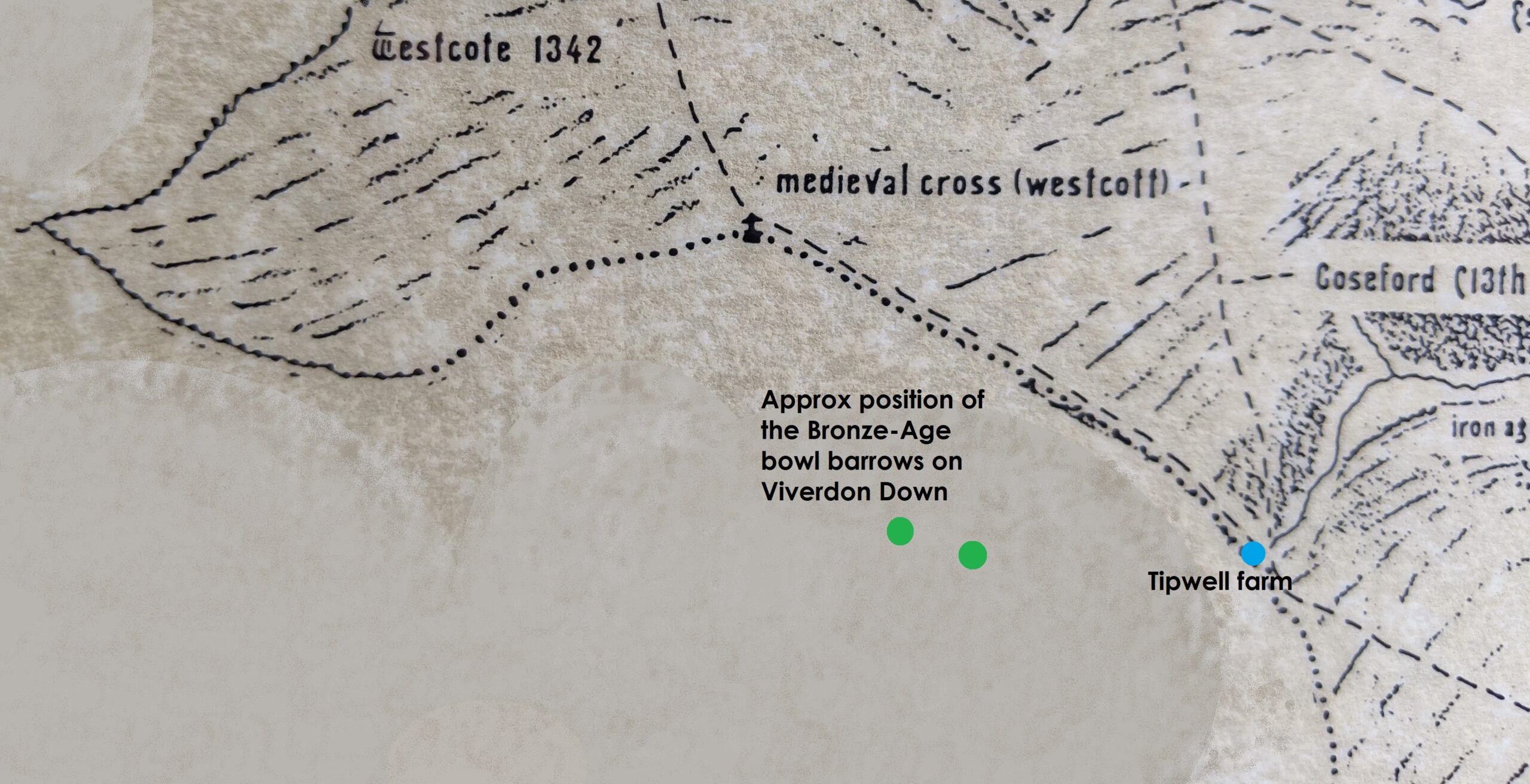
{For previous posts on the history of this area see St. Dominick History tab under ‘History – local and everyday’ Topic} Staying with our ‘pulled out’ focus we can see the only really local evidence of occupation in the Bronze Age (2500 – 800 BC). Up on Viverdon Down are a number of Bronze-Age bowl-barrows (burial mounds) Note: Barrow-burial is on a continuum from late Neolithic and through the Bronze-Age, and it has been noted in ref (3) that these would have also been visible from Balstone down. See map below
Cornwall Council Strategic Historic Environment Service in their article on Bronze-Age monuments in Cornwall states “Some mounds are probably burials of important people. The largest barrows are in prominent locations on hilltops and ridges. The smaller barrows, which do not normally survive in lowland Cornwall, are inconspicuously sited amongst the fields and near the contemporary settlements.” and “We can conclude that the many barrows found elsewhere in lowland Cornwall (eg. Cubert Common, Veryan Beacon) would have had round house settlements close by which are not now visible.” (1)
St. Dominick counts as ‘lowland Cornwall’. The earlier Bronze-age settlements were up on what we now term moorland – Roughtor, for instance, had a very large settlement, Bodmin Moor had many and their field systems can still be traced by low stone banks. The thought being that, as the soil in these areas became degraded by over use, they had to move onto the lower land, setting the pattern for farming today. Most lowland settlements, therefore, would have been created in the Middle Bronze Age (circa 1500-1200 BC) and were collections of circular houses.
However, their monuments (the burial mounds) were still usually situated on high-ground where possible, as Viverdon Down is.
Historic England records this listing: “Two bowl barrows on Viverdon Down, 540m north west of Tipwell Farm – This monument, which falls into two areas, includes two bowl barrows situated on the summit of a prominent hill called Viverdon Down which forms the watershed between tributaries to the Rivers Lynher and Tamar. The barrows survive as circular mounds surrounded by buried quarry ditches from which the construction material was derived. The eastern barrow mound measures 18m in diameter and up to 1.2m high, the western barrow mound is up to 14m in diameter and 0.9m high.” (2) (This is noted as a ‘legacy listing’)
sketch of the cross-section of a typical bowl-barrow
Though these barrows have not been investigated by excavation the construction of them has been observed by the Cornwall archaeology Society in 1994 when they visited. “Two barrows remain as prominent surface features, but erosion is being accelerated due to continued ploughing. The latter has nevertheless revealed the structure of the barrow mounds, with turf stacks capped with (now leached) orange clay presumably dug from encircling ditches. This degraded capping forms a near-continuous ring around the larger, more northerly, barrow. Both within this ring and outside it, dark organic weathered blocks of turf indicate somethingof the former extent of the stack. Between the barrows, and slightly westwards, a further areaof darker material in the plough-soil suggests the former existence of a third, smaller, barrow.” (3)
Follow the link under (4) in the References to help you try to locate these on the satellite view of the area with ‘side-by-side’ maps.
The question is, where is the settlement that sited these bowl-barrows on the hill? Now, what follows here is supposition – but the landscape around the hill is, even today, sparsely populated by any ‘homesteads’ – but just off the crown of the hill (and at the edge of St. Dominick parish) is ‘Tipwell’.
The name gives us the clue – most likely a settlement or homestead based on a well* – and it is indeed where another significant stream for St. Dominick starts. As we noted in the last part of this series – a water-source is an essential for a settlement. *[The name Towell – further into the parish – for instance, comes from the name At-Well (or AtteWell as it was written in the Manorial records) – so maybe that this is the origin of the name Tipwell too?]
A settlement at Tipwell would also have had the advantage of being near to the route of the ridgeway – which would still have been in use at this time – and, if the hypothesis of the route also going down to the river is correct, it would be on that too – a well placed settlement.
However – as the Cornwall Council Strategic Historic Environment Service comments “the evidence of these lowland settlements have, largely, been completely ploughed away”(4) or, indeed, maybe the settlements themselves were just built over – so we may never be absolutely sure.
That is it for the Bronze-Age in our area – as nothing else has been found and recorded – unless you know different, if so, please let me know!
Did you know there were Bronze-Age barrows on Viverdon Down?
Do you have any comments on this History of St. Dominick so far?
We would love to hear from you 🙂
-Ann
References:
(1) & (4) Cornwall Council Strategic Historic Environment Service
Do SHARE and COMMENT – I love to hear from you. Xx Ann
While you’re herePLEASE SIGN UP to this blog if you’d like to hear more – the box is at the top of the post on the right – Let’s keep in touch!I do not post often, perhaps fortnightly, so posts are easy to miss. {I had been building my followers since 2011 – and had around 640 when an unfortunate technical issue meant that I lost ALL of these followers contacts – and need to start again – so please do join to keep in touch}
ps If you are reading this on email and would like to comment just click onto the title and it will take you to the actual blog – so you can comment there. If it is the first time you have written a comment don’t worry if it doesn’t appear immediately, your first comment has to be verified (to keep the spam-bots out) and I do this personally – so I am sure to see your comment – thanks for reading – Ann
Remember – reviews of books are a great way to say ‘thank you’ to an author if you like what they write, Thank You
{continuing the ‘occasional series’ For previous posts on the history of this area see St. Dominick History tab under ‘History – local and everyday’ Topic}}
The original of this project map was created by the late John Dyke, an artist and, during the second world war and before his retirement from the NT, a cartographer, who used to live in Bohetherick.
On this map he included the streams and the river and dotted in the tracks that we believed would have been there by 1485, as they went from farm to farm or from these to the Mills, Church or the Manor houses. This was then shaded to show the hills in the manner used on very old maps, so that hills appear in profile even though the map is in plan-view.
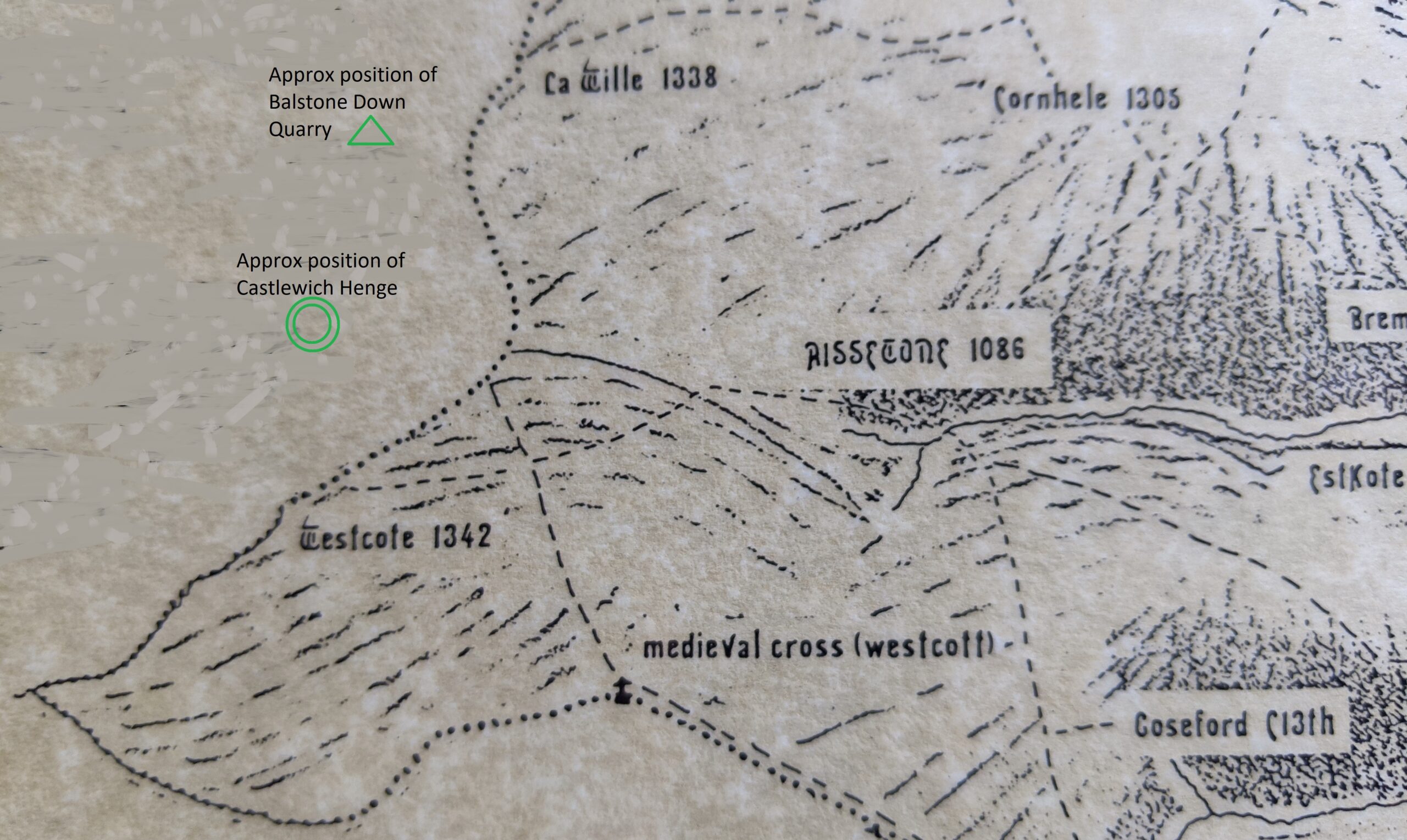
Section of Map 1 with added Neolithic detail outside parish boundary
However, in prehistory – of course – there was no such designated area as our Parish, but what there most probably was were the streams and the river. From countries, to counties to parishes, natural features, such as rivers and streams have been used to delineate borders, and so it is with St. Dominick parish – and it is that which gives it its shape and the slightly odd pointed end.
If you look at a reasonable large size ordnance survey of the area you will see that there are two main streams issuing into the Tamar, either side of our parish. One comes out beside Cotehele quay, the other at the far side of Halton Barton and Strawberry Hill, before Pentille. If you follow these up – you will see the parish boundary follows them as far as they go to at least one of the their higher sources (streams often having a few springs converging on them) From the highest point of each is a short run on up – and across what is now the A388 to join with the rising of two separate springs which themselves converge – and this is the odd pointed bit that just takes in Westcott. A rough sketch is shown below:
At one time it was a ‘fun’ and ‘educational’ event to ‘Beat the Bounds’ where ‘everyone’, especially the young* were taken around the whole parish boundary (*to teach them where the boundary lay). I understand there are many in the parish who took part in the last one held here – and have heard tales of this, especially concerning Westcott. Do comment if you have a tale to tell!
Setting this area in its larger pre-historic setting, by pulling our focus out a just a little, we find the Neolithic Henge (around 2500 BC) known as Castlewich Henge, situated between Castlewich and Westcott, and identified in 1951. This is not a henge like Stonehenge, but circular a bank and ditch henge, the ditch being inside the bank, of some 90m external diameter, and showing no signs of occupation (no signs of buildings within at anytime) and is therefore most probably associated with ritual or trade use in Neolithic times.
Above this, on the other side of the A388, is Balstone Down Quarry (in the triangle of trees between the A388 and the smaller road that cuts though to Callington) which was the site of Neolithic excavation and manufacture of greenstone axes – considered a Neolithic ‘axe-factory’.
Greenstone axes were prized in Neolithic times, a fine-grained dense stone it polished well and held an edge – and, for some reason, green-coloured hard stone, of any mineral composition, was popular across the Neolithic world. Some were for use but some are believed to have been used as ceremonial axes; given as gifts or deposited as votive offerings. Fifty-six greenstone axes, found in various places across the southern half of Britain, have been identified (by mineral analysis) as having come from ‘the Callington area’ and so most probably from the Balstone Down Quarry. There are only five greenstone quarries known of in Cornwall, only this one is near Callington and all the others further west – and producing a different quality of greenstone. (1)
That greenstone axes from this area were traded, and therefore found distributed across the country, bolsters the opinion that the henge may have been used as a site of trading, especially as a Neolithic ridgeway runs close to both these areas (quite likely part of the A388 follows this ridgeway)
A ridgeway was the Neolithic highway, going, literally, along the higher ridges where possible (safer to travel than the densely wooded valleys) from settlement to settlement. With the river offering a means of travel, this ridgeway is also believed to have headed down to the Tamar, quite possibly to the Halton Quay area, as travel by river was faster, safer and associated with trade. (2)
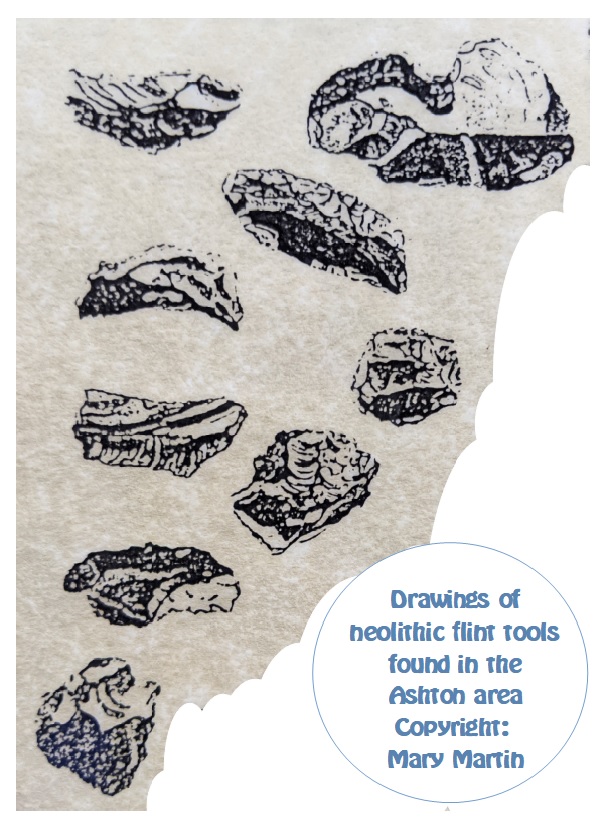
So, what of Neolithic evidence found within our ‘parish’ boundary, seeing as it is evidenced close by? Interestingly, the evidence within the parish is not of greenstone axes, but of a number of small flint tools discovered in the Ashton area. The picture below these is a drawing made by Mary Martin from the originals. (Copyright Mary Martin and reproduced here with permission) *when I have access to my stored papers I can replace this mono-chrome version with the original colour version.
I am not surprised that these were found in the vicinity of Ashton – as this is an area particularly well-endowed with springs – a pre-requisite for any early settlements. It is also closer to the recognised Neolithic features described above – henge, quarry (axe-factory) and ridgeway, – than the bulk of our parish area.
# Stepping out of the Neolithic: There are at least six springs in the Ashton area. Five of these had been turned into ‘captured-spring wells’* at sometime in history and given a little ‘well house’ – unfortunately there’s no date-line for this – but medieval is suggested (Noted by the Cornwall Archaeology Unit – referring specifically to Cornish Holy Wells “The numerous holy wells in Cornwall may be a reflection of a prehistoric, pagan, reverence towards water spirits and other natural forces. Many natural springs were provided with a well house or covering during the mediæval and later periods.” (3). The CAU only seem to consider ‘holy wells’ but there are many, many more ‘domestic captured spring wells’ that are totally disregarded and just disappear through lack of recognition or care)
*This is where a spring is dug out, a slate open box made, or carved rock basin placed, to contain the water and a little stone ‘well house’ made over it (back, sides and a roof, sometimes with a little slate shelf and usually a door to keep out animals and detritus). Water could then be dipped from this well, the excess water running over and out, making a small stream.
Four of these were visible roadside in Ashton until quite recently (when the falling of a hedgerow tree destroyed what was left of the little well-house of one and the other, basically one wall and a roof, just subsided into the stream), one is in the grounds of a cottage, one is semi-filled-in and hidden by undergrowth. The best condition and most visible is that beside Ashton Barton (the ‘manor house’ for the later Manor of Ashton) Photo below – if you zoom in you can see the well-water in the ‘box’.
REFERENCES
(1) https://link.springer.com/article/10.1007/s10816-019-09438-6Schauer, P., Bevan, A., Shennan, S. et al.British Neolithic Axehead D(2) Movement and mobility in the Neolithic. Editors: Jim Leary and Thomas Kadoristributions and Their Implications. J Archaeology Method Theory27,
Did you ‘Beat the Bounds’ back in the day? Do tell your tale in the comments!
Did you already know of Castlewich Henge and the greenstone axe ‘factory’ at Balstone Down?
Had you noticed the well-houses in Ashton – and in many other parts of St. Dominick too? Have you got one in your grounds, or in the lane outside locally?
Do SHARE and COMMENT – I love to hear from you. Xx Ann 🙂
ps If you are reading this on email and would like to comment just click onto the title and it will take you to the actual blog – so you can comment there. If it is the first time you have written a comment don’t worry if it doesn’t appear immediately, your first comment has to be verified (to keep the spam-bots out) and I do this personally – so I am sure to see your comment – thanks for reading – Ann
While you’re herePLEASE SIGN UP to this blog if you’d like to hear more – the box is at the top of the post on the right – Let’s keep in touch!I do not post often, perhaps fortnightly, so posts are easy to miss. {I had been building my followers since 2011 – and had around 640 when an unfortunate technical issue meant that I lost ALL of these followers contacts – and need to start again – so please do join to keep in touch}
Remember – reviews of books are a great way to say ‘thank you’ to an author if you like what they write, Thank You
Back in 2021 our local Pub, the Who’d Have Thought It, St. Dominick, had the great idea of providing a BLOG for the parish (the village and the parish have the same name!) They then asked for contributors – and yours truly offered to write up an occasional series on the History of St. Dominick – as I have gathered a huge amount of information over the years.
Though aware that my blog is read all over the world {NOTE 2026 – I have now lost ALL these readers from all over the world due to a technical hitch – you may sign up at the top of the site – over on the right} I have decided to re-post these blog-posts here too. St. Dominick is ‘home’ and St. Dominica(the patron saint of the church – and therefore namesake of the parish) is my inspiration for the book I am researching and writing at the moment.
So – welcome to our little corner of Cornwall, and I hope you enjoy this diversion into its history.
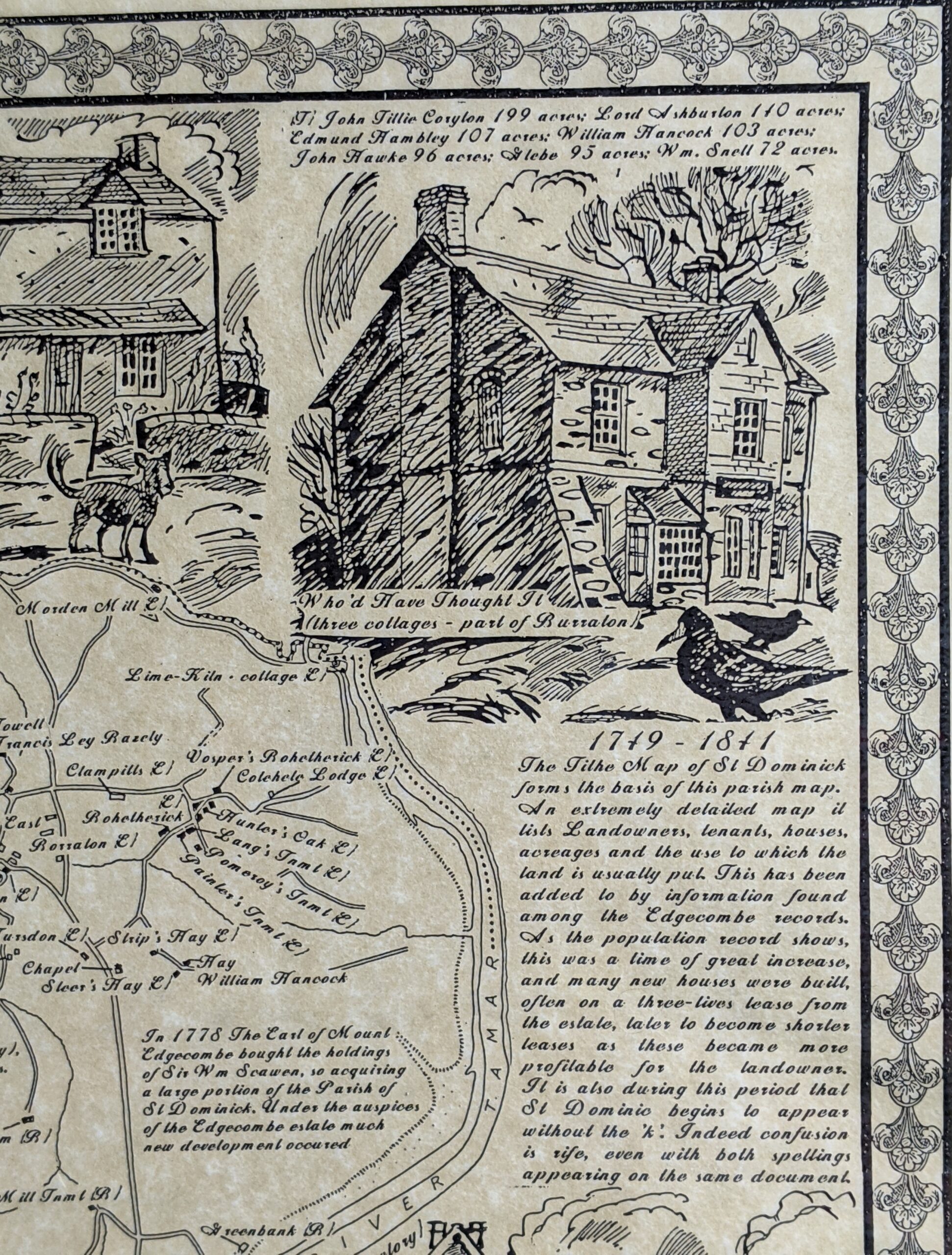
When we moved into Radland in 1983 I was determined to find out the history of that old house – and that also led me into glimpses of the history of St. Dominick itself. However, it was the inspiration of The Parish Map Project (a Common Ground initiative) that led me to work with about forty people within the parish, with many doing the research, artists creating the illustrations and others providing services, like photocopying, all to create a series of maps illustrating the history of the parish.
part of the 1485 – 1748 map
If you were not involved, a little about the Project. Parish Maps could be of any material, design, interest-focus or scope. We decided to take five snap-shots-in-time – and base most of them on existing maps. Many households in the parish have a copy, and there is a large-size set hanging in the Parish Hall.
As there were no actual maps of the area until the sixteen hundreds, so the first map was dated at 1485 – showing everything we found from pre-history to that time. This date was chosen as it is also the start of the Tudor period. It is acknowledged that the relative stability of the Tudor period accelerated change in all parts of the country, making this point a good place to pause and look back.
The second map was dated 1748, and was based on an existing map you can view if you go to St. Michael’s Mount – drawn by Thomas Martyn. (Note 2026: there used to be a copy at Lanhydrock, but it is now not available to view) To this was added the research that was gathered that focussed on properties that had been built and were still there between 1485 and the map’s date.
part of 1748 – 1841 map
The third map is based on the Tithe Map 1841, probably the most detailed map made of the area – ever! A tithe map was made to commute tithes-in-kind (for example: one stook of wheat in every10 harvested) into a monetary value – so they could be paid that way instead. The original tithe map is huge – and barely any of the fine detail could be shown on our maps, but the basic information and everything discovered was added to the original map.
The fourth map was based on the 1951 ordnance survey map – and shows how life had changed dramatically over the previous 110 years – and brings us firmly into history as remembered by people born in St. Dominick.
The final map was set at the year we completed the project,1995, and yet, even in this short time-period since then the changes are dramatic to see in terms of housing development and change of use for other buildings.
In this occasional series I hope to share with you the research and the sources (where possible) and describe this area as it developed from just an area bordered by streams and the river, into the parish we know today. I do hope you’ll join me for the journey – Ann
Do you like local history?
What aspects interest you most?
Have you taken part in any history projects where you live?
love to hear from you 🙂 Xx Ann
ps If you are reading this on email and would like to comment just click onto the title and it will take you to the actual blog – so you can comment there. If it is the first time you have written a comment don’t worry if it doesn’t appear immediately, your first comment has to be verified (to keep the spam-bots out) and I do this personally – so I am sure to see your comment – thanks for reading – Ann
Remember – reviews of books are a great way to say ‘thank you’ to an author if you like what they write, Thank You
At last, the second volume of my father’s memoirs is published – and these are the first words of the first chapter, it is D. Day – and six days later it was his 18th birthday and his call-up papers arrived.
Sadly this is also the final volume of Frank’s memoirs – even though, if Frank had the time left to him to write them, he would have probably been into volumes 4 or 5 at the very least before the end.
Volume 2 takes him up until he is 28, he then began Volume 3 … but the rest of his life is sketched in by his children (myself and my brother Mark) covering almost all the interests he participated in over the years and explaining a few of those unexplained bits he put in his own writing – saying – ‘more about this later’.
Frank had always intended his memoir to be a record for his descendants though, with his eye for detail, it is also a great exercise in observation of life in those times and a good social comment from the point of view of the ordinary man. With his descendants in mind, the book concludes with a piece he wrote before he began his memoirs – things he’d been told by his parents about their life and about their parents – taking the family memories back another generation.
The first four years of Volume 2 see him in the Army at the end of WWII and up until his (late) de-mob. In his inimitable ‘voice’ we have an insight into the induction of civilians into the war-time army and the procedures of life in the army. Much of his time he was posted in Europe – and these chapters include his own photographs of places he saw (some from tiny pictures – about 1″ x 2″).
Talking of photographs, from after the war there is a picture of the first car he and his brother Peter got – the photo this was taken from was about a half inch square (12mm square).
Editing this was a mammoth task – and I am pleased that it has been achieved. For those of you who read and enjoyed his first volume – it is available via Amazon HERE. (Or directly from me if you live close enough to pick it up) And for everyone – here is a sample of the rest of that first chapter.
Chapter 1 – Into the Army
One morning the sky seemed to be full of aircraft all with three broad white bands around their wings and fuselage. It was D day, 6th June 1944 and on the 12th of June I was 18 and I received my call up. With this came a travel warrant to report to Norwich barracks on the 29th of June. I had already handed my rifle into the Home guard but kept my uniform (battledress) to travel in – as I still had no decent civilian clothes.
On the afternoon before I went I pointed to the apples on the tree outside the window and said ‘There won’t be any of those left when I get home again.’
Next morning I set out to walk to South Zeal to catch the early bus to Exeter and the train to Norwich, a long tedious trip. When the train finally arrived we were met by Sergeants directing the recruits to army lorries. It seemed that all those that came from the West Country were pointed to a different lorry from the others. When we arrived at the barracks we were sent to the dining hall and given a mug of tea and a plate with something like soggy lumpy mashed potatoes – boiled butter beans – all ice cold. I started eating mine but sitting opposite me were two lads dressed in nice casual clothes moaning about the food, and when one reached across towards my plate and saying. ‘I don’t know how you can eat that,’ without thinking I slammed my fork into the table close to his hand and growled. He jumped back and said. ‘Christ where did they get you from?’ I was a bit disturbed as I realised I’d had a flashback to cripple school meals, and having to defend them.
The sergeant bawled out, ‘Outside for induction!’ I joined the induction queue and suddenly found myself in front of an ATS who snapped out, ‘Name?’ and then wanted all my other details, all in a tone that said I was holding up the complete war effort. Then she rattled off a string of numbers. I hesitated and she said, ‘That’s your number, move on.’ And then the confusion really kicked in as a single battledress was pushed towards me and the soldier behind the counter shouted out, ‘Battledress. two.’ (where others were given two) I realised that was because I was already wearing one. As I progressed along the counter more clothes and equipment were pushed at me, each time with the description called out including a ‘housewife, soldiers for the use of’ which turned out to be a sewing and darning kit. Then all the webbing equipment and water bottle were added, and just when I was so loaded I could not see over the top I got 3 blankets. Again I was asked my number. I staggered away hoping I had got it right.
We were told we were now fully responsible for the kits and any loss or damage would be replaced at our cost. Then we were marched away to the barracks – which turned out to be the old cavalry section and the area I was in, with 30 others, was the ex stables and faintly smelt like it. I was given a bunk which happened to be double and the other lad opted for the lower one – I was pleased with that. Then the order came to change into uniform. I began to look round at the others and was surprised at the obvious difference in ages. I thought they would all be my age but the call up was gradually creeping up and among us were men who had been in the occupation army in Germany after the First World War. So what it amounted to was, of the thirty in the barracks room, some knew the routine of army life but the majority were all ages called up as their reserve jobs came to an end, but all mature and confident … and me. Confused, lost and, in modern parlance, definitely out of my comfort zone.
Finally – I would like to wish YOU ALL a Very Happy and Hopeful NEW YEAR. May 2021 be a better and happier year for everyone, for you and for those you love.
I love to hear your comments – please do feel free to chat 🙂 X ANN
ps If you are reading this on email and would like to comment just click onto the title and it will take you to the actual blog – so you can comment there If it is the first time you have written a comment don’t worry if it doesn’t appear immediately, your first comment has to be verified (to keep the spam-bots out) and I do this personally – so I am sure to see your comment – thanks for reading – Ann
Remember – reviews of books are a great way to say ‘thank you’ to an author if you like what they write, Thank You
This story begins when I put up my first blog post about Lichen Sclerosus and why borax was my new best friend – back in February 2017. Very soon after I posted it, an American woman, Allicia Mae Cain, happened to find it. She’d been trawling the internet for something, some glimmer of hope, that her LS could be eased by something other than the steroids – as these had failed her – leaving her even worse than before.
She says that reading my blog was like ‘something almost magical’ – and went out and bought a box (being in the USA she could just pick a box of Borax up at her local supermarket). It worked for her – as it had worked for me – and she couldn’t wait to spread the word. Not having a blog – she set up a private Facebook support group. Private, so that only women with LS could join – and join they did!
When, two years later, (because I was getting questions in the ‘comments’ and directly by email, asking whether it was still working) I posted my LS and Borax Up-Date in Feb 2019 – Allicia reached out to me – and told me about her support group – inviting me to join.
I did join. It was great support group – Allicia has so much empathy, kindly patience, an ability to reach-out and reassure (even via the internet), to listen to others and to share the knowledge she had gained from her on-going researches.
By October 2019 this group was supporting 4,000+ women suffering with this condition.
Then one day – it disappeared! No warnings… No explanations … just gone!
As the Admin – Allicia sent numerous reports and requests for reasons, as did at least a 100 of us, with whom Allicia had a separate contact. No-one got a reply.
It seemed it had been axed at the whim of a faceless FB robot.
There was nothing for it but to start again. Concerned that having the word ‘healing’ or ‘borax’ in her title made it a target for the bots – she changed the name completely. Allicia’s new group, ‘Sharing is Caring about Lichen Sclerosus et al’ is growing with now 2,500 members a year later, and it, and she, are just as great – but it hasn’t yet been found by all the 4,000 who were on Allicia’s original group. There are many, many new members who weren’t in the original group, however, and now and again, someone joins with a ‘Thank goodness I’ve found you again! What happened?’ … and we still have no idea.
Back in November 2019 we were chatting about all the information that had suddenly vanished. How all the collated wisdom (the things people had found that worked for them – moisturisers, clothes, diet, soaks etc) had been suddenly withdrawn from everybody by the arbitrary closing of her group. I suggested that, together, we should put all we knew, particularly about the borax therapies, and the other collated wisdom, into a book, so they couldn’t be lost like that again – and Allicia said that she’d been wondering about that too, but didn’t really know how to go about it. And so our collaboration began.The idea behind the book was that all this information would then be accessible to those who needed it – regardless of Facebook’s weird decisions or even FB’s existence.
AND SO – since then we have been collaborating on this book– which is also going for the ‘longest title on a book ever’ competition’ #joke 🙂
And so you now know why I’ve been so quiet on my blog for so long. Working on this (and my father’s second volume of memoirs – out before the end of the year) have kept my computer time all occupied. #excusesmade 😉
All the best – Ann Xx
ps If you are reading this on email and would like to comment just click onto the title and it will take you to the actual blog – so you can comment there If it is the first time
you have written a comment don’t worry if it doesn’t appear
immediately, your first comment has to be verified (to keep the
spam-bots out) and I do this personally – so I am sure to see your
comment – thanks for reading – Ann
Remember – reviews of books are a great way to say ‘thank you’ to an author if you like what they write, Thank You
If you wish to keep it private – about LS and just contact me then just reply to the email this arrived on (or if you have found this on the internet then email ann@ annfoweraker .com (closing-up the gaps) – otherwise go to the actual page and click comments to add yours. NOTE: I am not a doctor – I speak only from my own experience – please do your own research too