SIX things I have Learnt from forty-hour Fasting

As readers of my blog will know, I am keen on the science of nutrition and on the fascinating revelations about our gut-biome – so it may not come as a surprise that I have been dabbling in intermittent fasting. The science behind it seems pretty solid, though the evidence can seem a bit subjective unless you are part of a proper test where all functions and levels are being measured.

So I have been doing the easiest of fasts to achieve, that is still shown to be effective in triggering the benefits, that is: 16 – 18 hours. My chosen day to begin is a Sunday, after a good lunch-time Roast dinner with dessert, and a lighter tea-time meal. So, from 6pm Sunday evening – no food until at least 10am on Monday – but often it runs to noon. Easy – as for half of it you are asleep!

No food – but I allow myself drinks – water, obviously, but also a very small glass of Kombucha and cups of milky tea – only, sometimes I do not put the tea in so then it is watery-milk aka ‘silver-tea’ – apparently). The watery-milk/tea may be ‘cheating’ but the Venerable Bede, writing in the late 600s – early 700s* records an exceedingly pious bishop as fasting ‘eating only a small piece of bread rarely and drinking watered milk’, so there is a precedent – even if I am only doing 16 – 18 hours – and he was doing the whole six weeks of Lent. [*I’ve been reading Bede’s ‘The Ecclesiastical History of the English People’ as part of my research for Dominica – my first historical novel set in late AD600 early AD700 Cornwall]

Which brings me neatly to Lent. This year I thought I might try to fast once a week – but for forty hours at a time. (You can see my thinking?) My plan was to begin the same way – 6pm, replete from a good Sunday fill-up – and keep going until Tuesday 10am. However, quite often I carried it on to noon – making it a 42 hour fast.

The first thing I learnt from a 40 hour fast was that it wasn’t as hard as I thought it would be!

The worst time, each time, was around 3pm on the Monday. After that was beaten – it returned to being easy. I have to say – I had pre-prepared meals for my OH – so I only had to heat them through and present them to him. I’m not sure it would have been so easy if I was preparing and cooking each time when I wasn’t eating – I love raw veg so much I’m sure I would have snacked a piece or two!

The second thing I learnt from a 40 hour fast was that sometimes when we are ‘peckish’ we really are not hungry – we are THIRSTY! 

Oh yes, there were hunger pangs – but generally a cup of hot watered milk and they went away – or, when the weather was hot, just a glass of water and that would do. It is a fact that – when we feel hungry we are often actually thirsty – but our brain is really not very good at telling the difference and telling us what we actually need.

The third thing I learnt from a 40 hour fast was that my mind seemed far more focussed – I got stuff done that I’d been procrastinating over for ages.

To begin with I thought it was because I wasn’t having to prepare and cook on the Monday – which gave me more time … (as I’d made a cook-chill roast for the OH at the same time as the Sunday dinner and opted to do him a kipper and grilled tomatoes at tea-time – which isn’t my favourite anyway) BUT there was more to it than that – when I set to a task I just got it done quicker – whether working on the computer or weeding the garden.

The fourth thing I learnt from a 40 hour fast was that it altered my sensing of the food in my mouth … and my speed of eating.

My dear OH eats fast! He always has. He likes to eat his food while it is still piping hot. No, really, you cannot imagine how hot food still is when he can happily eat it – I’m still blowing on a forkful to get it cool enough to put in. However, over the forty plus years we have been married I have become faster at eating too – sort of sympathetic speed-eating
After the second forty-hour fast I found I just couldn’t eat that speedily any more. The flavours and textures of the food were almost a little overwhelming – they needed savouring, each mouthful slowly and separately.

The fifth thing I learnt from a 40 hour fast was that I had more energy!?!?

WHAT – no food – but more energy?! I know. Weird – and totally unexpected! I, like others I have spoken to, thought that I would naturally feel lacklustre and sluggish, but the opposite was true! I suddenly found myself thinking – ‘Yes, I will walk there!’ (where-ever there was) rather than hop in the car. (I’m only talking short distances here – a couple of miles round trip generally) And then, when the OH was away for a while, I found that taking the dog for good-length walks was a pleasure – rather than a chore! Same goes for tackling some of the heavier garden jobs I’d been putting off.

The sixth thing I learnt from a 40 hour fast was that it had re-educated my appetite.

I suddenly noticed that I was getting proper ‘FULL!’ signals … and they were easy to recognise. I began listening and acting on them – so, for instance, my post Lunch yoghurt – became my tea (with a few added nuts and fresh berries) if my lunch had filled me up. Some meals I would normally have eaten, were just too much – so I was careful not to overload my plate next time. (can’t abide food waste – better not to put it on the plate)

I found these last two changes odd, and have since looked for a reason. According to Dr. Jason Fung, talking about 42 hour fasts – “There’s a very good reason for this decrease in appetite. As you start to break the insulin resistance cycle, insulin levels start to decrease. Since insulin is the major regulator of the body set weight (BSW) your body now ‘wants’ to go lower. In response, hunger is suppressed and Total Energy Expenditure is maintained. So – appetite goes down and TEE stays same or goes up. “

Lent is over … and I have resumed my weekly 16 – 18 hour fasts – but the legacy of the 40 hour fasts persists. Lowered appetite – heightened focus and energy – and, incidentally (as this wasn’t the object of the original exercise) noticeable weight-loss, even with the resurgence of my regular weights exercises to keep my muscle mass up – that is – losing weight even with putting on increased muscle weight!

I was careful to check that over the eating days – say over three eating days, my nutritional balance was right. That is, as long-time readers may recall, a low-carb balanced way of eating that I have tried to follow since the mid 1970s. It’s an omnivorous diet with nothing banned: meat, eggs, plenty of veg, nuts, home-made plain yoghurt, cheeses and a moderate amount of fruit – but very little carbohydrate-rich foods – like potatoes, pasta, bread, rice, sugary stuff etc. The only difference in my eating pattern, since back then, is that for the last few years I’ve try to cut out gluten as much as I can following the healthy gut-biome protocols (see here)

Which, also incidentally, is a way of eating Dr Fung agrees with. [remember, I’ve only just found what he says trying to work out why the energy levels and appetite seemed to act counter-intuitively]
Low-carb, whether very low to take you into a ketogenic stage, or moderately low (as I generally do) combined with fasting works to positively help your body lose stored fats. Remember, low-carb is also often fairly high in calories as good fats and proteins replace the carbohydrate elements – and Dr Fung continues the quote above by adding :-
“Note that standard ‘Caloric Reduction as Primary’ {cutting your calorie intake)} strategies produce the opposite effect – appetite goes up and TEE goes down.”  

Yes, well, we met this problem way back when I was trying to work out what to do about the menopausal weight that had crept on (see here) … the answer to that wasn’t cutting calories (as many women are advised to do) but to build muscle – because if you cut calories drastically you end up in a viscous cycle whereby, lack of calories means your body takes the extra energy from your muscles first – before your fat – meaning it would make it even harder to lose weight – as to lose weight you need muscle-mass to burn it for you!

{{{ NOTE: People who should NOT fast include those who are underweight or have eating disorders like anorexia, women who are pregnant or breastfeeding, and people under the age of 18. People on medication for conditions such as diabetes, should only fast with the consent of their doctors }}}

So, with that very important warning in place – I’ll leave you with the thought that maybe our bodies were designed to eat when food was plentiful – and ‘fast’ in between times. A hunter-gatherer lifestyle would create just that scenario on a regular basis.

Anyone here into fasting?
Noticed any unusual side-effects you didn’t expect?
Do share – you know I love to hear from you!

best – Ann

ps If you are reading this on email and would like to comment just click onto the title and it will take you to the actual blog – so you can comment there
If it is the first time you have written a comment don’t worry if it doesn’t appear immediately, your first comment has to be verified (to keep the spam-bots out) and I do this personally – so I am sure to see your comment – thanks for reading – Ann

Remember – reviews of books are a great way to say ‘thank you’ to an author if you like what they write,
  Thank You


Healing from Breast-cancer Lumpectomy update (my)

So here’s a catch-up on the healing process of my breast cancer lumpectomy. I know I promised a stage by stage report, but as you will know, a few spanners fell into the works – and then my blog/internet disappeared for a while. Well, back on track – here are some pictures to join the dots.

May – this was the last one I showed you …wp_20180428_07_30_40_proJune – by mid June the bruising had expanded and went all round the breast – making it swollen and tender.. wp_20180527_08_44_07_crop-proJuly – by mid July the swelling had gone down – but there was still the feeling of a hard knot under the scar – and the scar seemed rather pulled in. wp_20180629_08_21_48_proAugust – by mid August this had ‘filled’ in again and the ‘knot’ seems to have loosened – leaving the nipple slightly looking aside, but the breast feeling smoother.  wp_20180829_08_46_13_august-2018-pro

Now the ‘Other interesting Developments’ I mentioned at the end of my last post.

Well, when I returned to see the surgeon after surgery he said I would receive radiotherapy after my surgery had started to heal, followed by oestrogen blockers – but after I left him I was approached by a research team nurse.

She explained that this hospital were doing a phase three research study into whether radiotherapy did more harm than good in cases where the removed lump was, a, under 2 cms, b, early stage, c, oestrogen receptive, d, non-aggressive. In which case the treatment would be via oestrogen blockers only

I was asked if I would give permission for the lump to be examined for suitability, while I could read up about the research programme and the statistics. Armed with plenty to read I gave my permission for the lump to be tested.

When I returned to the hospital for my first appointment in the radiotherapy department the results were not in, so the research nurse appeared again and apologised (explaining that I ought to have been ‘caught into the research programme’ just after my biopsy – so the lump would have gone straight off) so now they would process me as if I was having radiotherapy … but not go ahead unless I decided not to enter the programme and it was required.

I was concerned about what would happen is I reacted badly to the oestrogen blocker. The common side-effects are to put you back into menopause symptoms. Having gone through them ALL, for five years ‘cold turkey’ (no HRT)  I wasn’t too enamoured with the idea – add to that, I had a friend who had, post breast surgery, reacted badly to oestrogen blockers of various kinds, living in a ‘brain fog’. I was told, that there were a variety to choose from, and that if one did not suit a different one could be prescribed. AND I was told I could begin right away, so that by the time I had to make the actual decision – I might have an idea if they suited me. That seemed like a good idea to me.

At the next appointment in radiotherapy with the consultant radiographer we were joined by the research team. Now I had to make my decision. Did I want to be on the programme?

Now I’d had plenty of time to consider. I had looked at various information; I had learnt that a phase three was considered ‘pre-clinical’ as in the last programme before it became recommended (that it was looking at much larger numbers to iron-out anomalies, but that it was showing great promise)

I already knew that they would be following me up with a mammogram a year for ten years – so that if anything occurred or reoccurred it should be spotted early. That 25% of women who have radiotherapy suffer long term, sometimes life-long, side effects, including marked breast shrinkage, constant pain or tenderness, burning sensations. One in 4 is a high number!

I had initially had a few weird feelings when taking the oestrogen blocker – but after a week these had disappeared. I was getting hot feet at night – but then the weather was quite warm anyway, but none of the other menopause symptoms like full-on flushes or brain-fog that I had feared. I decided to say YES.

However, now I had to give permission for them to look at the results to see if I was eligible. . . .

Ten minutes later they came back to say I WAS – the results from the lump met all the criteria and, when the formula was applied, I was given a 3.2 % chance or re-occurrence, meaning I could go on the research programme.

Since then I have had a bone density scan (as oestrogen blockers also make it more likely to suffer from osteoporosis – though remember I’d be on these anyway)  which came back as ‘normal’ and I now have a GP cancer-care follow up appointment lined up.

The hard scar tissue in the breast has softened, and though the nipple looks a little sideways now, the breast feels good and the cleavage is still smooth (well, as smooth as any at 64 years!)

So, here we are on my breast cancer journey – basically just getting on with it, taking the oestrogen-blocker pill everyday, trying to get back to my pre-2016 healthy lifestyle, exercising, eating well (basically low carb, including fermented foods, a few supplements (like vitamin D [October to May], omega3 oil, gulcosamine, and, of course, the borax maintenance dose and magnesium glycinate for the LS)

AND

Time to get back to writing, to being an author – and editing and running my business. Time to start living life again and trying out lots of new things.

Let me add – this is just my experience. I couldn’t find any early stage breast cancer stories on blogs – so decided that I would do it – for others who want to see what this stage is like ( as opposed to the drastic cases usually written about) Being positive, being informed, and getting on with it, is my way through.

Hope you found something useful – and if you want to share your experiences please do use the comments.

Best – Ann

ps If you are reading this on email and would like to comment just click onto the title and it will take you to the actual blog – so you can comment there ?
If it is the first time you have written a comment don’t worry if it doesn’t appear immediately, your first comment has to be verified (to keep the spam-bots out) and I do this personally – so I am sure to see your comment – thanks for reading – Ann

pps – if you are reading on the email and can’t see a video when it says there is one – again , please go to the actual blog by clicking the title – then it should appear ?

Remember – reviews of books are a great way to say ‘thank you’ to an author if you like what they write  ? Thank You


A touch of Spring and The Follow-Up

I wanted to bring you a montage of Spring (flowers, pond videos etc) to entertain you all before I went back to my stage 1 breast cancer journey tale. If you’ve just arrived the first instalment is HERE and the second HERE. 

So here is Spring – Cornish style (well in my garden anyway)

You can engage in some peaceful Newt Watching  [click here if reading on email  ] and just listen to the birds in the background! Or a wriggle of Tadpoles [click here if reading on email]
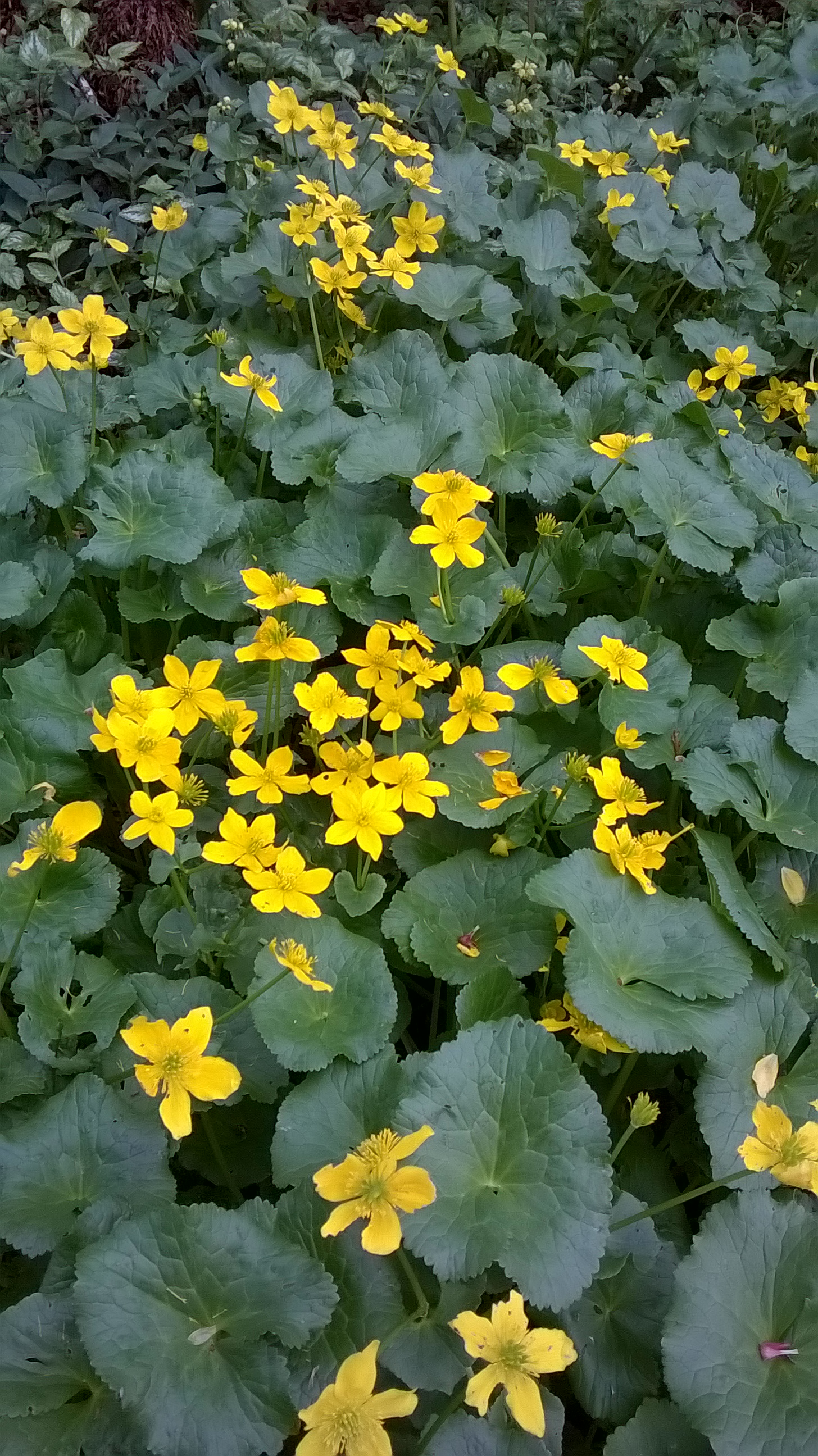
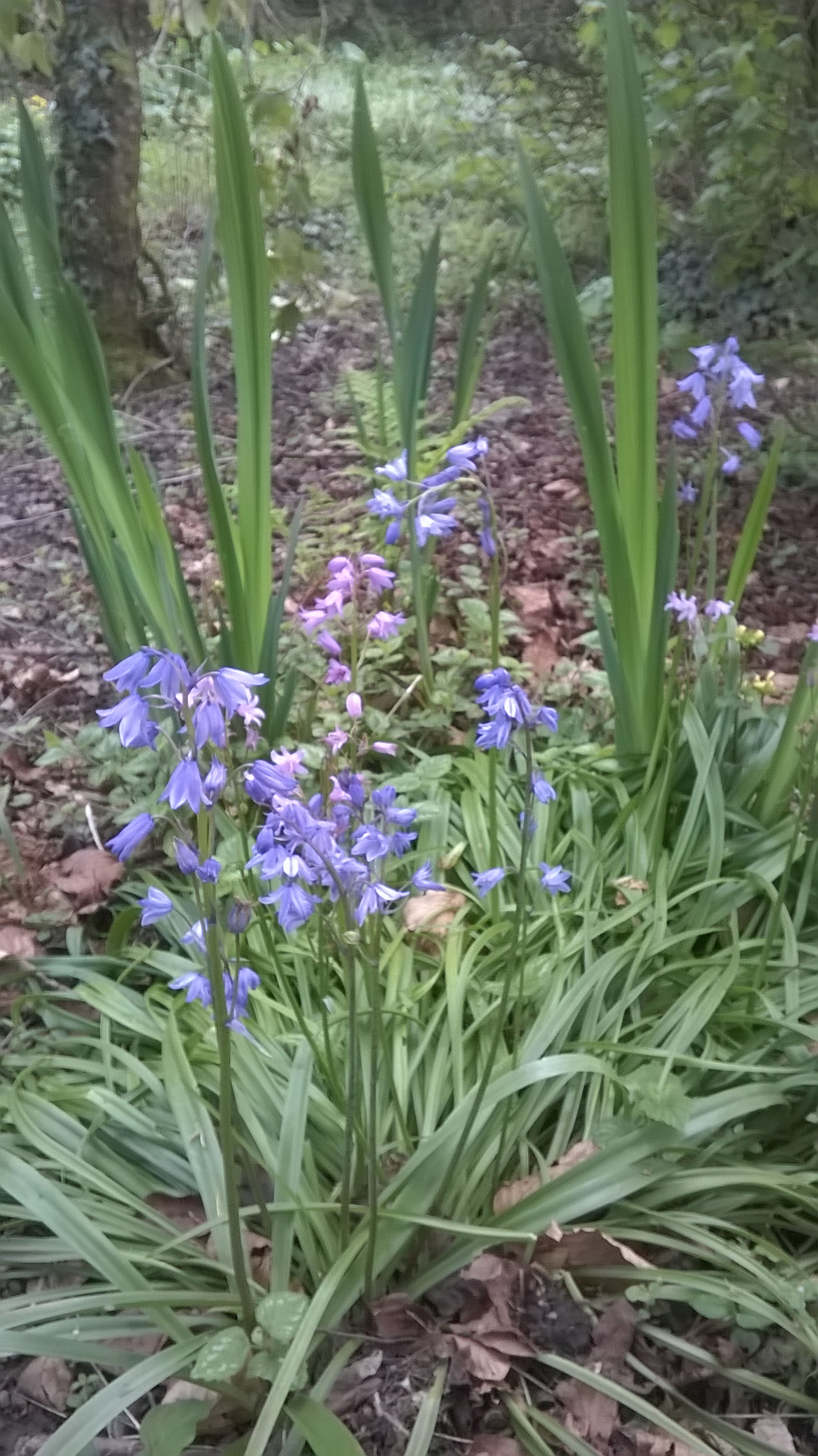
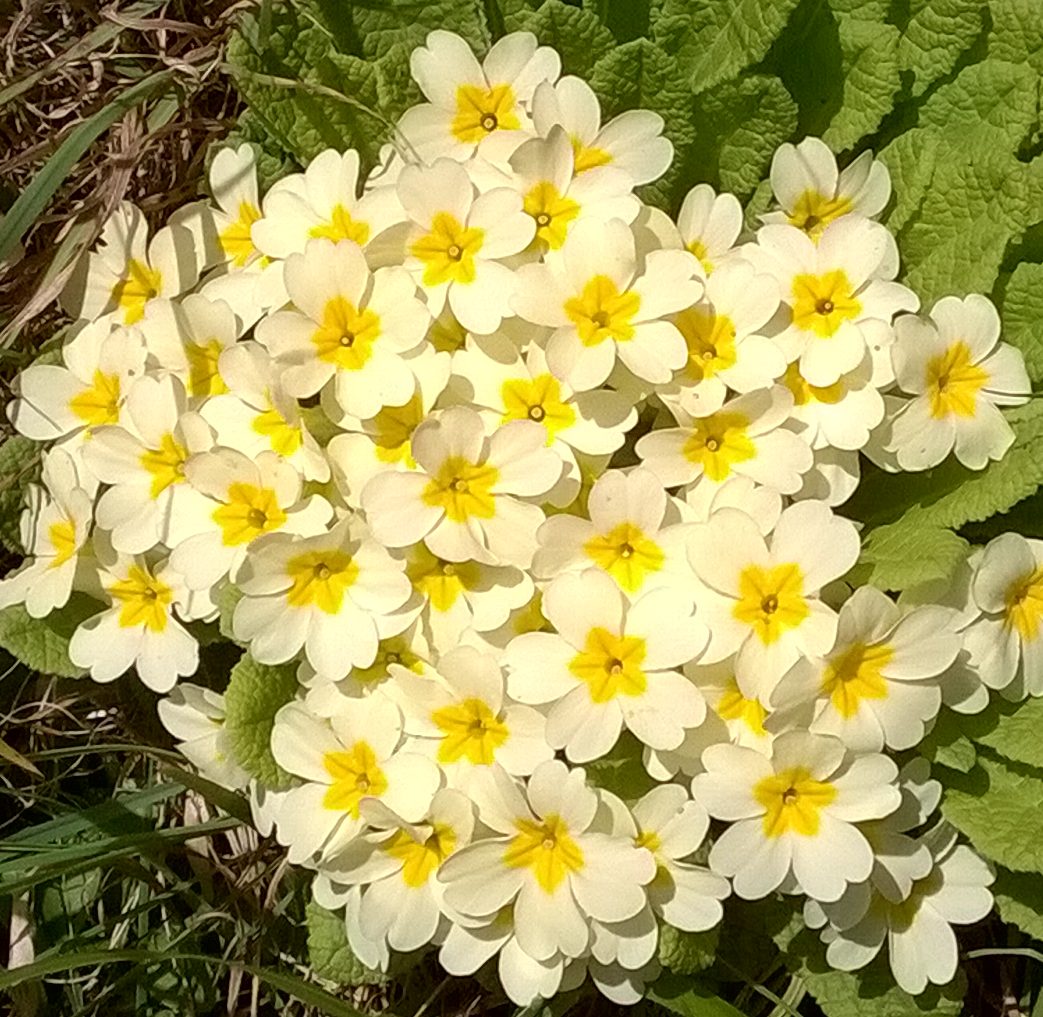
and just look at the flowers – all late – but here they come – and a nice bumble-bee too –  new life – JOY !

wp_20180425_18_04_22_pro wp_20180425_18_00_40_pro wp_20180425_18_00_10_pro wp_20180425_18_03_24_pro

And so now, in a relaxed and positive frame of mind, on to the second part of today’s blog, my stage 1 breast cancer journey continues …

The Follow-Up

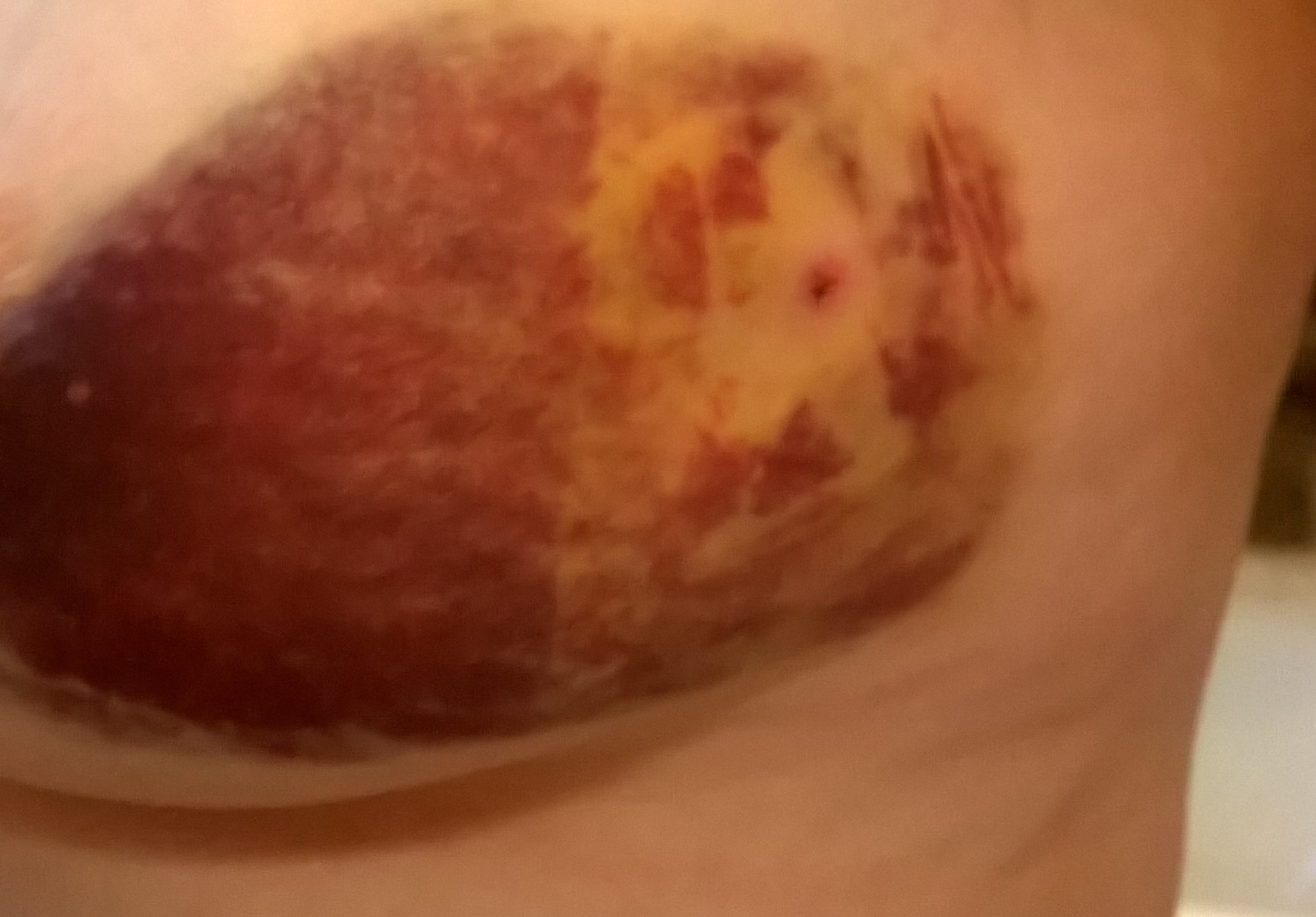
Maybe I had over-done it at Belly Dance the Thursday before – but my breast was a bit tender and the bruising was still changing from blue through those wonderful yellow shades, so didn’t look a pretty sight (see below) Not that it would bother the surgeon, I’m sure. He was mostly interested in the healing of the incisions … which was good 🙂

He then went through the results: No cancers cells detected in the margin of ‘healthy’ cells they took out with the tumour. (GOOD NEWS) No cancer in any of the 4 lymph nodes that they took from under my arm. (Extra GOOD News!)

Of the tumour – a total of 22mm – the central 9mm was Grade 2 stage Invasive Ductal Carcinoma – the outer layer ‘intermediate* grade’ Ductal Carcinoma In-Situ (DCIS) (*as in between 1 and 2) Not such good news – as the grade 2 is invasive –  and had already broken out of the milk duct it began in.

To mop-up any stray individual cancer cells – or other cells in the breast that were planning on turning cancerous – 3 weeks radiotherapy was recommended. This is not without risks, varying from minor to major, from as common as one in four to very rare, and can be very uncomfortable and tiring at the time and for a while afterwards.

Then he told me that the cancer was Oestrogen Positive. {often written ER+ because the Americans spell it Estrogen} This means that the cancer uses oestrogen to stimulate it’s growth. Now, being past menopause – you would think there wasn’t too much oestrogen kicking around anyway – however, there’s enough to be a problem! So the recommendation is a five year course of oestrogen blockers ‘hormone therapy’ – that stop the uptake of oestrogen by the cancer cells.

Which – hang on ladies – can throw you back into all those menopause symptoms you thought you had at last got over! Yep! Hot flushes, night-sweats, brain fog – whatever was in your bag. And after doing five years to get through it ‘cold-turkey’ (i.e. no HRT – one thing that is shown to increase chances of breast cancer) is a teensy bit annoying.

However – there are more than one ‘family’ groups of oestrogen blockers – and if you don’t get on with one – say after 6 months (because it takes at  least that long to settle into it) you may be changed to another to find one that does suit you. They say it is rare that someone doesn’t get on with any but with my reactions to so many medicines (and anaesthetics!) I’m a little trepidatious but I intend to take it up…

WHY? well, because taking the oestrogen blocker stops the cancer cells getting hold of their growth boosting ingredient – and this is shown to give a better chance of surviving after having breast cancer treatment.

The doctors will use a tool called Predict – to tell you what your long-term chances are if you ask (that is – five years and ten years after surgery and whichever treatments you have).  Once you have all your details you can find it for yourself here :  PREDICT

The difference that oestrogen blockers make in an oestrogen-positive cancer patient with my details (age, how detected, size of tumour, HER2-,  grade, treatment plan) is 2.9% after ten years (from 79.2% still alive after 10 years, to 82.1%)

So … watch this space – as they say … quite a while to go yet though – radiotherapy first … and I’m not really looking forward to that either having watched Dad go through it all not so long ago!

Oh, I promised you a picture of how it is healing up? … hang on … there – healing well – complete with ‘interesting colours’  🙂wp_20180428_07_30_40_pro

Let me add – this is just my experience. I couldn’t find any early stage breast cancer stories on blogs – so decided that I would do it – for others who want to see what this stage is like ( as opposed to the drastic cases usually written about) Being positive, being informed, and getting on with it, is my way through. Hope you found something useful – and if you want to share your experiences please do use the comments. If you want to praise the bounties of Spring – you can do that too!  🙂

Best Ann

ps If you are reading this on email and would like to comment just click onto the title and it will take you to the actual blog – so you can comment there ?

pps If it is the first time you have written a comment don’t worry if it doesn’t appear immediately, your first comment has to be verified (to keep the spam-bots out) and I do this personally – so I am sure to see your comment – thanks for reading – Ann

Plan of Action and Operation

primroses-with-redIn the last instalment of my stage 1 breast cancer journey – I had just received The Letter – and had an appointment to go and talk with the surgeon about my treatment.

So it was back to the Primrose Breast Care Centre and there I was met by a Primrose nurse and, having dis-robed my top half, was decked in a pink mini-cape. The surgeon then joined us to examine the problem.

To start with, I think the amount of bruising was exceptional, the Primrose nurse said ‘Oh my’ and she must see it all. I was asked twice if I was on any blood thinners – like aspirin. I am not.** see below **

I have to say that there were now two hard lumps, one about the size of half a marble, the other slightly smaller, that had come up with the bruising. I had put this down to the two sites of sampling, but when the surgeon said that the cancer sites (lumps) were quite palpable I had to say that they were not until the biopsy!

From the scan they had looked quite deep, but I was told they were here, where these two  ‘now palpable’ lumps were, therefore not far beneath the skin.

What can I say… if these, not-deep cancers, were not able to be felt – what chance to feel any deep-set ones! Yet the mammogram found them! So, as I said last week, if you get the call to the mammogram – GO!

Once dressed we met again to discuss the treatment, which had already been discussed with the medical team and a recommendation made. This was to remove the two lumps (a lumpectomy) along with a margin of cancer-free breast and also to remove one or more sentinel lymph nodes from just into my armpit.

Both the lumps and the nodes would be examined to check that there were no cancer cells, a, on the clear margin around the lumps and b, in the lymph nodes. If this is the case then, after time for healing, we can go forward to the next stage of treatment –  three weeks of radiotherapy.

** I thought I would look up the non-prescribed supplements that I take – in case any of these are blood-thinners… Cod liver oil, Vitamin D (used from October to May – while the sun isn’t strong enough to make vitamin D in the skin) Glucosamine and Chondroitin, Magnesium glycinate (half daily recommended dose) 3mg Boron, Vitamin B complex. The internet offered so much that was confusing and contradictory that I had another idea! No. 3 son is the one with the PhD in microbiology and works in a business that works with pharmaceutical companies – so I asked him. He came back with ‘there a whole lot of stuff that’s contradictory out there’, but, Chondroitin and Magnesium have scientific evidence of acting as blood thinners. Nothing wrong with this usually, but not good if you would like to avoid bruising. So I cut out both for a week before the operation **

The Operation Day

Another early morning – I really don’t do early very well but I was up early enough to shower and eat my usual breakfast one-egg omelette (breakfast was allowed as long as it was eaten before 7 – as my operation wasn’t until later in the afternoon).

The Husband dropped me off at the hospital at about 7.45am (about the time I start to wake up usually) and I made my way to my first stop – the Primrose Centre. I was armed for my waits with my kindle and a downloaded copy of Terry Pratchett’s ‘The Fifth Elephant’ – something easy to read, funny and distracting. I didn’t have much time to get stuck in as, within a couple of minutes of my appointment time, a nurse took me through to go through paperwork with me – mainly about the exercises to do after the operation and when and how to remove, or have the dressings removed, when the time came. A few minutes more and it was an ultrasound scan – from the same radiologist – who then drew on my breast to indicate the precise areas of the lumps as guided by the scan.

From there I had to head down to Nuclear Medicine – where a blue radioactive dye was injected into my breast so that it would flow through to the sentinel lymph nodes – whereby they could be made visible to the surgeon.

As it happens, I then had a two hour wait until I was due at my next appointment venue – the ward where I would go through all the preparations, checks and paperwork prior to the operation itself. It was a beautiful sunny day, if with a cool wind, so I set off to walk down behind the hospital to where I had seen a pond marked on trips with my Dad to the lowest areas of the hospital where the radiotherapy department is tucked away. The pond had both tadpoles and fish, which were diverting to watch for a few minutes, and a seat in a sunny spot that was ideal for reading, and chuckling, over Pratchett’s story.

wp_20180426_12_40_23_pro
my ‘bit of brightness’ dressing-gown

Later, after waiting between being ‘seen’ (that saw me reading and chuckling to myself – over the book I was reading – other waiting patients probably thought me mad) and after blood-pressure taking nurse, chat with surgeon, who further annotated my chest with arrows pointing to armpit and breast, and finally the anaesthetist, it was – get changed! Oh yes, and pop on these pressure stockings! SO tight to get on – even when I read the tiny instructions and did it the right way – yes, I have well-developed calves!  Then the usual, oh so elegant, hospital gown and then, my flash red ‘silk’ with-Peacocks-and-Chinese-blossoms-all-over-it dressing-gown, to cover it all. Well you have to look bright sometimes … and off we went for a little walk to the prep-room, to be administered the anaesthetic  >>> . . . . .  .   .    .     .       .

.    .     .    .   .  .  .  . . . . . … and woozily I was called back to the world. And the fun began. I had said to the anaesthetist that I didn’t do well with general anaesthetics – well the last time I had them – over 24 years ago. I was, confidently, told that anaesthetics had moved on since then.

Hmm, not for me it hadn’t. So they gave me an antiemetic (anti-sickness drug) to dissolve under my tongue – then tried with the sips of water again …. OOops  no go!! I guess, finding me coherent, if still sick, they decided I was fine to go into the next stage of recovery, where, nibbled ginger biscuits and sips of water were tried … OOoops! no go! So it was that they gave me an intravenous antiemetic … then a cup of tea! Down in sips – and …. OOOOps out again!

Seems my body still doesn’t like anaesthetics! By now the woman who came in well after me was happily feasting on tea and sandwiches! So – this aspect is just how it affects me! They decided they’d call the Husband anyway as it was getting late  … which they did … and sent me off with him, a couple of packets of pain-killers and a sick bowl!

Next morning I was fine – managed to eat quite happily! I also polished off the rest of the Pratchett as I didn’t feel up to doing much else! I took a couple of pictures – so that anyone interested in what the operation looked like at this stage can compare, should they need to.breast-after-op-crop Not much additional bruising to be seen, just in two places. The dark bruising towards the nipple is still what remains from the biopsy – and nothing to do with the operation. (note: my phone doesn’t have a ‘selfie’ camera, just an away facing one, so it makes taking these pics tricky!)

This is also the morning to begin the exercises – and though the dressings pulled the skin they were attached to – these were fine, not actually hurting. Certainly worth doing to make sure flexibility and strength are maintained!

The First Six Days

All week it has been sore! I’ve been taking one paracetamol and one ibuprofen every four or five hours – and that includes half-way through the night when the ache/pain woke me. A few days I found I just had to go and lie down, and easily slipped into a doze. An hour later I woke feeling much refreshed. Maybe this is the effect of the painkillers (medicines I rarely take and then usually only one at a time or they knock me out) or the healing process I do not know – but it’s good to listen to your own body and follow it’s instructions!

Wearing a bra overnight is weird – but recommended and I would say it does help support, and therefore not pull, on the operation sites. A bra-extender was recommended to counteract the tightness of your usual bra brought on by the swelling from the operation. As I’d not thought about it until a bit late, I constructed my own from an old bra, cutting the two fastenings off and sewing them back together – it has worked really well, making the bra far more comfortable! For anyone who thinks about it earlier they are easily available on eBay or Amazon.

DAY 7

I was told to remove the waterproof dressings on day seven . Options were given a, do it yourself, b go into a practice nurse to have it done, or c, if you were worried or had extensive surgery (like a mastectomy) to go back into the Primrose to have it removed. I opted for a.

Then, in the shower, the steri-strips all peeled off. Leaving the naked lines of the cuts visible. Not too bad looking, though the one under the arm feels lumpy, and the waterproof dressings had started to irritate my skin and cause a rash. breast-dressings-off-cropBoth cuts are about 5 cms long. The bruising from the operation has also faded a bit now – though there’s still some from the biopsy. Whether this was because I’d cut out the magnesium and Chondratin or because there is less force in an operation, I do not know.

So this is where I am, recovering …

… and I hope that this has been of some use to anyone facing the same level of diagnosis. As I said – I’m blogging this experience to help anyone else going through it, now or in the future, to have some kind of comparison – as most blogs seem to be about the worst cases – rather than the early ones.

Thank you if you emailed me with kind words, they are appreciated.

Thoughts, Comments, Questions – All are welcome, you know I love to hear from you.

Best – Ann

ps If you are reading this on email and would like to comment just click onto the title and it will take you to the actual blog – so you can comment there ?

pps If it is the first time you have written a comment don’t worry if it doesn’t appear immediately, your first comment has to be verified (to keep the spam-bots out) and I do this personally – so I am sure to see your comment – thanks for reading – Ann

And Now This …

And now this … those of you living near me probably know already … as I have roles in so many local groups that I found I had to tell a lot of people (so that I didn’t let anyone down at the last minute).

wp_20160424_15_37_05_pro
primroses

Oh! Why?  

Glad you asked, well, my three-yearly mammogram came round about six weeks after Dad’s funeral. I went along – as I always do – quite happily, being sure that I felt no lumps or anything unusual – and I do check.    . . . First a bit of history …

Back in 2003 a mammogram had found something suspicious … that call-back, followed by a biopsy a couple of weeks later, resulted in a diagnosis of Micro-calcification. (poem from the time below)

Evidence of micro calcification

I find myself aware of life, all life
taking care not to harm
even the ant. Just as when expecting,
an un-thought, instinctive  
seeking wholeness and health.

I ask, ‘worse case scenario’
tuck away pieces of terminology
seek little more, seem un-worried
but later, research thoroughly
– the odds work both ways.

Biopsy; as always, do as I’m told
be as still as I know how
the conscientious student
the un-worried patient
put it all at the back of my mind.

From the bath I rescue
both silverfish and spider, for once
pray for myself instead of just others.
Then the letter, and my relief reveals
to me the degree of my anxiety.

Ann Foweraker

Nothing to worry about after-all !

Then a few years ago I had a sort-of sore feeling in my left breast when I lay on that side, nothing to feel lump-wise, just sore – a bit like an old bruise that still hurts when pressed. The ‘soreness’ didn’t go away, so after a few weeks I saw the GP, who referred me for a mammogram just to be sure – it showed nothing to worry about at all ! (and the soreness went away too after a little while)

Then this latest mammogram – and the call-back. Immediately I checked again – I still couldn’t feel anything untoward! So set off in a hopeful mood – that this would also be a false alarm

In Plymouth’s Derriford Hospital we have the Primrose Breast Care Centre – here everything for breast care is drawn together so you don’t have to wander around the hospital, going from department to department. It is a charitable foundation working with the NHS to provide the best breast care experience and, completely coincidentally, something that one of the groups I’m involved with had recently voted as this year’s charity to support.

First it was in to take another set of mammograms – to check the area they were concerned with – though they took scans of both breasts – perhaps for comparison.

These must have been sent almost straight into the Radiographer, for that was my next port of call, within a few minutes. The doctor then did a ultrasound and told me, in a kind way, that there were two patches, right beside each other, that, in his opinion, looked very like cancer, and that he was usually right 19 out of 20 times. So he would need to do a biopsy.

There’s me thinking I would have to wait of a couple of weeks for this, as before – but no, within a minute or two he and the nurse were ready to perform the biopsy, the skin numbed and the needle guided by the ultra-sound scan. It wasn’t too painful – an odd tugging feeling in the breast as the needle ‘clunked’, twice, and it was done – the nurse pressing down to stop the bleeding and then putting paper-stitches and a waterproof dressing over the wound. After a meeting with another Primrose nurse to fill out forms, I was ready to go home.

Apparently the pressing is supposed to stop bruising – all I can say – is it didn’t work very well for me! I know I bruise easily – I’m always finding bruises on my hips and shoulders where I’ve caught something, so lightly I can’t remember doing it – but the bruise is there anyway.

breast-cropThis photo is after three days. You can see the site of the biopsy, where the tape was – it left un-bruised lines, and even the water-proof dressing curbed the depth of bruise – but the rest of the bruising spread far and wide! (Don’t be alarmed – it looks a lot worse than it felt – actually the main soreness was around the site of the needle insertion – the red dot)

 Then – about a week later – The Letter. ..

I’d definitely been diagnosed with breast cancer … and a trip into the Primrose Unit again beckoned, this time to discuss treatment with the surgeon.

My reaction? Well, to be honest – pretty miffed! I was just ready to get going again on so many fronts. Yet, somehow, not altogether surprised as I have seen, over the last ten years or so, so many people who have cared for others (often with cancer or another life-threatening, or debilitating, condition) who have then gone on to develop cancer themselves. . . it almost seems as if it is catching – but of course – it isn’t.

My next reaction – research! No point in panic or upset – I’ve just got to get on with it – but find out all I can! That’s me 🙂

Why? Oh Why? Am I blogging this?

Well, because my cancer is (provisional) stage 1 (Early – invasive ductal carcinoma) and, luckily HER2 negative (so, not aggressive) and when I was researching I found that there are many, many blogs out there about aggressive, or late-discovered tumours – but few about the early ones, therefore few to compare with.

AND because I couldn’t feel ANYTHING that would have warned me – even when I had the re-call letter and gave it a really thorough checking out! ONLY the MAMMOGRAM picked it up. So I want to say, when you get the call for your mammogram – GO! I’m only glad my call came this year – not in another couple!

One thing I know – there are hundreds and thousands of people out there who have had breast cancer – survived – and living life to the full – so if you’d like to share here – please do – as always, I love to hear from you – on this or anything else…

And that’s me for today … Best ~ Ann

ps If you are reading this on email and would like to comment just click onto the title and it will take you to the actual blog – so you can comment there 🙂

pps If it is the first time you have written a comment don’t worry if it doesn’t appear immediately, your first comment has to be verified (to keep the spam-bots out) and I do this personally – so I am sure to see your comment – thanks for reading – Ann

Apples and Memories

This week, on a warm day I went into the apple store and realised, by the fermenting aroma, that it was time! Time to sort out all the remaining apples and chuck out all the mouldy ones.

Now a really organised person would have been doing this all along – they’d have done this every time they collected apples – not dashing in, grabbing a few and flying out again, often at twilight, when sorting apples in an unlit shed is not easy.

Red admiral - telling us the apples are ready!
Red admiral – telling us the apples were ready!

As I stood turning over each of the apples that still looked good to check for damage, and chucking the obviously past-it apples into the bucket, I remembered picking this crop. We did it over a number of warm days, the butterflies dancing and tasting apples that had already fallen.

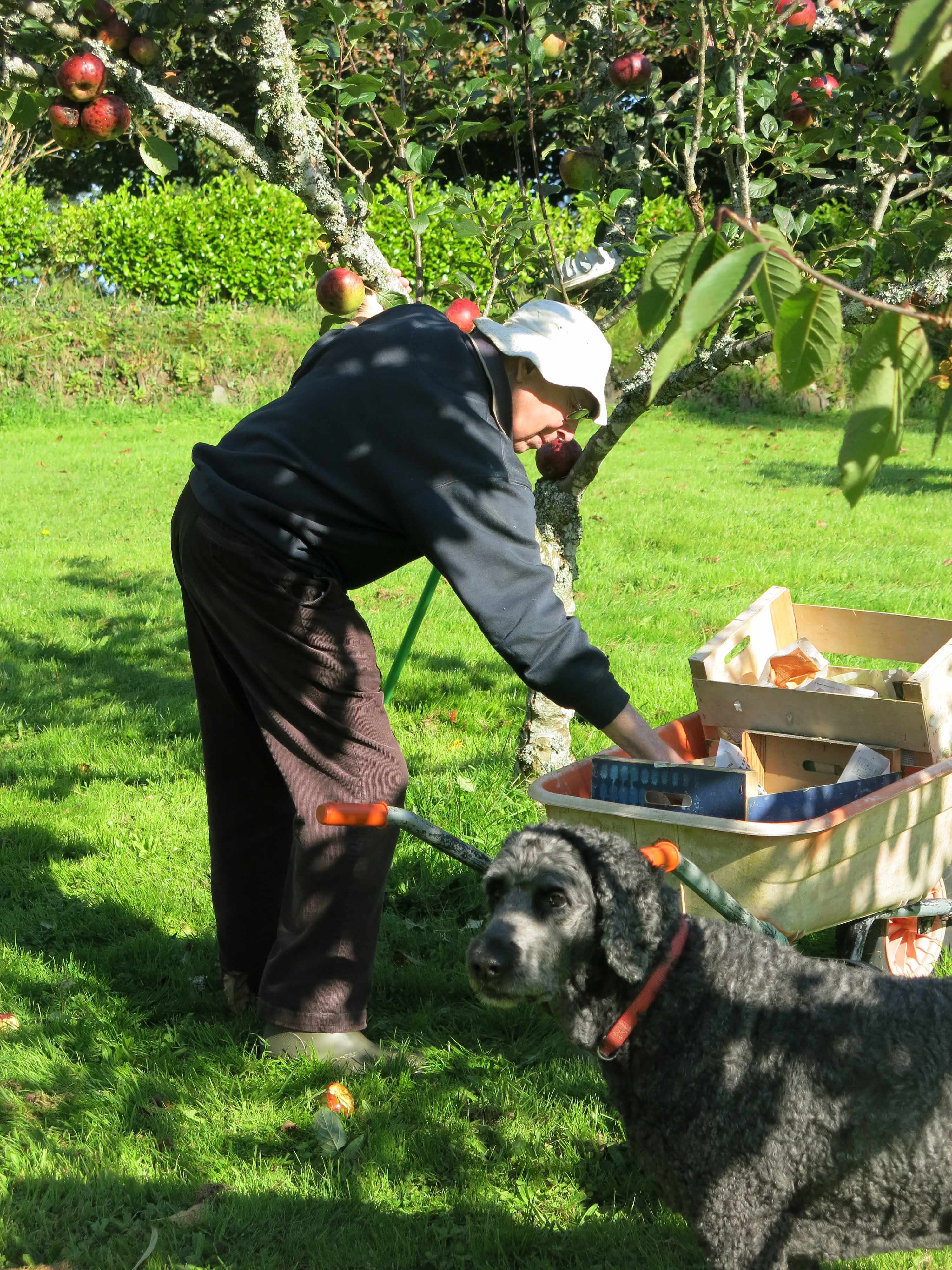
In past years Dad has always been the most assiduous fruit-picker in the family, he’d check the fruit, wait for the dew to dry and then set off into the orchard with a wheelbarrow full of boxes, and steadily pick apples and lay them out in the apple store all day, or until the apples that were ripe were all gathered in.dad-picking-apples-holding-on-2017

This year, ill as he was, he still wanted to help. So, over a few days, he did. I helped him walk down to the trees we were going to pick, and he held tightly to a branch and picked with his free hand, or propped himself against the trunk, and did the same. An hour or so of this and he was exhausted, but happy to have done his bit for that day, and after I’d helped him back he’d settle down in his armchair, feet up, and would swiftly be asleep. wheelbarrow-apples

trug-apples


dad-with-howgate-wonderThere had been an excellent crop, with some real whoppers from the Howgate Wonders – an apple I love to recommend as it is sweet enough for an eater, mushes down like a cooker (needing no added sugar) is a heavy cropper and keeps really well! Here’s a snap of Dad holding one, though not the biggest, of these lovely apples.

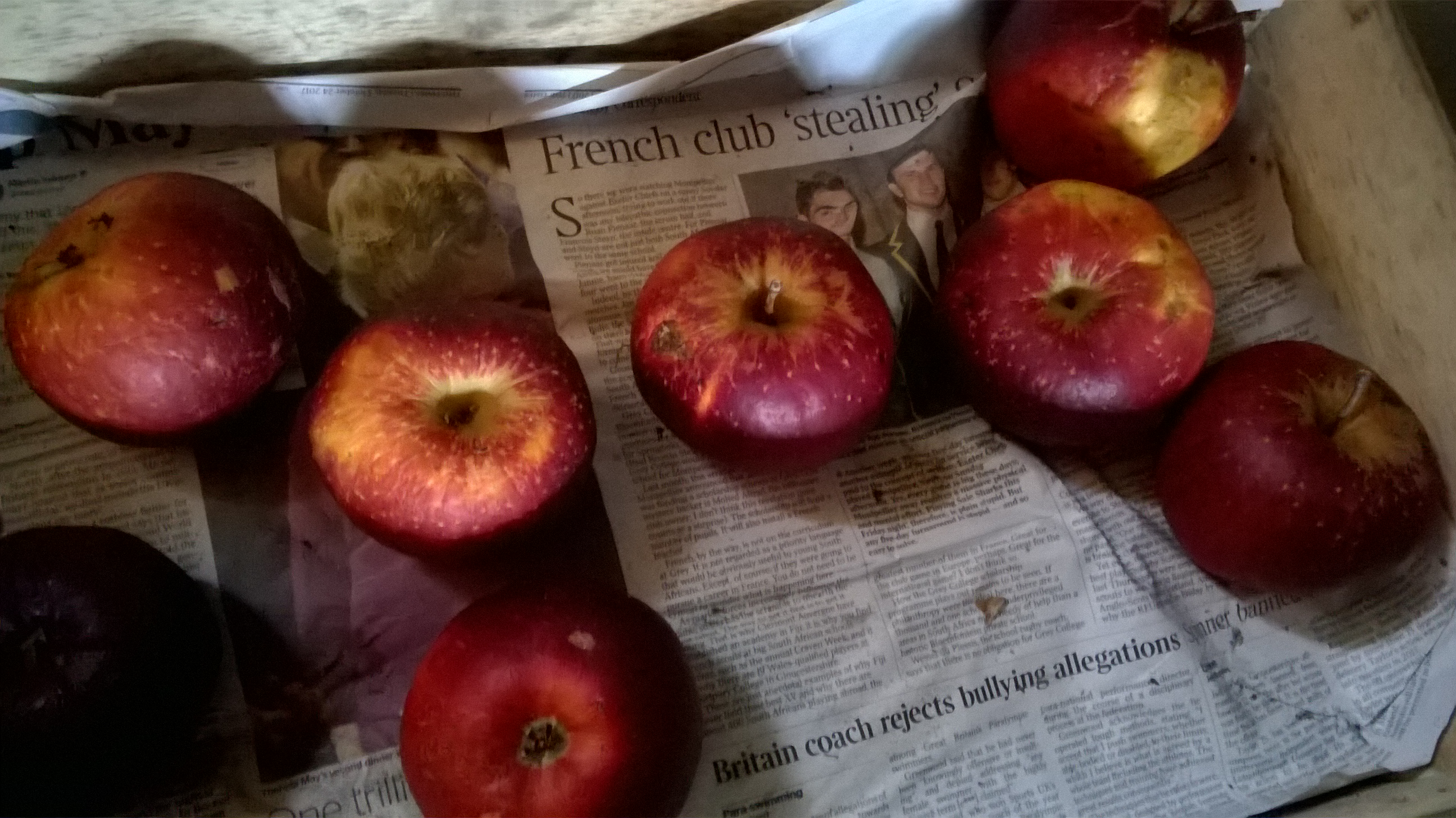
All this is going through my mind as I sort the apples, and here we are, the second week of April and I still have a range of apples left.wp_20180408_15_17_11_pro
They do not look as pretty as the chilled, native and imported, apples in the supermarket, but they haven’t been sprayed with pesticides or herbicides.wp_20180408_15_16_56_pro

They haven’t been waxed or coated in shellac . . . and if you don’t like the sound of these ‘old apples’ please note that *’apples you buy from the shops are usually anything from a few months to a year old’ * Times Newspaper 10/4/18

wp_20180408_15_17_01_pro

Yet even after all these months, peeled, they still taste wonderful, are free – wp_20180408_15_17_23_pro


and I reckon I have at least nine kilos left!


The mouldy and too-damaged-to-eat apples I’ve spread out on our open-top compost heap – where it won’t take long for birds to find them to have nice, unexpected, spring feast.

wp_20180408_15_22_54_pro

What have you been up to this past week?

What annual jobs in the home or garden are you tackling?

Do let me know in the comments – I love to hear from you 🙂


ps If it is the first time you have written a comment don’t worry if it doesn’t appear immediately, your first comment has to be verified (to keep the spam-bots out) and I do this personally – so I am sure to see your comment – thanks for reading – Ann


Reading the tea-leaves – bicarb to the rescue

wp_20170706_15_23_39_proHiya, now here’s a problem you might be able to help me with.
I think this household has been drinking PG Tips for well over thirty years – it has been the preferred tea that met the variety of flavour-requisites of those living here. Nothing fancy – unless you think their pyramid shaped bags are fancy – just straight-forward tea – everyone drinking it with milk (this is important to know later) some liking a strong cuppa – some (me) with so much milk in it most people would wonder where the tea was.

We have a vast array of mugs from which this tea is drunk – from Disney mugs with the initials of each of the 4 boys on – through supermarket stoneware or ceramic to proper lovely thin china. None of these ever became stained in all these years! (except the large mug one son took to using on a constant basis – never letting it get in the dishwasher – just rinsing and re-using (shudder – don’t ask!)

Now this maybe because they are usually dish-washed between uses, though rarely were they rinsed immediately after use (recommended for avoiding stains) before putting into the dishwasher. This may be due to the fact that we have very, very soft water (hard-water virtually guarantees staining – apparently). It may be due to the fact that no-one in the family drinks tea black (milk proteins are said to bind to the tannin preventing it sticking to the cup). All of the above are suggested by the internet as ways to make sure your tea-cups do not stain.

All well and good!

BUT – all of a sudden, about six-months ago, the stains started to appear!

WHY? Same cups. Same regime of ‘cleaning’. Same soft water. Same tea-with-milk. Same tea …  Or is it?

Over a year and a half ago PG Tips reduced the quantity of tea in its bags. We are talking a 0.2g reduction on 3.1g. Not a lot – but they claim ‘just as strong a brew’ and I wonder how that can be? I recall a demonstration at a tea-plantation in Malaysia where they poured cold water onto different tea bags, one high quality – one lesser. The inferior one leaked colour quite quickly, the better much less so. We were told that this was because the inferior one contained tea-dust which enhances the colour (yes, still tea-leaves – but very fine particles) and that these ‘leaked out’ through the bag making the tea look stronger.

wp_20170706_15_33_08_proLacking a ‘high-quality’ bag to compare it with in this manner, instead I broke open a tea bag and put it, dry, through a tea-strainer – not a lot stayed in the strainer as you can see …  and how fine is ‘dust’ anyway?  Not very scientific, I know – especially with no ‘old-size’ tea-bag to compare it with.

So I am not casting aspersions, as such, but I wonder if something like this has gone on – and that this is why the tea we have used for so many years now creates these ugly stains even in the nicest and smoothest of china-ware. Whatever – I now have, for the first time ever, tea stains to contend with!

THE SOLUTION

Now I have a regular task of dealing with this problem and have found my new friend Bicarb is in on the act, along with white vinegar. Which is good because I didn’t want any new chemicals in my life. I now keep a small bottle of half and half – water and white vinegar – handy. I pour some of this onto a sponge, give the mug a wipe around, coating the inner surface with the mixture. I then pour a little Bicarb out, dab the sponge into it then rub around the inner cup, with an extra rub where/if there’s a tide-line.

A good rinse – and this is done – then into the dishwasher it goes – and comes out sparkling!

Also … when I have finished the couple of boxes I have in my cupboard – I think I will be experimenting with other teas to see if any of them meet the exacting flavour standards AND do not create stains! So, dear readers, can you help me?

What’s your favourite tea?

Does yours stain your cups?

What do you recommend?

Do share – you know I always love to hear from you

Ann


Please, if you enjoyed a book by an indie-published author, help them gain a wider audience by doing a review on Amazon – doesn’t have to be in depth – just has to be heartfelt. Thank you X

Chicken talk of yolks

The recent government rules on keeping chickens in / away from migrating birds which might be carrying H5N8 bird flu –  has made me do something I have intended to do ever since we stopped keeping goats.

When you mainly cook from scratch and grow a lot of your own veg, and buy the rest from local sources, you end up with a lot of peelings. Especially when you like to have a lot of different types of vegetables with each meal!wp_20170226_12_56_25_proNow this was never a problem when we had goats – there was always the bucket for the edible scraps for the goats and the bucket for the compost heap. The latter generally only had onion skins, citrus skins and teabags in – judiciously mixed with torn cardboard loo-roll tubes and such stuff.

When we sold the goats, prior to putting our beautiful house on the market, the vegetable peelings joined the compost bin . . . even though I kept saying to myself that I ought to prepare them for the chickens.

With the chickens compulsorily being kept in closed-off quarters I eventually did something about it!

I first found that if you just give raw peelings, toppings ‘n’ tailings, outside leaves etc to the chickens they will peck at it … but they will not clear it up efficiently … for that you need to give it a light cooking.

So, after I have cooked and served-up our meal I now drop the whole pile of peelings into the largest pyrex bowl I have already used (in cooking the meal) and pop it in the Microwave for 10 minutes. wp_20170226_14_47_25_pro

When it is cool I put it back into an old bowl (or a re-purposed sweet tub even) to take out to the chickens.

They love it – especially with the odd soft apple, from the apple store, sliced up in it too.

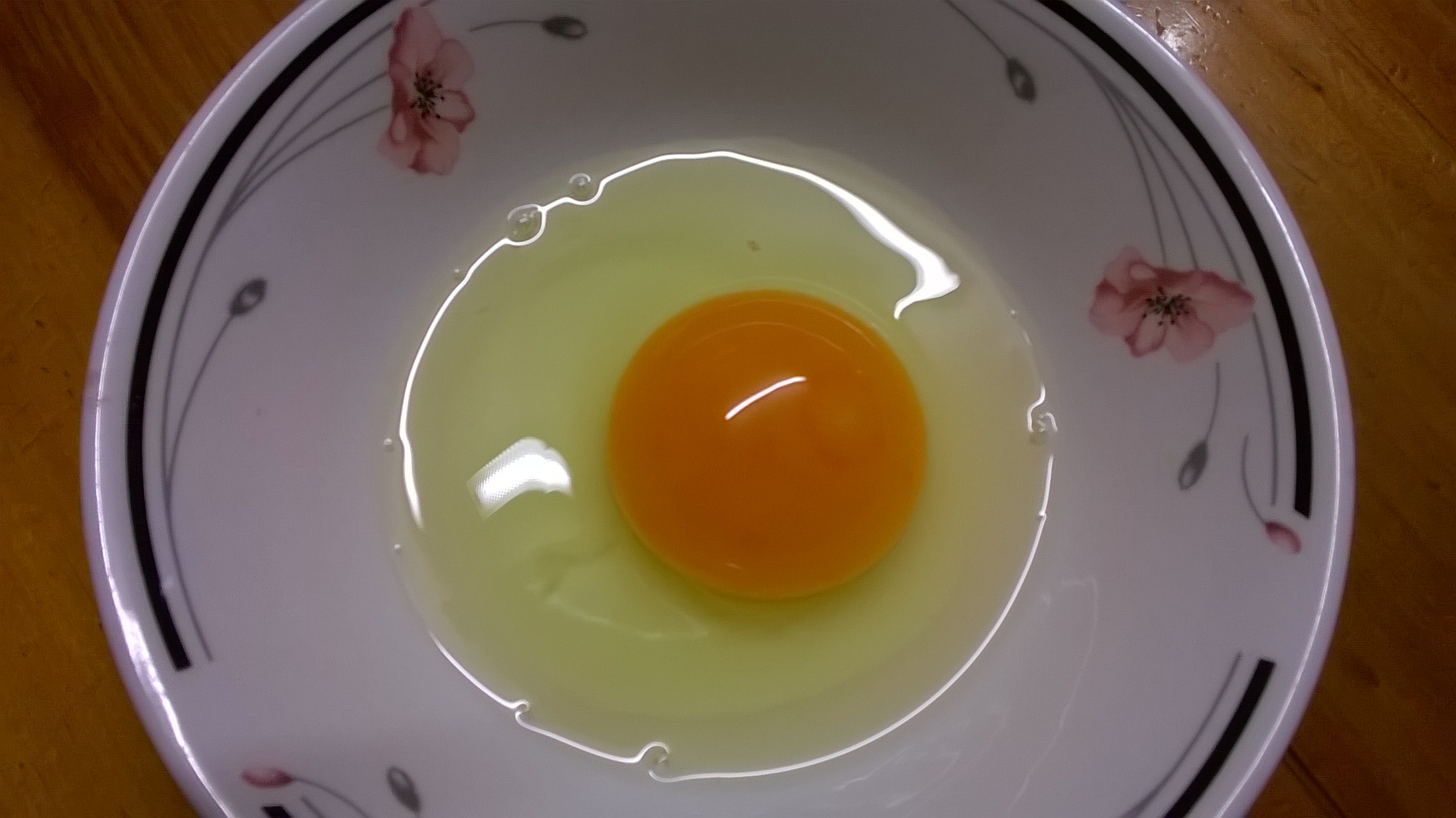
AND as a bonus, now they are back out on the grass and getting the extra veg-peelings regularly too, we now have the deepest yellow yolks going – yes even darker than usual – and that was pretty good anyway – and yes – this is the actual colour  – it is not a trick of the light.wp_20170301_07_06_42_proSo we get to eat tasty, rich, healthy eggs and I get to feel even better now that the peelings are being used properly again.

What do your do with your veg peelings?

Are you a chicken keeper?

You know I love to hear from you – do share

🙂  Ann

Lichen sclerosus and Why Borax is my new best friend

It’s difficult to talk about this – and this is why it has taken me two weeks to write one blog! After just telling my husband the diagnosis, lichen sclerosus, and that I had been prescribed ‘a cream’ for it I hadn’t mentioned it again even to him – and even though, over the course of four or five years, the symptoms got worse and worse.

Back at the end of October, the symptoms had become excruciating – and the ‘cream’ useless. I had been told that as an auto-immune condition there was nothing else medicine could offer apart from suppression of the symptoms by the ‘cream’ – a corticosteroid – classified as a ‘potent steroid’.

So, what is Lichen sclerosus? It is an auto-immune condition that affects mainly children and post-menopausal women. (Yep, tick that last box)  As I am sure you know, and auto-immune condition is one in which your own body turns on itself, destroying cells, and in this case making the skin thinner, prone to blistering, swelling, soreness, irritation and inflammation. Though, thank goodness, it isn’t infectious at all.

Lichen sclerosus also has a favourite location for this disruption of the skin – and this is why I (and many other people) don’t generally like to talk about it. It affects the skin between the buttocks and reaching forward to include the skin around the vulva. In people who have had it for decades it can even result in atrophy of the flesh.

By the end of October I was in pain all the time, especially when sitting, and every time I needed to use the toilet I faced the agony of cleaning and drying myself, and the area affected seemed to be extending. Now Corticosteroid must be used sparingly – frequent reapplication is not acceptable – not desirable – as Corticosteroid also THINS the skin

I positioned a mirror to look – the skin was red, shiny, swollen, cracked and blistered – no wonder it stung to blazes!

This is where I am surprised at, and ashamed of, myself. I have been looking into natural ways of supporting the body and brain by supporting the health of your whole system – but I hadn’t looked for a natural way of dealing with Lichen sclerosus. I had been ambushed by the fact that it was considered an Auto-immune condition  – and, therefore, I knew that meant it wasn’t curable.

…  or did I?

After all, hadn’t I been reading about other auto-immune conditions that had been helped by natural means – by a rebalancing of the gut-bacteria, specifically. However, I have already gone down this route for the sake of my brain, and I hope my gut-bacteria are now in a good balance and are being ‘fed’ the food-stuffs to keep them happy. I would say that in other ways my body was feeling better tuned and functioning well.

So it was, that feeling desperate, I began to research whether there was a natural way to help the condition . . .  and there was!

I read so many pages, so many personal responses. I read of people with this condition who were in a much worse state than I was – whose body had suffered permanent changes that were life-affecting. I also read of those who had found the answer – or an answer. And it involved my new friend Borax – also known as Sodium Tetraborate. I read around the subject – finding out lots more about Borax about uses – click here … and especially HERE and it’s uses, trawling sites for negatives as well as positives – until, convinced it was worth a try, I sent off for some, it was only £5.95  a kilo. (in 2016)

First it said, once you have obtained your borax have a bath – with one tablespoon of borax and one of bicarbonate of soda – just for relief. OH MY! That was SO GOOD, just in itself! That alone was enough to convince me to take the course.

Then there was the taking of borax in solution every day for a fortnight. This was in a specific high dose: One eighth of a level teaspoon of borax to be taken everyday, dissolved in one litre of (warm) spring water – consumed over the day.  Followed by a life-time of a much lower dose of borax –  every day – forever. AND the mandatory taking of a magnesium supplement always – as the borax needs that to work effectively. Magnesium citrate is easily absorbed but can also act as a laxative so I researched and decided on magnesium glycinate (click here) – which is also easily absorbed but does not have that side effect.

(NB. This site I looked at also advised (click here) adding one eighth of a teaspoon of ground Himalayan Pink Salt to the Borax – so I did this too … to begin with, until I had the odd reaction of tingling in my face – that seemed to be caused by an overdose of sodium – so I dropped the pink salt and continued with the borax – the odd reaction faded away.
Himalayan pink salt is often recommended by natural health bloggers for ailments – and I wonder if someone was trying a belt and braces solution that worked for them – but overloaded my system with sodium?
My verdict – I believe this works just as well with Borax only)

ANYWAY…. On day 5 – when I was drying myself I thought ‘Oh! What? My skin has gone numb in one small place.’ So I checked with the mirror to see where this numb area was. It turned out it wasn’t numb at all – just healed-up and looking normally pink, surrounded by skin that was still screaming at me – it only seemed numb in comparison.

Over the remaining time of the fortnight this small normal area grew – until all the skin looked pink and healthy and did not hurt any more. The swelling had gone down too – and it was only then I realised how bad that aspect had actually been.

One other thing I used over that fortnight was a simple ‘salve’ I made-up myself. Without the corticosteroid cream there was no slippery barrier to each inner cheek rubbing against the other and causing pain. ** see next section below for a better salve I came up with later** So I used two rounded tablespoons of coconut oil (which is a solid at room temp) melted it (in a small lidded pyrex bowl in the microwave, watching it carefully) and mixed into it one level teaspoon of bicarbonate of soda, one level teaspoon of Borax and 3 drops of lavender oil (essential oil) The dry ingredients are dissolved into the warmed oil and constantly stirred – even as it begins to solidify. The essential oil added before it solidifies but after the oil has cooled a bit.  This then sets to a hard ‘salve’ – so I would scrape off a little and it would melt on my skin providing the lubrication on the sore skin with the soothing qualities of the other ingredients.

***

*** I have now come up with this modification: *** Coconut Oil and Saturated-Borax-Solution crème – This is the one I use all the time now!

Method

A, Make a saturated borax solution: boil the kettle. Put about 2.5 – 3 fluid ounces (75ml) boiling water into a heat-proof mw-safe jug.

B, Teaspoon by teaspoon stir in about 5 – 7 teaspoons of borax powder, until no more dissolves. (You can heat this a bit more in the microwave if it has cooled – to get it to dissolve the maximum amount)

C, In another heatproof jug melt/soften 1 tablespoon of coconut oil.

D, Add 5 teaspoons of the saturated solution to the melted/softened coconut oil.

E, As it begins to cool, whisk with a stick blender.

F, When cool and going opaque – add 3 – 5 drops of lavender oil.

G, Keep returning to whisk the mixture until it begins to thicken – pour into a pot, cover and place in a fridge overnight.

To USE. Scoop up a little with a *spatula, transfer it to your fingers and apply, rubbing in to all affected areas. *(only put a spatula in the creme – do not use your finger to scoop it out as this can transfer contaminants to the creme)

Note: this version does not have any gritty bits in it – but is slightly softer. It also has no bi-carb.
SEE this blog post for a VIDEO HOW TO MAKE THIS SALVE / CREME
***

Three months down the line and there has been no more pain, I still take the 3mg dose of borax each day [1 tsp of borax dissolved in 1 litre of water – kept in fridge and only 1 – 2 teaspoons of this solution taken each day in water] and use a little of my own ‘salve’ especially after showers or baths.

This *borax treatment is such a blessing that, despite the embarrassment, I have to share it – even if only one other person with Lichen sclerosus gets some relief from the symptoms – then it would be worth it.

UPDATE >>> So many were asking if it was still working, that I have written an update TWO years on … Click Here to find it!

A good LS support group on FB based in USA, started by Allicia who found and followed this blog post, now has nearly 10,000 members (May ’24) from all around the world – you see – we are not alone in this.

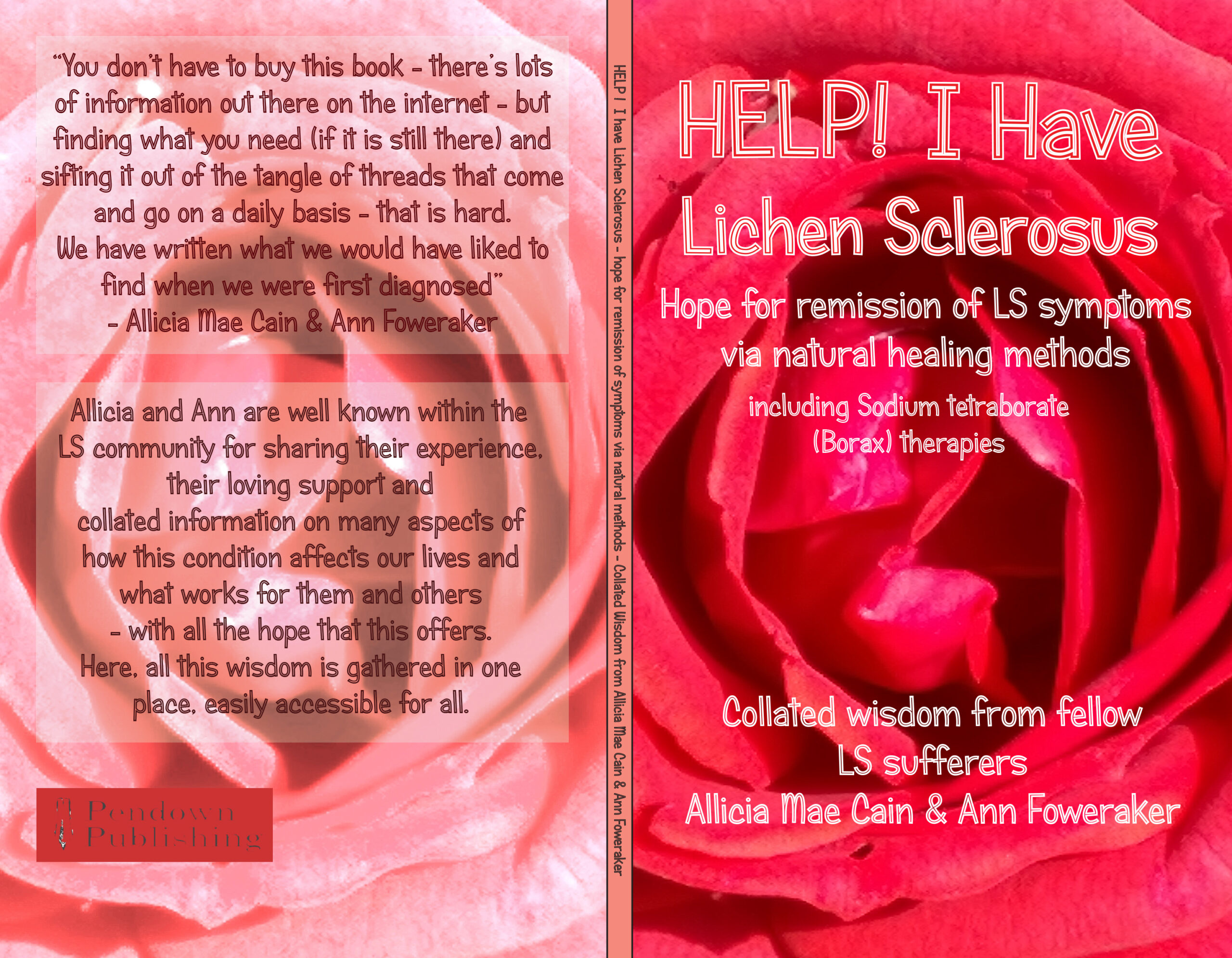
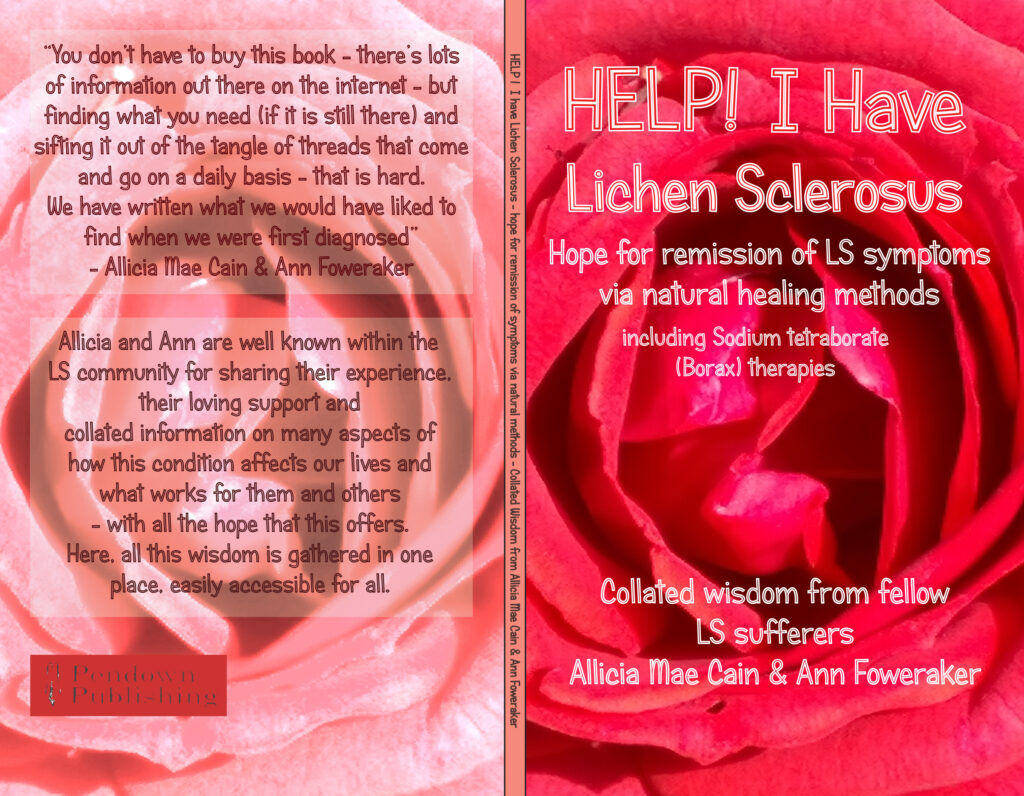
NOTE: (Oct 2020) Allicia and I have created a book together about LS – we never intended to write a book – but …
to find out the reason WHY WE HAD TO – see the  blog post HERE

Links to Amazon pages UK and US below

Available Here (UK) or Here (USA)

Comments welcome as always – but …

If you wish to keep it private and just contact me then just reply to the email this arrived on (or if you have found this on the internet then email ann@ annfoweraker .com (closing-up the gaps) – otherwise go to the actual page and click comments to add yours

Best – Ann

*borax etc –  as with any chemical – do keep these safely away from children 🙂

ps If you are reading this on email and would like to comment just click onto the title and it will take you to the actual blog – so you can comment there ?

If it is the first time you have written a comment don’t worry if it doesn’t appear immediately, your first comment has to be verified (to keep the spam-bots out) and I do this personally – so I am sure to see your comment – thanks for reading – Ann

pps – if you are reading on the email and can’t see a video when it says there is one – again , please go to the actual blog by clicking the title – then it should appear !

Remember – reviews of books are a great way to say ‘thank you’ to an author if you like what they write. Thank You

ppps  I am still happy with the new borax and bicarb hair treatment – and my hairdresser said that my hair felt thicker, and yes – this came out of the LS treatment too! See this blog post for info – click here

Cold Turkey Shampoo

No, Not a new ‘flavour’ of shampoo, but the first new attempt to use fewer nasty chemicals on my body.

Let’s face it – our skin is our largest organ AND it absorbs anything we put on it. Despite the long-held belief – which I occasionally still hear someone spout that ‘our skin is waterproof, sealing our flesh in and protecting it from everything’ – IT ISN’T.

Just think ‘nicotine patches’ – if our skin were truly impermeable these wouldn’t work – would they? They don’t contain a magic key to open the skin door.

I was reading around this when I read “shampoo and conditioners are applied to the whole body if used in either the shower or the bath” Oh! Come to think about it – so they are – and especially if you have washed your body while waiting for the shampoo or the conditioner to work and therefore rinsing those off is the the last bit you do – leaving them clinging to your skin.

So, what’s wrong with that? Nothing, if you like the idea of parabens and petrochemicals left on your skin.

Parabens are there more for the producer than for you – they are a type of preservative. They also happen to be a exonoestrogen and as such are able to mimic oestrogen in the body, and it is this factor that has shown a link to breast cancer.

Petrochemicals –  well, I don’t know about you, but I just really don’t like the idea of putting a petrochemical derivative all over my body (not now I think about it) This may not be rational – there are some studies out there that say the 1.4 dioxine is cancer linked – and others that say the exposure is minimal – you get more driving your car. What sort of concerns me is that if all these minimals in our lives are put together they they turn out to be maximal – to have those undesired effects within our body.

Now, I figure, if I can cut down on those that I CAN avoid – the ones I can’t may just remain at minimal levels.

There are also lots of other nasties in shampoo and conditioner – some to make the foam, some to coat the hair after the foaming chemicals have raised all the scales and made it tangly.

And apparently we do not need either of them – our hair and scalp was made to be self-cleaning … only it takes a while – anything from four weeks to 3 months to achieve its new equilibrium.

However, this doesn’t mean you do not clean your hair – you can go completely cold-turkey on any cleaning product and just wash with warm water – this may take the longest to transition, depending on hair type, or you can go the simple solution way – using Bicarbonate of soda and / or borax then vinegar (apple-cider) or citric acid as the neutraliser/conditioner.

*{{ NOTE: A Step-by-Step HOW TO – is NOW at the end of this blog }}*

I looked to my friend Krissi – a long-time advocate of No Shampoo – for advice and she favoured the bicarb solution and just rinse. However this can lighten hair and as my hair is darker [and the grey coloured with a temporary colour two shades lighter than my hair – so the coloured grey looks like highlights 😉 ] I didn’t want to just do that. (If I had blonde/ going white hair I’d definitely do that!) [Incidentally, Krissi used to make all organic, no nasties cosmetics – and this part of her life I borrowed for the character Marian Wood in A Respectable Life – with her knowledge 🙂 ]

hair
Ready for fourth wash today

Now, my new friend, Borax [sodium tetraborate – a naturally occurring mineral] link here (more about this when I get the courage up to tell you*) in a combination with Bicarb is also recommended by various No Shampoo (also called, unpleasantly, No Poo) websites, and as I am very happy to rinse my body in borax* (you will understand when I do get to tell you, honest) I went for this. *OK up-date – deep-breath! I’ve told all about my Lichen sclerosus now – find it HERE 

Having made up the mixture of 1 dessert-spoon of borax link here and 1 dessert-spoon of Bicarb [sodium bicarbonate] link here, in a litre of water I doused all my hair in it. Massaged it in*, then rinsed it under the shower, then made up another litre of warm water  with 1 teaspoon of citric acid, link here, in (you can use apple-cider vinegar instead if you prefer) . Again I massaged it in a bit then thoroughly rinsed it out. Lastly, another litre of water with a couple of spritz of almond oil, or a pin-head drop of all-organic moisturiser dissolved in a litre of water (my favoured solution), and poured over,  then rinsed out. It sounds long-winded – but really it isn’t – as you don’t have to work up a lather, and you are not coating your hair in a thick slime (conditioner) the rinsing takes barely any time at each stage. You only need a large plastic jug to make the mixture up in, and a dessert spoon and a teaspoon, to measure out the ingredients.

My hair is very fine, and there is not as much of it as I would like! Usually, for the first day after I wash it it is all fly-away and won’t stay up in a clip, but irritates and tickles my face if down … but by day three it gets greasy and hangs limply and separates into ‘strands’! I also have to give it a good condition too, other wise I can’t get a comb through it for the tangles. Generally I was only happy with my hair on day two.

What happened with the borax bicarb solution?

The first time I left the borax and bicarb on MUCH too long* (five or six minutes) as I was concerned that my hair wouldn’t get clean! And my hair came out like straw! Not the desired effect. However, it didn’t take long for it to ‘calm down’.

NOW I know it is almost a case of pour it on, give the hair a good squeeze, maybe massage the scalp a little and you’re ready to rinse, less than a minute!

The second time, five days later, my hair was much better as I’d reduced the time the borax/bicarb was on my hair to about 1 min – and though my hair started out feeling heavier (less fly-away) than it would after a shampoo wash, it did not change and get any greasier for days. And, I realised it wasn’t tangly after washing – which, if I ever used just a shampoo – without a conditioner, my hair definitely would be!

hair-2crop
After washing this morning 🙂 And it doesn’t tickle!

The third time (six days along) my hair was even more manageable again and I’d left it a whole week before I felt like it needed washing. Today I’m going to wash it again … and though it has not quite been three weeks I think it is beginning to find its equilibrium.

I’ll continue to fill you in on this experiment as it goes along …

Anyone already transitioned to No Shampoo?

Any good advice / thoughts about ditching the commercial products?

You know I love to hear from you, do share 🙂 – Ann


** March – Hair update – Why didn’t I know about this before – It is the best my hair has ever been!!**

*** ONE YEAR LATER – I WILL NEVER USE ANYTHING ELSE FOR HAIR-WASHING – IT IS THE BEST! ***

*{{ Step-by-Step guide to washing hair in Borax and bicarb }}*

Borax and Bicarb Hair Washing

Method

a, In a large plastic jug (1-2 litres) make up a mixture of 1 dessert-spoon of Borax and 1 dessert-spoon of Bicarbonate of soda [sodium bicarbonate] in about a cup of hot water – top it up to make a litre or more of warm water.

b, Pour it evenly over all your hair – but tip away the last half-inch – which will still have a few un-dissolved gritty bits in it.

c, Massage it in for half a min to one only.

d, Rinse hair thoroughly under the shower.

e, Make up another litre of warm water with 1 teaspoon of citric acid crystals in (you can use a tablespoon of apple-cider vinegar instead, if you prefer).

f, Pour evenly over all your hair.

g, Massage it in a bit – then thoroughly rinse it out.

It sounds long-winded – but really it isn’t – as you don’t have to work up a lather, and as you are not coating your hair in a thick slime (conditioner) the rinsing takes barely any time at each stage. You only need a large plastic jug to make the mixture up in, and a dessert spoon and a teaspoon, to measure out the ingredients.

 ************************************************************

Any links are to help readers only – I receive nothing for posting links 

ps If you are reading this on email and would like to comment just click onto the title and it will take you to the actual blog – so you can comment there
If it is the first time you have written a comment don’t worry if it doesn’t appear immediately, your first comment has to be verified (to keep the spam-bots out) and I do this personally – so I am sure to see your comment – thanks for reading – Ann

NOTE: In October 2020 Allicia and I created a book together about LS
To find out WHY we felt we had to – see the  blog post HERE
Available Here (UK) or Here (USA)

Remember – reviews of books are a great way to say ‘thank you’ to an author if you like what they write,
  Thank You

error

Enjoyed this blog? Please share :)