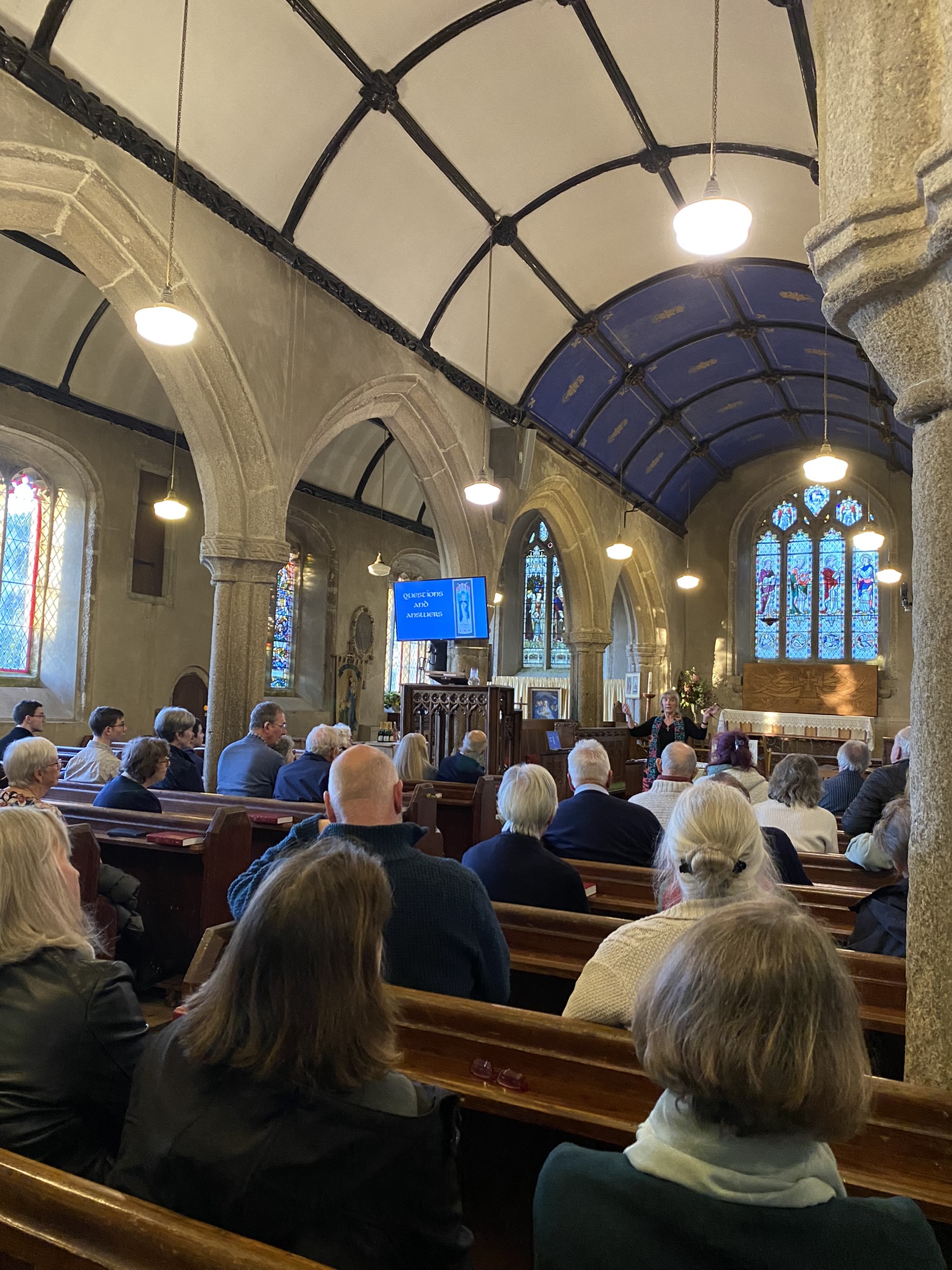
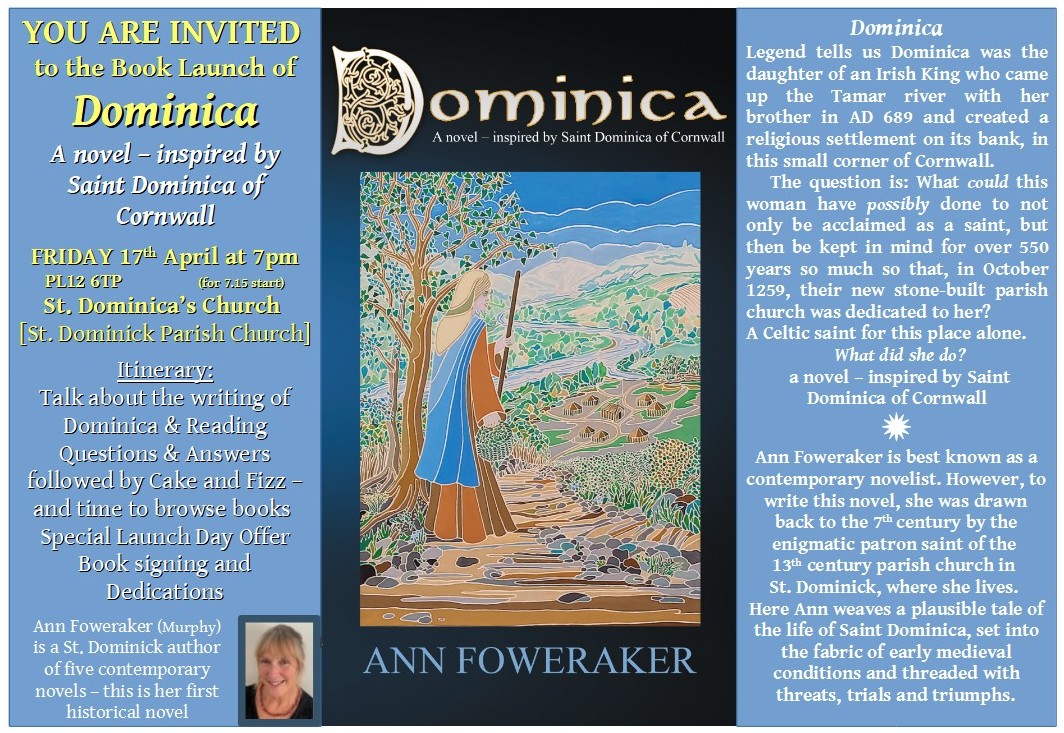
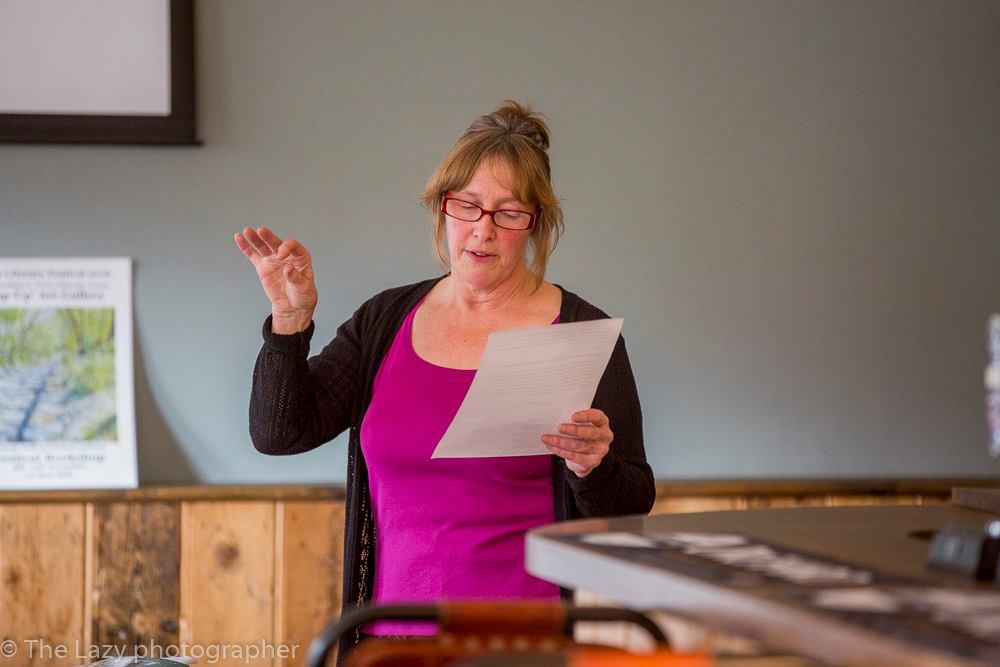
Not everyone could get to the launch – some were away – some too far away – but still nearly fifty people made the event feel well supported – and I was delighted. Delighted that the novel – Dominica – a novel inspired by Saint Dominica of Cornwall was getting released to the world in the very church that was named after her – and where the original inspiration hit me.
So, here for everybody – is the (pruned) transcript of my talk about the WHY and HOW I went about writing Dominica in the first place …
My WHY for writing this novel goes back to about 2010. And I am going to describe it to you – as it was, a bit extraordinary, as an experience.
It was a late Saturday afternoon and I had just finished doing the sacristan duty, which entailed setting up the altar and the bread and wine ready for the Holy Communion service the next morning in this church – the church of St. Dominica – the Parish church of St. Dominick. As usual I completed my time in the church with a little reflection and prayer at the chancel step.
The sun was coming in through the window to one side of the tower behind me, shining through the leaves that flickered in the breeze, and painting the interior of the church with moving patterns of coloured light from the stained glass window it shone through – see below.
and lighting up the pillars and parts of the floor around me. And it is in this, I hesitate to say magical, light-effect that I was reflecting and praying. The type of prayer that has no words, that is just resting in God and waiting to know what you need to pray for. ….. and then, into this reverie came the thought, loud and clear: ‘What did she do? and I knew it referred to Dominica.
Now, I already knew the time-line – so the question instantly became ‘what did Dominica do for the people that they remembered her for over 550 years? So much so that when they built their new stone church, in the middle of the 1200s, they named it after her? St. Dominica – a saint known only to them in this little piece of Cornwall beside the Tamar,’
And then this thought: ‘You could write her story’ came in. My immediate reaction was – Oh no! I do not write historical novels! For one thing, they are way too hard, for two, I have no idea what she could have done and for three, I was in the middle of writing a very contemporary novel, at that time – The Angel Bug – let’s just say it was a book involving dna / genome mapping and the Eden Project – to see how far away it was from this historical idea.
After about nine years of trying to ignore this idea of writing Dominica’s story, while finishing The Angel Bug, writing A Respectable Life and a non-fiction plus editing two other books (and going through my parents’ passing and breast cancer) – I felt she was still nagging me to write it. So I finally gave in and bumped it up my ‘book ideas list’ from number nine to number six.
And so we come to the HOW I went about it. I began by researching whenever I could. Firstly the legends – there are a few versions, but only one involves both Dominica and our area.
We, in this place, have the Legend“Indract and Dominica, son and daughter of an Irish King, came up the Tamar in a coracle to this place and made a religious settlement here.”
And there are other relevant interlinking legends too – one from Tamerton (Foliot) One from Glastonbury and two very local ones, only known in this parish. All of which I tried to weave into the tale.
The legends are in the section Author Notes at the end of the book. However I need to issue a ‘spoiler alert!’ if you do not already know of the legend involving Saint Indract and Glastonbury – I suggest you DO NOT read the legends until afteryou have read this story.
We have some facts too – but from a later date – We know that this church, though it was smaller than this at the time, was dedicated to Dominica in October 1259 when Bishop Walter de Bronescome did a tour of Cornwall dedicating churches
– and we know Dominica’s original saint’s day date was the 30th of August, from documentation requesting the change of date in 1445. Stating that it was then on ‘the day after the decollation of St. John the Baptist’ decollation is the beheading (which is the 29th of August) and asking for it to be moved to the day after St. Indract’s as it was ‘inconveniently in the middle of harvest’. Where it remains to this day as the 9th of May.
Then I began researching the times and what I could find out about life in Cornwall, in particular, at the time the legend puts her here – from AD 689. AD 689!
This was hard! This is deep in the Early Middle Ages, the time that used to be called ‘the Dark Ages’ mainly because of how little was known of those times.
There are few proper relevant records, not even a lot of helpful archaeology and it was a time of flux – especially on the borderlands of Saxon Wessex and Dumnonia, as the Celtic kingdom covering what is now Devon and Cornwall was then known.
Earlier, in the reign of King Centwine of Wessex, AD 676 – 685, the Saxons had invaded Dumnonia and then ruled the area right down to and including what we know as Exeter – but had then lost much of that area again during a time of instability in Wessex. So by the time this story arrives in Britannia, the old British kingdom of Dumnonia stretched roughly from Land’s End to a line lying roughly along the border of today’s counties of Somerset and Dorset with Devon.
The Saxon Kingdom of Wessex had, from AD 688, King Ina (also written as Ine and Ini) at its head. (but as it would be pronounced InA – I have used this version.
King Ina comes into the legends – so I researched him and his influence where it concerned Glastonbury and Cornwall.
When looking at my main characters’ origins, I also researched what being an Irish King of that era actually meant, again because the legend says Indract and Dominica were the son and daughter of an Irish King.
Then I delved into what is known about early medieval monasteries, both Irish and British, as our protagonists would come from the former type, and set up similar in Dumnonia.
The first thing I found out, very quickly, was that I had to forget everything that I thought I knew about medieval monasteries – for everything I knew was really about an entity and life-style that only came into being a few hundred years later than the date this book is set at.
I have always had a fascination for history, vernacular history in particular, yet I found I actually knew nothing actually relevant to this time. The monasteries we hear most about, in school for instance, are those of the High to Late Medieval period, with the latter eventually dissolved under Henry VIII, and as such would have been virtually unrecognisable to the people of Dominica’s time – and, most certainly in Cornwall, where things were different again to more eastern areas of Britain.
I spent a couple of years researching the history of the time, from a vast array of resources including published books, serious internet-based history platforms and up-to-date theses for PhD and Masters qualifications.
I also delved into scientific analysis of the ingredients of the herbal mixtures, poultices and potions probably used, and their actual effects on bacteria, viruses and well-being – combining this with the nature of diseases and ailments verified to that specific era and their usual outcomes.
I was even able to look into the weather! How amazing is it to be able to find out notable weather events and trends that were relevant to the dates and areas that Dominica’s story is set in?
Eventually I began to form an idea of what she could, possibly, have done … and sketched these out to make a proper storyline. In doing this, I sometimes had to pick and choose between competing narratives on the same scraps of information. And, as this is a novel, I chose the path that made it a better story.
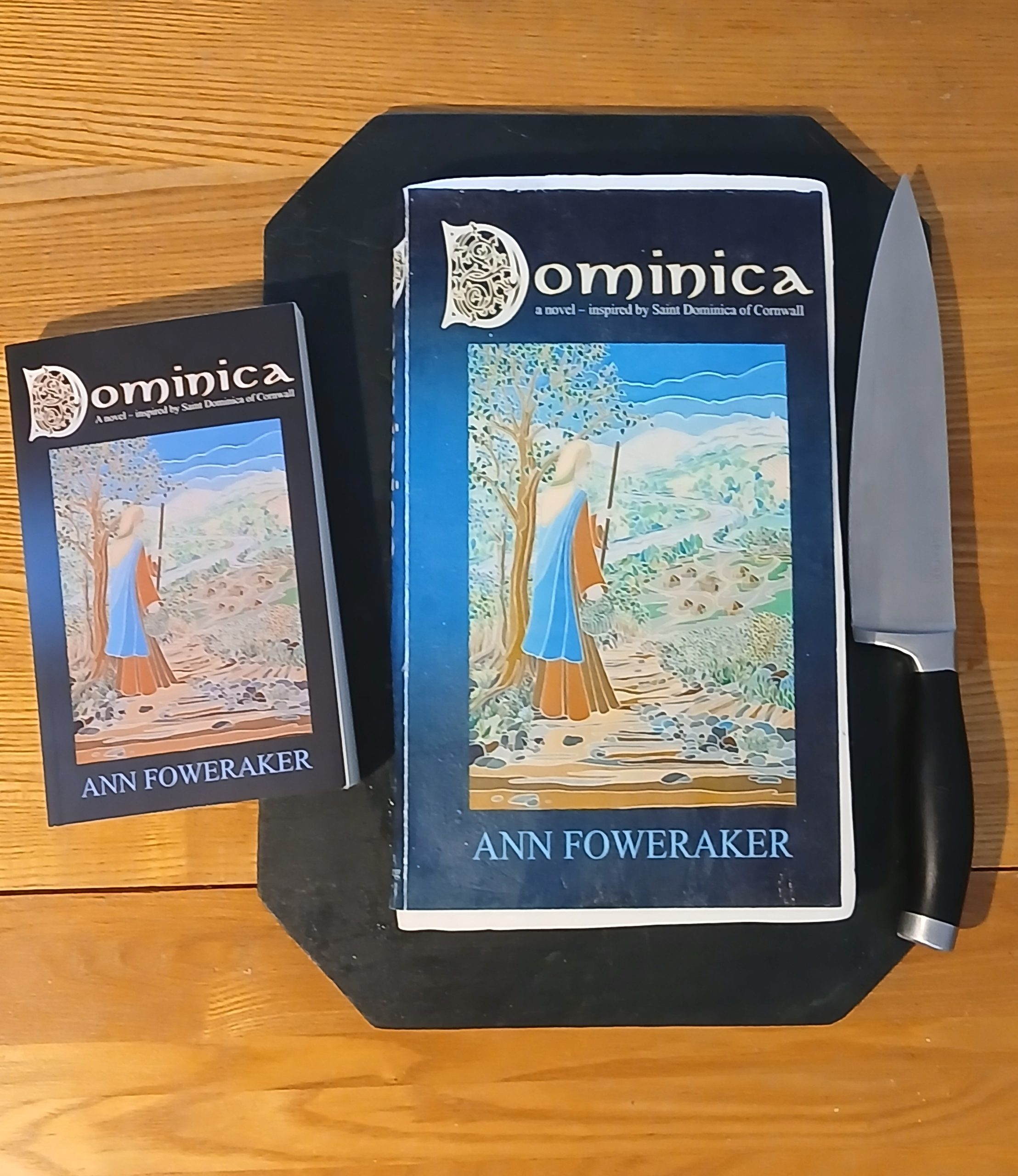
After the talk – and a reading from the first chapter – we then cut the cake (see below – with a real book alongside) and all partook of nibbles, cake and fizz to celebrate the launch in the proper way!
Thank You to everyone who came along – and to all who bought books – not only Dominica – but some of my others too!! Many thanks to to the family team, especially the grandsons who served said drinks and cake and acted as cashier for me – wonderful boys!
PLEASE SIGN UP to this blog if you’d like to hear more – the box is at the top of the post on the right – Let’s keep in touch!
{I had been building my followers since 2011 – and had around 640 when an unfortunate technical issue meant that I lost ALL of these followers contacts – and need to start again – do join to keep in touch}
ps If you are reading this on email and would like to comment just click onto the title and it will take you to the actual blog – so you can comment there. If it is the first time you have written a comment don’t worry if it doesn’t appear immediately, your first comment has to be verified (to keep the spam-bots out) and I do this personally – so I am sure to see your comment – thanks for reading – Ann
At last! After six (or more) long years of researching, writing, more researching, more writing – Dominica A novel – inspired by Saint Dominica of Cornwall – is ready to face the world!!
I have been almost shy of reporting much on this journey – sometimes I wondered if I would get it finished, sometimes I wondered if I should have ever attempted it in the first place.
However, it was a wild ride – I HAVE LEARNT SO MUCH – about early medieval histories (and other interesting side-notes) on the way to the finishing line.
And I have been privileged to be able to commission / buy paintings from two local artists to help create my cover Marion Kemp Pack for my front cover, showing Dominica over looking the river loop that gives the settlement its name. And David Thomas, who was just getting going in his chosen art-form when he happened to do a rendering of the Dominica window (in the tower window of St. Dominick Parish Church) which I noticed on his instagram page – and was able to purchase as a promise to myself that I would actually write the novel
For those of you too far away to come to my book launch – she is available both on Amazon and to order from bookshops – see info below ISBN: 978-1-909936-33-1 Dominica A novel – inspired by Saint Dominica of Cornwall – by Ann Foweraker
More info to come in a new post!!
Speak soon, Xx Ann 🥰
ps If you are reading this on email and would like to comment just click onto the title and it will take you to the actual blog – so you can comment there. If it is the first time you have written a comment don’t worry if it doesn’t appear immediately, your first comment has to be verified (to keep the spam-bots out) and I do this personally – so I am sure to see your comment – thanks for reading – Ann
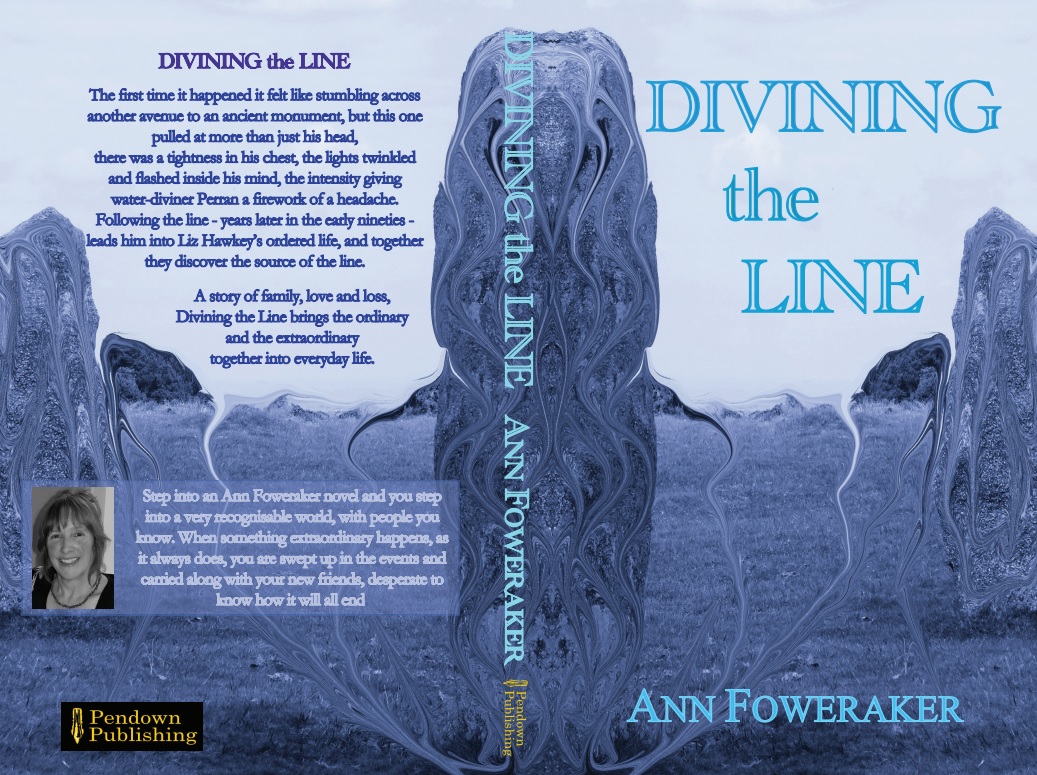
Not sure why this has taken so long. Divining the Line was one of my earlier novels, but has languished on the back burner as an ebook up until now.
I knew that it was good – my readers had told me so. I knew that there were some people who had read all my other books in print – but not being ‘techy’ AT ALL – had not read Divining the Line, and wanted to. Yet, somehow, it always got put on the back burner.
At the end of last month I eventually got the cover redesigned – based on the cover that it sold under as an ebook previously – but with a more stylised design. Hope you like it?
He smiled to himself at the enormous fuss that his elderly aunts made about him going off. It was as if he was a little boy staying away from home the first time, and they each felt they should take on the mantle of his parents. Truth was they loved to fuss round, and by going off for a walking holiday, no addresses available in advance, he’d made himself a target for their concern. He flicked his pack on his back and left the cottage that had been his home from birth, locking the door behind him, sliding the key deep into his pocket. As he sat on the train taking him up to Bristol, he thought of Nan Towans. She alone of the women folk had made no fuss, but then she seldom did. She had a wonderful capacity for understanding and though twice widowed and childless somehow she’d become known as Nan Towans by everyone. True to form she asked no questions when he’d popped in to say good-bye and it was not until he turned to leave that he saw anything but a smile in her eyes. ‘Take care m’ansum,’ she’d said, the smile gone for a second. ‘Good luck.’ As if she knew what was in his mind. Luck was what he needed. He was going on a pilgrimage to a place he didn’t know, just following the stars in his head. He wasn’t too sure that he’d even be gone very long. There were times when he could easily forget the feelings that had assailed him, times when he thought it all pure fantasy. Yet it had nagged at him since his return to England, all through his sorrow it had been there, like a siren voice, calling. He’d put it off, this quest, years ago when he’d escaped to the other side of the world. Now the longer he tried to leave it the more insistent the urge to follow up the strange sensation had become. With life just about under control he felt he could take some time out to find out what it was about, once and for all. ** Wednesday was Liz’s evening at Keep Fit, just as Monday would find her at a local history society and Friday at her paints with the town art group. It was her social life, carefully mapped out, time to see different people to those she met at work, time to express her long-term interests, history and art. When the summer came and the classes and societies took a break it disturbed Liz’s routine; disturbed her life. Things were on an even keel, just as she’d aimed for, just as she’d striven for over all the years that the children were growing up. Yet every so often she found herself feeling so disappointed with her life. In a rut of her own making, so deep, so hedged in that she wasn’t sure she could see any way out. As a child she’d always been careful and orderly. Her elderly parents had always cautioned her, kept her from danger. As a child she could seldom remember running or shouting. All, in memory at least, was muffled and actions carried out with some kind of deeply ingrained secretiveness. To be noticed would be terrible in some undefined way. Never said, just absorbed into her being, creating a quiet, polite, careful child. Is it any wonder that the adolescent rebelled? ** The pull had been strong, the ‘power’ line that he was following had led him right up through this sprawling estate of sixties housing, some small sectors had obviously once been council only, and were now mixed, others were always owner occupied, but some social engineer had interleaved them in curling cul-de-sacs and sweeping ‘ways’, so that, though the line held true, he had wandered and been thwarted and had to retrace his steps. It was a hot, arid day, the type of day that reminded him of Australia. The sun wafted its heat down upon him, beat it back up from the pavement, as he trudged up yet another curve lined with match-box houses. The line was strong. It, whatever it was, had to be somewhere near. As he reached the crest of the hill the ‘stars’ in his head almost completed the circle, danced and creased his forehead. He looked around for some clue. On both sides the houses seemed similar, only the one across the road retained a hedge where most had lost theirs to make way for a parking bay. The traffic buzzed lazily as it moved around the estate. Perran crossed the road to take a closer look at the house behind the neat privet hedge. He was disappointed. It was identical to its neighbours on each side. He turned his back on the gate and gazed away into the distance, through the opposite houses. Could this position have had some significance? Would the sun rise, or set over a point in the distance? Was it that simple? Finding no obvious signs on the horizon he reasoned that the line may merely pass through this point, and set off to circuit the line of houses and to take up from the other side. Twenty minutes later he returned to the same point on the road, certain now that there was something very important about that spot. Something that he could not define, something distinctly different to the types of power lines he was used to. ‘Can I help you?’ A voice from behind him cut into his thoughts. He turned. A tall attractive woman stood at the gate of the hedged house. Her tone was one of warning, but he smiled and stepped just one pace towards her. Suddenly she looked a little flustered. ‘Only you were standing out there a while back, and er, you’re back.’ ‘Yes, sorry,’ he began, letting his voice lapse into the mildly Aussie drawl he’d picked up while in Australia.. ‘I’m looking for somewhere. These roads can be kinda confusing. I’m sorry if I worried you, hanging around like.’ ‘No, not at all,’ she added quickly, ‘I was gardening you see, I just noticed, that’s all. Um, where is it? Maybe I can help.’ ‘Where?’ He found himself caught for a moment. ‘I – don’t exactly have the address – just a memory.’ He shrugged. ‘Not much good eh?’ ‘No. Been looking long?’ ‘Too right. Most of the afternoon!’ She looked at him for a moment, a quizzical smile touching her lips. ‘I’ll be off then, thanks anyway, looks like I’m right up a gum tree here,’ he chucked in for effect and turned to go. Over the road a balding man had emerged and was lining up an electric hover mower. He glanced up. Enough to let Perran know he was watching him. ‘Um!’ she succeeded in turning his head once more, felt sure she knew him from somewhere, something in his face was familiar. ‘If you tell me the description, I may recognise it – it could help.’ ‘Thanks, but it’s too difficult to describe.’ Suddenly his head was full of water, running dark and cool, sweet and fresh. ‘Tell you what, though, I could really go on a drink of water, if it’d not be too much trouble. I’ll stay right here.’ Liz looked at him again, darted a glance at her neighbour. ‘Sure! Sure, why not. Look, come in the garden,’ she unlatched her neat white gate, finding an irrational thrill run through her. This was foolish; dangerous. Mr Gransom was over the road, within ‘neighbour-hood-watch’ earshot, but it was outside her usual behaviour, and she knew that it was not wise. ‘There’s a seat – won’t be a moment,’ she said indicating a rustic-style bench that leant against the wall of her L-shaped house in the lee of a scattering of climbing roses and the wands of a winter-flowering jasmine. He smiled and flicked off his pack before sitting down. She nodded and smiled and felt as if she was being rude to her guest when she closed the front door and let the latch drop. Liz ran the tap, shook ice cubes from a tray to crack into tall glasses of lemon squash and bore them back towards the door. Suddenly she felt a little foolish. Silently she moved across the living room to the small window from which you could just see the bench. He sat, almost lay back, his eyes closed, head resting back on the red-brickwork, his long legs stretched out in front of him. He did not move, sunlight played through the gently moving roses and created patterns that danced and bejewelled his figure. She felt the strange sense of knowing him again, distantly, perhaps a forgotten friend of her son. He rested his head back, the firmness of the wall seemed to ease the tightness that he had been beginning to feel, it was good to sit and rest his feet. He was confused. The power line had led to this inauspicious place. But now the lights danced dimly and remained as a persistent blur. He really didn’t know what it was that he was looking for. A pilgrimage to nowhere. A dead end. Liz unlatched and eased the front door open, she picked up the glasses once more, fielding the door with her foot. At once his eyes opened and he stood. Feeling slightly silly she grinned at him. ‘Thirsty work – gardening,’ she said. ‘Sure is,’ taking his glass from her and sipping. ‘Please,’ she waved at the bench and sat herself. He followed suit. ‘So, where have you been travelling?’ she opened. As she drank she stole small penetrating glances at him, each look well aimed to ascertain some point. He had an attractive face, finely drawn for a man, but not effeminate, set under a curling straw-blond mop. He was slim yet his arms were tightly muscled and shone with sun bleached hair. Not as young as she’d first thought, so probably not a long forgotten friend of Zed’s. Michael, she reminded herself, not Zed now! Little Zed, her first born, had grown and was now twenty-three, a respectable accountant in Birmingham, and as old as the hills and just about as distant, and was to be called Michael, his middle name, his fathers name, from now on! As if she could remember the change after so many years, not that she had the chance to practise it that often. ‘Just recently, up from Bristol.’ His smile was broad, a sense of ‘being at home’ had invaded him. ‘Where are you headed next?’ He drank deeply for a second. ‘Not quite sure, you see,’ holding his glass in one hand he held the other hand flat, palm towards her, fingers pointing forward, he held the stance and looked at her before he spoke. She found her gaze drawn to the hand and his words filtered into her head as if coming from within, as if they were her own thoughts. ‘I’m following a line,’ he said, wondering as he did so why he had chosen to try to explain, yet there were those who would understand but then they understood so much else as well. Somehow in her mind appeared large masses of rock and stones, monoliths and circles, but she didn’t know why, and her conscious thought sorted through the lines she knew and settled on the Railway, that ran close, slicing through the swollen town. ‘The Railway?’ His hand dropped gently, he shook his head, though something had urged him to explain he had been mad to try. ‘No, this line I’m following, you can’t see it, it’s not man made.’ He was suddenly afraid that he was going to frighten her with talk of ‘strange’ things. ‘Have you heard of ley lines, between great ancient monuments, like Stonehenge and Avebury?’ Thinking she must know of them at least, to bring the conversation back to reality of a sort. Liz was surprised, her first unconscious reaction to his word had been the right answer, and yes, now she remembered a programme about an couple of odd blokes that had followed these lines right across the country using bent wires. Yes, it all came back now. She felt less uneasy, more sure of herself. ‘With bent wires!’ she pronounced, crooking her forefinger in example. His smile was warm to the depth of his eyes. Eyes that were of the darkest brown that she had ever seen, so dark it was difficult to distinguish the black of the pupil. The darkness reflected all he saw, like the windows of an ancient house, but the dark was warm if a little disconcerting, as if the house was the home of someone you loved, who you had been expecting to be at home. ‘I knew – all right,’ he said very softly, the Aussie accent fading into the Cornish. ‘What?’ said in curiosity and mild alarm. Something had changed, something wasn’t quite right. He shook his head gently, the smile still in place. ‘So where did they start?’ she began, ‘I’m sorry – I don’t know your name?’ Thinking, as she did so, how foolish these pleasantries could sound, of course she didn’t know his name! ‘Perran – Perran Lovering,’ he gave with a just-resistable urge to add, ‘at your service ma’am,’ curtailed only because she probably thought him strange enough already without that kind of humour adding to his quirkiness. ‘Oh!’ she sighed, ‘Another to suffer from the whim of ‘hip’ parents – we did it ourselves, neither of them use their names now though.’ Perran looked at her a little puzzled, she seemed sorry for him for some reason. She saw herself in his dark eyes, her tawny-blonde hair sweeping her shoulders, her hands reached up and hooked it back behind her ears, an old reflex in times of stress. She thought about choosing names together, her and Mick, scoffing at the old traditional names, seeking something that made a good sound, then, more to please his Mum than anything, tacking Michael in as a middle name. ‘We named our children Zed and Alpha!’ she shrugged resignedly. He suddenly understood. ‘No – er, mine’s not one of them,’ he , ‘Perran’s a family name, you know, father and father’s father? It’s a saint’s name too, and even,’ he smiled and gave a small laugh as if he thought she’d never believe him, ‘even the name of my village – in a way.’ She looked hard at him, he wasn’t being funny, he meant it. ‘In what way?’ she heard herself say, wondering where the name came in. Now he smiled his broad smile again, he was wondering whether she was going to believe him, he’d told a girl once the name and she’d sworn he was making it up until she had found it on the map. ‘Perranzabuloe,’ he announced. Her grey eyes narrowed, she was distinctly suspicious. ‘And where is that?’ she asked with a hint of defiance in her voice mellowed by a mischievous warmth. There was something there that he liked. ‘Cornwall, south-west of Newquay.’ ‘Mmm!’ she mused, that’s what it was, not Antipodean at all. ‘So where’s the Aussie accent come in?’ ‘I spent about eight years out there,’ he smiled. ‘Sorry. Bad habit when I’m in a tight corner.’ ‘But you’re originally from this …’ He knew she’d accepted it as true now. ‘Perranzabuloe, Saint Perran’s in the sand. The coast is known for its dunes.’ Liz just looked at him for a moment, then said, ‘So where are you going, following this line, do you know?’ ‘No, not really, it’s not quite the same, this line has been there for me for – years. It’s only now I’ve the time to follow it,’ Perran said, he hoped, simply. Liz looked at his backpack, lying on the grass, no sign of the wire things. ‘So where’s the wires?’ she said crooking her finger once more. ‘Ah! Well that’s part of what is different, I don’t use them, I can, but I don’t need to.’ As he spoke stars danced in the back of her mind. ‘It is like lights inside my head, they tell me which way to go,’ he concluded enunciating his words carefully, hoping that by clarity she would understand and believe. She sat up, the action drew her away from him slightly, the usual reaction to something strange. Yet she had to acknowledge the stars that had spun in her head before he spoke of them, and perhaps this was something like the stones she’d ‘seen’ before; she held her tongue. He was watching her, he was aware she was uncertain of him again, yet a feeling of comfort and closeness filled him, something akin to like-minds meeting, he knew he was right to tell her. ‘Usually I know what I’m looking for,’ Perran continued, thinking of water hidden deep beneath the ground that was the basis of his family’s living, ‘but this time it’s more of a personal quest, an adventure!’ His grin that accompanied his words rendered it as quite acceptable. They had finished their drinks and time was slipping by, measured by the shadow that now engulfed their wall. Liz shivered slightly and Perran glanced at his watch. It was well on the way to five o’clock, and certainly time he was moving on, reluctant as he was to leave this friendly face. ‘I must go,’ he said, indicating the time, ‘I’ve taken far too much of your time and your hospitality.’ ‘Not at all,’ Liz smiled in reply, and meant it. He stood, flicked his pack on his back, held out his hand. Liz took it looking straight in to his dark eyes. ‘Thank you, er,’ he gave a small laugh. Liz realised what was wrong. ‘Mrs. Hawkey,’ she began, then shook her head, her long hair adding to the swing, ‘Liz, Liz Hawkey.’ ‘Thank you Liz,’ Perran repeated, and turned to go. She stood where she was until he reached her gate. ‘Where?’ Liz called, he stopped and turned to listen, head at a slight inquiring angle. ‘Where are you going, to stay, tonight I mean?’ Walking over to him, wondering why she’d asked, she knew she had nothing she could safely offer. ‘I’ll find somewhere quiet, I’ve got all my kit,’ he smiled with the sort of confidence you believe in. ‘Oh, fine – fine. Good trip,’ she finished feeling inadequate and foolish. ‘Bye.’ ‘Bye.’ He said softly as he walked away. He didn’t want to go, this was stupid. Liz moved to a point where she could watch him until he disappeared as the road wound round the arc. The garden seemed so empty. She wandered back to the bench, plucked up the two empty glasses and stood there holding them for a moment. Shaking herself mentally she strode indoors to dump the evidence of her afternoon’s insanity.
Chapter 2 Blood and wine It was ridiculous, he’d been travelling for four days, following this ‘centre of attraction’, this strange force but now, after a pleasant hour and a glass of lemon-squash, he didn’t want to go on. The direction was confused, he put it down to tiredness, and the maze of houses that he had to escape to find somewhere suitable to sleep, and trod wearily down the hill to the town. The journey had been slow, unnecessarily so as he already knew its centre was somewhere in or near Berkshire, but he’d been determined to follow it faithfully, kicking off from Bristol and working his way towards ‘it’. It had first hit him fifteen years ago, when he was hitch-hiking back to University with a friend. They’d had a lift that had dropped them near Avebury. There was a place, the lights danced in his head as they crossed the line of the avenue and he could distinguish the ‘feel’ from that of the water that he usually divined for. Dowsing ran in the family, his father had been the first to turn it into a business, to use his divining power to pinpoint where to position the machinery for drilling bore holes, and it was soon obvious that ‘young Perran ‘ had the same gift. Come to that most people had it to some degree, could work the wires, but the Loverings knew more, and didn’t have to rely on hazel twigs or wires. It had been enough for his father to use the twig, it was well known and accepted in his part of Cornwall, but he insisted that his son should have the only qualifications that would become acceptable, pieces of paper in subjects that would convince the disbelieving, even though the practical method of locating the underground water may remain the same. They trudged on, no lifts being forth-coming, then it hit him. Like stumbling across another avenue to an ancient monument, but this one pulled at more than just his head, there was with it a tightness in his chest, the lights twinkled and flashed and the intensity gave him a headache. He’d clasped both hands to his head and stood, eyes tight shut, dazzled by the fireworks display. When his companion had appeared concerned he’d called it a migraine attack, and soon after they were picked up, and dropped almost on the doorstep of their college. As the car had driven through the tail piece of Berkshire the power had become intense, then began to fade and his ears seemed full of a keening sound, like he’d heard once on a programme about old Irish life, and death, until his head was clear and he began to think that perhaps it had been migraine after all. He’d driven the same road at other times, and not felt a thing. Then once, by now convinced that it was nothing, he’d stopped to stretch his legs at a lay-by somewhere past Hungerford. Almost as his head cleared, relaxed from the driving, the ‘force’ was there. He was frightened, a panic sent him back into the car as if the walls of glass and steel had protected him. It was not so, it was only as he began to concentrate on pulling out into the steady traffic that the pyrotechnics faded. Filled with regret, a heavy sadness of something important missed, he drove on, back to the safe academic world of Geological studies. ‘That was years ago,’ he thought as he came to an underpass that sounded inhabited, and decided to leap the barriers and defy the sparse traffic as a safer alternative. He found a non-too-smart pub that served bar meals and took a pint and a greasy helping of chicken and chips. As he nursed the last of his pint he considered where he could find to doss down. The way up from Bristol hadn’t been too bad, most of it through real farm land and he’d found suitable dry places to spend the night. Here in the town he wasn’t so sure. There were plenty more spending their nights out on the streets here, as in any town. It was one of the things he’d been shocked to find when he’d returned. At one time it had only been the hardened down-and-outs. Today there were so many, and so many younger ones. He remembered Tam. Tam who’d worked and lived on the road for all the years that Perran had known him. A true old man of the road. He tramped as a career. He had his stop-off places, those where he’d find a few days work for a few quid. ‘Even on the road you needs a few quid,’,he told Perran, ‘If’n you goin t’ keep yo’self decent like.’ And he hadn’t meant booze, not even food, but toothpaste and silk underwear! Tam had taught him plenty about living on the road. As a boy he’d absorbed the old man’s stories as he’d sat by and watched him eat the bread and cheese that his mother had sent out for him. Now Perran wandered through the well-lit empty centre, the only signs of life being those round the garish pubs and take-away places that reeked of stale oil and yet still made the saliva run, only to find himself out on the other side of the town with a few large residences and then the river. Lights from a sea of houses told him that ahead lay more housing estates, yet here by the river was an island of darkness, a breath of countryside before the houses crowded in again. He stood on the bridge and watched the inky blackness slide by for a while and listened to the sounds of a town at night. He wondered if it was dry and clean and quiet beneath the bridge, and scrambled down the first side to find the way wide and well walked and smelling slightly of burnt wood and urine. It was too dark beneath the bridge to view the other side so he took himself back up, and over, and down to the bank. It was grassy and six-foot wide near the mouth of the bridge, becoming a very narrow, barely worn, path between hard stone and water as it disappeared beneath it. It smelled sweet and clean and, providing any rain that fell did not get driven under, it would be dry. In his present deflated mood he didn’t much care any more, so settling hard by the support of the bridge he squeezed into his sleeping bag, set his rucksack as a pillow, and drifted into sleep. * They came staggering down the path between the trees, their heavy shiny boots scuffing the soft earth, getting caught in stray exposed roots, causing expletives to burst from well lubricated mouths. Two, almost identical in dress, they differed in stature. Stocky, with thick neck, rounded features and near bald head carried plenty of weight, enough to make it matter, whereas his companion was taller and lean, and wore more hair than the other, though still aggressively cut. They wavered on the edge of the dark flowing water and, in unison, in ritual, unzipped and relieved themselves, their streams creating different cadences as they cascaded into the river. Satisfied they bent and straightened and stumbled on. It was dark here, overhanging trees blocked the lights from the road that ran over the bridge, the path was narrow, they went in single file. Lean felt nauseous, he’d taken one too many lagers, spent a few quid too many – he was expected to, being the only one with a regular job, and that was one thing. Okay, so he liked the way there was always a lot of space made for them when they walked down the street, yeah, and he liked knowing he was ‘safe’ with his mates, but perhaps it was time to move off, they were turning into a right bunch of losers, always moaning about lack of dosh, and there was the other thing. So it wasn’t much of job, working behind the desk in a motor insurance office, pretty run-down building it was in, and right up a back street, but it was a regular job and, if he didn’t blow it, it had ‘prospects’. There’d been talk of sending one of them on a college course, part time, with a chance of some qualifications. Then he’d be really in. He knew he had a chance, rubbish as his GCSE results were they were better than Sharon’s, and she might leave anytime, she’d just got herself engaged and bosses aren’t stupid. He watched the back of Stocky as he made his way along in front, in blurred silhouette, arms swinging away from his sides in an act of balance, Lean found a sneer slide into his mind, a snide thought, that he looked ‘ape-like’ and had a brain to match. They neared the bridge, a patch of sodium gold lit the grass giving it a sickly hue, beyond the ominous black mouth stood in contrast, from which flowed the river gleaming like oil. ‘Wass that?’ blurted Stocky, breaking the peace, then as Lean moved to look he must have made up his mind. ‘Hey! Wino! Wino!’ he chanted out in battle cry and threw himself forward in a thundering run that ended in a guttural shout and a jump, both feet together, whole body weight force, aimed to be broken only by impact with flesh and bone. Drawn on in tribal pursuit Lean arrived as the body sat up in instant and acute pain, saw the pale disc of the face just before it was obscured by Stocky’s boot swinging it back in a sickening thud against the hard stone. Stocky drew breath and passed a sly look that spoke of force and made Lean swing his own Doc’s into the soft centre of the man, the force drew the body back into a curve, his head back into line for the next swipe, like a punch-ball on a spring.
Perran didn’t know which came first the awakening or the pain, the shape above him was enormous against the mouth of the bridge, but it staggered a little way back. The pain was in his legs, trapped in the sleeping bag they felt pinioned – he tried to move – fire and sweat rushed through his whole body – and the shape moved towards him, his arm fended part of the blow but he felt the scorch of rough rubber burn across his temple as his head was snapped back and cracked against the wall. The chicken and chips forced its way between his teeth as he was folded over another blow, and in his retching he did not see the next coming, but endured a bodily movement that drew him up, back, propelled on a boot end, where the wall crashed against his skull and buried him in oblivion.
The way that the body gave and, soft, absorbed the blow from his boot had sickened Lean, he turned, and found the rucksack, an inanimate target, he raised it with both hands and performed a drop kick sending it in an arc above the oily blackness. ‘Goa-wl’ he sang out as it splashed, sank, bobbed and, caught in a current, span away into darkness. It was then he heard it, two soft long whistles. He froze to hear better, reached out to Stocky to stop him crunching against the body’s chest. ‘Listen!’ Lean hissed. He saw the small flick of a torch a long way up the path, and the whistle again. ‘Shit – someone’s fucking cumin!’ he spat, turning; running away under the bridge, running the tightrope of path between wall and water, long legs lifting the boots high and clear of the ground, head cleared by fear. This was the ‘other thing’ a record and he’d be out of a job, and he’d just made up his mind, that wasn’t on! *
dot dot dot ….. So, that is what I have been doing lately – and I am still working on my next novel – my first Historical Novel … which is taking a LOT of time as I keep finding more research I need to do as the story unfolds – yet I’m still about a third of the way through 🙂 .
Have you found yourself putting things off – again and again and not really knowing why?
What are your top tips for motivation to get on with these ‘on the back burner’ tasks?
Do share – you know I love to hear from you!
Best Ann
ps If you are reading this on email and would like to comment just click onto the title and it will take you to the actual blog – so you can comment there. If it is the first time you have written a comment don’t worry if it doesn’t appear immediately, your first comment has to be verified (to keep the spam-bots out) and I do this personally – so I am sure to see your comment – thanks for reading – Ann
Remember – reviews of books are a great way to say ‘thank you’ to an author if you like what they write, Thank You
It is amazing where researches for a book take you. Regular readers will know that I am embarking upon my first historical novel – and that it is set in early medieval times – late AD600s to be precise.
So my wise-woman is going to help a female Saxon slave to ensure she doesn’t conceive. Umm – and how does she do that? The male in question is not going to be party to any care that needs taking – so off into the depths of the internet I go – following one thread after another until I find some answers – and other interesting facts…
One thread took me back so far that the herb in question had become extinct even before the years I was looking at! But was fascinating anyway. A herb that was the making of Cyrene – wanted for so many reasons apart from that of being the most effective contraceptive potion available. The plant was known as Silphium and it featured on the coins of the country – that’s how important it was! It appears to have been only able to grow in a narrow strip of land – and, despite many attempts, could not be propagated anywhere else. Seeds simply did not grow, roots or cuttings did not work elsewhere.
Silphium had properties that also made it a go-to culinary condiment and ingredient, where leaves, stems and roots were used – as well as making the meat of sheep grazed on it most wonderfully tender. It was used to treat a wide range of maladies – and then there was its powerful contraceptive properties. It was so valuable that Julius Caesar had a cache (1,500lbs or 680kg) stored in the official treasury. Ultimately it was harvested (or eaten by the sheep) into extinction!
Medical Texts from ancient Greece and Rome
In many medical texts available at the time, there were lists of mixtures designed to ‘hurry the menses or cleanse the womb’, therefore these mixtures were usable to end an unwanted pregnancy, especially very early or before it had begun! One version of the Antidotarium has several recipes for ‘quickening the menses’ utilizing a number of herbs including arum, birthwort, artemisia, century plant, lupine, pepper, Queen Anne’s Lace, myrrh, licorice, pennyroyal, rue, peony, parsley, and cypress.
Did they work? Well, I’m not sure about pepper but pennyroyal, parsley, and Queen Anne’s lace for instance, are so effective that modern women are recommended to avoid them if they want to become pregnant. In fact, for many of them to work, the concentration had to be so high as to be dangerous to the women themselves. (Yes, I’ve looked a lot of these up – and many are on the Poisonous plants list!)
Herbs could also be used as physical barriers for conception or as pessaries, pulped and often mixed with pungent oils, honey or even animal dung. Ewww!
I need something that would be growing in Ireland at the correct time, and so far have settled on Queen Anne’s Lace – the wild carrot. Modern day use of this as a contraceptive suggests a number of ways, but chewing the seeds for a number of days after intercourse looks like a method that could have been used in Eire in that time, and would be a safer alternative. Apparently it works because chemicals in the seeds block progesterone synthesis, thus disrupting implantation thus preventing pregnancy. I wonder – how did they find that out in the first place!?
Now to find out if the plant grew there, then! Harder than you might imagine as it will only be if it has been traced by pollen in samples or if a book written, at the correct time in Eire, mentions it, even though it is described as a native plant nowadays – I have discovered this does not necessarily mean it grew there in AD 600.
Do you end up down the rabbit tunnels of the internet – just because you looked up one thing?
Have you ever wondered how they managed these things back in deepest history? – when being pregnant was a very dangerous condition – resulting in death more times than we like to think about.
Do share your thoughts – as always I am fascinated to learn
Oh! Here I am, back again after what seems a frenetic and frantic time. Oh, yes, life sometimes throws things our way that knocks all the writing to pot – including the blog.
In this case my father’s sudden eruption of a HUGE ulcer on his tongue, followed by numerous and sequential trips to the hospital for every type of scan, followed swiftly by an operation to remove a largish bite of his tongue and several lymph nodes from his neck following the diagnosis of cancer. Thank goodness for the NHS! Subsequently we’ve been on the recovery stage – trying to regain weight lost while eating was difficult – while eating is still difficult (with sore but healing new shaped tongue) However, things are stabilised now and I have found my lap-top and returned to all of you.
And returned to the studies of everyday plants that my character – Dominica – might be able to use in her healing around AD689 – and today I’m looking at the plant known as the navelwort – or pennywort.
Wort, or wyrt, is actually a Viking or Norse suffix meaning ‘medicine’. So the name of this plant in this country comes from later than the time I am dealing with, so I have to check with my sources as to whether it was an introduced plant – or was here already but known by another name. (Yes, Historical writing is tricky!)
I have always rather liked this plant. The round fleshy leaves are one of those edible leaves that my boys readily took to eating just for fun (after being told they were edible) They taste a bit cucumbery.. basically fleshy, wet and green, not bad in a sandwich. However, I didn’t know of their medical usage. The names, pennywort and navelwort I assumed came from their shape and the dimple, like a bellybutton, in the middle, even though, somewhere in the recesses of my mind the ‘wort’ rang a herbal-use bell.
Now, the mini-course I went on tells me that the navelwort, Umbilicus rupestris, have strong antimicrobial properties and would have been placed over the end of the umbilical cord and tied on, where they would dry-on forming a seal and keep infection at bay. Thus navelwort referred to this property (though under the doctrine of signatures – they would also have been saying – ‘look at me, I’m for use on the navel!’) Oddly, this use doesn’t seem to be generally mentioned in online sources, so maybe it’s a very old use, perfect for my story.
It seems that these can also be carefully dried and stored for babies that arrived out of the navelwort-growing season too. Now I am really hoping this plant in a real native as I am sure this could work its way naturally into Dominica’s medicine kit.
So, barring any other type of emergency, medical or otherwise, I’ll write to you next week – in the meantime –
have you ever eaten a pennywort sandwich – or even just nibbled a leaf?
Here we are again, we are back in the late AD600 – when the wise-woman, or the monastery-trained, were the go-to people when you were ailing. Why? Mainly because they still held the knowledge honed by the druids about which herbs had which effects on the body.
So it is that I found myself signing up to a herbalist-led course here in the Tamar Valley. My Dominica will have to use the plants that grow here if she is to be a healer (which – in my telling of the tale – she will be)
Here I am going to give a first glimpse of what I learned but how this will be used in the story I have yet to discover (that’s the way my writing works – fill up the brain with lots of information and then let the sub-conscious sift through and weave it’s own patterns).
We didn’t even have to leave the property where the talk took place – and I suspect you wouldn’t have to stray far from your garden too for the one herb I’m going to touch on here.
Hands-up those who have dandelions in their garden? *sees a forest of hands* Really? LOL 🙂 … well it seems that a Dandelion is a medicine chest all on its own.
Leaves: Make a ‘tea’ from them to drink. (A ‘tea’ basically is as it sounds, pour boiling water over them and allow to steep for a few minutes – remove herb bits – drink)
Many of you will know this is a diuretic (we all remember the warning as children not to pick dandelions as they will make you wet the bed!) Diuretics are used in many conditions today: – for reducing blood-pressure; congestive heart-failure and oedema (swelling due to water-retention) *This is not to say you should treat yourself for these conditions willy-nilly with dandelion tea!*
But did you know that dandelion tea is also a anti-lithic (a stone-breaker) that breaks gall or kidney stones to allow them to be passed?
Roots: Wash, cut and make a tea – this provides a liver-detox.
Then there’s the sap – that white milky fluid that comes from the broken stem. This can be used to treat warts. It is actually a form of latex and seals the wart off from the air. It needs to be reapplied frequently but eventually the wart will drop off leaving a wet pit on the skin that then heals up. (this make total sense – if you recall my experiment with the duct-tape method of wart removal (here) this works in the same way)
! Not only that – but apparently dandelion sap was even used during the war as a latex (rubber) supply (Not one of us on the course had ever heard of that before!) but as things go – in a serendipitous manner – within a day an advert popped up on FB for Continental tyres – saying they are experimenting with dandelion rubber (due the disease attacking rubber plants worldwide) as well as for other things that use latex.
That’s dandelions for you – amazing and fascinating – now I need to check with Dulcie of Dumnonika, the Iron Age re-enactment group, who has an careful list of truly native plants, whether they were here in this part of the UK back in those times.
I’ll share some of the other medicinal-weeds I learnt about with you another time 🙂
What are your favourite herbal remedies?
Do you remember the warnings about picking Dandelions?
I’ve been gone one thousand, three hundred and twenty-eight years – back in time … to an era we call ‘The Dark Ages’. The Roman garrisons have gone – left these isles to tend to their problems closer to Rome with a farewell letter to the Romano-British from the Emperor Honorius, in AD410, to see to their own protection – even as they called for aid to fend off the raiding Saxons. However, by the date I’ve been visiting, AD689, the Angles, Jutes and Saxons are well ensconced in the majority of what will become England, but the Vikings are not yet attacking.
Can you see the river Tamar, just behind the trees – and further beyond?
I am in Cornwall, here, just over the border – the river Tamar. Though, in AD689 Cornwall is not Cornwall – as such, it is part of Dumnonia, roughly Devon and Cornwall and part of Somerset and Dorset, and it is a different place culturally to the rest of ‘England’. The West Saxons (those being the closest – Wessex) have not overtaken the people of Dumnonia yet – in fact – even the Romans had made little impact here, this side of the river, either … a few forts only – no fancy towns all laid out Roman style with villas and influence over the local Kings* here. (*or ‘big-man’ as the system seemed to be in Cornwall in the pre-Roman times … and probably was even at the end of the AD600s.)
So it is a tumultuous time on the border, the threat of invasion by the West Saxons is real, they have made in-roads into Dumnonia … and they have a new battle-cry. By this time the Anglo-Saxons had, by and large, turned from their pagan gods to Christianity, some converted by missionaries from Rome, some by missionaries from Ireland. This had resulted in a clash of Christian doctrines – the Roman church and the Celtic church having different ways to work out the Christian calendar, different tonsures for their monks, and differing rules and ways of worship and a different attitude towards women. Within my time-line comes the decisive synod of Whitby, AD664, that found in favour of the Roman Church and meant that the Celtic churches that would not change were then seen as heretical – and to be wiped out.
The Church in Dumnonia, and especially the ‘Cornish’ ones backed by King Geraint and so rich in Celtic saints from Ireland, refused to change – setting themselves up for the West Saxons to proclaim a ‘religious war’ as a motive to back-up their invasions.
It’s been hard to get back to the here and now – I look at the landscape around me with different eyes – where would have been occupied? Where would have been safe? I read the names of the places I know and refer to my books to see whether I can call the place by its current name – whether the name we know is, in fact, original Celtic (Cornish) or an English name given only after the West Saxons’ invasion, or a blend … and even that has made me look at the landscape again and see things with different eyes as I find the meanings behind the words.
Those who know me in person, know that I am interested in history, mainly local history rather than that of Kings and Queens, but this is something different. To weave a story based on a few scanty legends (Dominica and Indract), set in a time that is poorly recorded (there’s the reason it is called the Dark Ages) and to try to throw myself back into that time and inhabit that landscape and that life is, for me, an extraordinary experience, both thrilling and very scary. It is also totally absorbing and takes me to a place I have never travelled before!
Wish me luck on my time-travels 🙂
Do you go time-travelling?
Do you find yourself inhabiting a different world when visiting ancient houses or estates?
I don’t know about you – but I do not usually re-read novels. I may re-read a paragraph if, as I’m going through a book, I wonder if I understood properly something that was intimated, when subsequent events suggest I didn’t – but a whole novel – no. Even as a writer of fiction I tend to think that if I have read it – that’s it, done and dusted – there are far too many books out there to re-read fiction. Usually, if I have read a fiction book I have got from it all I wanted. Intrigue, thrills, laughter, a new perspective, escape … and then I look for the next novel to entertain me.
So, I can honestly say, I have never consciously re-read a novel. Now, I do know that I have sometimes started to re-read a novel … one that has come out in a new cover say …but as soon as I get into it and realise I know where it is going and that I have read it before I abandon it.
Just after January settled itself down, I was tidying a book shelf … !yes, unusual phenomena – but there were a few books that needed to be homed – so a bit of judicious shuffling had to happen! … and I spotted a novel by Terry Pratchett that I had not read – and I thought I had read them all over the years. Now I need to explain that #2 son had emptied his rucksack of books out onto these shelves, in what had been his room, before he set off to ‘climb around the world for a few years’ – and at some time he’d had a lot of Pratchett books too.
‘Nation’ is not part of the disc-world series, in fact it is not part of any of Terry’s other series either … it is a complete stand-alone. Weirdly, I hadn’t even heard of it. So I picked it out of the shelf and began reading. ‘Nation’ is set in a parallel world at a time we would call early Victorian, so much is recognisable and that which isn’t is just that little shift different and all this makes for an unusual and engaging book.
Mau, a boy about to become a man, has left his tribe as boys must, to go to the boys’ island, to come back a man. I do not think I will spoil anything by saying that as he leaves the island to return home a big wave comes, a tsunami … and all that follows is as a consequence of this.
I couldn’t but help think about the tsunami that hit Thailand, and neighbouring countries, on Boxing Day of 2004, and of the island of Koh Phi Phi where #4 son spent a few years, more recently. There 70% of the buildings were flattened, and up to 40% people of the ten thousand estimated to have been on the island at the time (including tourists) were wiped off the face of the land by the wave, leaving 104 children with no parents. Only 850 bodies were recovered, the rest remain missing.
After I had finished reading it I went to my Goodreads page to write a review … and while I was looking for the correct version cover to put on the page I realised that this book had been first published under Pratchett – Children’s books, then only later more generally. I wondered why it was ‘for children’ – as are a few of the disc-world linked novels – but decided it was only because it featured young people as the main characters as it is as intricate and full of meaning as many of his other books.
Yes, full of meaning – as well as being full of ‘funny layers’ and ‘hard truth layers’ and quirky asides. If you are a Pratchett fan you will recognise all these aspects of his work. If you have never read them – or just picked up one and read a little bit here and there, you may think that his books are too weird, too ‘other’ for your taste, but I would urge you to settle down and read a few, to get to know the city of Ankh-Morpork and the Watch as a start. You do not need to know about their world view (a world that is a disc, on the backs of four elephants balanced on the back of a celestial turtle, hurtling through space – it doesn’t really feature much) you only need to know a heaving metropolis populated by the adventurous of every kind of sentient creature that exists on their disc-world – be it dwarf or troll, werewolf or human, vampire or Nobby Nobbs.
So it was, that, after reading Nation, and feeling in the mood for more Pratchett I had to resort to re-reading a novel. I chose THUD!.
THUD! Is an exquisite commentary on our times. If you swapped out dwarves and trolls for Muslims and Christians you could be near the mark. And history – oh, history and how it can be manipulated and cause trouble in the mouths of the wrong people. And then there’s the Watch – Ankh-Morpork’s policemen – made up of almost the right mixture of beings to represent the inhabitants of the city… Sure – there are comic elements – in fact I know I literally laughed out loud more than once – but there … there it is – a fundamental message, glowing in the ‘dark’ of a ‘fantasy’ novel.
I have since gone on to re-read ‘Jingo!’ about War and those who actually wish for it, create it, push for it … to further their own agendas – regardless of the consequences to the ordinary people … also somewhat pertinent.
Do you re-read novels?
If so – What is your favourite – and how many times have you re-read it?
Do share – I’d love to know which novels you think are worth reading twice.
‘Welcome to Looe’ the sign said – indeed – welcome to the Looe Literary Festival 2016, no longer a baby – now a three-year-old and growing and learning every year.
I was honoured, once again, to be invited to present my new book at this festival – the places aren’t unlimited, even though the brave organisers, June and Amelia, try to make space for all.
It was great to see Waterstones, led by Lee (who held my launch of Some Kind of Synchrony in the Plymouth, New George Street, branch) getting involved as the Literary Festival’s main book seller – and it was great to have the pop-up Art Gallery and ‘locals’ book shop at Archies once again (after missing out on it last year.)
The venues had almost all changed as well. Us Local Authors were in the very nice space of the upstairs of The Black Swan. So it was there that a goodly number appeared to hear my talk. Now, without an interviewer this year I planted questions to get me on my way. (*if I do this again, and you happen to come along, you might like to know that if you volunteered to ask me a ‘planted’ question you would be entered for an instant draw – the prize for which, this time, was a signed copy of The Angel Bug.*) – but this isn’t my authorly-secret.
This scheme kept me on track with the main bits I wanted to include – but I also left a gap for random questions from the audience. One that I have never had before was concerning the book that will never be published – the first one I ever wrote. I had pointed out that I was glad that it had not been possible to just pop a book up on Amazon back when I started writing – as I might have been tempted and ruined my writing career before it had begun, whereas I could now see that it was full of the worst ‘first-book’ ‘new author’ errors. (no, this isn’t the authorly-secret either)
‘What were these errors?’ I was asked … and I had to admit to ‘purple prose’ – too much description, every flower, every petal described on a walk… type of thing. I also admitted to ‘far too much introspection’ as the protagonist contemplated her lot and agonised over decisions. What eluded me at the time, but I recalled when I returned home, was the lack of real driving storyline. Sure she went from one relationship to another – but she did not exactly grow in the transition – and throughout was beset with angst. I’d called this book, eventually, ‘Windmills’ – after the song title ‘Windmills of your mind’ and had each chapter headed with a different line from the song. (seems that, had I actually published this, I might have ended up in trouble for using the lyrics without permission – who knew! – but this isn’t the authorly-secret either)
As it happens this never-to-be-published book found its way into A Respectable Life. It gets a sideways mention as one of the other books that the book group are reading from the ‘Best-Reads’ short list. It amused me to put it in there but, until now, only I knew! – and that IS my authorly-secret! And now you all know and will recognise it when you read that line!
All in all it was a fantastic weekend and it was SO GOOD to meet some of my readers – especially those who have read my other books and came along specially – if that was you – it was great to meet you!!
Thank all of you, both at the book launch and after the Looe Lit Fest reading, who also encouraged me to put my poems out in book form too. I am now considering it…
Back to researching and writing now … and working on fermented foods … and researching natural healing … and sorting poems … and …
What are you all getting up to as the days draw in and the cold weather starts?
Do share – you know I love to hear from you
Best – Ann
Please, if you enjoyed a book by an indie-published author, help them gain a wider audience by doing a review on Amazon – doesn’t have to be in depth – just has to be heartfelt. Thank you X
So ‘A Respectable Life’ is out there now … my baby – toddling around in the world – hoping people will like it… and reports suggest they do 🙂
The book launch itself was quite different from the one to launch the paperback of Some Kind of Synchrony. That one was held in Plymouth Waterstones, particularly apt as the very same building had been the Western Morning News building at one time (and the WMN was where I had done my research for that book) and I had a ‘serious’ type interview with Simon Parker, an editor with the WMN who had been a young journalist in that very building.
This time, as the book was set in the Tamar Valley in the imaginary village of Hingsbury sited quite close to St Dominick (where I live) I chose to launch the book from the village hall – BUT the village hall was pretending to be ‘Hingsbury hall’ for the evening, in the throes of the ‘Hingsbury Art Fair’ organised by Cordelia, the ‘owner’ of the respectable life.
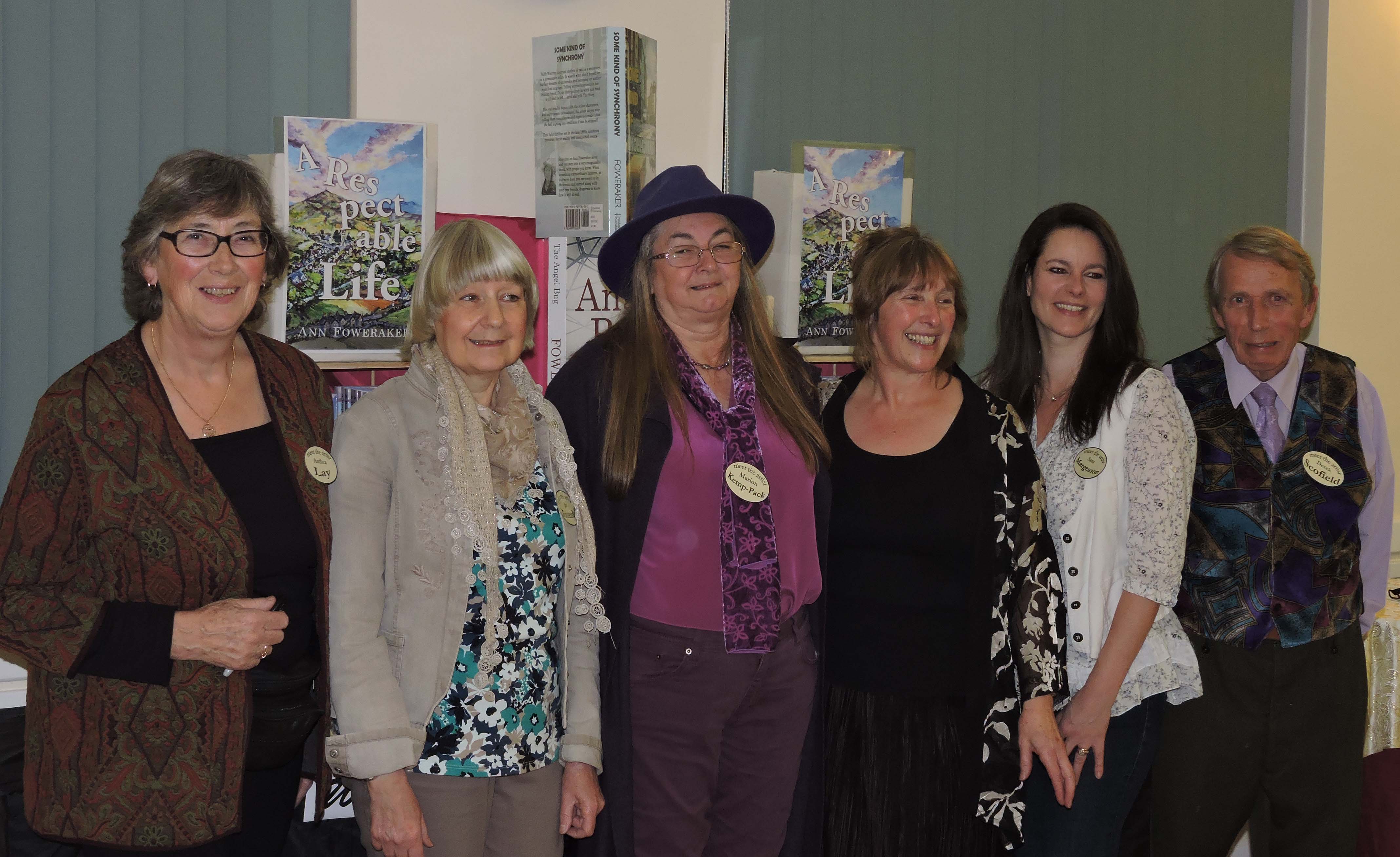
L >R The Artists line up – Anthea Lay, Jo Totterdell, Marion Kemp-Pack, Myself, Sam Margesson and Derek Scofield
Five lovely and talented artists of my close acquaintance (most of whom either live in the parish or close by) exhibited in a pop-up way for the evening. (quite the antithesis of the carefully staged and managed Art Fair Cordelia runs in the book)
The evening was well attended – with about fifty people filling the chairs – indeed, more had to be brought out!
I presented a short talk about my writing history and the writing of the book and, after I read a piece I took questions from the audience, finishing with mentioning what I was working on next.
THEN I cut the cake – a book shaped and Respectable Life decorated cake. Which was the cue for drinks, nibbles, and looking at art or getting books signed.
I had a fabulous time, and I hope everyone who came enjoyed it too – warm thanks to everyone to came along!
Here’s a link to the Looe Lit Fest schedule – so may good writers to see, some talk are free, some to be paid for, plus workshops and great fun for children – if you are in the area don’t miss it! {You’ll notice the Liskeard Poets on Saturday morning – I’ll be reading with them too 🙂 }
Have you been to any good book launches?
What do you think an Author MUST do to make a launch go well?