How did the Dominica Launch go?

Not everyone could get to the launch – some were away – some too far away – but still nearly fifty people made the event feel well supported – and I was delighted.
Delighted that the novel – Dominica – a novel inspired by Saint Dominica of Cornwall was getting released to the world in the very church that was named after her – and where the original inspiration hit me.
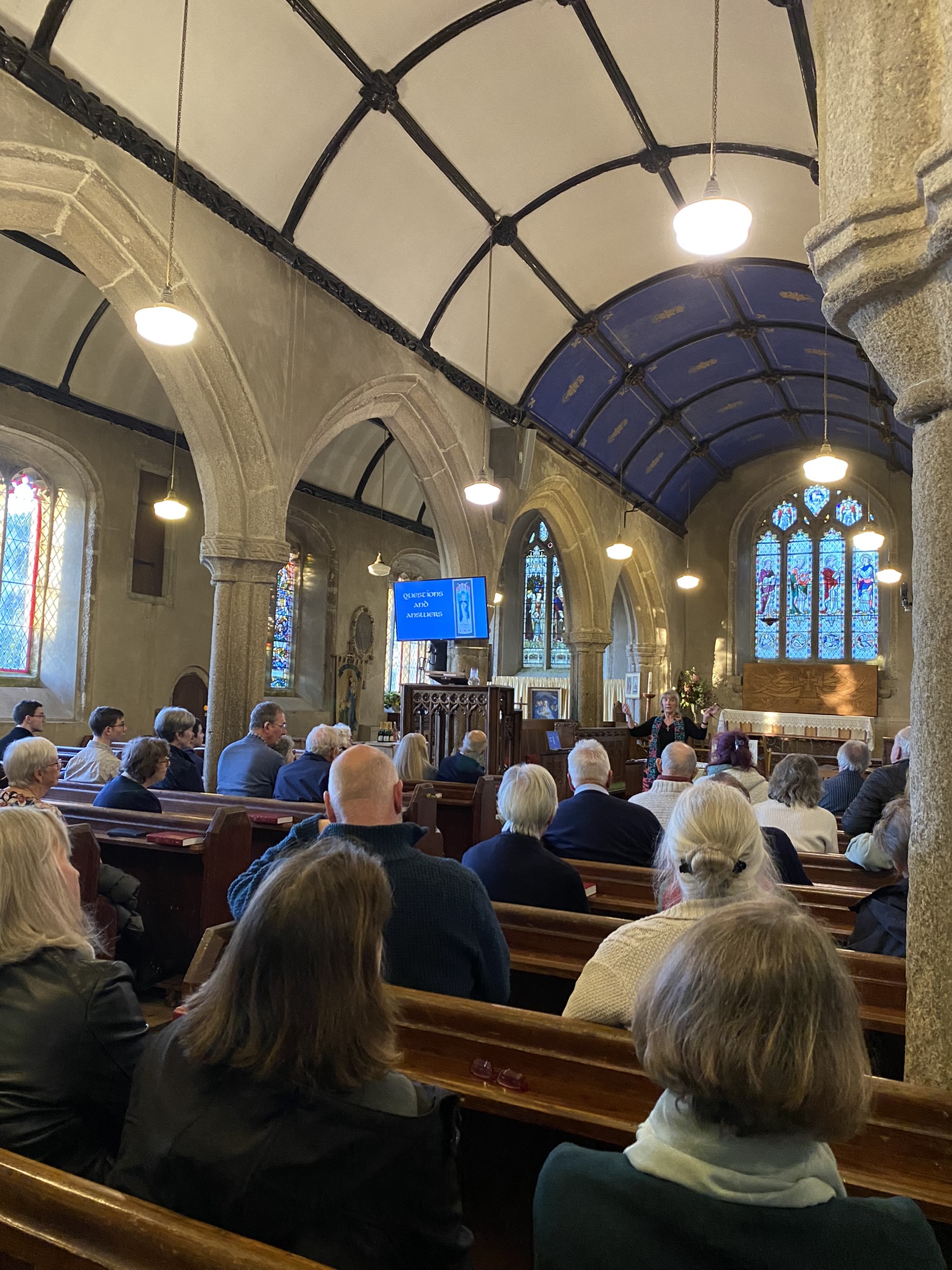
So, here for everybody – is the (pruned) transcript of my talk about the WHY and HOW I went about writing Dominica in the first place …

My WHY for writing this novel goes back to about 2010. And I am going to describe it to you – as it was, a bit extraordinary, as an experience.

It was a late Saturday afternoon and I had just finished doing the sacristan duty, which entailed setting up the altar and the bread and wine ready for the Holy Communion service the next morning in this church – the church of St. Dominica – the Parish church of St. Dominick. As usual I completed my time in the church with a little reflection and prayer at the chancel step.

The sun was coming in through the window to one side of the tower behind me, shining through the leaves that flickered in the breeze, and painting the interior of the church with moving patterns of coloured light from the stained glass window it shone through – see below.
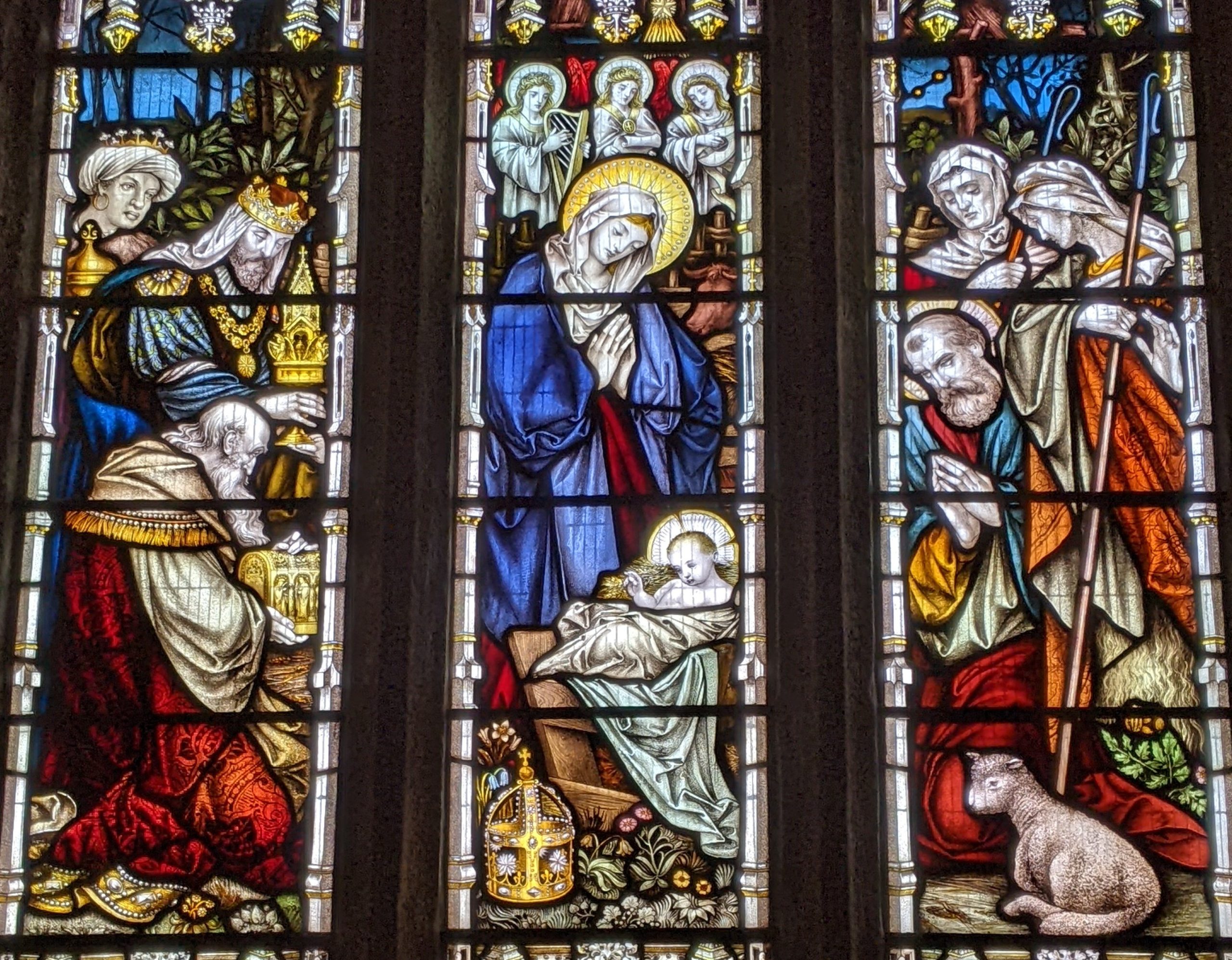
and lighting up the pillars and parts of the floor around me. And it is in this, I hesitate to say magical, light-effect that I was reflecting and praying. The type of prayer that has no words, that is just resting in God and waiting to know what you need to pray for. ….. and then, into this reverie came the thought, loud and clear: ‘What did she do? and I knew it referred to Dominica.

Now, I already knew the time-line – so the question instantly became ‘what did Dominica do for the people that they remembered her for over 550 years? So much so that when they built their new stone church, in the middle of the 1200s, they named it after her? St. Dominica – a saint known only to them in this little piece of Cornwall beside the Tamar,’

And then this thought: ‘You could write her story’ came in.
My immediate reaction was – Oh no! I do not write historical novels! For one thing, they are way too hard, for two, I have no idea what she could have done and for three, I was in the middle of writing a very contemporary novel, at that time – The Angel Bug – let’s just say it was a book involving dna / genome mapping and the Eden Project – to see how far away it was from this historical idea.

After about nine years of trying to ignore this idea of writing Dominica’s story, while finishing The Angel Bug, writing A Respectable Life and a non-fiction plus editing two other books (and going through my parents’ passing and breast cancer) – I felt she was still nagging me to write it. So I finally gave in and bumped it up my ‘book ideas list’ from number nine to number six.

And so we come to the HOW I went about it. I began by researching whenever I could. Firstly the legends – there are a few versions, but only one involves both Dominica and our area.

We, in this place, have the Legend“Indract and Dominica, son and daughter of an Irish King, came up the Tamar in a coracle to this place and made a religious settlement here.”

And there are other relevant interlinking legends too – one from Tamerton (Foliot) One from Glastonbury and two very local ones, only known in this parish. All of which I tried to weave into the tale.

The legends are in the section Author Notes at the end of the book. However I need to issue a ‘spoiler alert!’ if you do not already know of the legend involving Saint Indract and Glastonbury – I suggest you DO NOT read the legends until after you have read this story.

We have some facts too – but from a later date – We know that this church, though it was smaller than this at the time, was dedicated to Dominica in October 1259 when Bishop Walter de Bronescome did a tour of Cornwall dedicating churches

– and we know Dominica’s original saint’s day date was the 30th of August, from documentation requesting the change of date in 1445. Stating that it was then on ‘the day after the decollation of St. John the Baptist’ decollation is the beheading (which is the 29th of August) and asking for it to be moved to the day after St. Indract’s as it was ‘inconveniently in the middle of harvest’. Where it remains to this day as the 9th of May.

Then I began researching the times and what I could find out about life in Cornwall, in particular, at the time the legend puts her here – from AD 689. AD 689!

This was hard! This is deep in the Early Middle Ages, the time that used to be called ‘the Dark Ages’ mainly because of how little was known of those times.

There are few proper relevant records, not even a lot of helpful archaeology and it was a time of flux – especially on the borderlands of Saxon Wessex and Dumnonia, as the Celtic kingdom covering what is now Devon and Cornwall was then known.

Earlier, in the reign of King Centwine of Wessex, AD 676 – 685, the Saxons had invaded Dumnonia and then ruled the area right down to and including what we know as Exeter – but had then lost much of that area again during a time of instability in Wessex. So by the time this story arrives in Britannia, the old British kingdom of Dumnonia stretched roughly from Land’s End to a line lying roughly along the border of today’s counties of Somerset and Dorset with Devon.

The Saxon Kingdom of Wessex had, from AD 688, King Ina (also written as Ine and Ini) at its head. (but as it would be pronounced InA – I have used this version.

King Ina comes into the legends – so I researched him and his influence where it concerned Glastonbury and Cornwall.

When looking at my main characters’ origins, I also researched what being an Irish King of that era actually meant, again because the legend says Indract and Dominica were the son and daughter of an Irish King.

Then I delved into what is known about early medieval monasteries, both Irish and British, as our protagonists would come from the former type, and set up similar in Dumnonia.

The first thing I found out, very quickly, was that I had to forget everything that I thought I knew about medieval monasteries – for everything I knew was really about an entity and life-style that only came into being a few hundred years later than the date this book is set at.

I have always had a fascination for history, vernacular history in particular, yet I found I actually knew nothing actually relevant to this time. The monasteries we hear most about, in school for instance, are those of the High to Late Medieval period, with the latter eventually dissolved under Henry VIII, and as such would have been virtually unrecognisable to the people of Dominica’s time – and, most certainly in Cornwall, where things were different again to more eastern areas of Britain.

I spent a couple of years researching the history of the time, from a vast array of resources including published books, serious internet-based history platforms and up-to-date theses for PhD and Masters qualifications.

I also delved into scientific analysis of the ingredients of the herbal mixtures, poultices and potions probably used, and their actual effects on bacteria, viruses and well-being – combining this with the nature of diseases and ailments verified to that specific era and their usual outcomes.

I was even able to look into the weather! How amazing is it to be able to find out notable weather events and trends that were relevant to the dates and areas that Dominica’s story is set in?


Eventually I began to form an idea of what she could, possibly, have done … and sketched these out to make a proper storyline. In doing this, I sometimes had to pick and choose between competing narratives on the same scraps of information. And, as this is a novel, I chose the path that made it a better story.

After the talk – and a reading from the first chapter – we then cut the cake (see below – with a real book alongside) and all partook of nibbles, cake and fizz to celebrate the launch in the proper way!
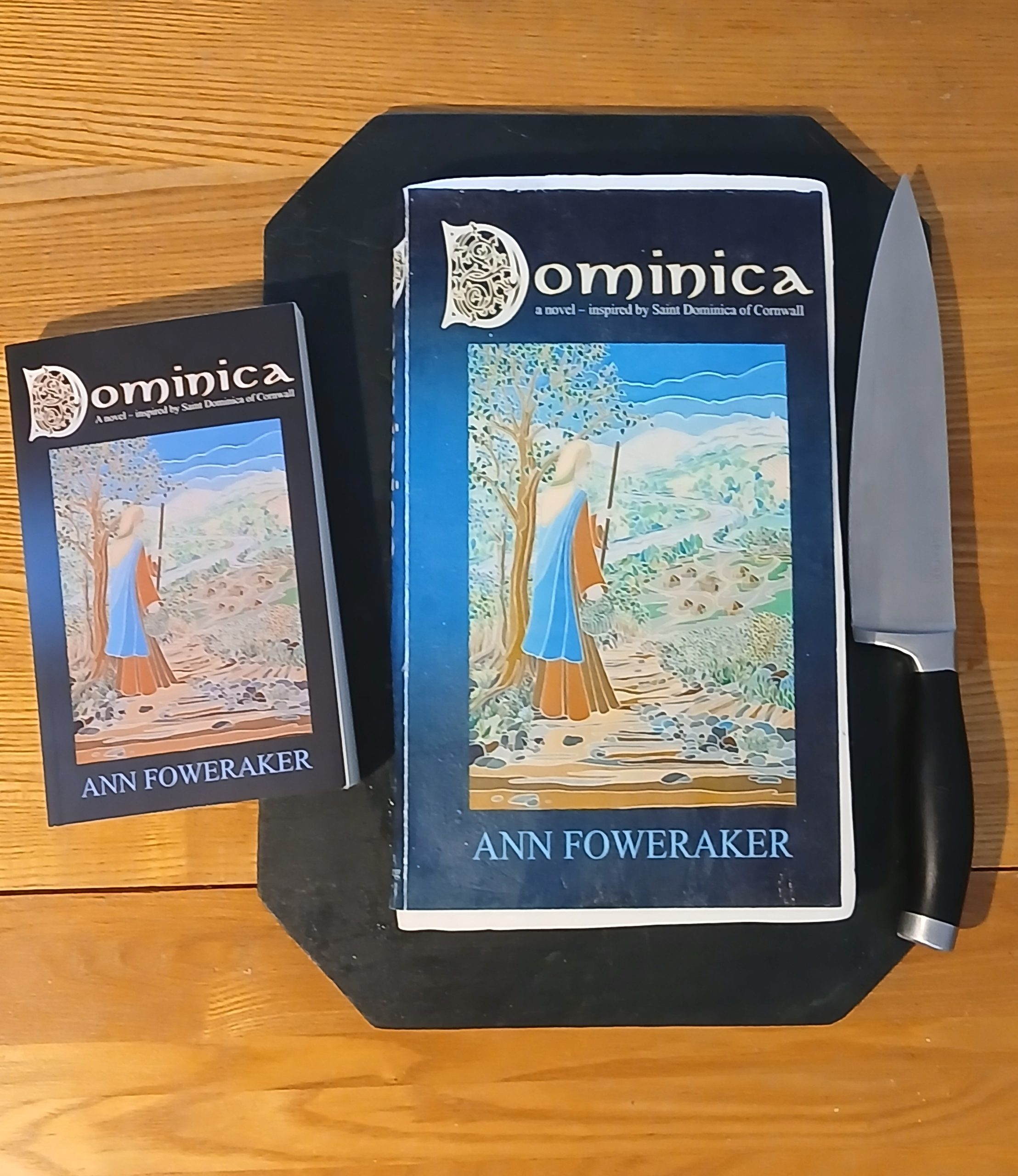
Thank You to everyone who came along – and to all who bought books – not only Dominica – but some of my others too!! Many thanks to to the family team, especially the grandsons who served said drinks and cake and acted as cashier for me – wonderful boys!

PLEASE SIGN UP to this blog if you’d like to hear more – the box is at the top of the post on the right – Let’s keep in touch!

{I had been building my followers since 2011 – and had around 640 when an unfortunate technical issue meant that I lost ALL of these followers contacts – and need to start again – do join to keep in touch}

ps If you are reading this on email and would like to comment just click onto the title and it will take you to the actual blog – so you can comment there.
If it is the first time you have written a comment don’t worry if it doesn’t appear immediately, your first comment has to be verified (to keep the spam-bots out) and I do this personally – so I am sure to see your comment – thanks for reading – Ann

** Pre-Launch Party ** for The Angel Bug

WoooHooo – Welcome to the Pre-Launch Party for THE ANGEL BUG  – due to be released on the 1st July!

What is a blog pre-launch party? Well, I’d love to break out the champers and serve up the caviar but on a blog all I can offer is some PRIZES  and some TASTERS.

champers PRIZES  *******

I will give away one ebook a day (winner’s choice) from my previously published novels, to a correct entry in the competition below – EVERYDAY ALL THROUGH JUNE!

So get reading,

answer the questions

and email your answers and your book choice to ann@anfoweraker.com.

The sooner you enter the more chances you get! Each week I will organise a random pick for seven lucky winners!

COMPETITION QUESTIONS!

(click book links to read first 3 chapters of each, in pdf, to find the answers)

1] In DIVINING the LINE what county does Liz live in?

2] In NOTHING EVER HAPPENS HERE where, in Cornwall, does Sally suggest Jo and Alex might go to, to get away from London?

3] In SOME KIND of SYNCHRONY what is Di’s new job?

{hint: all answers are within the first chapter}

Competition Rules:

You need to be signed-up to this blog (email sign -up is easy if you are not signed up already – see ‘subscribe’ box top left)

Answer all three questions and email the answers and the following information to ann@annfoweraker.com

The novel* you’d like to receive as a prize AND the eformat you would like it in (MOBI for kindle: EPUB for nook/sony/kobo: or  PDF)

* to read blurbs – to help you chose – go to Ann Foweraker Bookshop on TOP bar

One winner per email address; chosen via random.org. The prize ebook will be emailed to the winner after the weekly draw.

and now the caviar TASTER  ******

every week, added to the usual blog, will be excerpts from my latest novel The Angel Bug due to be released on July 1st … read the first instalment Today !

The Angel Bug  1

Gabbi – October 18th

Thirty years should change a man, I thought, but looking at the handsome face on the huge poster it didn’t look like it had done much to Luke Adamson’s features except, perhaps, make him look more rugged, a man to be taken seriously.

I hadn’t mentioned knowing him when it was first mooted that he might be able to fit the Eden Project into his UK trip; publicising his book and film, rumoured to have made him a millionaire already. ‘Jungala’ was a box-office phenomenon, though it started out as a serious film on ‘Man’s relationship with plants and the importance of preserving biodiversity’.

It shouldn’t have made it as a blockbuster movie, however, something happened in the filming; the ‘baddies’, a real threatening force, turned up and turned Luke into an Indiana Jones character. Added to that, in the three years it took to film, two major breakthroughs in treating terminal illnesses in man had been developed from extracts of plants hitherto only known and used by natives of the rainforests. With his superb on-screen presence, deep knowledge of his subject, film-star good looks and some excellent cutting, the serious ethno-botanical study became a mainstream ‘true-life’ film complete with soundtrack and an eco-song reminiscent of ‘Born Free’.

You see I knew all this, I’d read about it in the papers; his name, as always, drawing my eye and, despite my conscious thoughts, my interest, I’d even gone up to Plymouth to see the first screening. So why hadn’t I said anything to Mikaela when she was bubbling on about ‘how wonderful it would be’, and ‘what a coup it would be’, and ‘wasn’t he the most sexy scientist out there’? Well, I knew myself too well, I knew if I’d said anything that I’d have blushed, and then there would have been that kind teasing that they went in for in the Eden family, and I didn’t think I could cope with that, and they would have no idea that it would be difficult for me.

The Eden family, that’s how I felt about them all, a great bunch of people that easily became friends as they seemed to have, at their core, the same values. To me they had been a true life-line, welcoming me in and giving me both a focus in life and the gentle external framework I had needed to grow into a stronger person when my main support had been so suddenly cut away.

Well I’d had a month to get used to seeing his photo everywhere, even in my local Co-op, and now his visit was only a couple of days away. I wasn’t really worried, I told myself, even at university he’d been one of the ‘celebrities’ and I was definitely ‘one of the others’. He probably wouldn’t recognise or remember me, so it wouldn’t be anything to be fussed about, I told myself – again.

‘Gabbi!’ Mikaela called, waving me over as soon as I reached the open-plan office floor of the Foundation building. When I got close enough, Mikaela swung her chair round to face the others too, ‘Hey, listen – Luke Adamson’s emailed me. “So looking forward to seeing the eighth wonder of the world! I have heard so many good things about the Eden Project – and as it is the last date on my tour I intend to take a break and see a bit of Cornwall while I’m there. Recommendations welcome.” Wow, what do you think? What would a guy like that want to see?’

‘He’s American – anything older than 200 years should do the trick,’ cut in Andy from the plant pathology desk.

‘Cynic!’ Naomi muttered, her eye to a microscope.

‘He’s used to old buildings,’ I murmured, seeing him standing under the arch of King’s College, then, as Mikaela turned a puzzled face to me, I added quickly, ‘PhD at Cambridge.’

‘So he did!’ Mikaela turned back to Andy, ‘So, maestro?’

‘So, it had better be King Arthur then, Tintagel, um, some of the prehistoric stuff, Men-a-Tol,’ Andy offered, pushing himself back from his desk, ‘Coffee anyone?’ Heads were shaken, one hand up, Andy shambled off to fetch one for himself and one for Naomi.

‘You know I keep thinking this is his first UK visit, when it’s just his first visit to this part of the UK!’ Mikaela beamed brightly, ‘I’m sure we can find some really Cornish places to recommend to him, might even be able to escort him round a bit,’ she added with a twinkle in her eye.

I smiled at Mikaela’s enthusiasm and thought he’d probably be quite happy to be escorted by Mikki. Twenty-eight, pretty, long-legged, blonde and shapely, Mikki was the antithesis of the dowdy scientist, very much the sort of girl Luke used to go for, I thought, and the type who went for him back then. I didn’t suppose he’d changed in that respect either.

By mid-afternoon, truth be told, I was feeling a little drowsy as another restless night caught up with me and I was finding the rows of figures in front of me swimming. Somehow, while Eden was between senior botanists, I had ended up with the role, partly through an odd deference to me as the senior by age and, I believed, an acknowledgement of my organisational skills. I shook myself and, deciding on a restorative cup of tea, pushed my chair away from the desk. As I did so my phone rang, sliding the chair forward again I answered with a voice much brighter than I felt.

‘Hello, Gabbi Johnston.’

‘Gabbi! Josh here, I’m in H03. There’s something not right with the Moringa – I think you had better come and take a look.’

From the designation, H03, I pictured the slight, pale boy, Josh, standing by the Orang dan Kebun, the Malaysian house and garden area in the humid-tropics biome.

‘All right, Josh, I’ll be right down,’ I said already standing as I replaced the phone. A quick whiz down to the pit was probably the best antidote to the lethargy I was feeling anyway.

Picking up my mobile I headed out of the Foundation building, turned sharply and collected my bike. As a health and lifestyle statement and as a method of keeping fit I kept a bike at Eden for getting around. Easy on the trip down into the pit, as the site of the biomes was appropriately known to the employees of Eden, but a darn sight harder on the muscles on the way back up to the administration buildings on the rim.

I felt that sense of wonder and exhilaration that I always did as my pedal strokes brought me in sight of the Eden that everyone recognises from books, TV and adverts, the soap-bubble constructions piled against the sides of the once raw granite china-clay pit, then, as I neared, the panoply of the temperate zone, the largest, the ‘outdoor biome’. All of it looking both small and vast at the same time.

After walking briskly through the jungle conditions of the humid biome I was perspiring slightly by the time I reached H03 and there was Josh standing beside the Malaysian house, keeping out of the way of the visitors who were wandering, gawping upwards, stopping and bending to read notices, children dashing back and forth to drag parents on to the ‘thing’ they’d found, or trailing behind, tired and hot.

‘Hi!’ Josh said when I stood beside him. ‘You have to get to the higher side to see it.’

We walked with the crowd round the edge of the garden, but where the rest flowed onwards we stopped and stepped to the far side of the path.

Josh raised his hand and pointed to the top most leaves of the Moringa oleifera.

‘There!’ he said, ‘Earlier, when it was clouded over, I could see quite clearly that the top-most leaves are going red.’

The sky beyond the ETFE bubble biome structure was bright now, I shaded my eyes but I still couldn’t see the leaf colour properly; the higher delicate fronds were just dark silhouettes.

A family came and stood between us and the tree. The mother read from the guide in clear tones. ‘ “Moringa oleifera, also know as the Horseradish or Miracle tree, has edible leaves, beans, flowers and roots.”  I wonder if it’s the roots that give it the Horseradish name. “Beside it stands the Neem tree known throughout the East as the world’s most useful tree, providing medicine, fuel and food.” Well that sounds impressive for one plant. ’

The family stood a moment or two looking the two slim trees up and down, the younger boy pointing out the bean-like seed pods. They moved on, the mother reading the next section as they walked.

‘I’m going higher,’ I said. ‘I can’t see well enough from here.’

Josh nodded assent and followed me as I turned and took a near vertical route up through the planting to get as high as possible.

Now I could see. Josh was right; there were a significant number of leaves turning red, as if for an early autumn. Yet these trees shouldn’t have an autumn, shouldn’t be changing colour.

‘What’s the watering like?’ I asked

‘Fine, checked that, no problems now or recorded.’

‘Hmm, okay, well we will need leaf samples anyway – so dehydration can be ruled out while we look for other baddies,’ I smiled. ‘Could you arrange that for me Josh?’

‘Sure, only one for you, or one to each?’ he said, meaning, a sample for the plant pathologist and one for the entomologist too.

‘Better make it one to each, thanks,’ I said frowning. ‘Better make them bio-safe and labelled urgent. Okay?’

‘Okay, no probs!’

No probs! Indeed! Big Probs!! I thought as I sweated the bike back up the slope. Perhaps I should have had a sample sent to Mikki too. It might be easier than actually telling her that there was a problem with the Moringa. Of all the trees in all the biomes, why did it have to be that one, a paraphrased Bogart said in my head, if no other plant, Luke would certainly zero in on his pet, the tree that made his name in ethnobotany!  Back at my desk I bashed Moringa oleifera into the Forestry-Compendium website to check out if it had any history of turning red, and what the cause might be………

 I hope you enjoyed that little taster ….. more next week.

Have you ever been to The Eden Project in Cornwall?

Do share your thoughts on the excerpt, the competition or Eden … you know I love to hear from you.

error

Enjoyed this blog? Please share :)