How did the Dominica Launch go?

Not everyone could get to the launch – some were away – some too far away – but still nearly fifty people made the event feel well supported – and I was delighted.
Delighted that the novel – Dominica – a novel inspired by Saint Dominica of Cornwall was getting released to the world in the very church that was named after her – and where the original inspiration hit me.
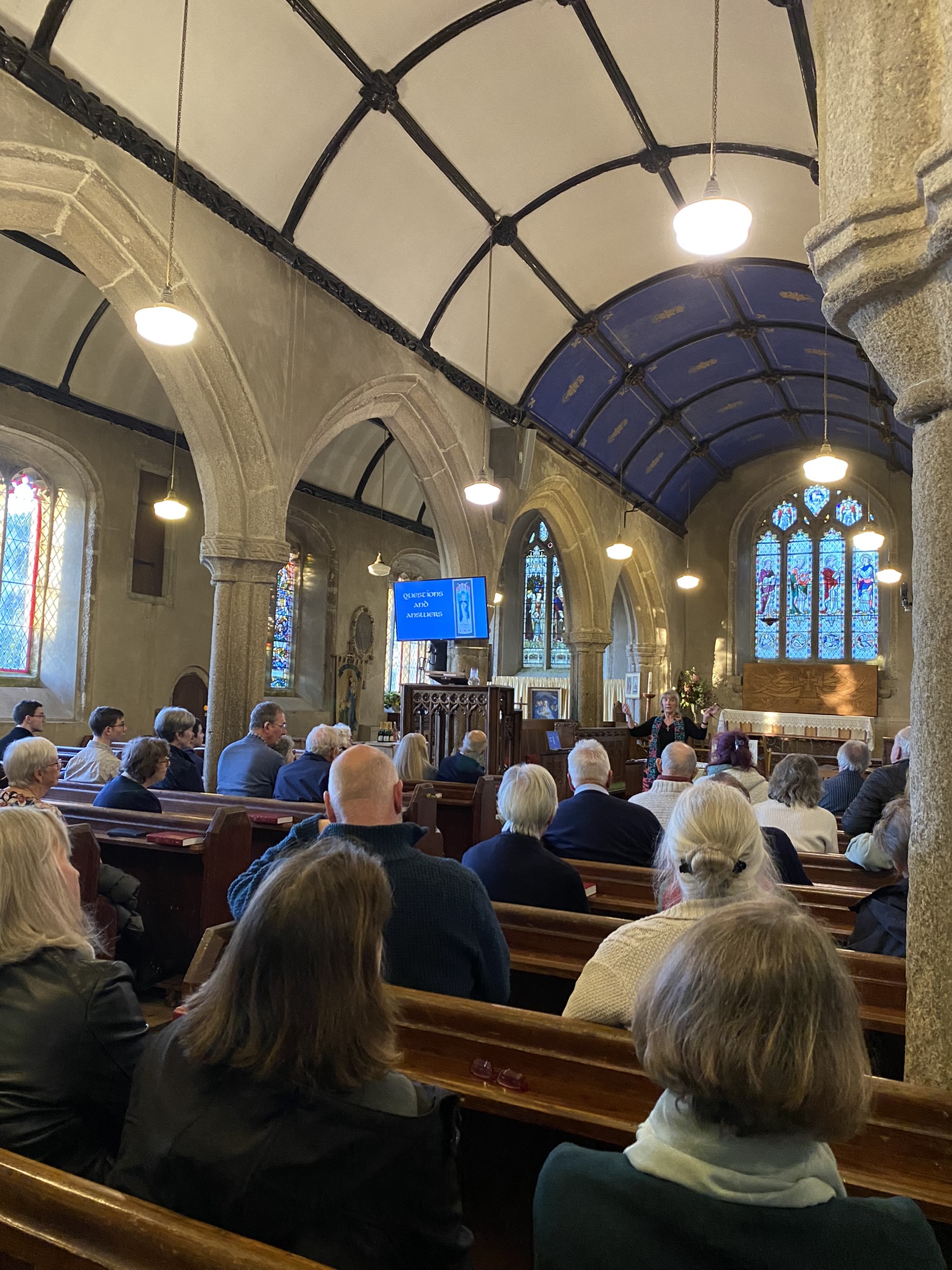
So, here for everybody – is the (pruned) transcript of my talk about the WHY and HOW I went about writing Dominica in the first place …

My WHY for writing this novel goes back to about 2010. And I am going to describe it to you – as it was, a bit extraordinary, as an experience.

It was a late Saturday afternoon and I had just finished doing the sacristan duty, which entailed setting up the altar and the bread and wine ready for the Holy Communion service the next morning in this church – the church of St. Dominica – the Parish church of St. Dominick. As usual I completed my time in the church with a little reflection and prayer at the chancel step.

The sun was coming in through the window to one side of the tower behind me, shining through the leaves that flickered in the breeze, and painting the interior of the church with moving patterns of coloured light from the stained glass window it shone through – see below.

and lighting up the pillars and parts of the floor around me. And it is in this, I hesitate to say magical, light-effect that I was reflecting and praying. The type of prayer that has no words, that is just resting in God and waiting to know what you need to pray for. ….. and then, into this reverie came the thought, loud and clear: ‘What did she do? and I knew it referred to Dominica.

Now, I already knew the time-line – so the question instantly became ‘what did Dominica do for the people that they remembered her for over 550 years? So much so that when they built their new stone church, in the middle of the 1200s, they named it after her? St. Dominica – a saint known only to them in this little piece of Cornwall beside the Tamar,’

And then this thought: ‘You could write her story’ came in.
My immediate reaction was – Oh no! I do not write historical novels! For one thing, they are way too hard, for two, I have no idea what she could have done and for three, I was in the middle of writing a very contemporary novel, at that time – The Angel Bug – let’s just say it was a book involving dna / genome mapping and the Eden Project – to see how far away it was from this historical idea.

After about nine years of trying to ignore this idea of writing Dominica’s story, while finishing The Angel Bug, writing A Respectable Life and a non-fiction plus editing two other books (and going through my parents’ passing and breast cancer) – I felt she was still nagging me to write it. So I finally gave in and bumped it up my ‘book ideas list’ from number nine to number six.

And so we come to the HOW I went about it. I began by researching whenever I could. Firstly the legends – there are a few versions, but only one involves both Dominica and our area.

We, in this place, have the Legend“Indract and Dominica, son and daughter of an Irish King, came up the Tamar in a coracle to this place and made a religious settlement here.”

And there are other relevant interlinking legends too – one from Tamerton (Foliot) One from Glastonbury and two very local ones, only known in this parish. All of which I tried to weave into the tale.

The legends are in the section Author Notes at the end of the book. However I need to issue a ‘spoiler alert!’ if you do not already know of the legend involving Saint Indract and Glastonbury – I suggest you DO NOT read the legends until after you have read this story.

We have some facts too – but from a later date – We know that this church, though it was smaller than this at the time, was dedicated to Dominica in October 1259 when Bishop Walter de Bronescome did a tour of Cornwall dedicating churches

– and we know Dominica’s original saint’s day date was the 30th of August, from documentation requesting the change of date in 1445. Stating that it was then on ‘the day after the decollation of St. John the Baptist’ decollation is the beheading (which is the 29th of August) and asking for it to be moved to the day after St. Indract’s as it was ‘inconveniently in the middle of harvest’. Where it remains to this day as the 9th of May.

Then I began researching the times and what I could find out about life in Cornwall, in particular, at the time the legend puts her here – from AD 689. AD 689!

This was hard! This is deep in the Early Middle Ages, the time that used to be called ‘the Dark Ages’ mainly because of how little was known of those times.

There are few proper relevant records, not even a lot of helpful archaeology and it was a time of flux – especially on the borderlands of Saxon Wessex and Dumnonia, as the Celtic kingdom covering what is now Devon and Cornwall was then known.

Earlier, in the reign of King Centwine of Wessex, AD 676 – 685, the Saxons had invaded Dumnonia and then ruled the area right down to and including what we know as Exeter – but had then lost much of that area again during a time of instability in Wessex. So by the time this story arrives in Britannia, the old British kingdom of Dumnonia stretched roughly from Land’s End to a line lying roughly along the border of today’s counties of Somerset and Dorset with Devon.

The Saxon Kingdom of Wessex had, from AD 688, King Ina (also written as Ine and Ini) at its head. (but as it would be pronounced InA – I have used this version.

King Ina comes into the legends – so I researched him and his influence where it concerned Glastonbury and Cornwall.

When looking at my main characters’ origins, I also researched what being an Irish King of that era actually meant, again because the legend says Indract and Dominica were the son and daughter of an Irish King.

Then I delved into what is known about early medieval monasteries, both Irish and British, as our protagonists would come from the former type, and set up similar in Dumnonia.

The first thing I found out, very quickly, was that I had to forget everything that I thought I knew about medieval monasteries – for everything I knew was really about an entity and life-style that only came into being a few hundred years later than the date this book is set at.

I have always had a fascination for history, vernacular history in particular, yet I found I actually knew nothing actually relevant to this time. The monasteries we hear most about, in school for instance, are those of the High to Late Medieval period, with the latter eventually dissolved under Henry VIII, and as such would have been virtually unrecognisable to the people of Dominica’s time – and, most certainly in Cornwall, where things were different again to more eastern areas of Britain.

I spent a couple of years researching the history of the time, from a vast array of resources including published books, serious internet-based history platforms and up-to-date theses for PhD and Masters qualifications.

I also delved into scientific analysis of the ingredients of the herbal mixtures, poultices and potions probably used, and their actual effects on bacteria, viruses and well-being – combining this with the nature of diseases and ailments verified to that specific era and their usual outcomes.

I was even able to look into the weather! How amazing is it to be able to find out notable weather events and trends that were relevant to the dates and areas that Dominica’s story is set in?


Eventually I began to form an idea of what she could, possibly, have done … and sketched these out to make a proper storyline. In doing this, I sometimes had to pick and choose between competing narratives on the same scraps of information. And, as this is a novel, I chose the path that made it a better story.

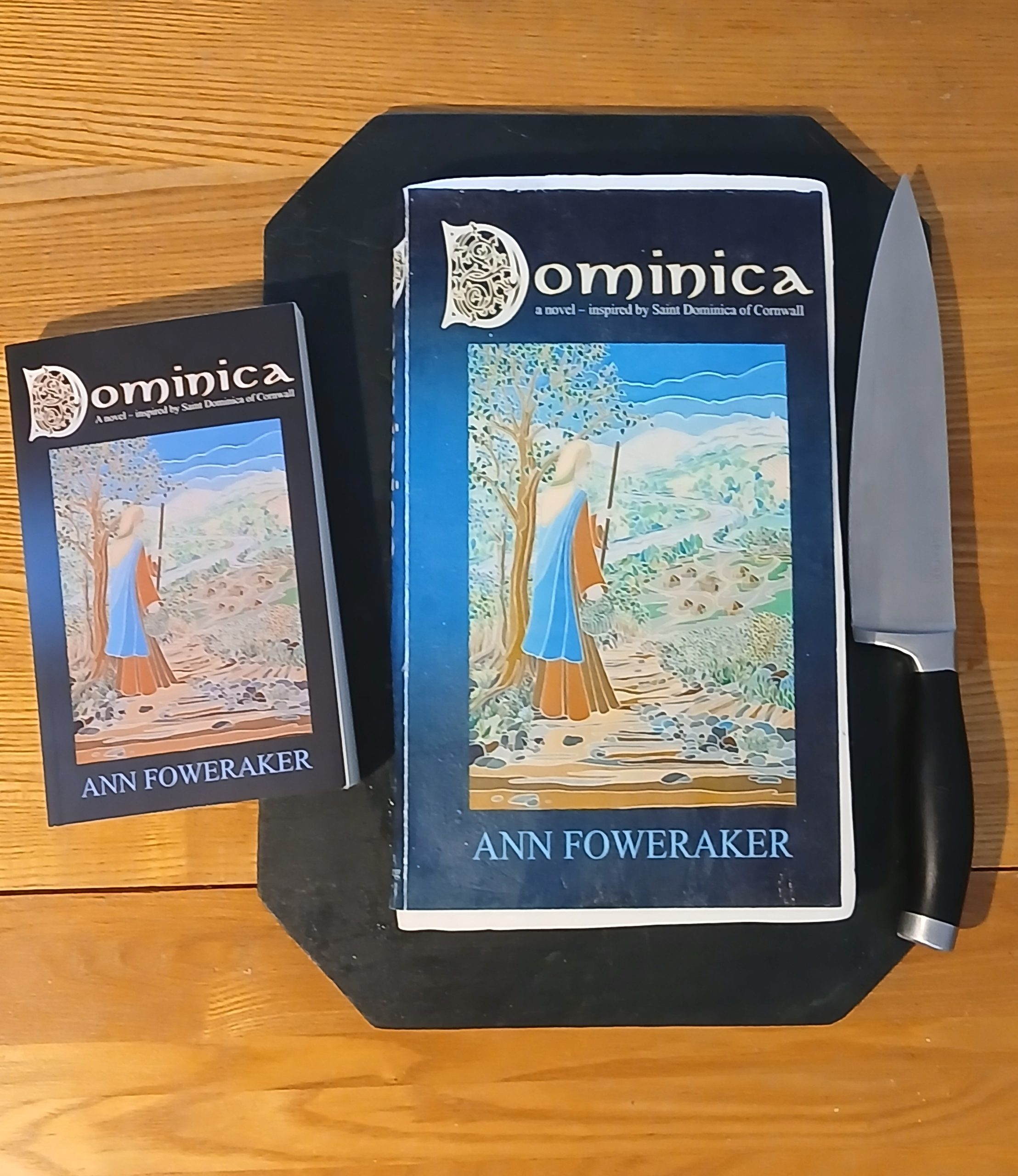
After the talk – and a reading from the first chapter – we then cut the cake (see below – with a real book alongside) and all partook of nibbles, cake and fizz to celebrate the launch in the proper way!
Thank You to everyone who came along – and to all who bought books – not only Dominica – but some of my others too!! Many thanks to to the family team, especially the grandsons who served said drinks and cake and acted as cashier for me – wonderful boys!

PLEASE SIGN UP to this blog if you’d like to hear more – the box is at the top of the post on the right – Let’s keep in touch!

{I had been building my followers since 2011 – and had around 640 when an unfortunate technical issue meant that I lost ALL of these followers contacts – and need to start again – do join to keep in touch}

ps If you are reading this on email and would like to comment just click onto the title and it will take you to the actual blog – so you can comment there.
If it is the first time you have written a comment don’t worry if it doesn’t appear immediately, your first comment has to be verified (to keep the spam-bots out) and I do this personally – so I am sure to see your comment – thanks for reading – Ann

No so much Navel Gazing as …

Oh! Here I am, back again after what seems a frenetic and frantic time. Oh, yes, life sometimes throws things our way that knocks all the writing to pot – including the blog.

In this case my father’s sudden eruption of a HUGE ulcer on his tongue, followed by numerous and sequential trips to the hospital for every type of scan, followed swiftly by an operation to remove a largish bite of his tongue and several lymph nodes from his neck following the diagnosis of cancer. Thank goodness for the NHS! Subsequently we’ve been on the recovery stage – trying to regain weight lost while eating was difficult – while eating is still difficult (with sore but healing new shaped tongue) However, things are stabilised now and I have found my lap-top and returned to all of you.wp_20170512_09_02_15_pro

And returned to the studies of everyday plants that my character – Dominica – might be able to use in her healing around AD689 – and today I’m looking at the plant known as the navelwort – or pennywort.

Wort, or wyrt,  is actually a Viking or Norse suffix meaning ‘medicine’. So the name of this plant in this country comes from later than the time I am dealing with, so I have to check with my sources as to whether it was an introduced plant – or was here already but known by another name. (Yes, Historical writing is tricky!)

I have always rather liked this plant. The round fleshy leaves are one of those edible leaves that my boys readily took to eating just for fun (after being told they were edible) They taste a bit cucumbery.. basically fleshy, wet and green, not bad in a sandwich. However, I didn’t know of their medical usage. The names, pennywort and navelwort I assumed came from their shape and the dimple, like a bellybutton, in the middle, even though, somewhere in the recesses of my mind the ‘wort’ rang a herbal-use bell.

wp_20170623_10_52_15_proNow, the mini-course I went on tells me that the navelwort, Umbilicus rupestris, have strong antimicrobial properties and would have been placed over the end of the umbilical cord and tied on, where they would dry-on forming a seal and keep infection at bay. Thus navelwort referred to this property (though under the doctrine of signatures – they would also have been saying – ‘look at me, I’m for use on the navel!’) Oddly, this use doesn’t seem to be generally mentioned in online sources, so maybe it’s a very old use, perfect for my story.

It seems that these can also be carefully dried and stored for babies that arrived out of the navelwort-growing season too. Now I am really hoping this plant in a real native as I am sure this could work its way naturally into Dominica’s medicine kit.

So, barring any other type of emergency, medical or otherwise, I’ll write to you next week – in the meantime –

have you ever eaten a pennywort sandwich – or even just nibbled a leaf?

Or do you know these plants by any other names?

Do share – you know I love to hear from you!

A Weedy Medicine Cabinet – Dandelions

Here we are again, we are back in the late AD600 – when the wise-woman, or the monastery-trained, were the go-to people when you were ailing. Why? Mainly because they still held the knowledge honed by the druids about which herbs had which effects on the body.

So it is that I found myself signing up to a herbalist-led course here in the Tamar Valley. My Dominica will have to use the plants that grow here if she is to be a healer (which – in my telling of the tale – she will be)

Here I am going to give a first glimpse of what I learned but how this will be used in the story I have yet to discover (that’s the way my writing works – fill up the  brain with lots of information and then let the sub-conscious sift through and weave it’s own patterns).

We didn’t even have to leave the property where the talk took place – and I suspect you wouldn’t have to stray far from your garden too for the one herb I’m going to touch on here. wp_20170512_09_06_03_pro

Hands-up those who have dandelions in their garden? *sees a forest of hands* Really? LOL 🙂 … well it seems that a Dandelion is a medicine chest all on its own.

Leaves: Make a ‘tea’ from them to drink. (A ‘tea’ basically is as it sounds, pour boiling water over them and allow to steep for a few minutes – remove herb bits – drink)

Many of you will know this is a diuretic (we all remember the warning as children not to pick dandelions as they will make you wet the bed!) Diuretics are used in many conditions today: – for reducing blood-pressure; congestive heart-failure and oedema (swelling due to water-retention) *This is not to say you should treat yourself for these conditions willy-nilly with dandelion tea!*

But did you know that dandelion tea is also a anti-lithic (a stone-breaker) that breaks gall or kidney stones to allow them to be passed?

Roots: Wash, cut and make a tea – this provides a liver-detox.

Then there’s the sap – that white milky fluid that comes from the broken stem. This can be used to treat warts. It is actually a form of latex and seals the wart off from the air. It needs to be reapplied frequently but eventually the wart will drop off leaving a wet pit on the skin that then heals up. (this make total sense – if you recall my experiment with the duct-tape method of wart removal (here) this works in the same way)

dandelion-fiels-freeimages-live! Not only that – but apparently dandelion sap was even used during the war as a latex (rubber) supply (Not one of us on the course had ever heard of that before!) but as things go – in a serendipitous manner – within a day an advert popped up on FB for Continental tyres – saying they are experimenting with dandelion rubber (due the disease attacking rubber plants worldwide) as well as for other things that use latex.

That’s dandelions for you – amazing and fascinating – now I need to check with Dulcie of Dumnonika, the Iron Age re-enactment group, who has an careful list of truly native plants, whether they were here in this part of the UK back in those times.

I’ll share some of the other medicinal-weeds I learnt about with you another time  🙂

What are your favourite herbal remedies?

Do you remember the warnings about picking Dandelions?

Do Share – you know I love to hear from you!

Lost in Time – researching for Dominica!

I’ve been gone one thousand, three hundred and twenty-eight years – back in time … to an era we call ‘The Dark Ages’. The Roman garrisons have gone – left these isles to tend to their problems closer to Rome with a farewell letter to the Romano-British from the Emperor Honorius, in AD410, to see to their own protection  – even as they called for aid to fend off the raiding Saxons. However, by the date I’ve been visiting, AD689, the Angles, Jutes and Saxons are well ensconced in the majority of what will become England, but the Vikings are not yet attacking.

wp_20170406_15_34_30_pro
Can you see the river Tamar, just behind the trees – and further beyond?

I am in Cornwall, here, just over the border – the river Tamar. Though, in AD689 Cornwall is not Cornwall – as such, it is part of Dumnonia, roughly Devon and Cornwall and part of Somerset and Dorset, and it is a different place culturally to the rest of ‘England’. The West Saxons (those being the closest – Wessex) have not overtaken the people of Dumnonia yet – in fact – even the Romans had made little impact here, this side of the river, either … a few forts only – no fancy towns all laid out Roman style with villas and influence over the local Kings* here. (*or ‘big-man’ as the system seemed to be in Cornwall in the pre-Roman times … and probably was even at the end of the AD600s.)

So it is a tumultuous time on the border, the threat of invasion by the West Saxons is real, they have made in-roads into Dumnonia … and they have a new battle-cry. By this time the Anglo-Saxons had, by and large, turned from their pagan gods to Christianity, some converted by missionaries from Rome, some by missionaries from Ireland. This had resulted in a clash of Christian doctrines – the Roman church and the Celtic church having different ways to work out the Christian calendar, different tonsures for their monks, and differing rules and ways of worship and a different attitude towards women. Within my time-line comes the decisive synod of Whitby, AD664, that found in favour of the Roman Church and meant that the Celtic churches that would not change were then seen as heretical – and to be wiped out.

The Church in Dumnonia, and especially the ‘Cornish’ ones backed by King Geraint and so rich in Celtic saints from Ireland, refused to change – setting themselves up for the West Saxons to proclaim a ‘religious war’ as a motive to back-up their invasions.

It’s been hard to get back to the here and now – I look at the landscape around me with different eyes – where would have been occupied? Where would have been safe? I read the names of the places I know and refer to my books to see whether I can call the place by its current name – whether the name we know is, in fact, original Celtic (Cornish) or an English name given only after the West Saxons’ invasion, or a blend … and even that has made me look at the landscape again and see things with different eyes as I find the meanings behind the words.

Those who know me in person, know that I am interested in history, mainly local history rather than that of Kings and Queens, but this is something different. To weave a story based on a few scanty legends (Dominica and Indract), set in a time that is poorly recorded (there’s the reason it is called the Dark Ages) and to try to throw myself back into that time and inhabit that landscape and that life is, for me, an extraordinary experience, both thrilling and very scary. It is also totally absorbing and takes me to a place I have never travelled before!

Wish me luck on my time-travels 🙂

Do you go time-travelling?

Do you find yourself inhabiting a different world when visiting ancient houses or estates?

Do share – you know I love to hear from you!

error

Enjoyed this blog? Please share :)