I’ve got the bug …

I always have had … the ‘need to know’ bug.

But this time – following my ‘need to know’ I came up with more than I expected. brain

Lets start with dementia. As you may know from other blogs, my lovely, extremely intelligent mother is suffering from Dementia.

Now this is like saying a forest is made of trees; there are different types of dementia – and the most well known (to the general public – as the ‘face’ of dementia) is Alzheimers. Too often the term Dementia is substituted for the term Alzheimers … causing confusion. For example the headline ‘Breakthrough in treatment of Dementia’ turned out to be a drug which, if caught very early, slows down Alzheimers. It wouldn’t do anything for vascular dementia which is caused by a narrowing and blocking of the small blood vessels in the brain – causing the brain cells they served to die from lack of oxygen – like lots of mini-strokes.

Well, this isn’t a blog about dementia – but it is an explanation of why and how I got interested in reading about how we can support our brain – to help keep it as healthy as possible because, and I do not need to tell anyone who has had a family member suffer from any form of dementia, losing your brain function looks like a living hell – and if I can do anything to stop myself from following that path I want to know about it.

Now, when I support anything like this I need to temper it with ‘that which makes sense to me’ – that is, the me that has always been a bit of scientist, the me that likes to question, the me that has, at base, my own sense of ‘common-sense’ – call it a GUT FEELING about things – if you like.

bacteriaSo when I read an article which cited a book by a neurologist who had ‘jumped  ship’ and was saying that what happens in your gut was very important for your brain health – I was interested. I read a bit more – learnt a bit more  – then bought his book ‘Brain Maker – the power of gut microbes to heal and protect your brain – for life’

I read the book slowly, checking out the references to the scientific papers cited throughout. It made sense. It chimed with many of my own observations over the years. It linked into other ‘new’ science I have been reading about lately – epigenetics. Moreover, though Dr Perlmutter is an American, much of what he recommended as treatment, I had heard of already in the UK* which, oddly enough, was where he’d had to send some of his patients for a treatment (more of this in a later blog) AND he wasn’t trying to sell me anything (apart from the book lol) – in fact his book finished up with old-fashioned recipes for foods to make at home that would help your gut to help your brain! (*some even on TV’s Trust me I’m a Doctor)

So why am I blogging about this? I could merely say – go out and buy this book – I think it is good. Yes, I could – yes, you could. However it is packaged in a strange blend of ‘common-touch’ language and ‘detailed scientific’ language. He wants to tell us everything in each section, so if I was concerned about one aspect or another it was easy to get bogged down in the other aspects touched upon.

I’ve been going through the book and doing something I NEVER do – marking a BOOK! (horror) with different coloured highlighters for the different disorders that he deals with that are affected by the operation of the gut biome. So I’m going to try to blog half-a-dozen or so times about this – each focussing on a different aspect. Then, if you are interested – go and get his book to fully understand and get his recipes – if you want. However, remember – I am not a scientist (as such) or a doctor – in this case, I hope, just to be a faithful interpreter.

These are the sections I intend to separate my blogs out into, though not necessarily in that order.

What the ‘good’ gut bacteria do for us and Inflammation
Alzheimers
Auto-Immune conditions
Diabetes / Obesity
Depression / Anxiety disorders / ADHD
Autism

 Do any of these interest you more than others?

Any experiences you would like to share – I’d love to hear

Ann

Find me on Facebook & Twitter @AnnFoweraker

Tune up your body ;)

… so this doctor said, to the woman on the Radio 4 programme, ‘I recommend that as you get older you change the radio station you listen to – choose a music station with music you like to dance to … that way you can exercise whenever you are working around the house – just dance!’

WP_20160203_16_27_07_Pro
me … in my youth 🙂

OH YES!

I grew up with Radio 4 on in the background (Home Service in my youth – if I am truthful) and though as a teenager I listened to Radio Luxembourg / Pirate radio and eventually Radio One (when they gave up fighting it and made pop-music mainstream) on my radio in my room while doing homework or reading in bed – Radio 4 was the sound-track to my home life.

After my parents moved in with us down here in Cornwall, Radio 4 was once again the default on the radio – and always on. When, because of her developing dementia, Mum couldn’t follow what they were saying and she began to get annoyed with Radio 4, I found that music stations were better for her … and for me. Radio 2 now became the default and, though I missed the thinking pieces, the reports and studies, and some of the humour from Radio 4 – I found I really liked the music played on Radio 2 as so much was ‘my era’.

Music of your own era is hard-wired into your brain. It is a fact that memories associated with music are extremely evocative and form some of the strongest memories. There have been various pieces of research that indicate that the emotional response that music can create may have something to do with this. Dementia patients, who respond to very little else, will suddenly join in with songs and music from their youth – singing along with Old Music Hall songs (as my Mum would) or be-bop-a-lula – if that bit younger.

As for me – hard-wired is the operative term – and it is both brain and body. There are some pieces of music that I just cannot sit still and listen to – I have to get up and dance around (or at the very least tap my foot enthusiastically) 

So – I listened to the doctor – and dance as I go about my everyday life. And it works – okay – so it may look strange to see me pirouette and shimmy across the kitchen, utilising all my favourite belly dance moves – or mosh to heavy-metal in the dining room – but it keeps this old gal limber (love that word!) and if another lovely memory 😉 happens along with the song – it puts an extra smile on my face.

Now for your Saturday Smile – enjoy this video – and go on, GO ON! Why not?  Have a dance around 🙂

What is your favourite music to dance to?

Do your have music-linked memories that return every-time you hear a tune?

do share – I’d love to hear from you

Ann


Find me on Facebook and Twitter @Ann Foweraker


Warning! Nasty things revealed – warts and all!

Think of this as my Halloween blog post – and it won’t seem quite so horrible….

I quite like the programme  ‘Trust Me I am a Doctor’ on BBC2.

Only ‘Quite’ as it does that annoying thing of dashing back and forth between the topics of the programme instead of pursuing one to the end before starting on another. I wonder, is this because all media have been told we have very limited concentration spans or, in a self-fulfilling prophesy, we will all end up with very short attention spans because they only offer us tiny tid-bits and flash around the subjects catching up on each one as they go (in case you have so little attention span you have forgotten!) Rant over.

So, a while back they had a little piece about WARTS. Urgh! Yes, I know. Warts and Verrucas to be precise – or to be less precise – as they are the same thing – really.

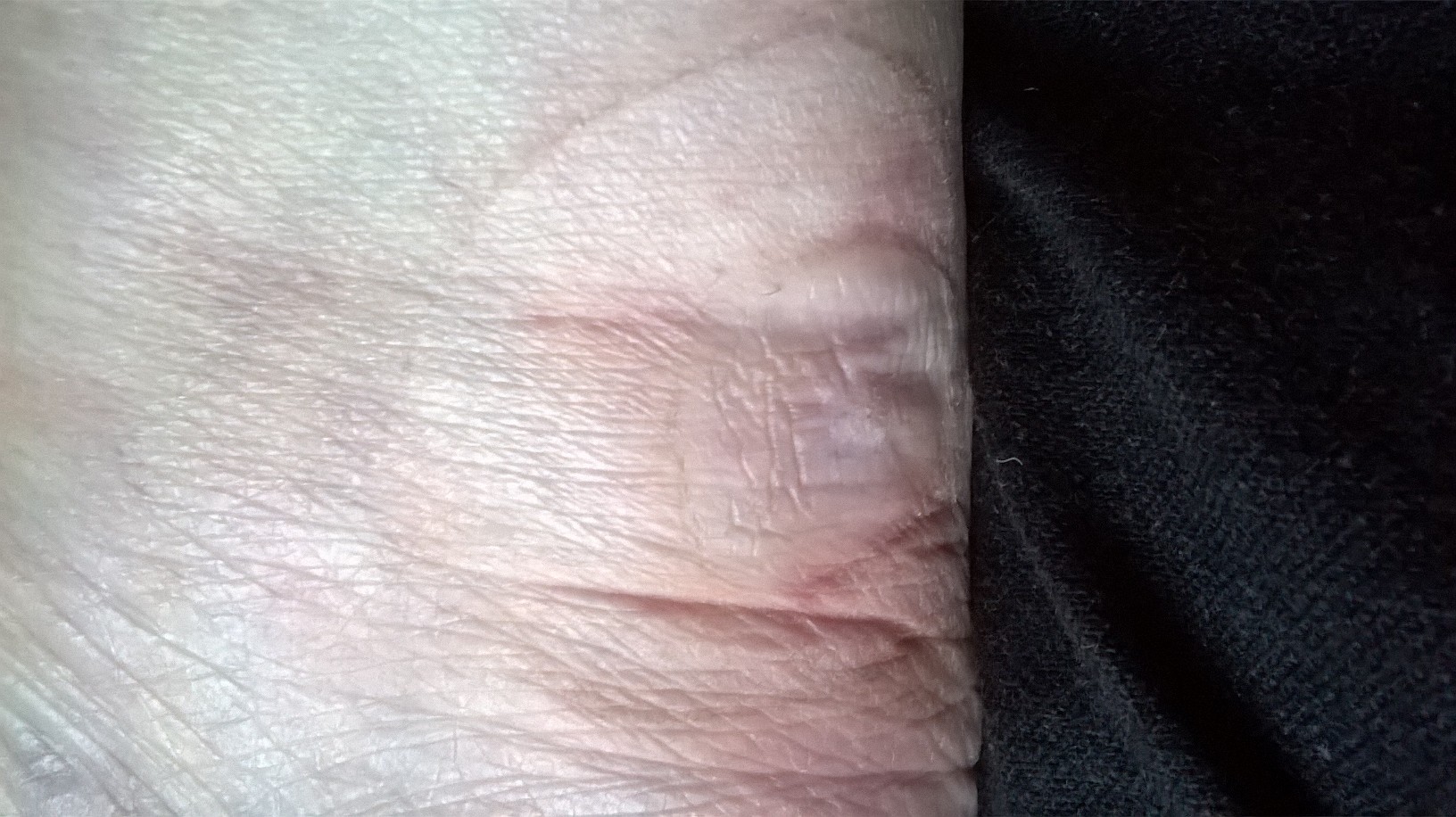
Now, this item interested me in particular as a wart had developed on the inside of my ankle. Just in an annoying position where it caught on some of my sandal straps, where it somehow found its way to annoy me – lots! I’d not had a wart anywhere since I was about six – not even a verruca! Not nice – are they? They certainly have the Halloween YUK! factor!

AND  it wouldn’t go away – despite treatments!

I had read (including on our own doctors website) that they didn’t go in for the freezing treatment much nowadays, that the salicylic acid treatment was just as good.

So… I bought a salicylic-acid based treatment and proceeded to treat the wart as instructed. In the position it was in it was very difficult to prevent the liquid running onto the normal skin! This caused some peripheral ‘burning’ and was painful and sore, as it was where the sandal straps go, and therefore a nuisance – but worse, it didn’t seem to have any effect on the wart itself. After repeated treatments and a long time and no change … I bought the Extra Strength version.

This was duly applied, and the result, after many weeks, was the same.

So, after about five months of this, I did ask the doctor – who obliged and treated the damned thing with the freezing treatment. It was ‘painful’ for a short time, but, if the wart was going to go – well worth it.

Over the next few weeks bits seemed to break off from the wart – when, after soaking, it was abraded it sort of peeled off. At Last! I thought. However, it only got to be almost flat – though still a different texture to the skin surrounding it.

Then, inexorably – over the next month –  it grew again – albeit with a rougher and flatter top. Arrgh!

It was then I saw the ‘Trust Me I am a Doctor’  programme – which actually ended with the words ‘try the experiment and report back to us’

What Experiment? Oh! Yes – the one where you treat the wart with DUCT TAPE!

WP_20151026_15_05_44_Pro
duct-tape with micropore disguise (at end of 2nd 6 days)

We have duct tape – of course we do – but I didn’t run out to the workshop and get some – I kept meaning to – but it was actually few months later when I cut a piece, covered the wart, and then ‘disguised’ it with a couple of layers of micropore tape and left it on for 6 days. After which, the usual soaking and abrading – by which time it was half the size. Much better result then, so far, compared to the salicylic  acid treatment.  Leave it a day then re-apply the duct-tape (and disguise) and wait a further 6 days.  It says to follow this routine at least four times – or for four weeks.

WP_20151026_15_26_44_Pro
End 2nd 6 days – duct-tape just removed

I have just removed the duct-tape after the second week – the wart is almost flat (and it hasn’t been soaked and abraded yet) – as much as it was after the freezing treatment and weeks of abrading … and I shall complete the four weeks as prescribed. I think this ‘occlusion therapy’ (as it is called elsewhere on the web) may actually work! (wish I’d taken a ‘before’ picture – but then I never expected to be writing about it)

No doctors time, No burning of the normal skin – Barely any cost!

The TV programme is not taking any further submissions – they have thousands from people who tried it out and will reveal their results in the next series. I will be interested to see what they are, and I’ll report back here when the ‘course’ is finished.

Anyone else tried this out there?

Worked? or not?

Do share – you know I love to hear from you 

the tidy bed vs the healthy bed

Do you always make the bed in the morning?                I do… or rather I did.

Tracey Emin's My bed courtesy Andy Hay via Creative Commons
Tracey Emin’s My bed courtesy Andy Hay via Creative Commons

I don’t like a bed looking like Tracey’s  😉

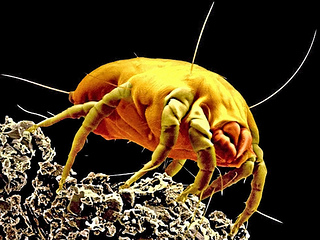
Now, I’ve known about dust-mites for a loooong time. I thought I understood what they like and don’t like – how to change pillows / bedding etc often enough to keep their numbers and, more importantly, their frass to a minimum (the eponymous dust – which is really just their faeces, dead fellows and our dead skin cells).  I knew about their relationship to asthma and other allergies and knew I didn’t really want to encourage the pests but, somehow, I’d missed this ‘new’ info the first time round (2005) so I’m glad it re-surfaced recently.

Anyone who knows me knows I am not a tidy-freak… but a made bed – yes, that was something I liked – it seems to start the day on the right note – even if I can’t manage to be tidy all day 😉

Then last week I read about what the dust-mites don’t like (example here) and what can even kill them off sometimes – drying out! It seems it is much better to let the bed get well and truly aired – they do not like that at all, they need the moisture – from our bodies – held in by the covers – and without it they suffer.

8547358930_a5fcea8434_n
Dust-Mite – courtesy Arkhangellohim via Creative Commons

It turns out that I wasn’t alone in liking a tidied bed to start the day – when this news was circulating again a week ago there were loads of comments roughly saying ‘I hear the message … but I’m still going to make my bed because I don’t like it looking untidy’

  … BUT … the dust mites !!!!

So … not a neat-freak – but yes I like the bed to look tidy. The solution?

I now swish the covers back to lie neatly folded over the end of the bed, draped to almost touch the floor – pull the bottom sheet tight and give the pillows a shake. Sometime, much later in the day, when I happen to be in the room, I will waft the covers and duvet right back over again. Tidy – Tidy. WP_20151006_10_38_07_Pro

Okay, so if I were showing someone round the house (as I do occasionally at the moment as we are ‘on the market’)  I’d make the bed conventionally – but for everyday it is fine – the day still feels like it is off to the right start… and, if the research is right, then far fewer dust mites thrive in-between our sheets.

Have you ever suddenly changed a habit of a lifetime?

What are your bed-making preferences?

Do share – you know I love to hear from you

error

Enjoyed this blog? Please share :)