{For previous posts on the history of this area see St. Dominick History tab under ‘History – local and everyday’ Topic}
Staying with our ‘pulled out’ focus we can see the only really local evidence of occupation in the Bronze Age (2500 – 800 BC). Up on Viverdon Down are a number of Bronze-Age bowl-barrows (burial mounds) Note: Barrow-burial is on a continuum from late Neolithic and through the Bronze-Age, and it has been noted in ref (3) that these would have also been visible from Balstone down. See map below

Cornwall Council Strategic Historic Environment Service in their article on Bronze-Age monuments in Cornwall states “Some mounds are probably burials of important people. The largest barrows are in prominent locations on hilltops and ridges. The smaller barrows, which do not normally survive in lowland Cornwall, are inconspicuously sited amongst the fields and near the contemporary settlements.” and “We can conclude that the many barrows found elsewhere in lowland Cornwall (eg. Cubert Common, Veryan Beacon) would have had round house settlements close by which are not now visible.” (1)
St. Dominick counts as ‘lowland Cornwall’. The earlier Bronze-age settlements were up on what we now term moorland – Roughtor, for instance, had a very large settlement, Bodmin Moor had many and their field systems can still be traced by low stone banks. The thought being that, as the soil in these areas became degraded by over use, they had to move onto the lower land, setting the pattern for farming today. Most lowland settlements, therefore, would have been created in the Middle Bronze Age (circa 1500-1200 BC) and were collections of circular houses.
However, their monuments (the burial mounds) were still usually situated on high-ground where possible, as Viverdon Down is.
Historic England records this listing: “Two bowl barrows on Viverdon Down, 540m north west of Tipwell Farm – This monument, which falls into two areas, includes two bowl barrows situated on the summit of a prominent hill called Viverdon Down which forms the watershed between tributaries to the Rivers Lynher and Tamar. The barrows survive as circular mounds surrounded by buried quarry ditches from which the construction material was derived. The eastern barrow mound measures 18m in diameter and up to 1.2m high, the western barrow mound is up to 14m in diameter and 0.9m high.” (2) (This is noted as a ‘legacy listing’)

Though these barrows have not been investigated by excavation the construction of them has been observed by the Cornwall archaeology Society in 1994 when they visited. “Two barrows remain as prominent surface features, but erosion is being accelerated due to continued ploughing. The latter has nevertheless revealed the structure of the barrow mounds, with turf stacks capped with (now leached) orange clay presumably dug from encircling ditches.
This degraded capping forms a near-continuous ring around the larger, more northerly, barrow. Both within this ring and outside it, dark organic weathered blocks of turf indicate something of the former extent of the stack. Between the barrows, and slightly westwards, a further area of darker material in the plough-soil suggests the former existence of a third, smaller, barrow.” (3)
Follow the link under (4) in the References to help you try to locate these on the satellite view of the area with ‘side-by-side’ maps.
The question is, where is the settlement that sited these bowl-barrows on the hill? Now, what follows here is supposition – but the landscape around the hill is, even today, sparsely populated by any ‘homesteads’ – but just off the crown of the hill (and at the edge of St. Dominick parish) is ‘Tipwell’.
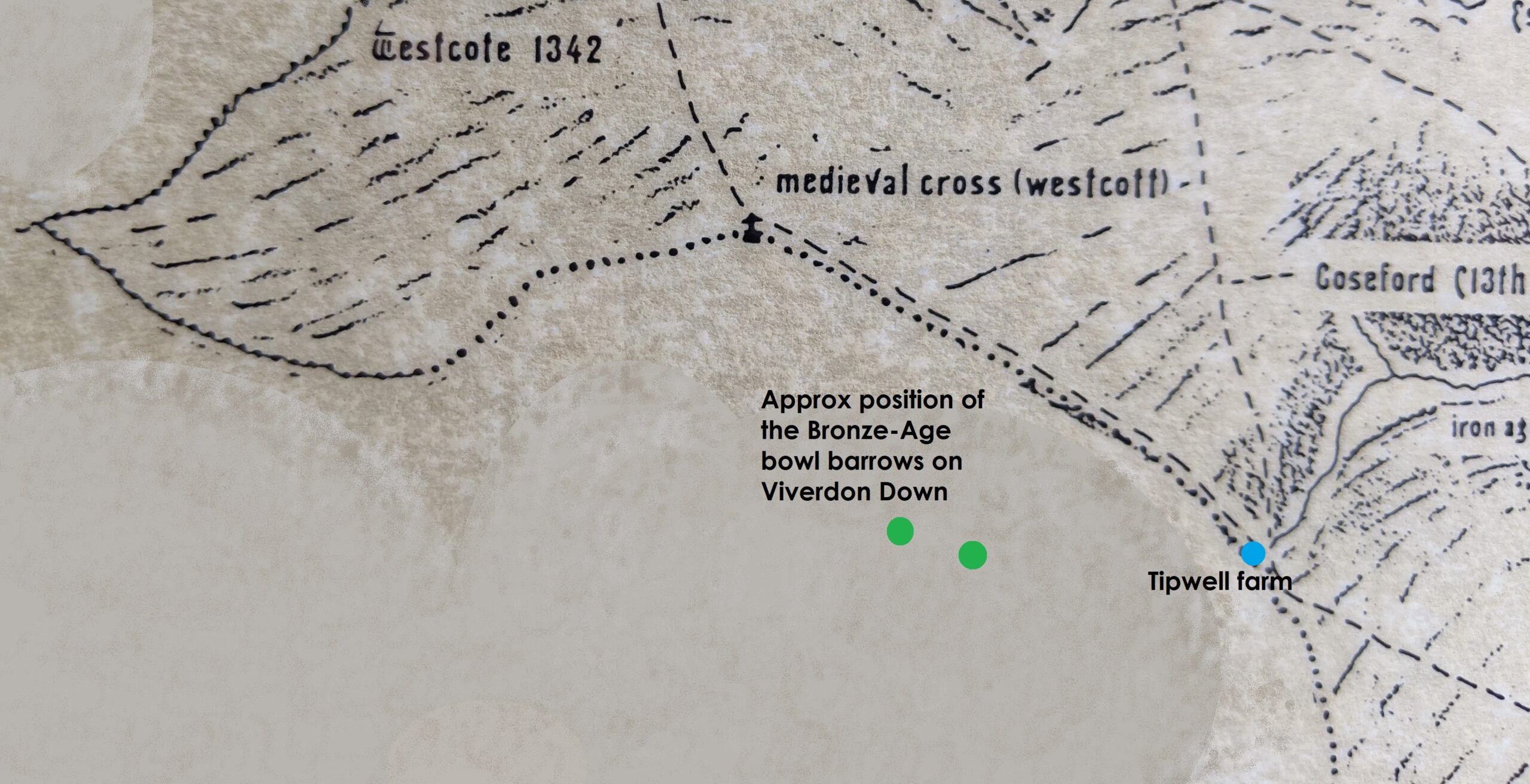
The name gives us the clue – most likely a settlement or homestead based on a well* – and it is indeed where another significant stream for St. Dominick starts. As we noted in the last part of this series – a water-source is an essential for a settlement.
*[The name Towell – further into the parish – for instance, comes from the name At-Well (or AtteWell as it was written in the Manorial records) – so maybe that this is the origin of the name Tipwell too?]
A settlement at Tipwell would also have had the advantage of being near to the route of the ridgeway – which would still have been in use at this time – and, if the hypothesis of the route also going down to the river is correct, it would be on that too – a well placed settlement.
However – as the Cornwall Council Strategic Historic Environment Service comments “the evidence of these lowland settlements have, largely, been completely ploughed away”(4) or, indeed, maybe the settlements themselves were just built over – so we may never be absolutely sure.
That is it for the Bronze-Age in our area – as nothing else has been found and recorded – unless you know different, if so, please let me know!
Did you know there were Bronze-Age barrows on Viverdon Down?
Do you have any comments on this History of St. Dominick so far?
We would love to hear from you 🙂
-Ann
References:
(1) & (4) Cornwall Council Strategic Historic Environment Service
(2) https://historicengland.org.uk/listing/the-list/list-entry/1004394
(3) Cornish Archaeology No. 33 1994
Keith Ray: The barrow group at Viverdon Down, St Mellion: some observations on 24th April 1994
(4) Side-by-side maps to try to locate the barrows on satellite view (cursor and + sign show positions on corresponding maps)
Do SHARE and COMMENT – I love to hear from you. Xx Ann
While you’re here PLEASE SIGN UP to this blog if you’d like to hear more – the box is at the top of the post on the right – Let’s keep in touch! I do not post often, perhaps fortnightly, so posts are easy to miss.
{I had been building my followers since 2011 – and had around 640 when an unfortunate technical issue meant that I lost ALL of these followers contacts – and need to start again
– so please do join to keep in touch}
ps If you are reading this on email and would like to comment just click onto the title and it will take you to the actual blog – so you can comment there.
If it is the first time you have written a comment don’t worry if it doesn’t appear immediately, your first comment has to be verified (to keep the spam-bots out) and I do this personally – so I am sure to see your comment – thanks for reading – Ann
Remember – reviews of books are a great way to say ‘thank you’ to an author if you like what they write,
Thank You