I’m not sure where September went – it seems to have gone so quickly. I know I spent a week away (that turned into 10 days because of the Brittany Ferries strike) but the end of this month still seems to have arrived at a gallop. I’ve created lines of photos this month – by way of a change.
Earlier in the month we had a few days of warm sun, some of the border flowers had a burst of colour and the butterflies (peacock and tortoiseshell) and bumble bees were out in force. There was even a dragonfly laying late eggs into the moss hanging over the edge into the pond.
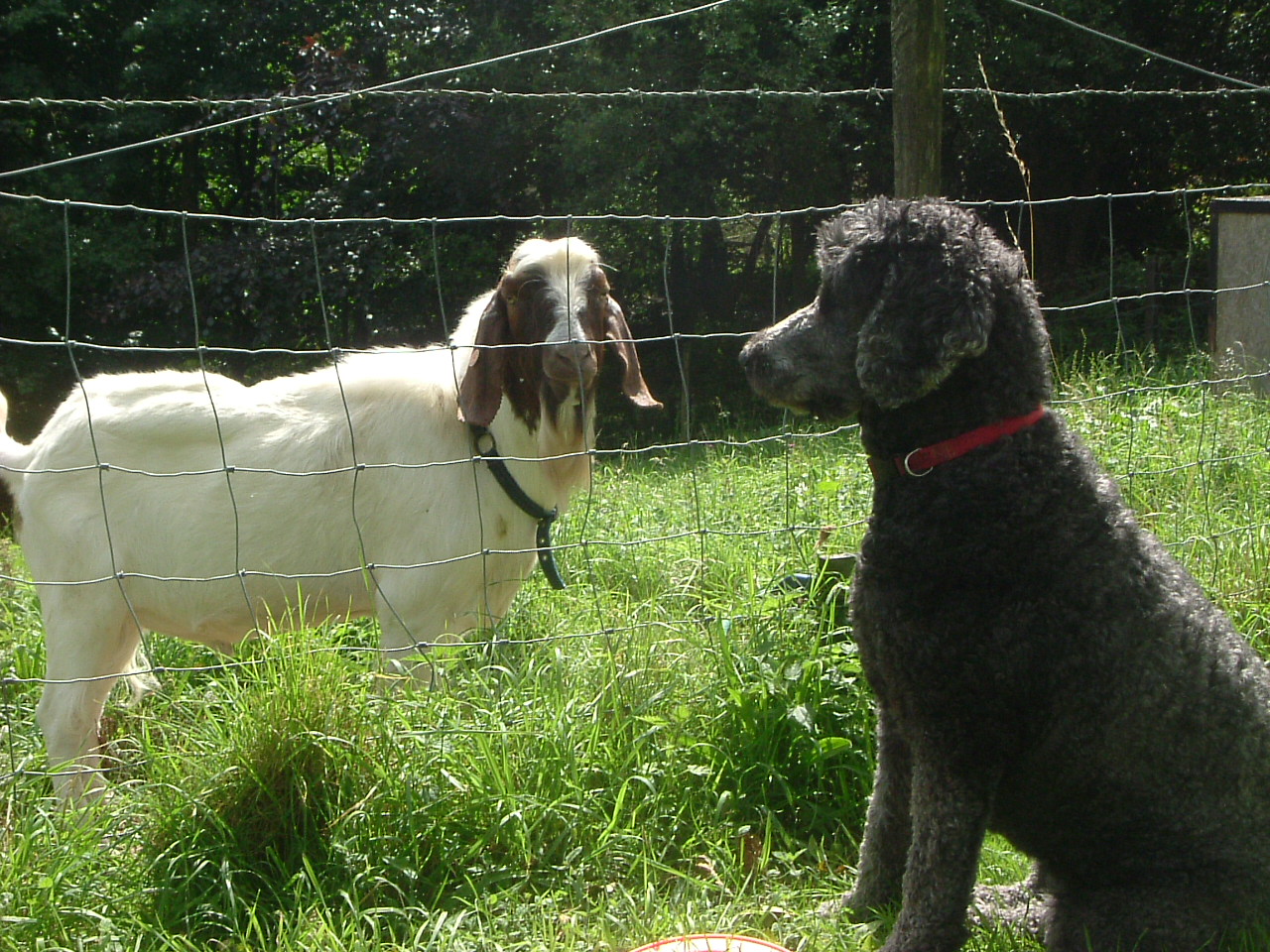
The billy goat has come into season and is making himself fragrant for the ladies ( nanny goats) Do you want to know how he does this? If you have a low ‘YUK’ threshold look away now…. ok? Apart from the scent glands on his head he also contorts himself to aim a stream of urine right at his beard. This will soon acquire a strong odour (which, apparently, the nanny goats consider a great attraction in a male) Considering the good scenting abilities of a dog I’m amazed that the dog is happy to sit so companionably close to the big feller at this time of year!
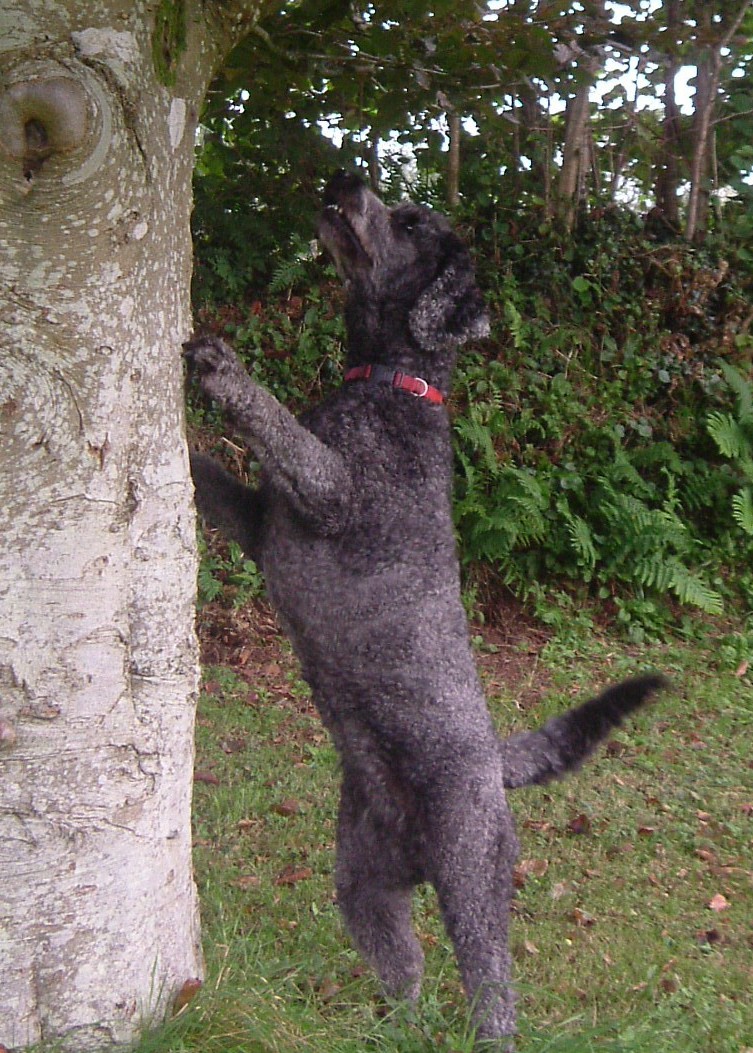
And talking about scenting – the squirrels have taken just about every cob nut from the tree – most before they were even ripe. Their trail leads across the lawn and up the beech tree – and where the scent trail follows the dog tries to go too. It’s just not fair that dogs don’t climb trees, is it?
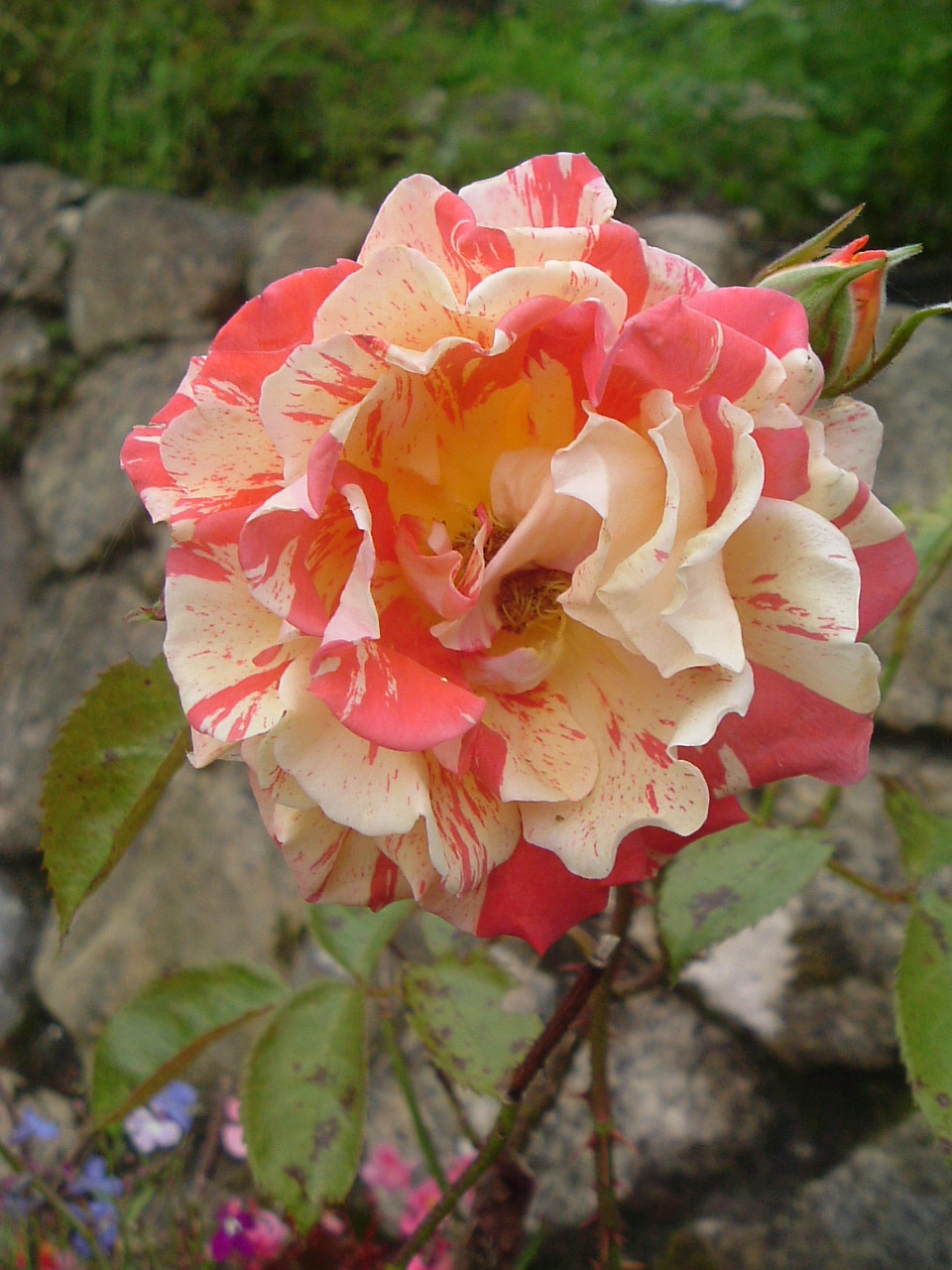
Having got over the ‘scent’ of the billy goat I thought I’d add a little fragrance with this scented late flowering ‘oranges and lemons’ rose – so pretty.
And a cucumber twin found growing in the greenhouse – making interesting figure 8 slices when cut.
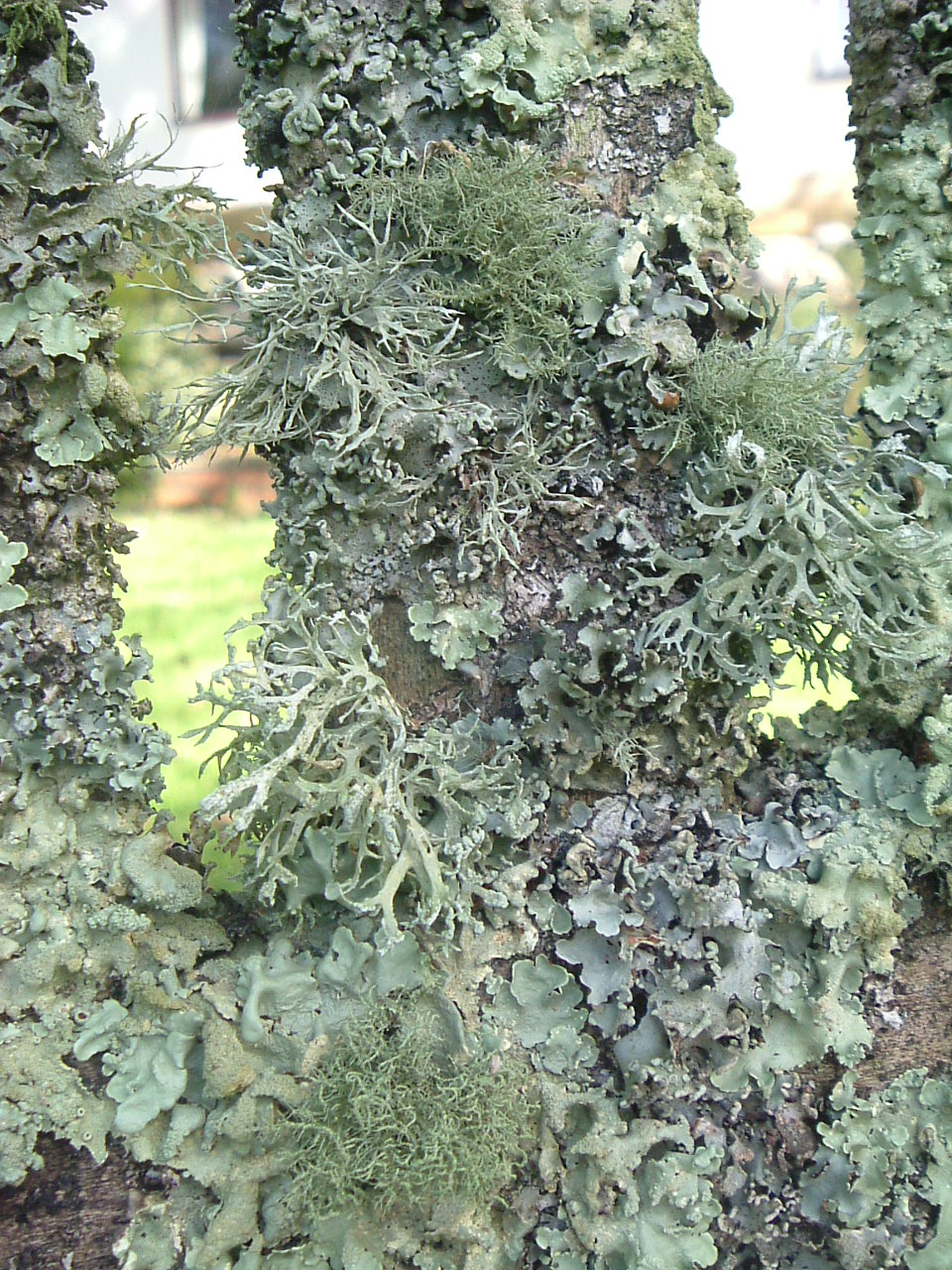
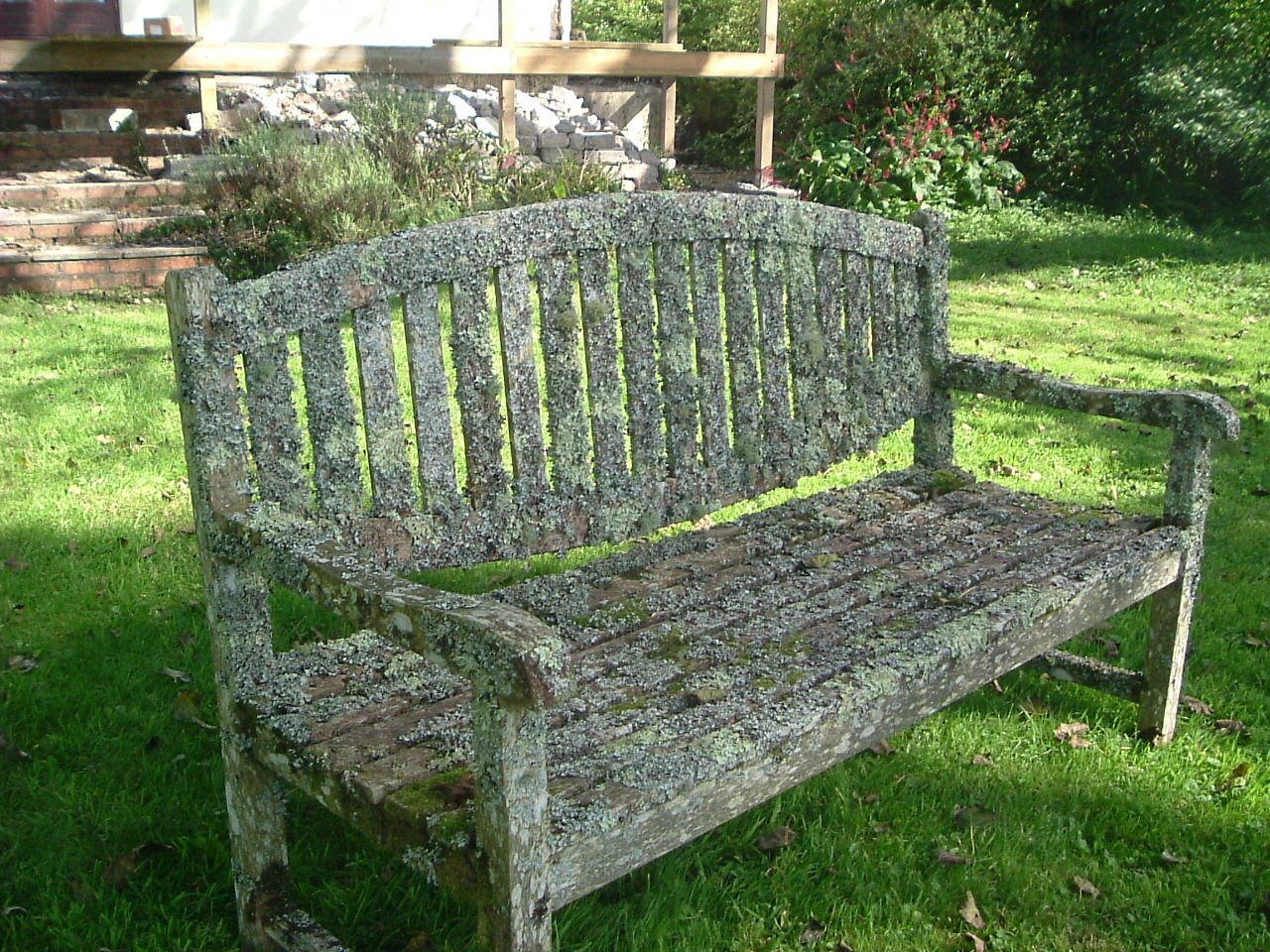
Finally, a series of photos taken of a garden seat belonging to friends of ours, a wonderful example of a good lichen habitat – the whole seat has been covered by a range of different types of lichens – quite wonderful! Front view, side view and close up of a couple of slats. These really deserve to be clicked and viewed as enlargements!
The FWT results (for the information of my cheerleaders) this week are a half pound down! So we are back on track – YAY! (after the hiccup caused by the ferry-strike-imposed inaction and junk food)
At the moment I am also thinking about Food for the poetry workshop I am leading on the 16th of October at the Landulph Festival of Music and Art where I shall be encouraging poets to use foody metaphors and experiment with new ways of describing their experiences. Then, later the same day, I’ll be reading with the Liskeard Poets – if any of you are close enough to come along I’d love to meet you there!
How was your September – did you see anything interesting in the world of nature? I love to her from you – please do share 🙂
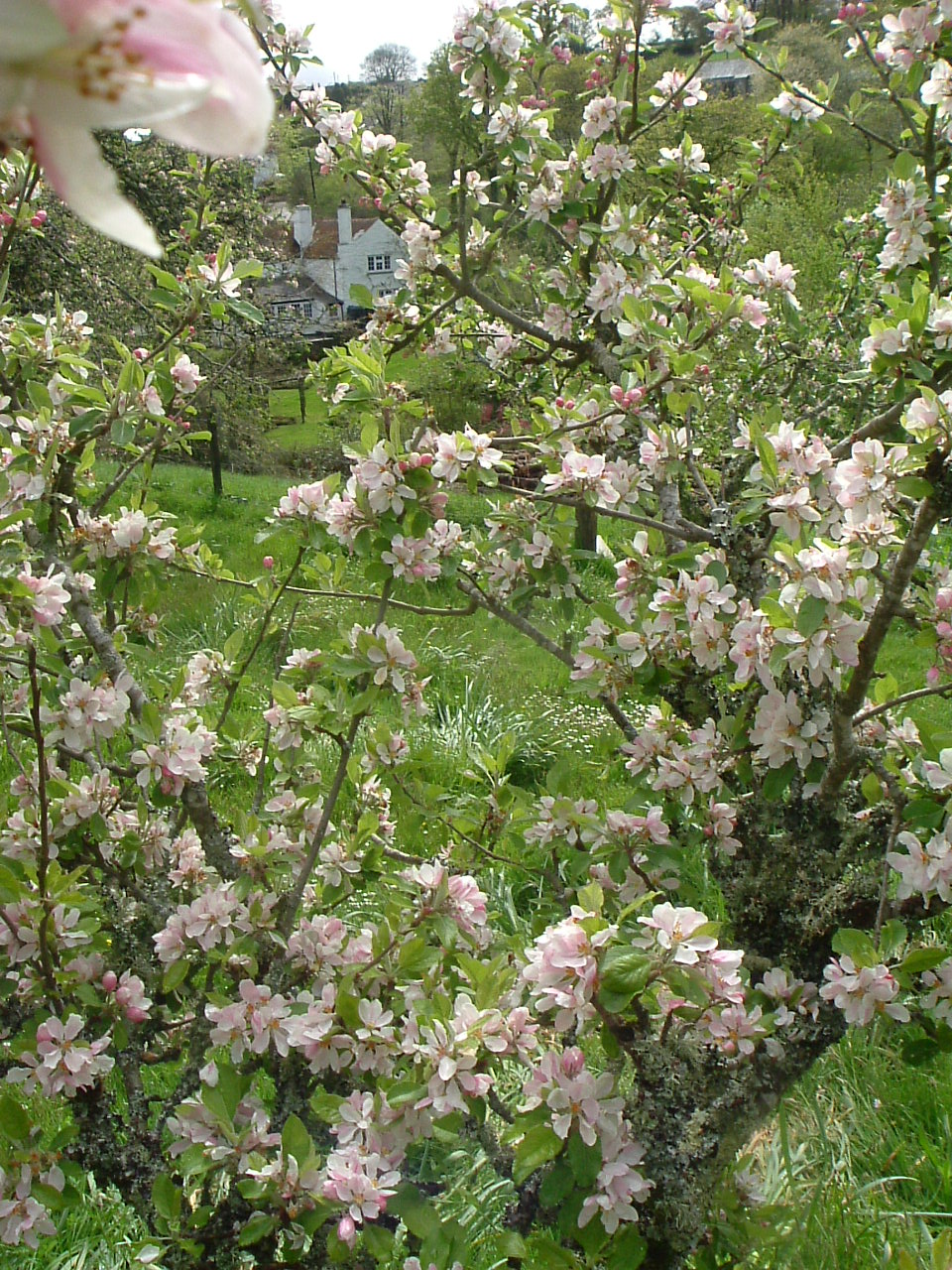
We all know what rubbish weather we’ve had for an excuse of a summer this year – but it has taken its toll on nature and the garden. So this week’s nature notes come as a look at fruit. In our village we are lucky enough to have an apple-pressing business, where you can take your surplus apples and for a reasonable price have them pressed, the juice pasteurized so that it will keep, and bottled. Last year there were so many apples we had a few extra bottles done – just as well as this year’s apples do not look good at all! In spring I took pictures of trees laden with blossom – and then it rained, and rained! Some of the blossom was early enough and has set – so we will have fruit from a couple of varieties, other varieties it’s a case of spot the apple. On top of this, some that did set well have now started to split. Whether this is because of a the repeated pattern of a few hot dry days followed by a week of wet I don’t know, but the toll on the apples is high. Add in that apples which seemed perfect but are unfortunately close to a suitable perching-upon twig, are being attacked by the birds – now, before they are ripe!
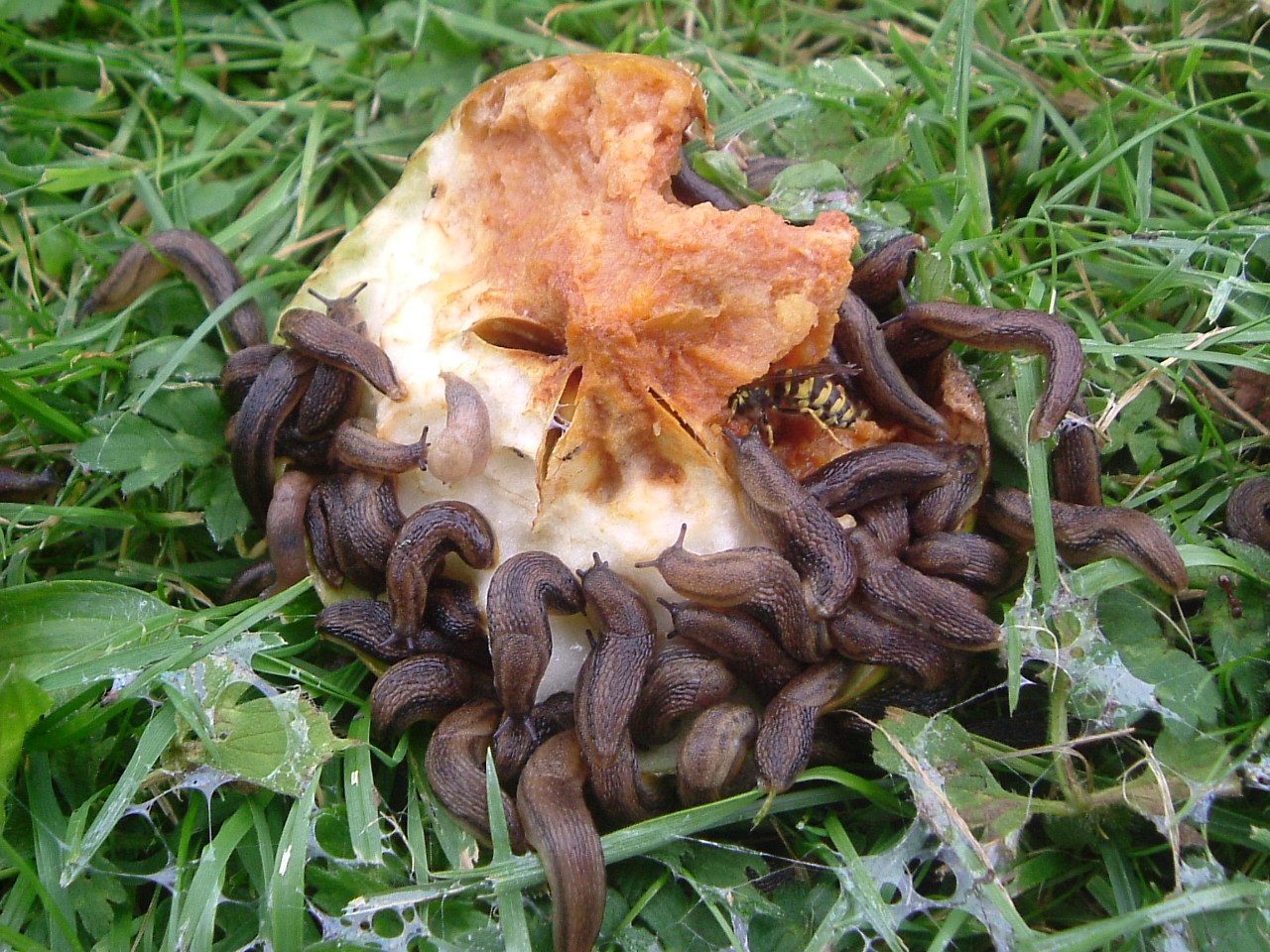
And before I move on from apples – fallen ones also provide a feast for other wildlife. First the rabbits come along and nibble them, characteristically leaving one chewed flat side. Then the wasps find this opened juicy treat, then as evening comes on the slugs come out to play gorge. Last summer we also had a glut of bullace ( a wild plum that grows in our orchard hedge) and I created a microwave recipe for making jam from them. This year I won’t have enough to make jam from them that’s for certain, and again, many are splitting before thay are fully ripe.
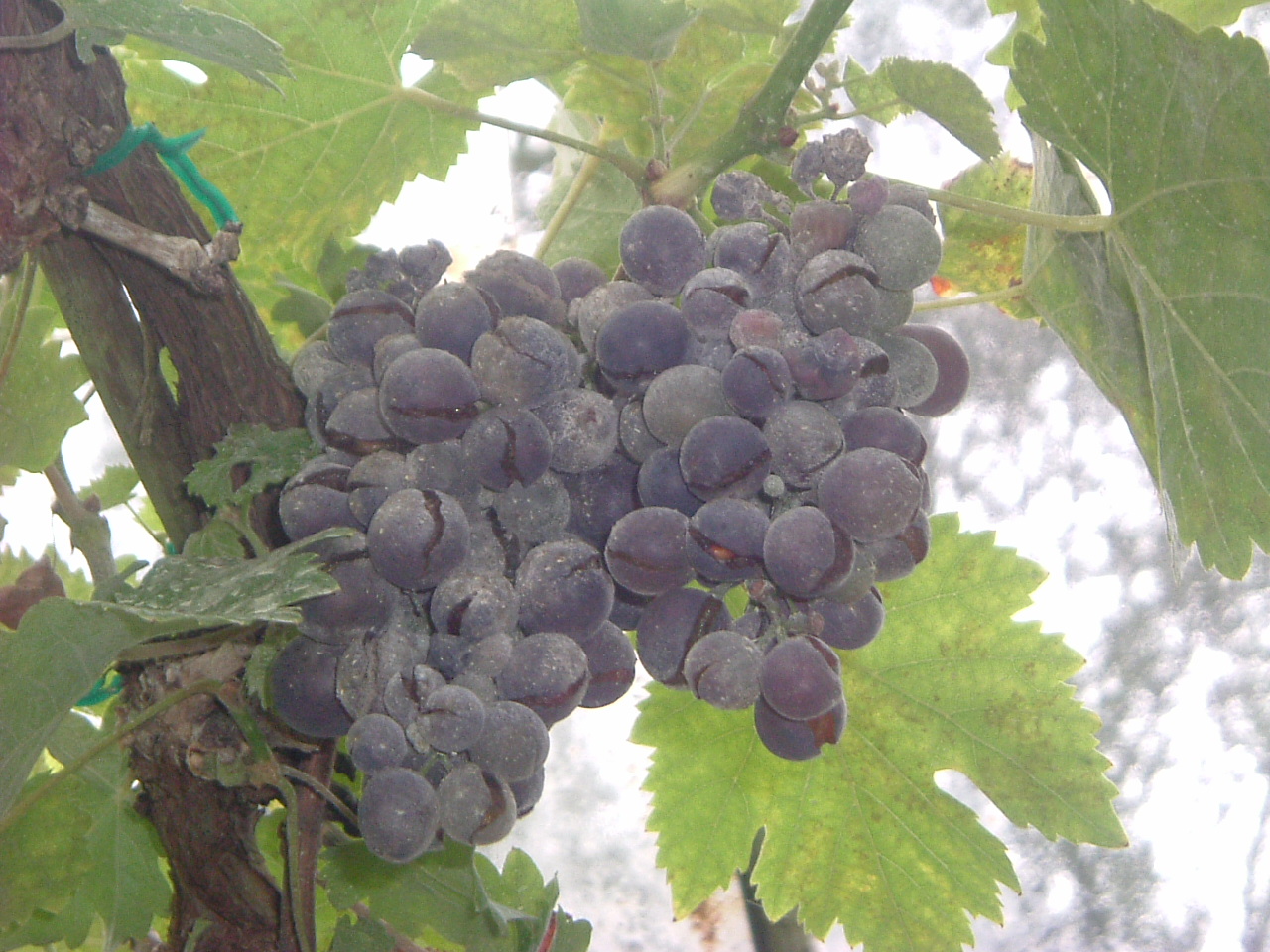
And even in the green house the trend goes on – the grapes are a wipe-out as they have split this year too – and though the interior conditions are controlled the ‘watering’ isn’t as the roots of the vine are outside in the ground, as recommended.
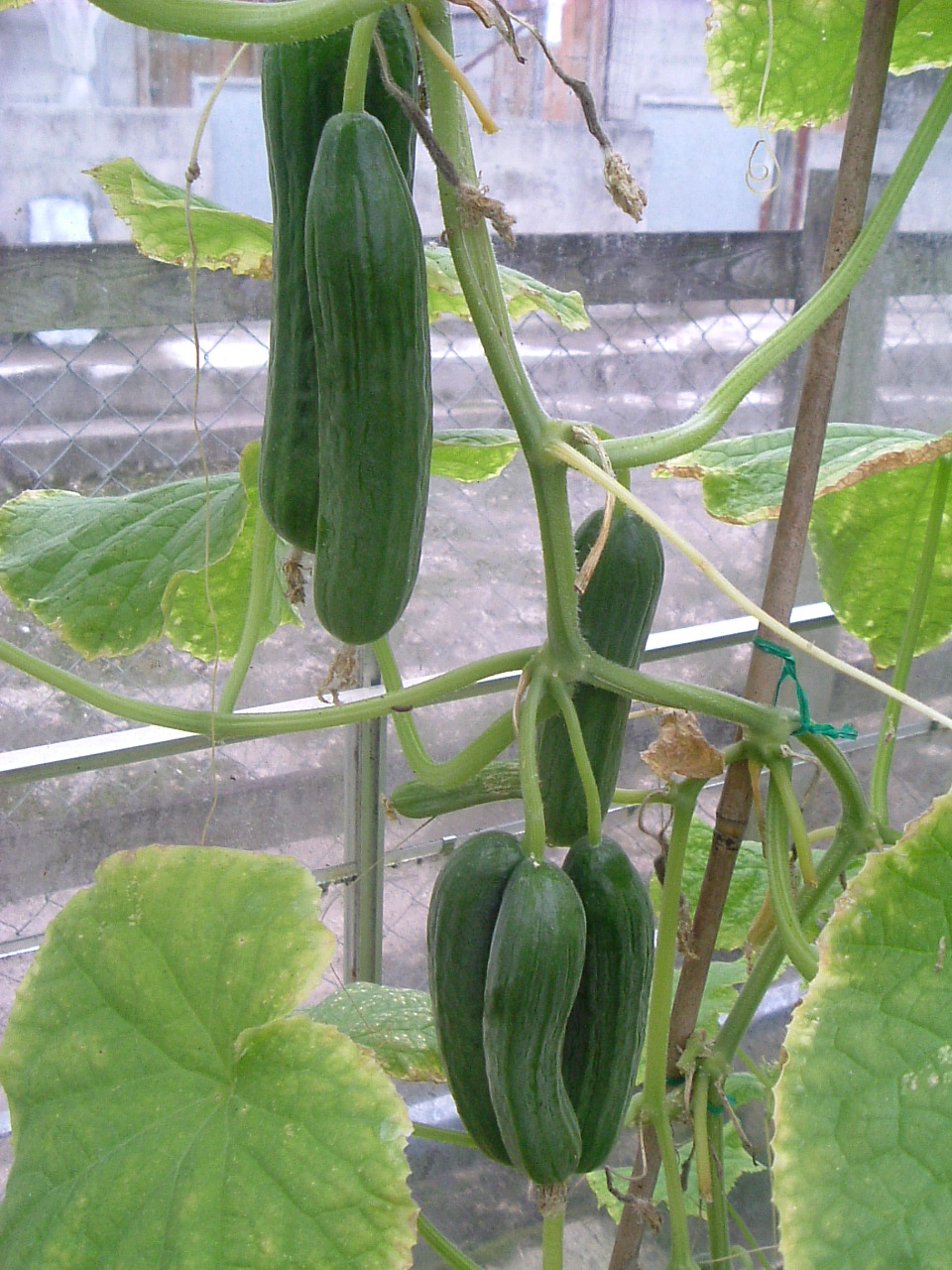
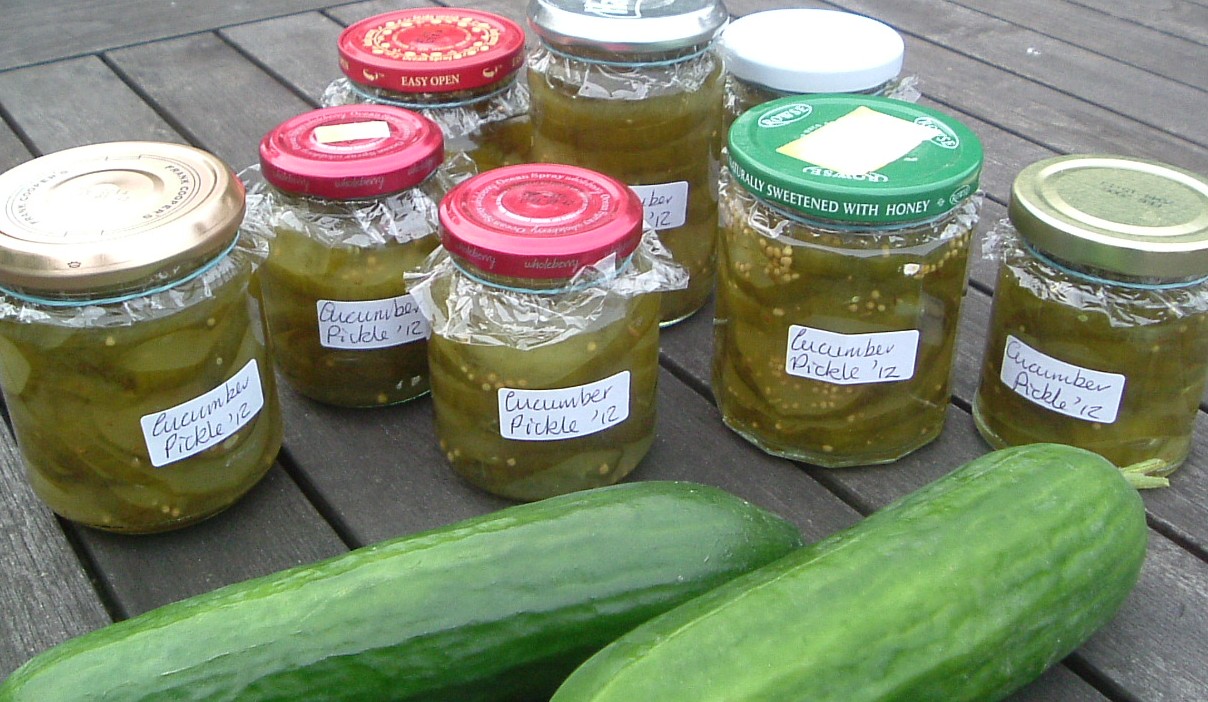
Inside watering is controlled – and even though the grapes are in a bad way the cucumbers are going bananas – and growing like grapes in bunches. So much so that I have made sweet cucumber pickle from some of the excess. And in my usual way, having an ingredient missing (celery seeds), I substituted another (cumin seeds) and have created a ‘warmer’ cucumber pickle. If you are inundated with cucumbers the recipe is on the Recipe drop downs from top bar.
The winner of an ecopy of ‘Nothing Ever Happens Here’ for correctly identifying the caterpillar last month goes to Liz Gentil and the caterpillar was the voracious Mullein Moth caterpillar Cucullia verbasci
And for my FWT cheerleaders the results for the past week are – weight the same and measurements the same as last week. Could it be the picnic party I went to on Saturday? We will see next week.
Again– an urgent message for DeborahKennedy2@…. please contact me back before 10/9/12 after which I must deem that you have refused the prize offered and make a re-draw.
What changes in nature have you noticed with the changes in weather? How do you deal with excess produce in the garden? I love to hear from you on the blog – click on the title if you are reading via the email and it takes you through to the main blog where you can add comments!
At last some sun.. even though we had to get almost three-quarters the way through July to get it! I’m going to start by letting you all know what the answer was to the picture quiz in last month’s Nature Notes. Here is the same spray now ….
The answer was Kiwi Fruit !! And I shall be sending ecopies of Some Kind of Synchrony to all three who guessed correctly! The fruit still have got quite a way to grow but you can see what they are already.
And if you are here looking for the results of my Win a Kindle draw (drawn 10th July) click Here
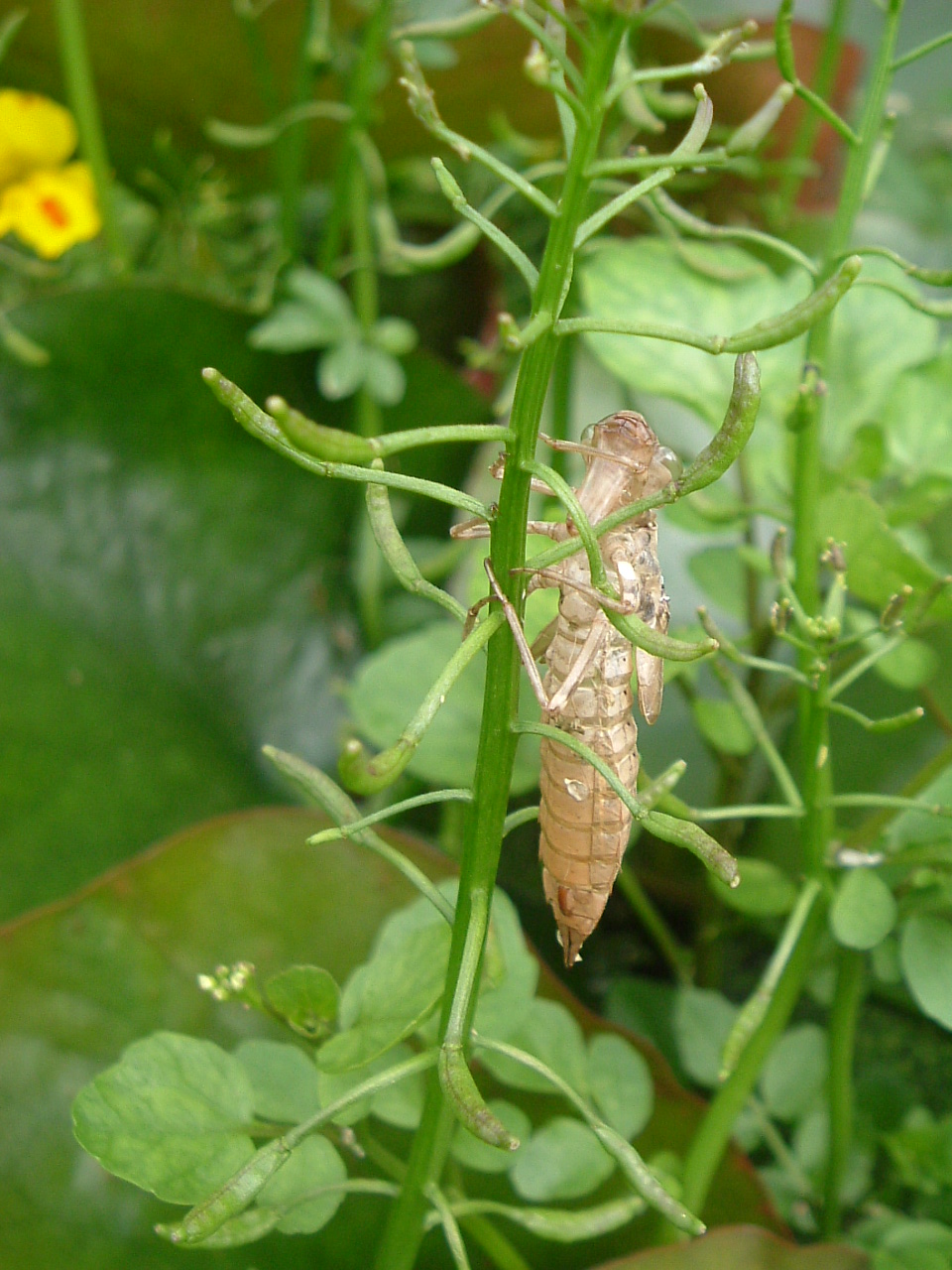
While back in the pond things have been stirring and the dragonfly larvae have been crawling out of the pond to breakout of their last larval skin and turn into dragonflies. I spotted this ‘case’ still clinging to the pond plant it climbed out on. The dragon fly larvae have been described as the ‘tiger of the pond’ as they are fierce predators taking down tadpoles and small fish. Some years there have been huge numbers in our pond but in recent years they have been few and far between. Perhaps this year is the start of another rise in population. Watch out tadpoles!
Meanwhile the more delicate cousins of the dragonflies, the damselflies, were making sure there would be other types of larvae in the pond too – here two of the common Large Red damsel fly, mating. You’ll really have to click on the picture to see them clearly in their attractive red livery.
You just have to see this! One morning I was called out to the patio with ‘Come and look in the dog’s bowl!’ The dog has a plastic water bowl out on the patio – to try to persuade her not the drink the water from the dishes under the patio pots (doesn’t work – she still prefers this water to clean fresh stuff) and, there, sitting in her half-full water bowl was …… a newt!
I guess he thought he’d found a nice personal little pond of his own. Now this is a good twenty metres from the main pond, needless to say he was transported to the pond in the bowl and released, before the dog came looking for a drink!
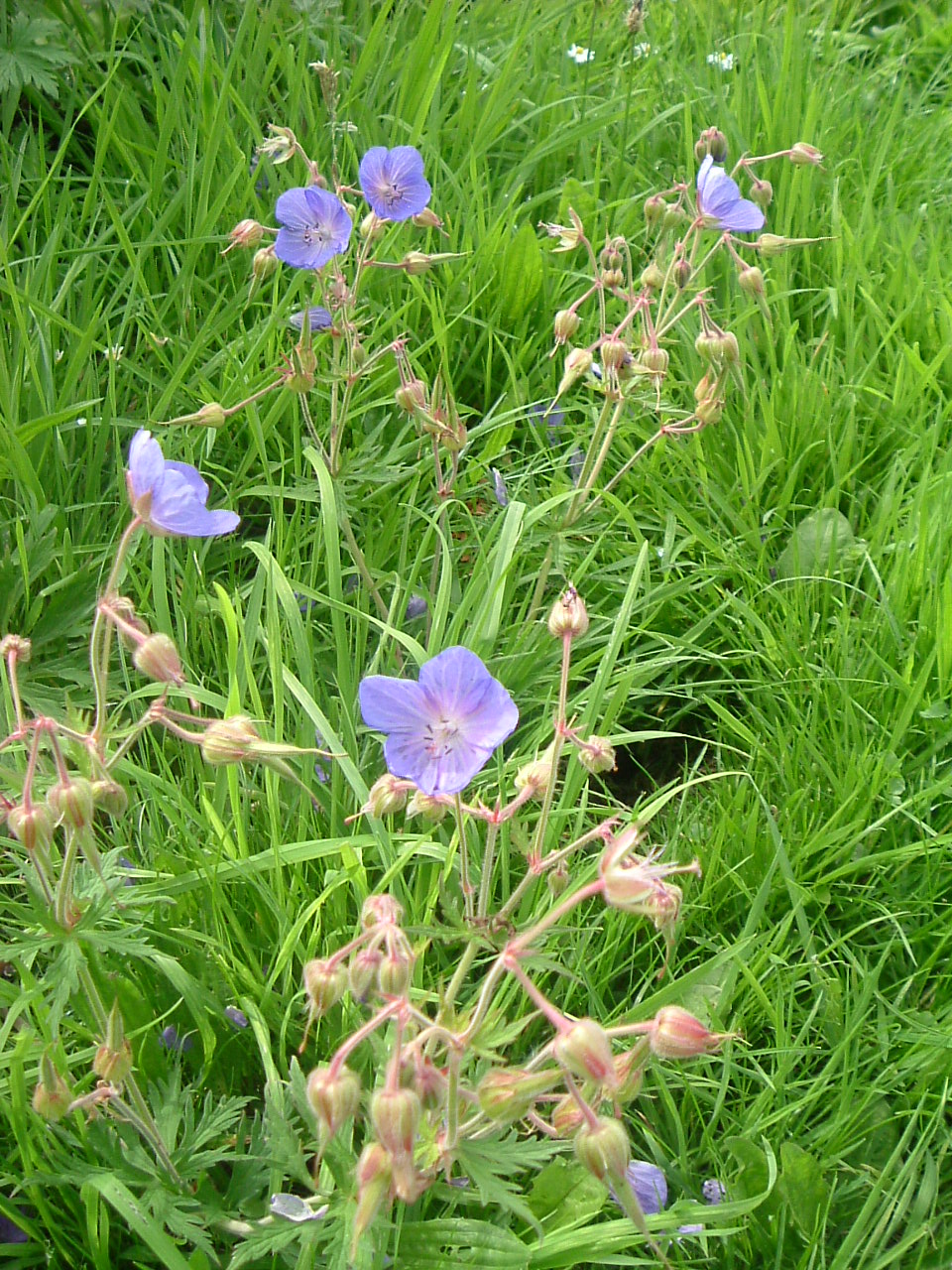
In the flora in July we’ve moved into some delicate purples, the meadow Cranesbill ( in the geranium family) and the Self-heal ( Prunella vulgaris). The latter small plant so called because it is used in herbal medicine as a poultice for wounds and abrasions and as an infusion for sore throats and more. This year it has grown in profusion looking quite pretty amongst the grass.
This week’s picture quiz is this ‘common’ beastie which I didn’t recognise who, along with his brothers and sisters, was destroying one of the perennial plants in our front border. Do you know what it is? First correct answer will win an ecopy of Nothing Ever Happens Here (as a pdf)
And for my FWT? cheerleaders – weight is now 9st. 11.5 lbs – yes – that’s down a whole pound this week! Full details on the drop-down for week 30
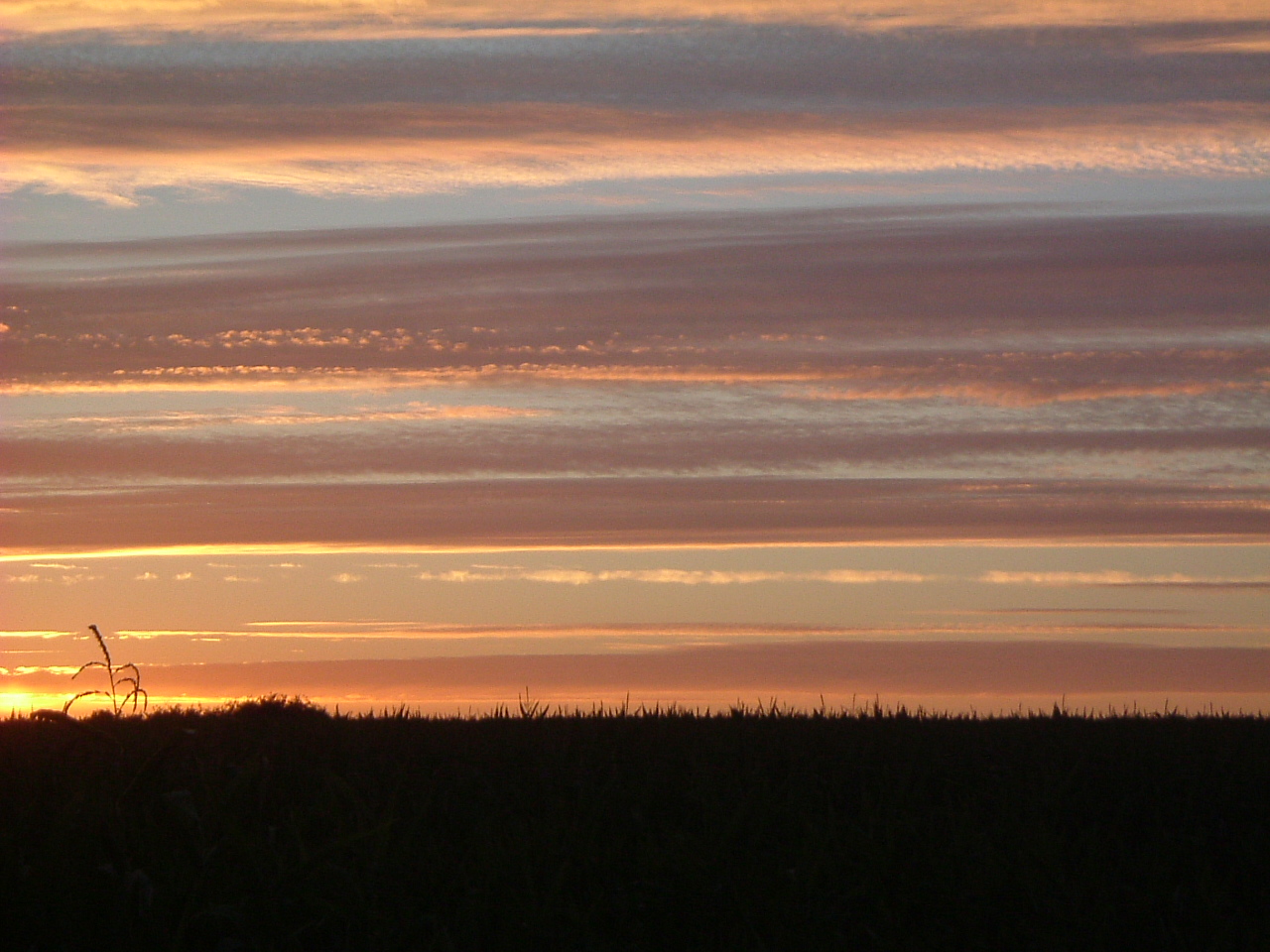
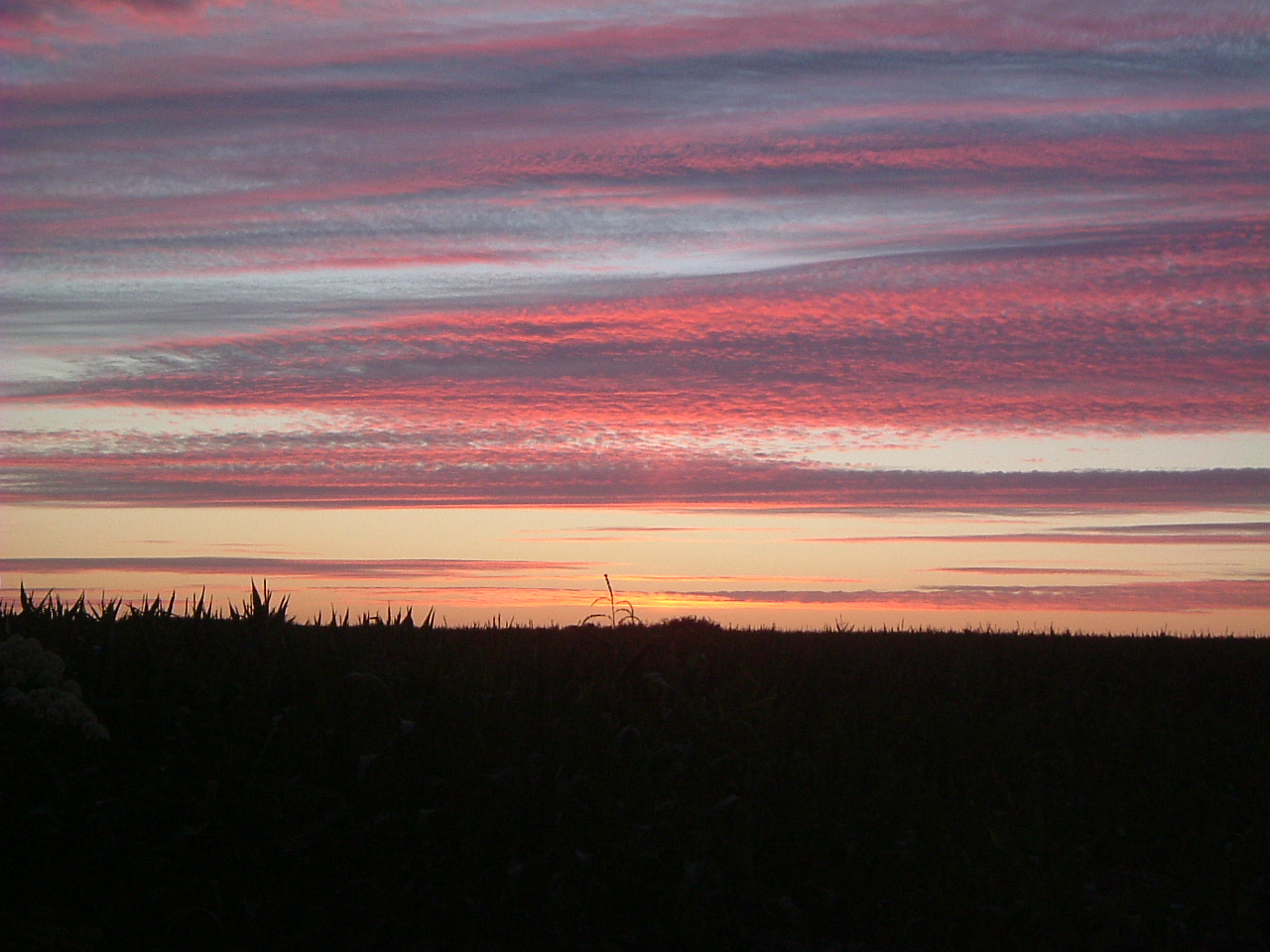
Lastly – a series of sunsets from one evening in July – not sure I’ve seen such a stripey sky before. How about you? do you just love sunsets – have to get the camera out to capture them? I love to hear from you !
One Last Chance .. to enter my Win a Kindle Draw – where there are now only 39 places left before this draw is called. If you’ve not entered, or know someone who hasn’t, then just go toWin a Kindle for all the details – do share with anyone who you know who would like a chance – before they all go! ALL GONE!!
It looks as if this June is going into the records as the wettest ever in the UK – however, nature takes it all in its stride – some things suffer and some things do better. Umbillifers and ferns and the ubiquitous and insidious bracken seem to be thriving – all working to hide the most recent flush of hedgerow flowers.
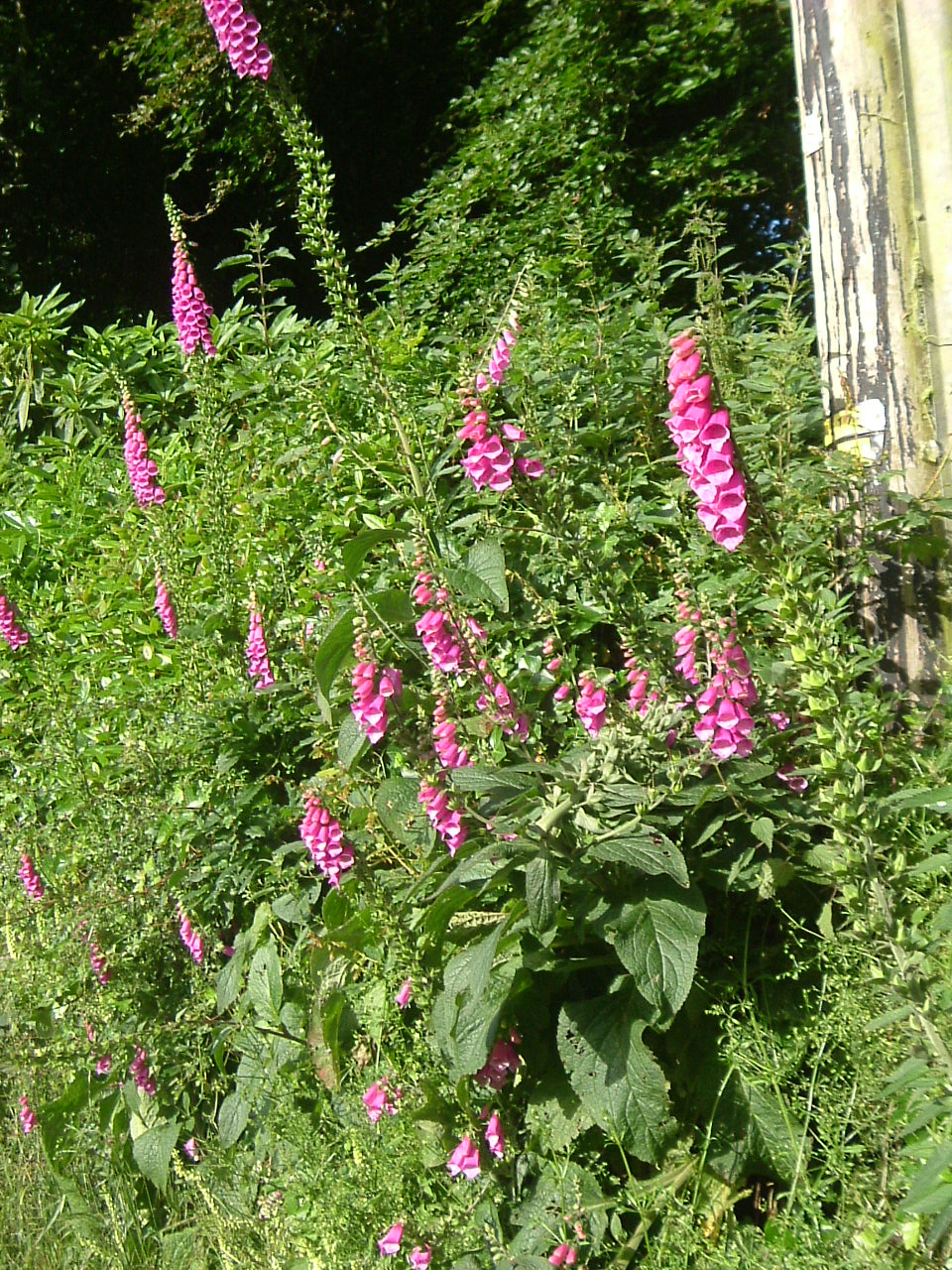
The Spires of June are the lovely-to-look-at foxgloves, Digitalis pupurea. Lovely – but both highly poisonous and a very important medication. In some unfortunate cases, foxglove leaves have been mistaken for comfrey leaves (which are a similar shape and texture before the flowers appear) and made into a ‘tea’ – with deadly consequences. Digitalin is used to treat heart conditions and has been for centuries, described in medical literature as early as 1785. Dioxigenin, found solely in the leaves and flowers of foxgloves, is a steroid used as a molecular probe to detect DNA and RNA.
In June these bedeck our hedgerows, large enough to stand proud from all the other foliage, especially in a June like this has been.
A much humbler, and perhaps overlooked, spire of June is the flower-spike of the Wall Pennywort (or Navel-wort or Penny-Pies).
pennywort - early Junepennywort late June
The names for this plant are so descriptive – the round, penny shaped leaves have a central dimple – like a belly-button and are edible. You can see where each local name for Umbilicus rupestris comes from. Many people do not even associate the white flower spikes with the flat round leaves noticed much early in the year as the leaves seem to shrink when the spikes reach their maximum.
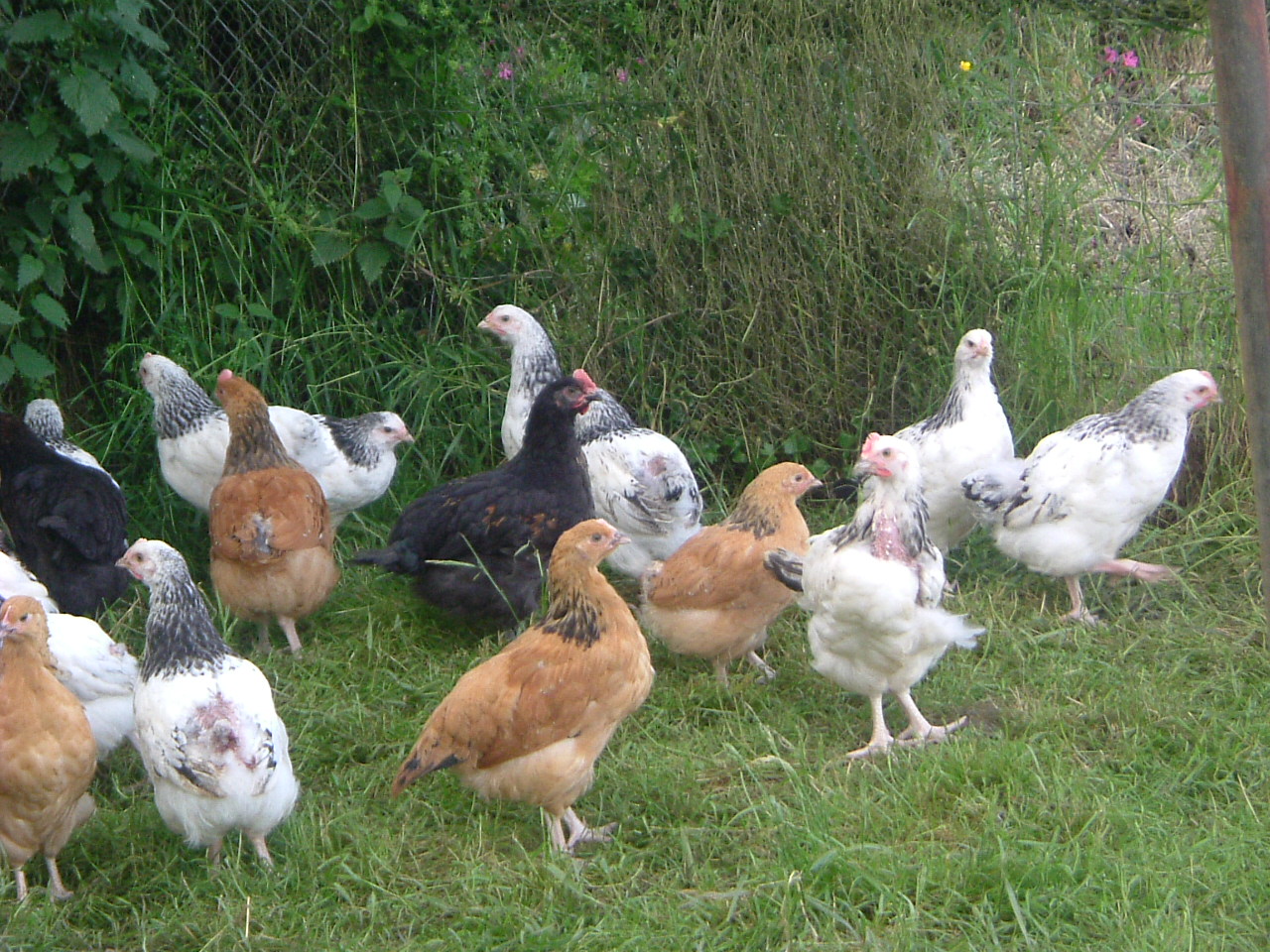
What else do I have for you for June, well a catch-up on the chicks – hatched in mid-May – might be an idea. A real mixed bunch!
And a cutie shot of one of the little billy goats enjoying the long grass. nom-nom The whole herd seem to be swimming as they wade through the long grass in the field – grass which has grown like crazy due to the extra wet, yet warm, June.
And finally – a photograph of one of our garden plants in flower – it produces fruit for us each year – though you might not expect to see one growing and fruiting so well in the UK. Any idea what it could be? Post your answers in the comments – the first correct one will get an copy of my novel ‘Some Kind of Synchrony’ (in pdf format) Want to know what Some Kind of Synchrony is about – click this LINK to read the blurb and the first 3 chapters. Answer at the end of the month.
I hope you’ve enjoyed catching up with nature in our little corner of Cornwall. What has June been like where you are? There have certainly been some sets of extreme weather in all sorts of places this year. Do tell – I love to hear from you!
OK, hands up all those who thought this was going to be a blog about the Queen’s Jubilee!
I see ….. 🙂
Anyway – this is, and on time for once, NATURE NOTES for MAY.
May started quietly enough, a few blues already in the hedges, violets, birds-eye, bluebells.
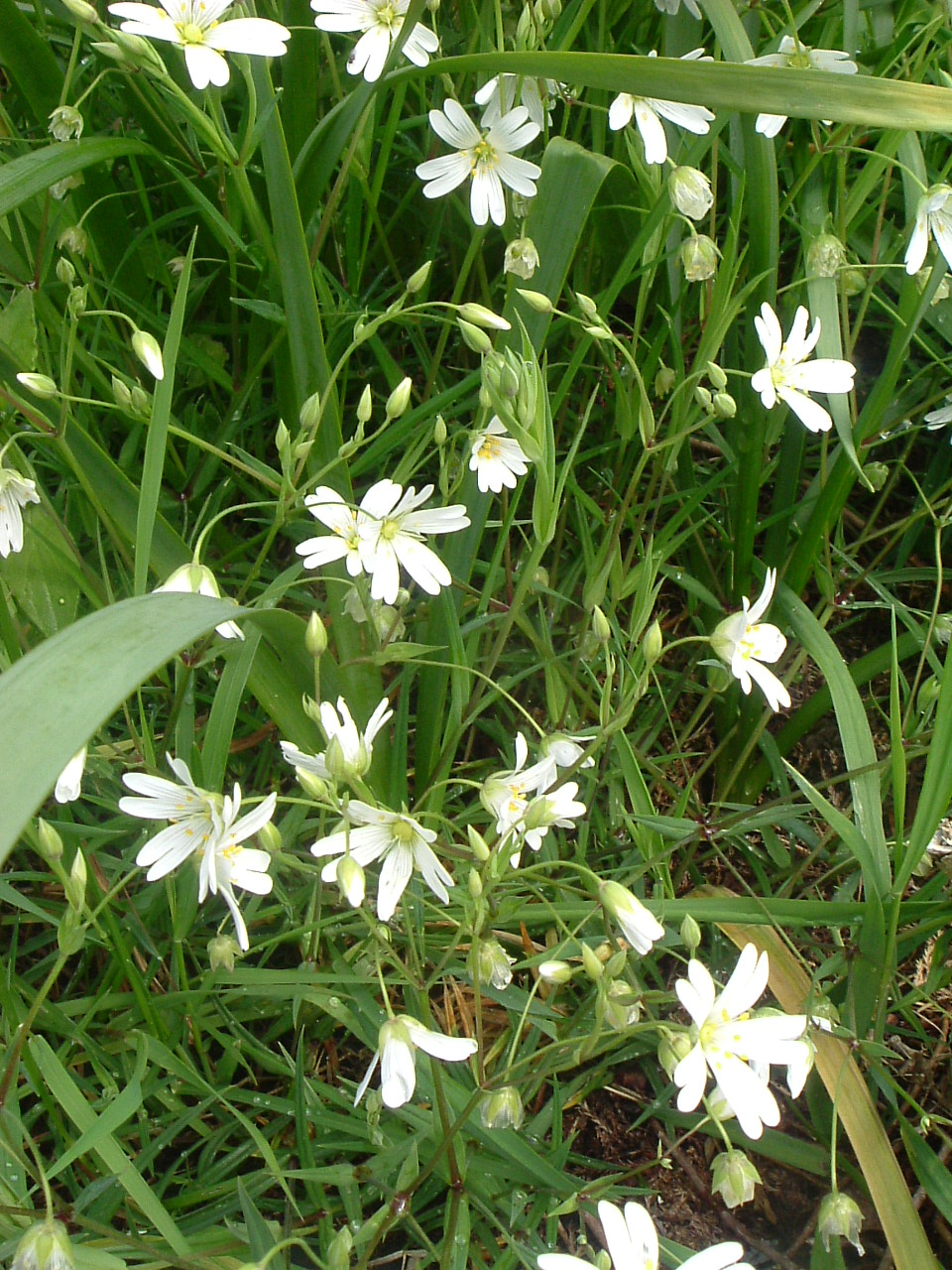
Red CampionsWhite Stitchwort
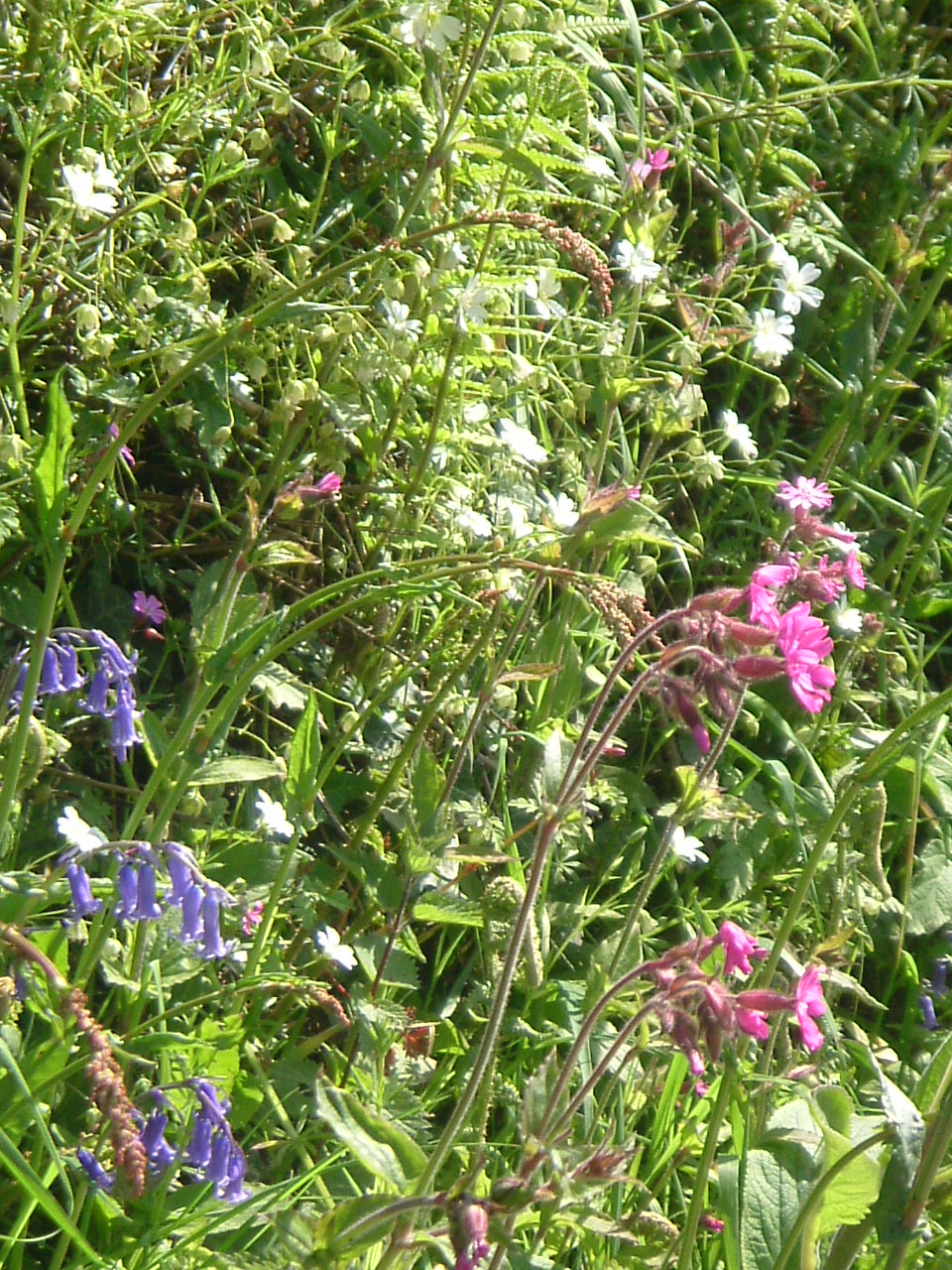
but then .. my favourite display – the red,white and blue. Red Campions, White Stitchwort and the Bluebells – all mixed together!
No matter what I do the camera cannot capture the beauty of this brief time, usually about two weeks, rarely longer, often shorter, when these three plants are most noticeable all along our Cornish hedgerows. All too soon the large umbilifers, like cow-parsley, and the ferns unfurl and take over
Cow-Parsley takes over.
Unfurling fern
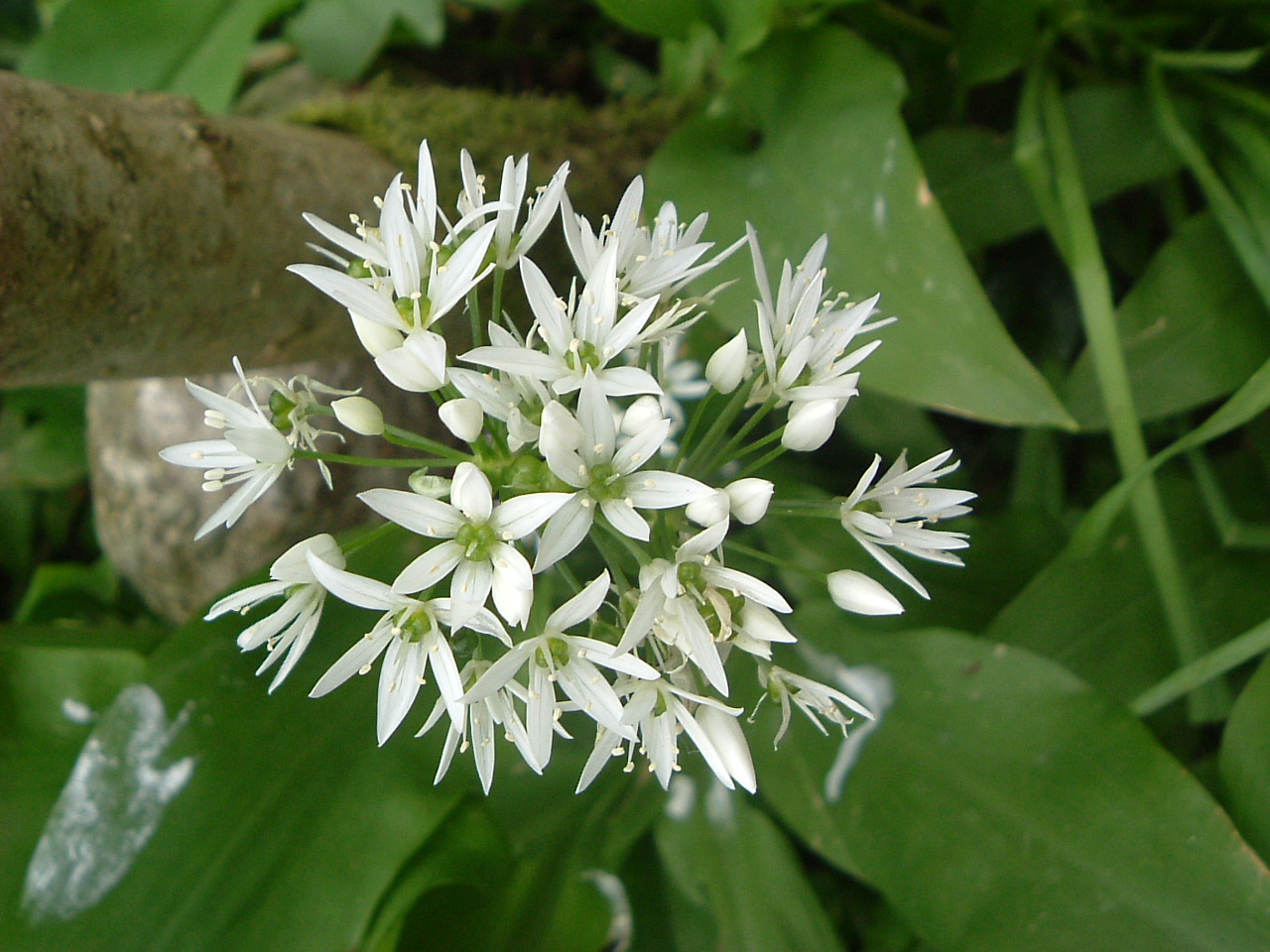
Other whites have come and gone – the pretty starry flowers of the Ramsons (wild garlic) are found in large patches in this area and even lining the lanes. I hear that they are valued in the restaurant kitchens of London … here they are abundant and free!
The other blooms that have come and gone is the apple blossom on the orchard trees, again it is brief, but the scent as you walk past a tree absolutely laden with blossom, as they were this year, is delicious!
Also in the hedgerow is this plant – known as Bastard Balm – not a common plant despite it’s name (Just means it isn’t the real balm by the way)
So that’s my cheer, Hurrah for the Red, White and Blue – colours of our May hedgerows.
And talking of Cheer – just to let all my FWT? cheerleaders know, I am now at 10st !! and my reward is a time of stabilising before I decide on the next goal! Thanks for all the cheering from the sidelines – the day by day notes will continue.
My Win a Kindle draw is still running – just – though it really is the last chance for you to let your friends and family know, as of today there are only 99 places left – Click Here for all the details!
What do you like about the month of May? I’d love to hear from you on your favourite signs of spring where-ever you are in the world!
Late again, I know (supposed to post this at the end of each month) – so here we go! Can’t resist starting with this out-of-this-world alien-like lichen in full fruiting body form! Wonderful. Please click on the picture to appreciate it in full size!
Next up is those pretty and delicate flowers of this season , the second year in a row where they have been prolific in the hedges around here – I give you the violets!
As pretty as these are, everyone knows a violet when they see one, but what about a hairy woodrush. Large patches of these have appeared , not only in the orchard, but also on a damp area of the front lawn. Small, delicate and interesting in shape.
Hairy WoodRush
Spotted in amongst the daffodils – a hen pheasant. She went on to lay a clutch of eggs amongst the daffodil stalks in the orchard, not too clever in an area where a labradoodle roams. She’s moved on to a wooded area nearby now
Hen phesant amongst daffodils
And, I know it’s not wild, but above these daffodils is the magnolia, casting its beautiful light.
A quick catch-up on the goat kids.. oh yes — they are still feeding ….
Cute or What?
Our Light Sussex Cockerel
And here’s the chicks’ Daddy (well of some of the chicks now hatched) handsome fellow, isn’t he?
some of the chicks in the brooder
And here’s some of the chicks, a total of 31 only this year – lots were not fertile at all.
So great to share some of the nature notes from around our little corner of Cornwall and our smallholding. And so great to share the wonderful Free Draw to Win a Kindle or one of four other prizes including an AnnMade slate cheeseboard and ecopies of my three novels. If you’ve already entered (if not – why not – it only takes a sign-up to this blog) please share the good news and let all your friends and family know so they can enter too. And good luck to you all – a lucky five people out of just one thousand must win something but there’s only 269 places left as I write, so hurry.
Do you like taking photographs of nature – what was your favourite picture of? I love to hear all your comments.
For the past twenty days I have been turning eggs.
eggs being collected - turned each day
To be more accurate, I have been turning eggs for at least ten days more than this, as they require turning once a day even while you are collecting them to put in the incubator, but these twenty days are the ones that count as the eggs incubate.
Incubator - eggs on view through window
We lay them out on trays of sawdust, marked with a O on one side and a X on the other with an arrow on one egg per tray to remind me which way to turn them*. Over twenty years ago we bought a large, second-hand paraffin powered 100 egg incubator. This old beast has been temperamentally incubating our eggs each year ever since.
eggs in the incubator tray - thermometer held at top of egg level
Modern, and expensive, incubators automatically turn eggs for you, each of our eggs has to be turned over, morning one way 180 degrees, evening back the other way the same, gently by hand, rotated not flipped. *(Though this is to prevent the yolk from settling on one side of the egg it’s not a good idea to keep rotating in the same direction as this can create a ‘spiralling’ effect on the contents)
Though there are about 80 eggs in the incubator they are not all from our own flock, which we have reduced to just seven laying hens, as the maximum premium collection time is just 10 days and they don’t lay quite that many! So a number of the eggs are from a friend’s flock of mixed hens giving a wide range of shell colour (and eventually, we hope, chickens)
And that is it – not counting your chickens until they have hatched! One thing you learn in doing your own incubation of eggs is that the number you get out bears little resemblance to the number of eggs put in. So, we wait to see …
Rhubarb and fronds of Sweet Cicely
Another harbinger of spring for me is eating the first rhubarb of the year – slender, tender stalks of fresh rhubarb sweetened by laying a few fronds of Sweet Cicely over them as they cook. If you have never come across this amazing natural sweetener then be prepared to be amazed, I was! A friend at the market gave me a couple of uninspiring looking roots, which I planted and which took (I am not green fingered, so this was a bonus) and grew these delicate cow-parsley-like fronds. A few of which, laid across rhubarb or cooking apples, will lend them such a sweetness that no added sugar is necessary! You just lift the fronds off after cooking and dispose of them (into your compost bin of course).
Now for the Hungry Questions – then a little goat-kid video about it …
If you have been following my Fat Woman Thinning? posts you’ll know I’ve said you shouldn’t go hungry between meals – I know – counter intuitive isn’t it.. I mean, what diet ever said you shouldn’t feel hungry. (BTW if you are following the results from last week are on the FWT? drop-down – 1lb down!)
Anyway, I’ve been thinking how you know when you are hungry.
Fact is half (or more) of the times that you think you are feeling hungry; you are actually thirsty. Doing the resistance weights course you are advised to make sure you drink plenty of water anyway – it helps metabolise the fat your body is burning. And I have said I always drink a glass of water about 10 minutes before I eat a meal, it cuts out the ‘thirst’ part of ‘feeling hungry’ and perhaps helps you feel full earlier so you don’t tend to overeat. So, first stop when feeling ‘hungry’ is to check you are not thirsty. (NB. it is possible to over-do the water – be sensible about it)
Then there is the ‘bored’ sense of feeling hungry. Yes, if you are bored sometimes your brain suggests that you might feel peckish … So, if this is the case you need to ask yourself – do I feel hungry just because I am feeling bored? And if answer is ‘yes’ then go and do something well away from the temptation. (difficult, I know, if you have to be working in the kitchen) My main ‘bored’ time for ‘feeling hungry’ is often while I am occupied – with doing the boring work of cleaning, but now I recognise the signs I can easily fight them and will have my ‘safe munchie’ (safe for me – as one is usually enough) of a cube of plain chocolate and a brazil nut with some hot water and milk to drive away that hungry feeling.
Ok, so you are not thirsty and you are not bored, and there is pudding on offer after your meal. Do you eat it? Are you still hungry or is it just ‘habit’. Do you ‘always’ have a dessert? Now, I love a dessert – especially with fruit – and cream oh and sometimes meringue too! So, if it is just habit but you don’t want to cut out your lovely puds then pop it away for an in-between meals snack. No, you wouldn’t want to do this everyday with a high carb pud – but a plain yoghurt or stewed fruit (with sweet cicely) would be great.
Lastly there is the ‘am I hungry or am I just tired’ question. Yes, feeling tired can trigger a feeling that you are hungry, that you need a ‘quick-fix’ and you will crave the sweet high carb foods. Ok, so you may not be able to take a ‘power-nap’ (ten minute shut-eye) but if you can this may sort the problem. Otherwise resort to the drink and your safe munchie solution, combined with doing something that occupies your mind happily and you may get through until you can get enough sleep not to feel tired.
I guess these two might be hungry! They nearly have lift-off!
and maybe you might just be hungry too, look it’s lunch time already!
But before you go and eat – have you entered my great Draw to win a Kindle or 1 of 4 other great prizes, including ecopies of my three novels … and if you have, have you made sure all your friends and family have entered.. there’s only 398 places left so don’t delay click here for all the details. And as always – I love to read your comments on whatever part of the blog interestes you!
Nature Notes for March (very late – sorry – please see last blog for my excuses) and Week 15 FWT?
Our parish hedgerows look stunning at this time of year, and behind their beauty lies a small bit of local history. As you drive around you will notice many of the Cornish hedgerows festooned with daffodils, ranging along the tops, dotted amongst the twiggery, pouring down the sides. So many, you would be forgiven for thinking it were some free-for-all Britain in bloom affair, but the truth lies in the War Effort.
Many, many years ago, in the early nineteen hundreds, a St. Dominick man, sending other produce ‘up the line’ to London, picked and bunched some wild daffodils that grew here. The Tamar Valley has a micro-climate and produced early strawberries and cherries, and the daffodils were early ones too. They found a ready market in London and soon everyone was growing daffodils as they became a profitable crop. This was very much a market garden parish and not only were whole fields set aside for growing daffs (and a factory set up to treat the bulbs against disease) but most people with a bit of land would grow a few rows and band together with others to send boxes of daffodils off to market.
Now, come the War and Dig for Victory, all the arable land had to be turned over to food production. The daffs had to come out of the fields, and as they were cleared they often got thrown up onto the hedges, and there many thrived, and seeded and grew until now many of our hedgerows look like the photograph (above top) in spring with daffodils in abundance.
As for those homes with a ‘bit of land’ a large garden or an orchard, well the daffodils from those rows are still there – developed into great swathes – like this one that covers most of our orchard (above).
I took the camera round the orchard on one day and took pictures of the daffodils that were in bloom that day. I have to say that many were still in tight bud and would not show for another week or two so this is not the complete range that grow here – but you can see the variety we have.
The Dog loves to cool off by lying in the daffodils (though it makes a mess of them!)
So my much belated March Nature Notes consist this year of daffodils, daffodils and more daffodils.
The Not Dieting part of this blog is the Fat Woman Thinning? report for week 15, and I can claim yet another one pound loss and half an inch off the waist measurements. So now at 10st 5lbs. This is much steadier loss than I expected, especially as my weight gets further from the 12st starting point. If you are a late-comer to Fat Woman Thinning and wonder what it’s all about you can look at the FWT? dropdowns from the top bar where it will tell you the why and the how of my losing weight without dieting.
And looking at Bonny (The Dog) in the daffodils – she is very pleased her video has brought more people to enter the fabulous Draw I am holding on my blog here. You only have to sign-up to my blog to enter, though if you are on Facebook or Twitter you can have extra entries – what’s more, as soon as just one thousand people enter, the draw gets made. And what can you win? Well, first prize is a KINDLE,(Yes a Kindle!) then there’s a Nero Slate Cheeseboard, and then ecopies of my Novels: – Divining the Line, Nothing Ever Happens Here and Some Kind of Synchrony. If you haven’t entered yet – just click here for all the details, and if you have, don’t forget to spread the word – your friends and family deserve to know about this great free draw!
Does your area put on a particularly wonderful natural show at any time of the year? If so I’d love to hear about it – or any of your comments.
February Nature Notes – a round up of what has been happening nature wise in this little corner of Cornwall.
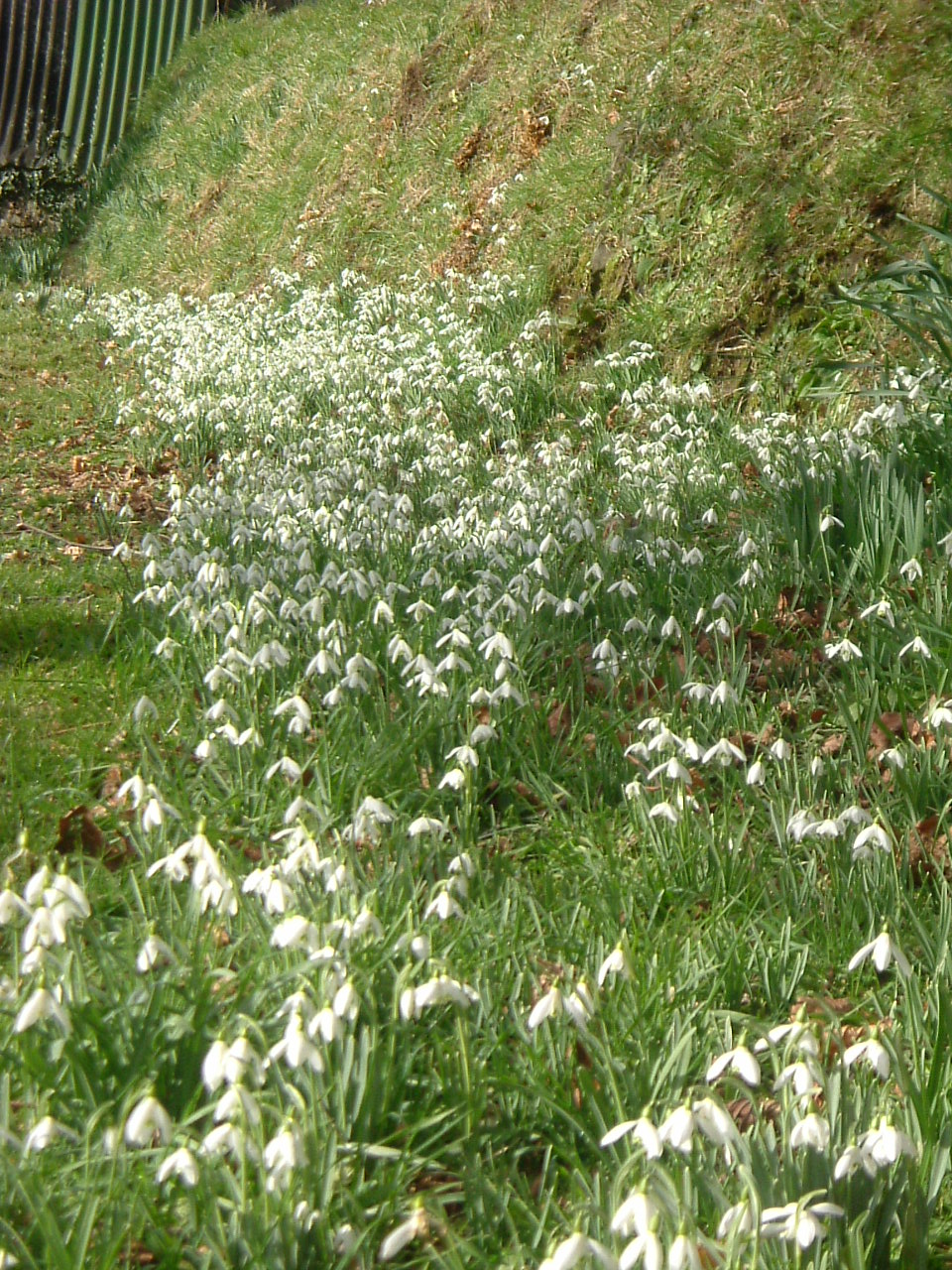
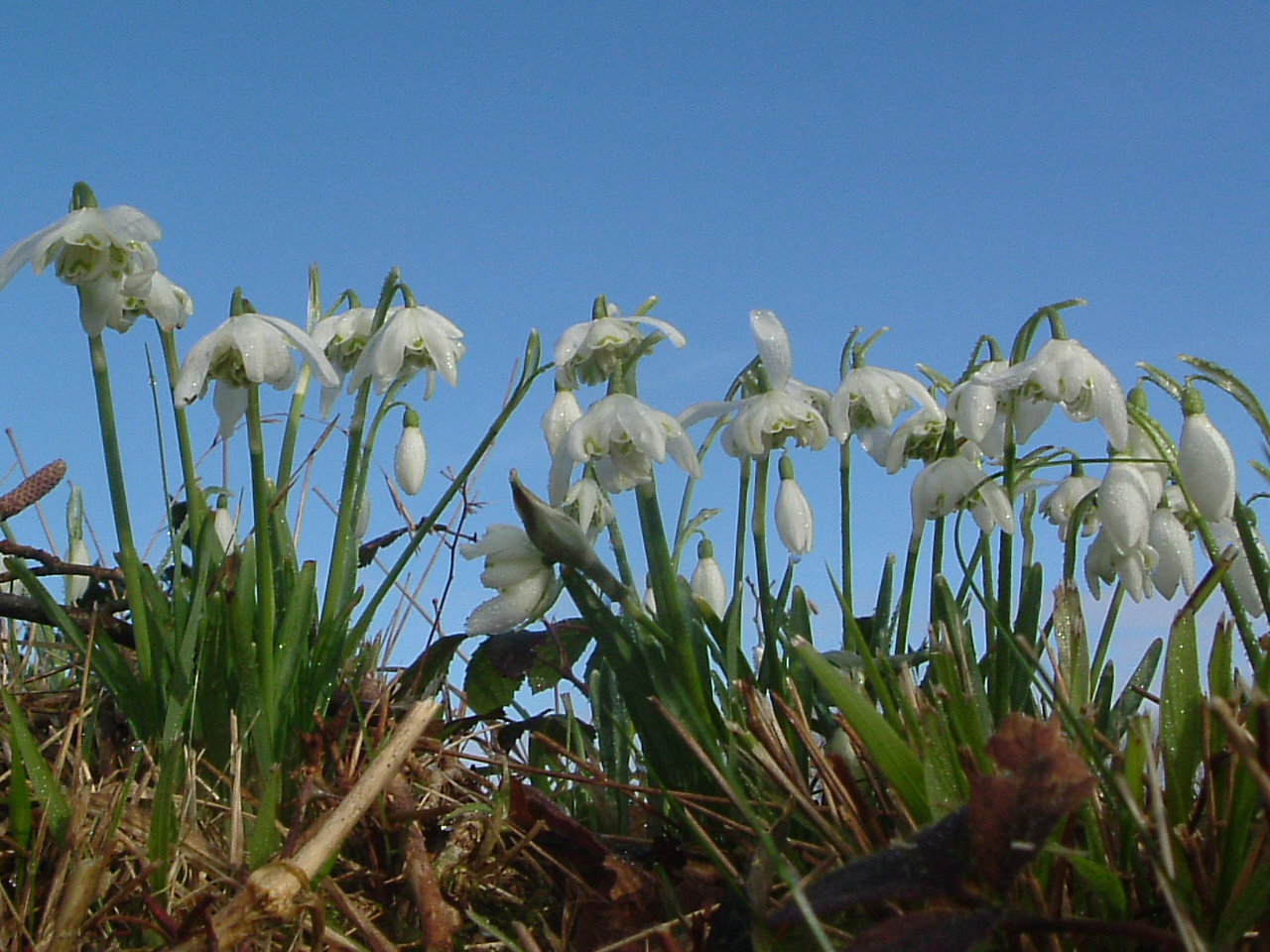
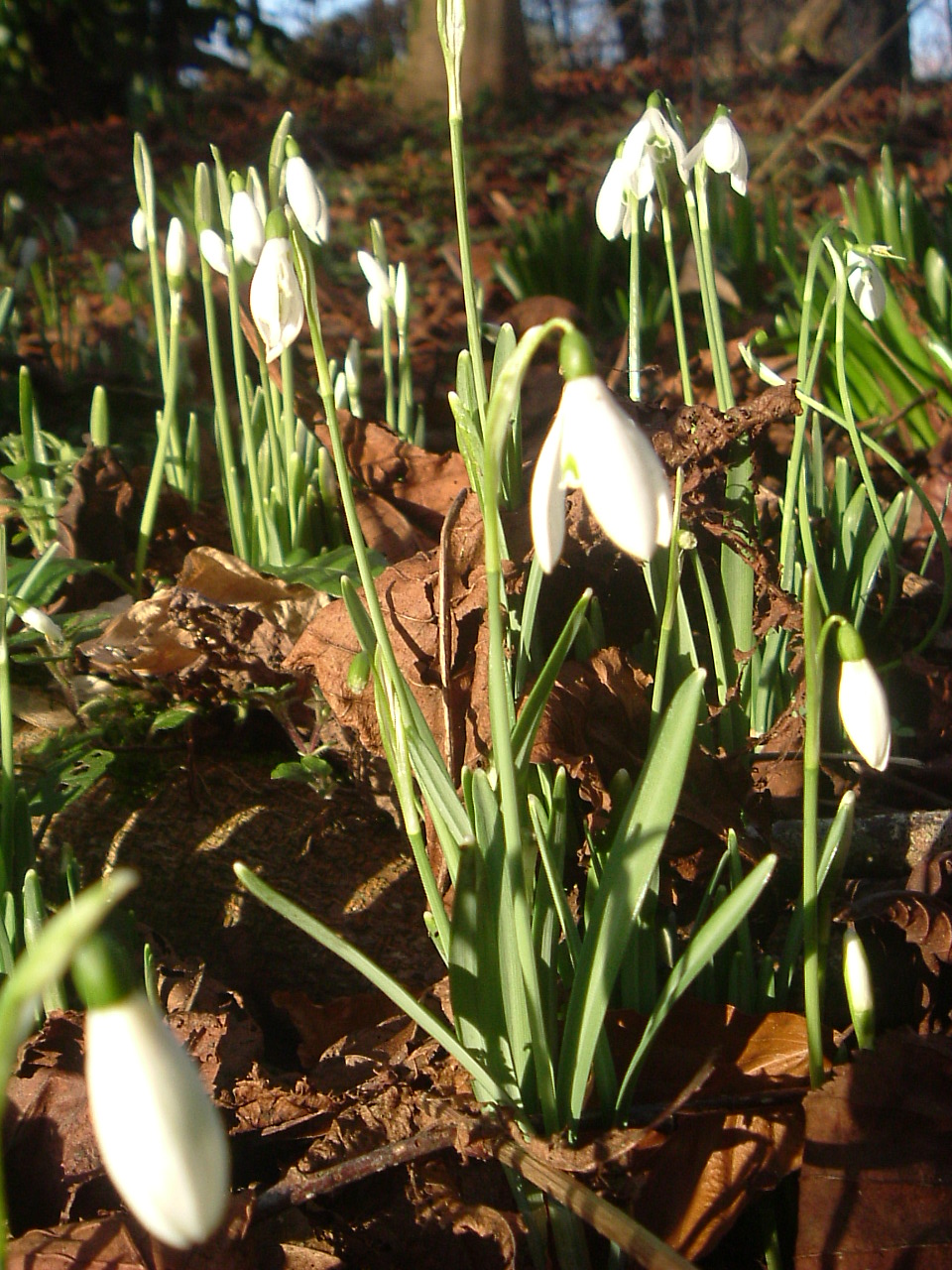
February started with a drift of snowdrops here as the snowdrops along the base of the Cornish hedge all decided to bloom at once, an effect heightened by the top of the hedge also being trimmed with these lovely harbingers of spring, also known as the Fair Maids of February, both singles and doubles.
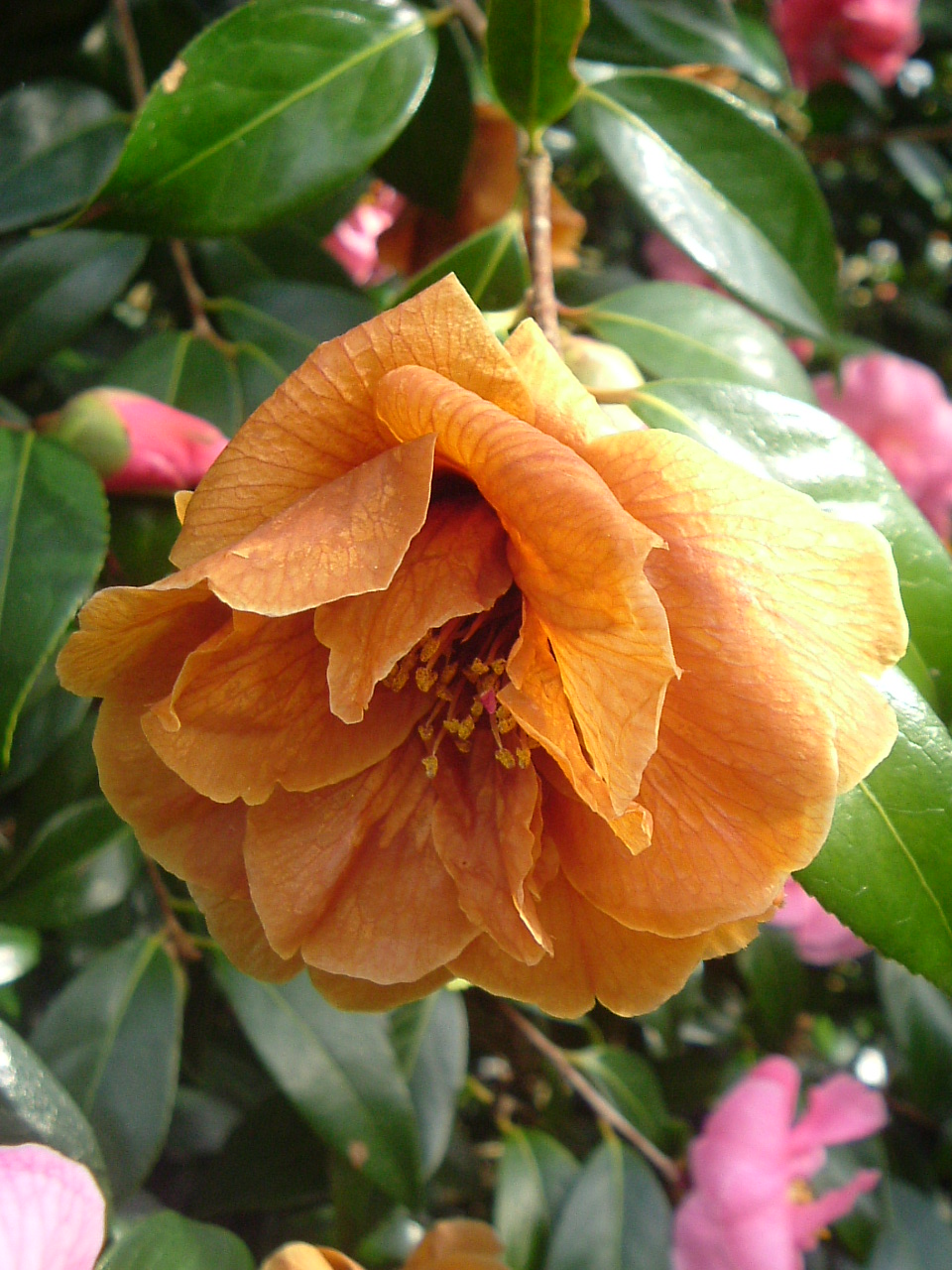
Then came a set of really frosty days. We hadn’t had much this year and the Camellias were in full bloom, but, call me strange if you like, the resultant ‘coppery brown’ blooms had a beauty all of their own. It wasn’t long before new buds opened and the mixture of frosted blooms and fresh ones was quite interesting.
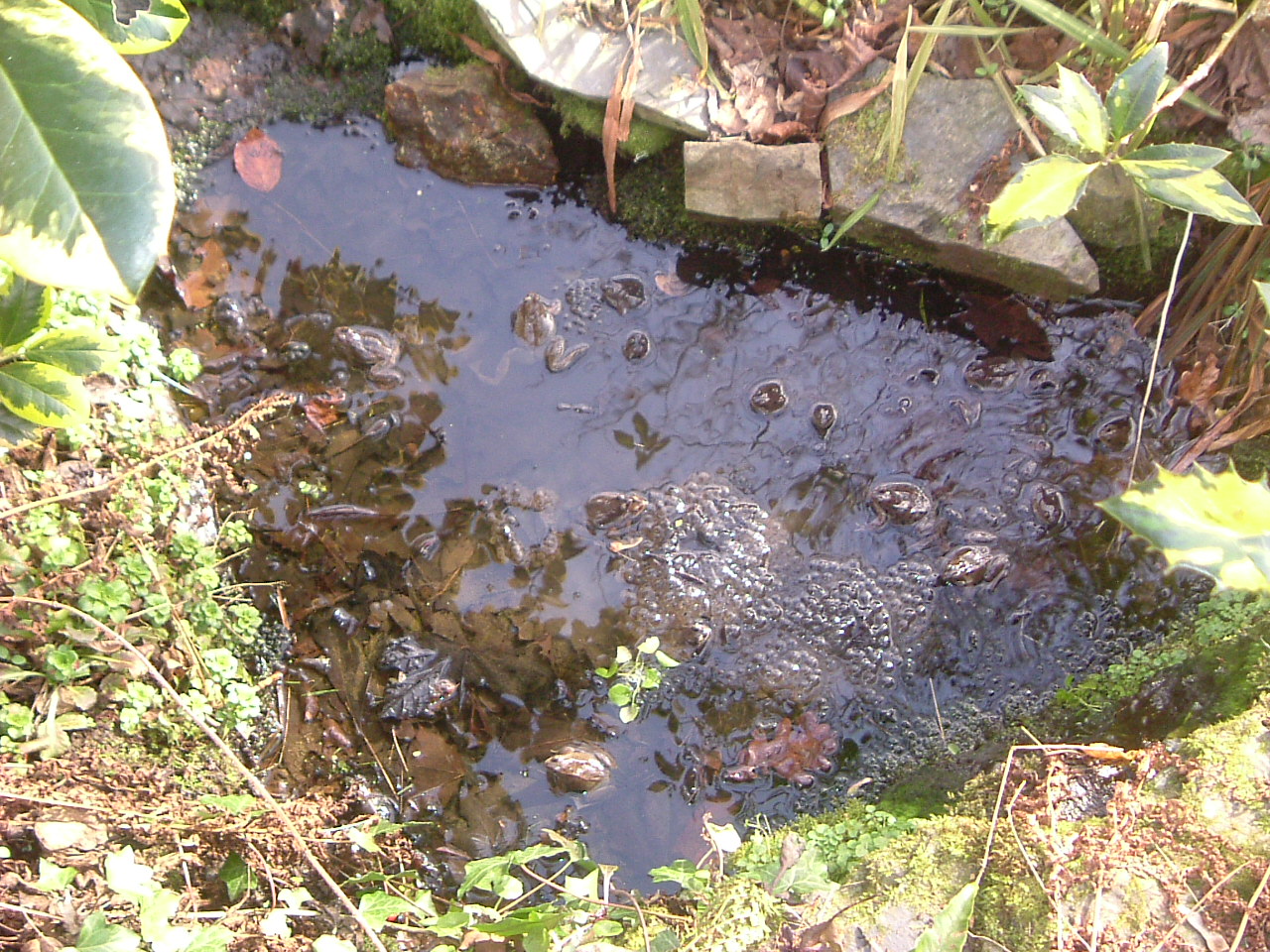
Now if you remember, the frogs were beginning to call and mate leaving the odd clump of frog-spawn in the small shallow water-features in the new-wood part of the garden. By the second week in February you could hear the noise from the frogs in the main pond at 50 metres and the water features were heaving with frogs (I counted 14 in a small pool no more than half a metre square)
So click on this picture I took later to have a close look at that pool – how many frogs can you see?
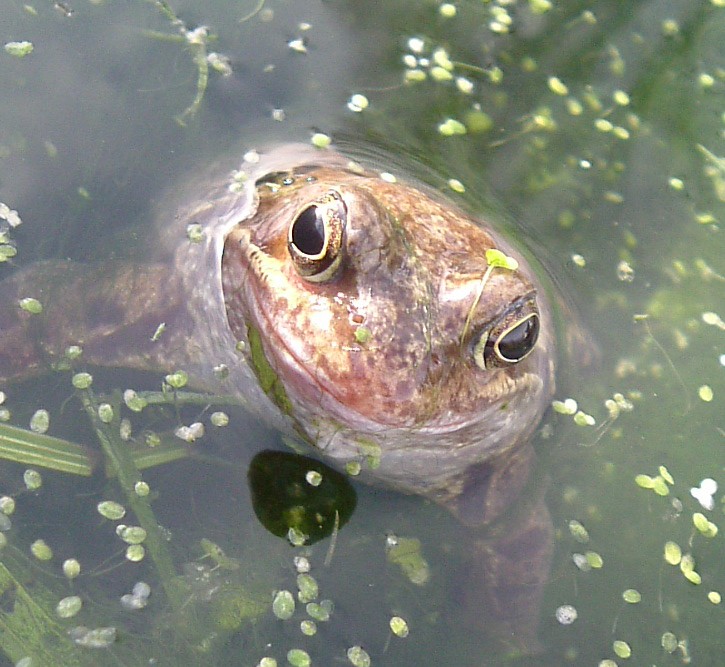
Here’s a nice fellow who held still long enough for me to photograph him. And his friend : below.
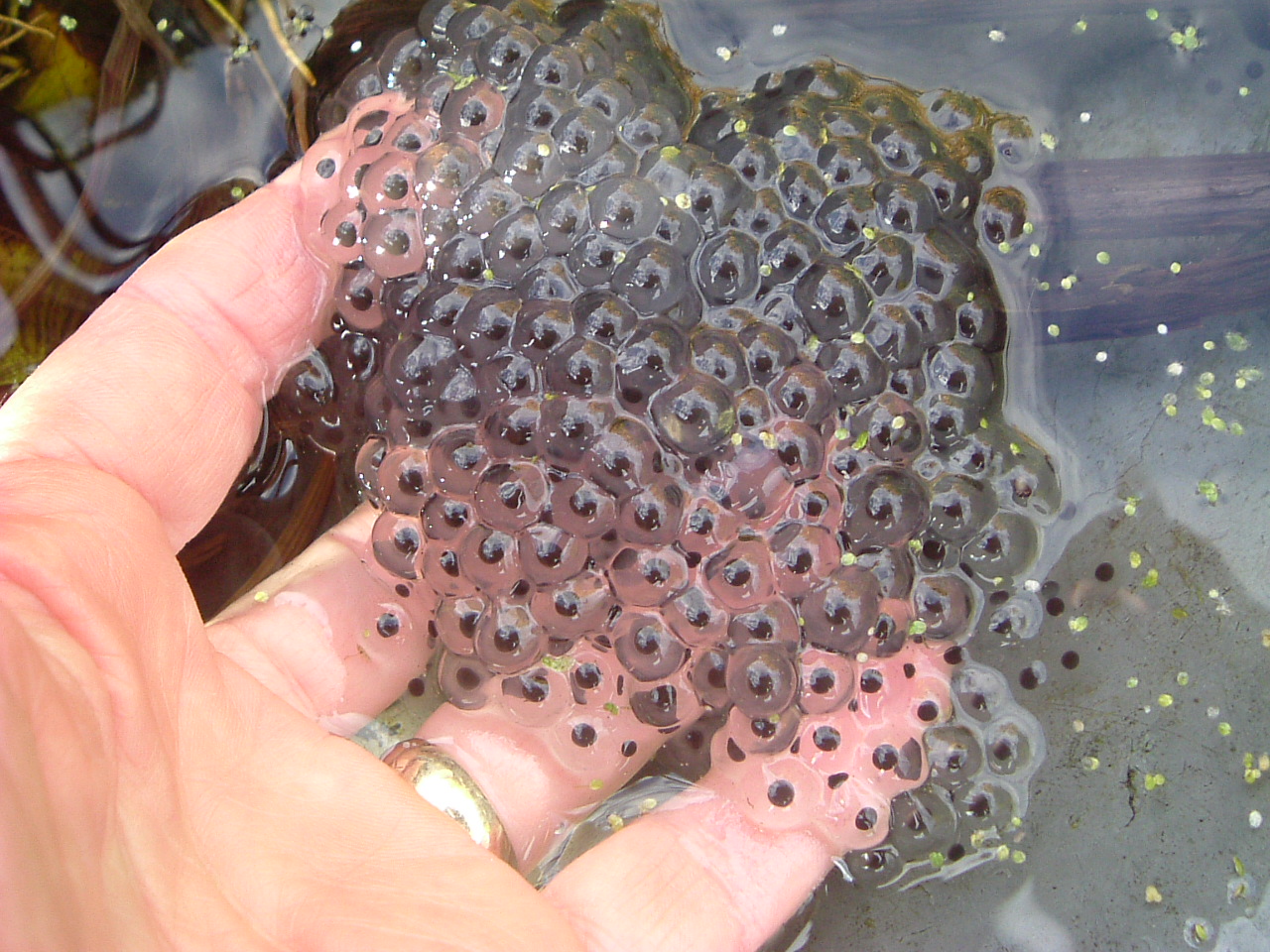
The photo shows fresh frog spawn, in tight, high clumps, the centres a small black dot. The same frost that caught the camellia also caught the early frog spawn leaving it milky with dead white centres.
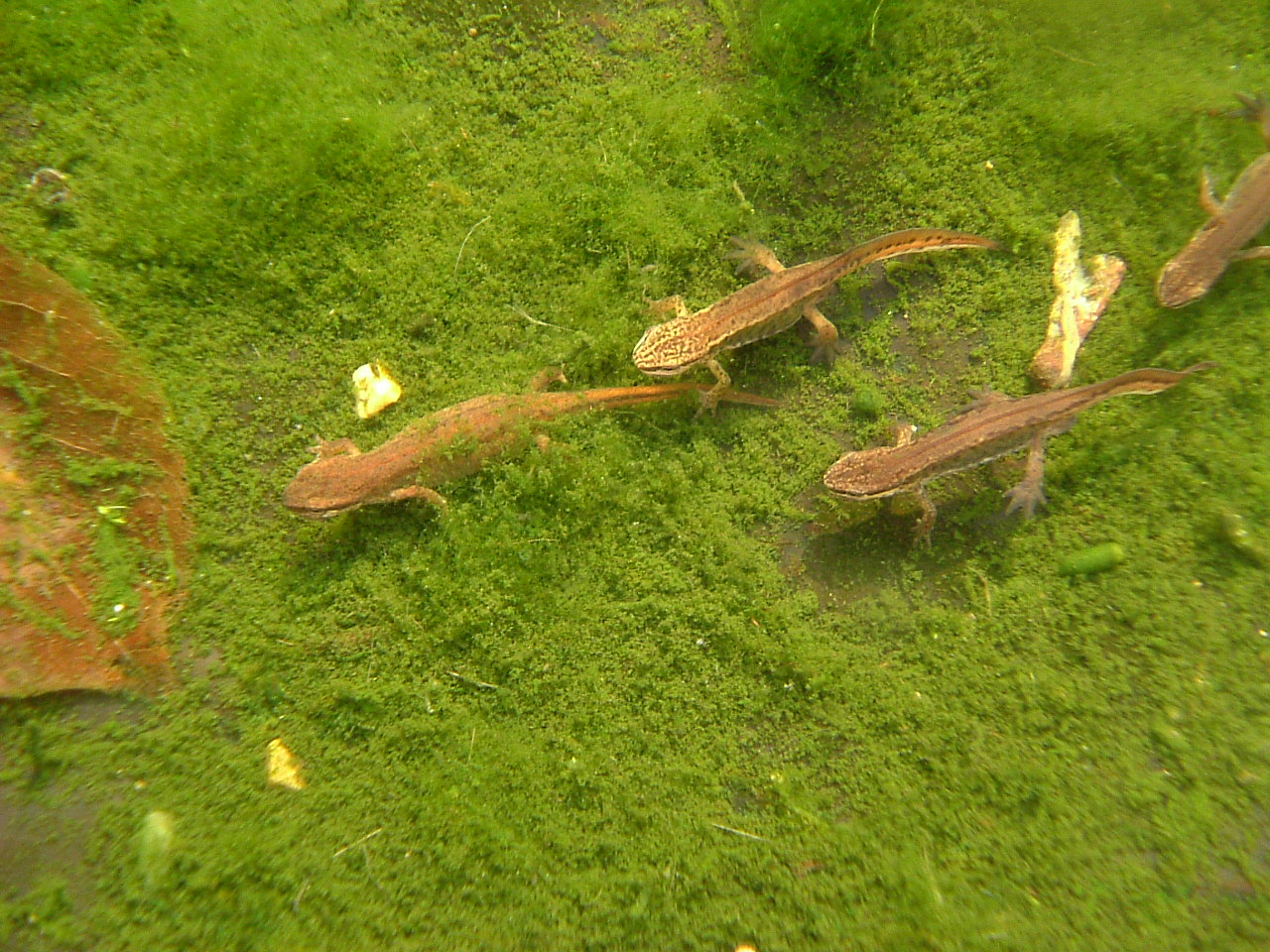
And while we are still at the pond and in the water (as it were) by the end of Feb. the newts were out and about – following each other around the bottom of the pool and getting frisky. By accident I found out how to get a good photo of these underwater (without the refraction shadow) you dip your lens in the water as you take the picture (I’m sure it’s not recommended)
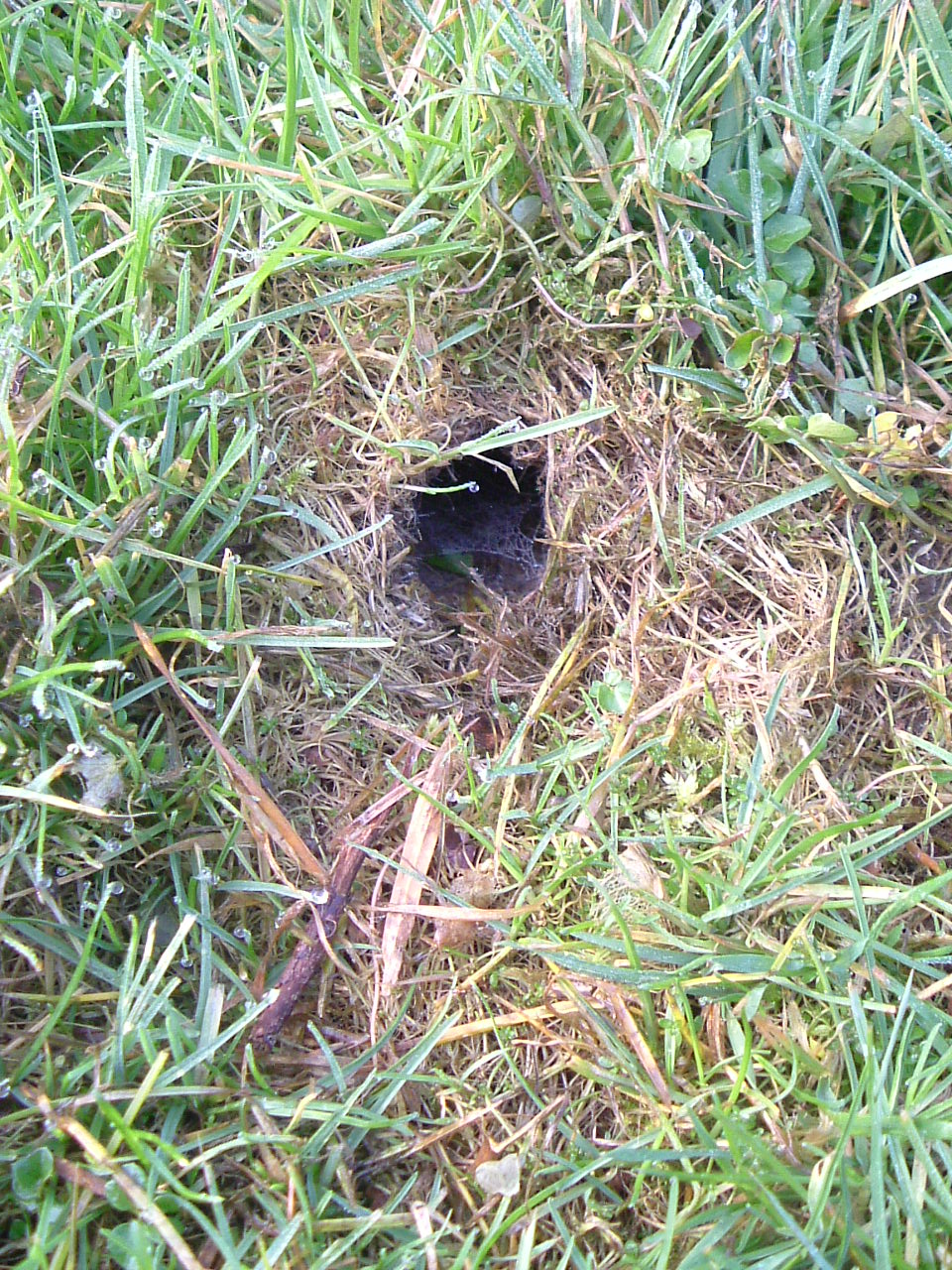
Leaving the pond I have to report on the Moles and the Voles. The moles have been creating havoc with the pasture in the field – and are a proper nuisance – I’m sure I don’t have to post a picture of masses of molehills for you to understand. The voles, however, I am delighted to see – though see is perhaps the wrong word as they are mainly out and about at dawn and dusk. For the past three years there has not been much evidence of these small vegetation-eating mouse-like creatures with short tails. I am talking about the field vole – Microtus agrestis. ‘agrestis’ as they are aggressive little creatures – as I recall from my college days when we spent time catching them in Longworth traps (a harmless ‘trap’ that keeps them in a hay-lined box until morning when you tip them out to weigh and measure them for ecology study) Now, I am not so pleased about their ‘runs’ (tunnels just beneath the grass that make the ground ‘squashy’) but I am pleased to see them return as along with them come an increase in the owls, as they are a substanial part of an owl’s diet. Strangely enough the population of field voles are recorded as having a four-year cycle – building up to to a peak then dropping back down again, so this may be just what has happened here. So, apart from the ‘squashy’ feel to the grass in the orchard and around, how do I know they are there if I don’t see them? Well there are plenty of their little entrances to be seen, a hole with a neat nibbled area just in front of it, as if they’ve sat safe in the hole entrance and nibbled around for a bit!
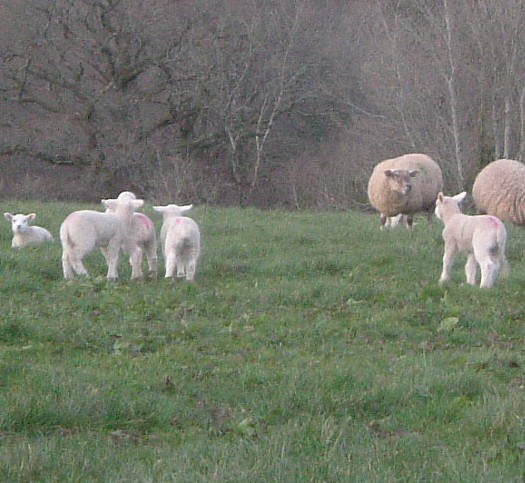
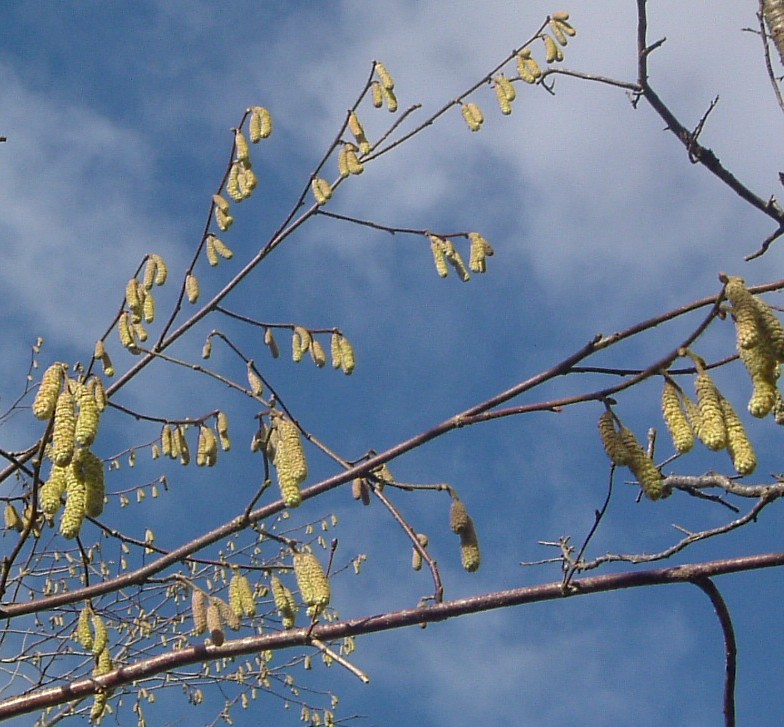
Lastly for February I’m venturing up the road for a picture of the lambs in the field nearby (yes, know they aren’t leaping .. but the year is with the 29th) – and the lambs-tails on the hazel tree.
As you may have guessed I love the Cornish countryside and it often features in my novels – especially Divining the Line and Nothing Ever Happens Here – both of which are mainly set in Cornwall.
What is it you love about the countryside round you – or even the nature in your own garden? Do share your enthusiasm for nature here – I love to hear from you!
Winter still has not really had much of an effect on this little corner of Cornwall, it has been exceptionally mild and pretty wet too. I missed taking a photo of a row of early daffodils blooming against the backdrop of the Ginster’s Christmas tree outside their Pasty factory in Callington (I didn’t have my camera with me and the next time I passed it was after 12th night) But I have a shot of our first daffs to bloom – not an early variety but they were blooming by Wednesday of last week (25th Jan) and the snowdrops that line the bottom of the Cornish hedge these grow on were also blooming well. The first snowdrops however had been those in the new wood, where these (see photo) were out before the end of December. In between I have noticed the usual spring blossoms, the camellias are already putting on a great show and primroses peeking out amongst the grass, however there are also roses still in bloom in both the front and back gardens.
I couldn’t resist these two examples of fungi – amazingly attractive, one bracket fungus and some toadstools, which I believe to be a honey fungus but must check it out as it was close to one of our apple trees!
The frogs have returned to the water-feature (a run of very small shallow ponds going down through the new wood, fed by spring-water that runs into the main pond near the house) I tried to capture these on camera but the vibration of walking, even ever-so carefully, sends them scooting under the leaf-litter debris in the bottom of the pools. The frogs that inhabit here vary in shade and markings, from the usual green and gold, brown and gold to a dark liver red colour. Their great clumps of frog-spawn, are, however, quite visible and, as they protrude above the shallow water, are also vulnerable to frost if we get one.
In the main pond (which also holds numerous shubunkin type goldfish, ranging from dark brown, through speckled to gold – none of which we have see at all since late November) the newts have reappeared. I have tried to capture these on camera but being under-water means I always get a ‘light refraction’ shadow – so they are not that clear. If anyone out there can tell me how to take these photos in a clear way (using a simple old digital camera) please do! Our newts range in shade from a dark olive green to a basic brown, through a russet red to a pale pinkish colour. As the water warms up I expect to see more of them as they start their mating behaviour – where a female will be followed around the bottom of the shallow shelf on the pond by a number of suitors.
My father has a new bird-feeder, it looks like a log with holes cut in the sides and you fill it with ‘fat-balls’ which are, much as their name suggests, balls of fat with seeds and grain in them. This has attracted two varieties of woodpecker, the green woodpecker and the greater spotted woodpecker, to the garden where we can see them from the kitchen window (we often hear them in the area). They have been accompanied by the long-tailed tits, which usually fly in a group of about a dozen and flitter round the trees where the feeders are, feed briefly but then swiftly move on, however the fat-ball log seems to keep them here much longer.
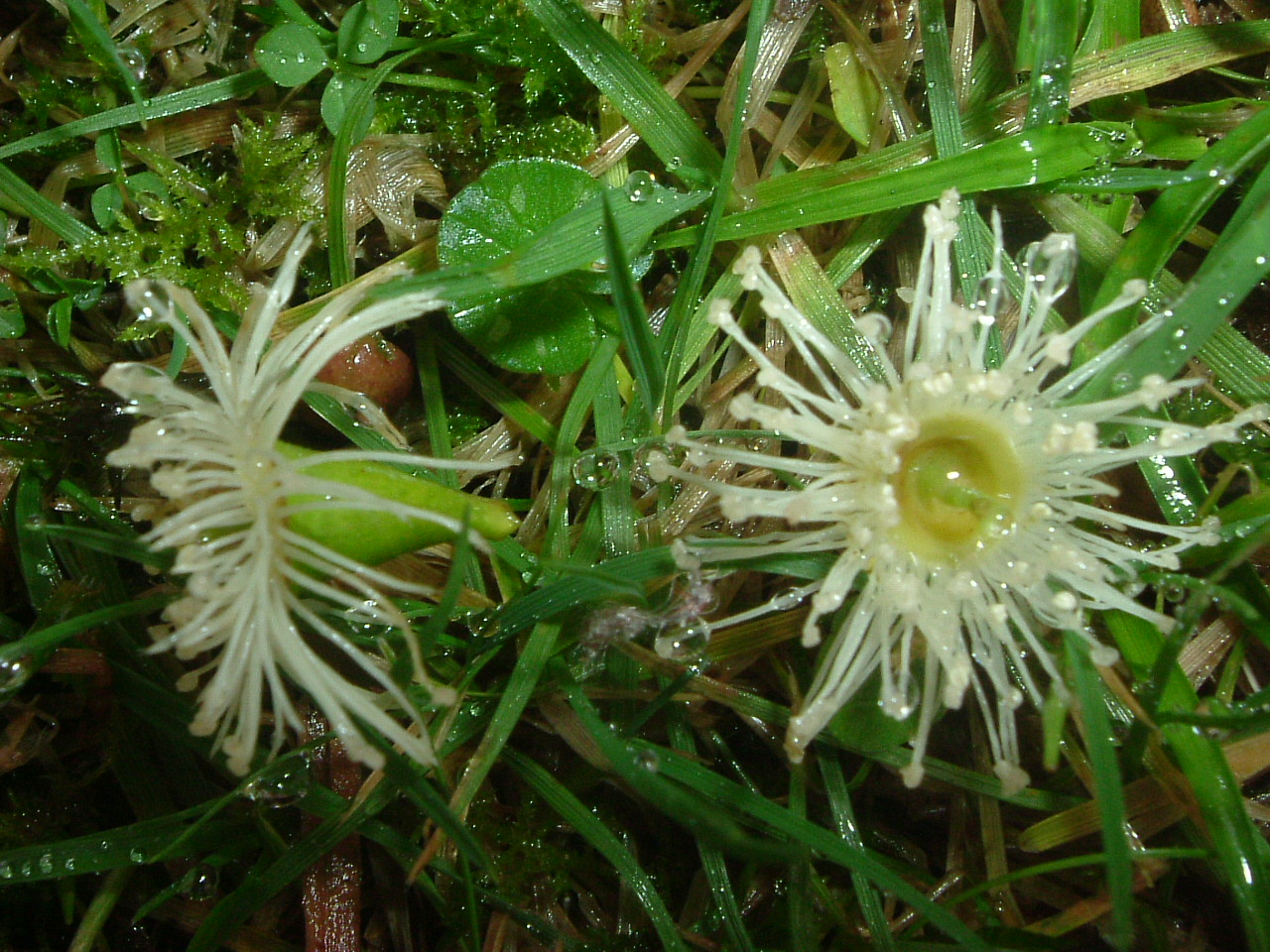
Lastly a picture quiz: What is it? I took this photograph in very late December in our garden. A click on the picture will enlarge it for you. Can you identify the plant these fell from? Answers in the comment please – I’ll give the correct answer next week!
Clue 1: These came off a tree.
Clue 2: This tree belongs on the other side of the world – native of Australia.
Clue 3 This tree has silvery green leaves, round on young stems and elongated and pointed on older.
FIRST PERSON TO POST CORRECT ANSWER IN COMMENTS WINs AN E-COPY OF Divining The Line
And if you want to know more about the novels by Ann Foweraker ‘Divining the Line’, ‘Nothing Ever Happens Here’ and ‘Some Kind Of Synchrony’ just click HERE to be able to the first 3 chapters in pdf FREE ! Answer and Winner?? – See the comments!


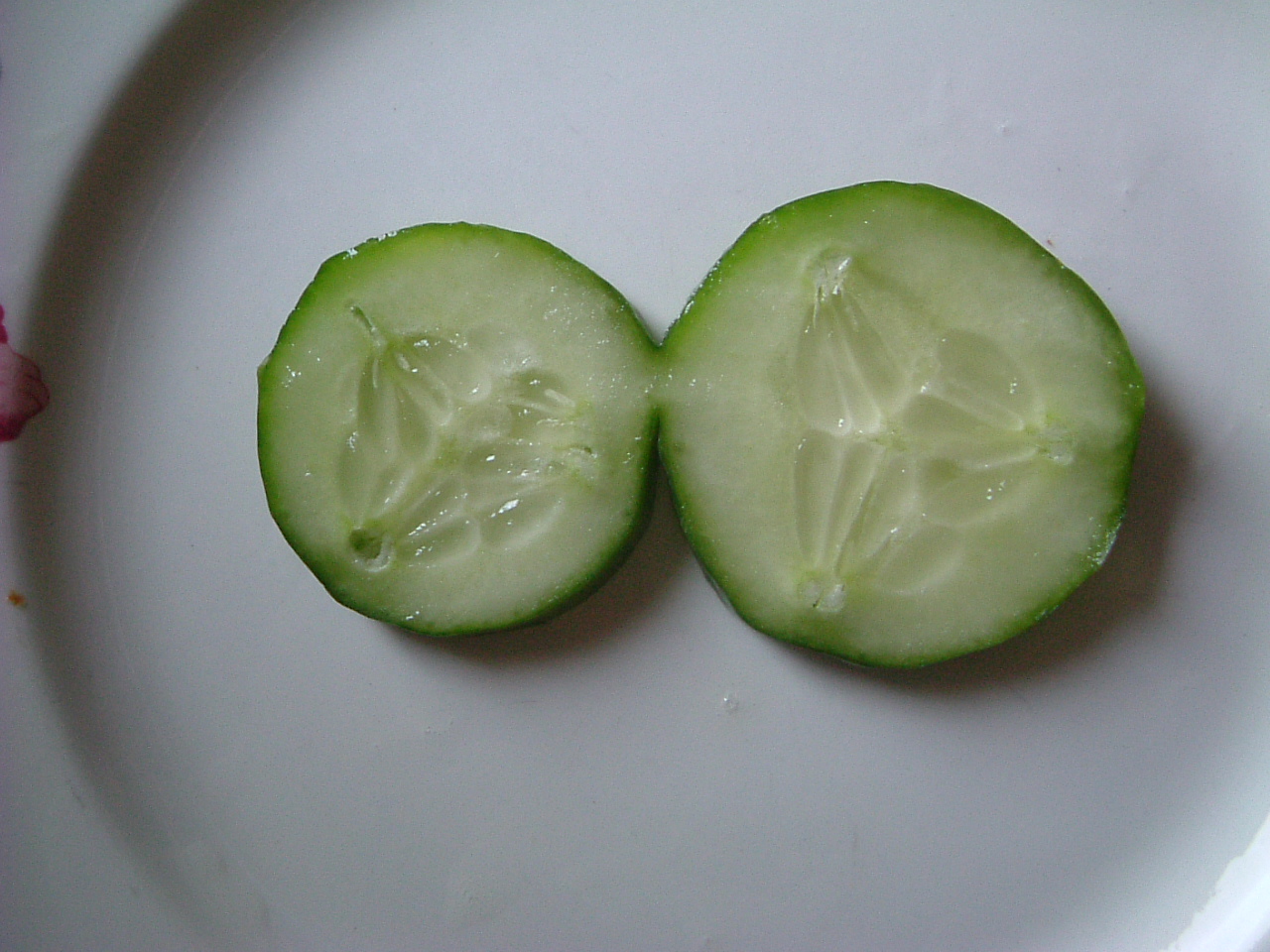
 And a cucumber twin found growing in the greenhouse – making interesting figure 8 slices when cut.