… it was easier than I thought. No starving myself into a size 6 (HaHaHa – I wasn’t that even when I was 6!) …. it was as easy as putting up my hand
The ladies of our WI were organising a fund-raising event in aid of the local Memory Café – more of which later. One of our members, with contacts within Debenhams, managed to get their agreement to come out to our village hall and bring a range of fashions to show. All they needed from us was the set up, the paying audience and at least half a dozen models. At this point, along with a few other members, I put my hand up – and that was it – committed.
Fashion show ‘special occasion wear’ finale (click to enlarge photo)
A number of weeks later and armed only with the knowledge of our dress-size (and that can be pretty vague can’t it?) and our height, the ladies from Debenhams arrived with over £5000 worth of clothes. They brought with them two bare-Minerals make-up artists who ‘did’ all our faces. (It was fun to hear later from two people that know me well, that they had a little argument as to whether I was actual me – or not, when I did my first promenade – no, I do not usually wear any make-up – can you pick me out?) We were each given a set of clothes to model, a day-wear set, a Autumn / Winter Coat and a glamorous evening or special occasion outfit.
A swift ‘walk through’ with guidance on where to walk, where to stop and where to turn while the music blared out – and the audience were let in – and we were on! The audience giving each turn a lovely round of applause. Two-thirds way through the 33 outfits the make up girls gave a twenty minute demonstration, giving us time to change into the glamorous gear.
It was a fun event which couldn’t have been done without the dedication of the Debenhams team, especially the personal shoppers who had made all the selections which, amazingly since they had so little details to work with, not only fitted but on the whole suited the models! So huge thanks went to them.
The Debenhams team had to rush off at the end to get the goods back to the store and checked in, but the audience and the models (now back in civvies) enjoyed tea and choccy biscuits. What a fun way to raise over £400 for the Memory Café….
Memory Café? What is that? .. it is a ‘club’ set up for people with memory difficulties and their carers, and indeed anyone of that generation who wishes to spend a bit of time reminiscing. The organisers bring memory stimulating games / quizzes / music / items etc and share lots of chat with the guests while having tea, coffee and cake, on every other Saturday afternoon. As someone who has family that attend I can vouch that it is a very worthwhile organisation that gives joy to our older citizens and values their memories. It also supports the carers, often older people themselves, of those that are struggling due to memory problems whether just getting absent minded or whether diagnosed with Alzheimer’s or vascular dementia.
So have you ever found yourself doing something unexpected by simply volunteering?
What was the strangest or best thing you ended up doing?
Well, here we are – enjoying a bit of summer as it used to be. ‘Lazy, hazy, crazy days of summer’
Why is it that the dog, when thirsty, prefers to drink the water from the dishes under the patio pots instead of her own water bowl brimming with fresh spring water (note – we are on a spring – I do not buy bottled water to give the dog LOL) (Email-readers there’s a video here – please click into the blog title to see the 7sec video)
This unaccustomed heat has had the memories rolling. I recall days (well they felt like days) playing over the fields. The field next to where I lived usually flooded in the spring – meaning that the wheat didn’t grow in certain areas. In these ‘blank’ places the wildflowers grew. There would be whole large patches filled with poppies, dog daisies and cornflowers, and you could walk (carefully, so as not to damage any wheat) along the tracks to end up in them, hidden from view.
Then, later, after harvest, there were the straw bales to turn into castles and forts, for imaginative play.
There was the small stream half way between our village and the next, where it would be good to take a ‘picnic’ (anything we could scrounge to eat or drink from our respective parents). We’d sit on the two-plank bridge and dangle hot feet in the trickling water, eating whatever and talking nonsense.
My memories are of a country life, living on the edge of a small village in Berkshire – how different they might have been if my parents had not moved out of the east end of London when I was on the way!
What memories do you have of childhood summer days?
Do you think the weather has really changed that much over your lifetime?
Today, yes, today, I was at a village celebration! ….. Excited?
People gathering before the start
Well, if I told you this was a celebration for the opening ceremony of a LAY-BY – would you still be excited?
Getting the new lay-by ready for the ribbon cutting
Yeah – I know it sounds weird … but this is country life… and when they say things move slowly in the country this lay-by is a prime example. The post-office corner is a good right-angled bend and the road is just wide enough for two cars to go round it carefully. Opposite the post-office village shop used to be a fairly high bank, seemingly grassed, but as we all know, grass banks in Cornwall hide a slate and granite hedge! There has always been a bit of roadside parking up the little lane leading down towards the ‘main’ road through the village, but not much, and you were always aware that tarrying too long meant others could not park. Then there are the Mobile Library days, when all that space it taken by the Mobile library for half an hour. Or deliveries to the shop, or the postman collecting the mail.
All in all, many would stop on the corner, against that high bank… and thus prevent the bus getting round the corner much to the consternation of the bus drivers ( Yes we are lucky enough to still be on a regular bus route – and I imagine each time the bus is prevented from keeping to schedule the likelihood of keeping the service diminishes)
So, for years … and I mean Y E A R S …….. the idea of having a small carpark opposite the post office village shop has been mooted. However, up until now, nothing has ever come of the ‘idea’. It has taken a savvy person on the parish council to work though the ever tricky procedure of applying for grants and permissions, others to plan and oversee the works, for a community group to put forward some of the funds to show willing and for the grants to be actually awarded and in the end we have it!
Two, of the three, vintage cars, parked in the lay-by
It was part of the stipulation of the largest funding body that there should be a formal opening ceremony with press – so it became an event – with posters drawn by children from the village primary school, with official ribbon cutting, with tea and cake, with a procession of vintage cars, one carrying the oldest village resident at 101, and a vintage bike against the bike rack with its basket filled with bunches of flowers for various people handed out by children from the village school and with speeches (short ones!) of thanks to all involved!
And so, it turned out to be a really nice country-style village celebration of something both very small and significant at the same time. There is now room for 5 cars ( if they park tidily) plus the space for three up the side lane remains, and no excuse to block the path of the bus (or any other large vehicle that needs to turn the ‘post-office’ corner).
We all hope it makes a difference inside the shop too, with more people using it – as we are also very lucky to still have a post office and village shop and that needs the village people to use it and buy a significant amount every week to keep it going.
Lucky people!
The first lucky seven people will be getting their choice of my already published novels arriving in their email inbox on Friday!! There is still a chance to get in on the first draw if you enter before noon on Friday 7th June… but even if you enter afterwards you will be in the draw for the next three weeks draws. If you’re not sure what this is about .. just click on the link to go to my **Pre-Launch Party** where YOU CAN WIN a copy of one of my novels. (if you haven’t got an ereader these are available as pdf – or download kindle for pc and ask for a mobi version – to read them on your computer)
I’M GIVING AWAY ONE eNOVEL A DAY ALL THROUGH JUNE!!
Do you live in a village or tight-knit community?
What makes your community special?
Do you find pleasure in these ‘small things’?
You know I love to hear from you – do share 🙂
AND NOW.. the next excerpt from THE ANGEL BUG ……
Gabbi has returned to the Foundation building…
Andy and Naomi were heralded by their voices, obviously in heated discussion, followed by their persons as they came up the central staircase into the light and airy office space.
‘But it could be Thrips Palmi,’ Andy was saying.
‘What, with the quarantine measures all in place? Besides it isn’t as if it came from some dodgy place.’
‘Well, Kew has been known to have its own problems with diseases and vectors.’
‘Do we have a new problem?’ I cut in.
‘W04, some die-back co-incidentally right beside the new introductions.’
‘Which were quarantined for three months as usual!’ Naomi retorted.
‘Anyhow, we’ll know soon, samples coming over pronto.’
‘Well we’re going to be busy then, I’ve asked for you to see some from the Moringa as soon as they come in. It’s a bit tricky, it’s the last tree we want to have a problem with just now,’
‘Why? Any time is bad for any of them isn’t it?’ Naomi said, shrugging.
‘Ah, but Luke Adamson’s coming and he’s sure to make a bee-line for it.’
‘Why’s that?’ Andy said as he sat down.
I looked at Andy and Naomi, both of them looked puzzled, and young all of a sudden. I smiled, ‘Well back when you two were in nursery school, Luke made his name with the first comprehensive ethnobotanical study of the Moringa.’
‘Oh dear!’ Andy pulled a mournful face, waggling his head in a mocking way.
‘Oh dear, indeed,’ I almost laughed, Andy, at least didn’t seem in awe of the superstar.
The three of us busied ourselves in the portacabin laboratory at Watering Lane, Eden’s nursery a few miles west of the main site, each wearing the standard kit, lab coat, latex gloves, and, when we were cutting, goggles.
‘So,’ I said firmly, looking up from my microscope, ‘it’s definitely not a dehydration problem, these cells are as turgid as we could wish for.’
‘And so far I have found no signs of microbacterial infection,’ added Andy. ‘So I’m going to culture some sections, especially of the red cells.’
‘You just do that!’ Naomi said to his back as he went into the second half of the lab.
‘Nothing?’ I asked, looking across to her. There was an atmosphere between them that I couldn’t quite put my finger on, though it might have just been the cross accusations over the source of the plant infections.
‘Nothing, certainly on this sample, I’m off to take a good look at that tree and the area, put down a few sticky pads to see what insect vectors I catch.’
‘Okay. I have to admit I’d rather we found something concrete before Adamson turns up.’
Naomi turned and gave me a quizzical look as she hung up her lab coat. ‘I don’t know why you’re worrying, Gabbi, that new senior botanist will be here tomorrow and she can talk herself out of any hang-ups Dr Adamson has about our trees.’
Naomi just about slammed the door behind her, leaving me wondering what had ruffled her feathers. There was something in the way that she had said ‘senior botanist’ that suggested that the new boss was a problem, but, as I had not been in on the day of the appointment I’d not met Dr. Ananias. I had heard that she had made an impact on all of them in different ways, some by her looks, some by her ‘air’ and some by her obvious intelligence, however, perhaps not all opinions were favourable. I recalled that Naomi had been unusually reticent at the time.
I turned the leaf over again; the under side was a definite red, not unlike many plants that have a red underside to reflect light back through to the chlorophyll-bearing leaf tissues. I began to wonder whether the Moringa had the ability to adopt this red pigment in reduced-light circumstances. After all the ETFE bubbles of the domes did not allow a hundred percent light through them, then add to that, the fact that many of the largest of the trees in the tropical biome had grown so fast, faster than had been expected, that they had already needed pruning to prevent them reaching the skin of the dome, and so they were cutting out even more light.
‘Hey, Andy,’ I called. ‘I’m going over to reception to see if I can chase up anything on Moringa and low light levels.’
‘Okay, catch you up later.’
I cleared and washed up, then hung up my lab gear and left the laboratory. I glanced up at the vast range of glasshouses that had brought on the bulk of the trees and plants needed to create Eden, and now continued that work, with the sideline of producing plants for sale in the shop. Reception was a building that looked, appropriately, like an overgrown garden shed. Inside, it had the appearance of belonging to a set of artistic hippies; six foot butterflies hung lazily on fine threads from the ceiling, a foam rubber and papier-mâché tree wound itself around a central pillar, and collection boxes for all kinds of recyclable stuff were everywhere. The reception desk itself was little more than a bare board and unmanned as usual, yet above it hung the ubiquitous picture of Luke.
‘Hiya, Jim,’ I called as I circled round to a spare computer.
‘All right?’
‘Will be if we can sort out this blessed Moringa before he comes.’ I nodded to the picture.
‘Yeah, I heard you had a problem. Anything I can help with?’
Jim was one of those truly green-fingered horticulturalists that make you believe in such things; anything he touched grew.
‘Not unless you can tell me why these Moringa leaves should turn red with no obvious reason. I’m just looking up the likelihood of a change to utilise reflected light, though there was nothing in the Forestry guide’
‘No watering problems?’
‘Nope.’
‘Hmm, light sounds like a possibility then, and that guide’s not infallible. I’ll leave you to it,’ he added as he left the building.
Half an hour later Andy broke through the trance that I’d sunk into as I flicked from article to article dealing with plants that utilised the red underside of their leaves. There were no cases where Moringa had exhibited this pattern of adaptation and the only plants where the colour changed, as opposed to always being red, had a well documented histology that demonstrated that they were always ready and willing to change as soon as the light levels decreed it.
‘Ready to go back?’ he asked.
‘Yep, might as well, not getting anything useful here. Of course I might be on to a new research paper,’ I grinned. ‘The adaptation of Moringa to life under ETFE.’
Andy grinned back; he knew how little I wanted to do any such thing, even though progress in the scientific world was made just that way. I’d said often enough that I was so glad I didn’t have to jump through those hoops as I had no ambition now to be a botanical high-flyer. After all I’d seen at first-hand what it meant. James had been at the top of his field for decades and it had driven him to despair at times, especially when out ‘scrounging’ for research funds, yet it still amazed me when he threw it all in and retired at fifty, many of his colleagues were just getting into their stride at that age.
We were no further on when I left for home. I drove my mini quite sedately, there being no need to hurry home, and the twists and turns of the high-banked hedges and the road between them meant that being ready and able to stop within a few yards of spying another vehicle was a distinct advantage. My mind wasn’t on my driving however; it was still on the problem of the Moringa.
There are many pluses to living in the countryside, and immediately we are all thinking of green fields, bird song, the lowing of cattle, fresh air, peace (not necessarily quiet – it can be a noisy place in unusual ways) and hedgerows bedecked with wild-flowers. However, here I am thinking of the simple pleasures that may be taken without the censorship of what is ‘cool’ or ‘in fashion’ because, somehow, these things just do not matter here.
hedgerow bedecked with wild flowers
Maybe it is because we know we are blessed there is a lot of fundraising for good causes that goes on out here in the sticks. Not a week goes by when there is not one or even two fund-raisers for good causes within a five mile radius of where we live. These can be as parochial as the fabric of the local church (grade 1 listed building with parts dating back to 1259) or as far afield as a small locally run charity (Tamwed) to enable the rural poor in India to help themselves by growing foods with better nutritional values and supporting mobile health advice and care.
The events are usually the coffee morning, cream tea, pasty and pud, quiz night, craft-fair or bazaar / garden fete variety, and though people try to inject an element of ‘fun’ none of these are a patch on the Evening Meal with Pig Racing that we attended a few evenings ago.
The meal was the main focus of the evening … a chance to share, explore new flavours, and do a quiz that got everyone talking… however, it was the pig-racing that put the FUN into the evening.
So, here we have a short video clip from the evening – the people at the far end of the race-track are the ‘racing-pig ‘owners’ (for that race) They had the privilege of naming the pig and the chance to take home the race-pig owners prize … and the responsibility of catching the pig at the end of the race!
PLEASE NOTE – IF YOU ARE READING THIS ON THE EMAILED POST YOU WILL SEE NOTHING HERE. CLICK ON THE BLOG TITLE AND IT WILL TAKE YOU TO THE BLOG PROPER – WHERE THE VIDEO CAN BE SEEN!
What was the most FUN fundraiser you have ever been along to?
Do share (we are always looking for more ideas) and you know I love to hear from you!
So you have been drumming your fingers on the desk and wondering what exactly was missing … and then you realised … you hadn’t had your email from the practical hedgehog! And why.. because she’s had one busy weekend – where her fingers have not had time to hit the keys.
Rural life can be exceedingly busy if you throw yourself into local events and organisations. Take this weekend when we had the culmination of the Great Parish History Quiz.
No use just hitting the internet on this quiz – all answers could be found without a computer – though only some were available online, and then only if you looked hard enough. The questions referred to our parish only, making it very specific. You needed your two weeks to visit places in the parish, to hunt out the interesting bits of information.. like ‘Who has a black memorial slab near the priest’s door in the church, and what is the symbol on it? answer: Reverend Nicolas Sharsell and the symbol – skull and crossbones. (My boys always thought he must have been a pirate – where in truth he was a solemn minded man of the puritan cloth)
Final answers could be posted in the box up to 11am at the History coffee morning, for which I had spent the whole of Friday baking cakes and putting flowers in vases for the tables, to say nothing of the other times I had spent helping to create the quiz, making and distributing posters, road-side signs and quiz sheets. Not that I was alone, on the day a whole team of wonderful people turned out with cakes, raffle prizes and help to run the event!
And that’s part of what living in a rural village is all about – being part of the community, joining in, helping out, supporting events. It brings people together and heightens the feeling of belonging. I have lived in a city and belonged to organisations there, but there each remained separate; living in a village is different. When you join in with things in a village you become linked to the whole village.
At eleven the answers were given out and, at the end, I took away the entries to mark. Which I could not do that day, as I had other errands to run, my car to load for a craft-stall the next day and a 60th birthday to attend in the evening.
Cards from prints of Jo Totterdell's botanical paintings (click to view)
Next morning, bright and early, with feet still a little sore from dancing to great 60s hits in high heeled shoes, I set off for an open garden event in aid of Hospice SW. I took with me my annmade slate-ware, local botanical artist Jo Totterdell’s card selection, to sell on her behalf, and the quiz sheets to mark. I am pleased to take Jo’s work along as I think it is exquisite and so I’m also giving you a chance to look at some more of her lovely paintings here. You won’t find these on the internet anywhere either.
A weekend when different things I am involved in collide and make me over busy is a fairly frequent occurrence… I am told it is my own fault for trying to do too much. There – that’s my excuses for a late blog – the pace of rural life 🙂
Is your life full of different clubs, groups and societies or do you go for the peaceful life?
Why are some of us, seemingly, programmed to ‘get involved’ while others are happy not to?
And do you feel more relaxed now that you’ve heard from me? 🙂
Do share your thoughts – you know I love to hear from you!
Every year it gets more difficult to find a card for my mother which says
‘Happy Mothering Sunday’.
This year I scoured the card shops in our local town and found none – they all said Mother’s Day. (Though my brother (or his wife) – living in a larger town – did manage to find a ‘Mothering Sunday’ card so there are some still made)
Well, what’s the fuss? It just happens that my Mum likes the correct wording to reflect the history behind the day.
Indenture of 'poor child of the parish' John Roberts age 8 years, to learn 'Husbandry' 1797 (click to view)
From the sixteenth century Mothering Sunday used to be the only day that all the family could be together for families with children ‘in service’ as it was the only guaranteed day off. This would affect most families from yeoman class down. Children as young as eight went into service, or went as an apprentice in another household. Some went as maids of various levels, gardener’s boys, stable lads, and could work their way up through the hierarchy to cook, housekeeper, footmen, head gardener, etc. Children of the ‘deserving poor’ were also placed in apprenticeships by the Parish Overseer’s of the Poor to learn things like Husbandry (looking after farm animals) or Housewifery (looking after the domestic duties of a farm-house – including things like cheese-making and milking)
Originally a church festival, and falling on the fourth Sunday of Lent, it was the day you returned to your ‘mother church’. Which, in much less mobile times, meant you went back to where your family lived. Along the way children would pick posies of wild flowers to give to their mothers, and some would be sent with a Simnel cake, to take home (if they were lucky)
I have spoken to elderly ladies from this village who remember picking primroses from the hedgerows to bunch and sell in the markets for Mothering Sunday – the money from this would buy them a dress for Easter (or, rather, the fabric to make them a light-weight dress for Summer) This is a parish abundant in primroses even now.
Back to the history- so what happened to turn this ancient special day into Mother’s Day – was it just a short-hand way of saying it?
Afraid not- and this is why my Mum likes it to be known as Mothering Sunday. Mother’s Day is a different thing – created by an American lady in 1907 called Anna Jarvis in memory of her mother, Ann, a truly wonderful woman who set up Mothers’ Day Working Clubs in five cities to improve sanitary and health conditions. This new Mother’s Day is set on the second Sunday in May (closest to Ann Jarvis’ birthday) and was , later, to become known as International Mother’s Day.
In the UK observance of Mothering Sunday had lapsed by the time of the first world war, but, inspired by the success of Anna Jarvis in the US, a revival of Mothering Sunday was brought about by Constance Penswick-Smith’s campaign called ‘The Mothering Sunday Movement’. Businesses soon saw the potential and jumped in by promoting the day with cards and suggestions of gifts.
Confusion
Our Church's Mothering Sunday posy
After the second world war, what with many Americans over here, and international companies and communications, before long the two traditions got blended together – and now we have Mother’s Day promoted on Mothering Sunday in the UK. I heard on the radio yesterday that Mother’s Day / Mothering Sunday is worth £1.6 billion to UK retailers, so no wonder.
Our village church holds a Mothering Sunday service – at which posies are given to all mothers, or to their children of all ages to give to their mothers – though not primroses from the hedgerows, today they are more likely to be locally grown daffodils.
And how did I sort out my problem of not being able to find an appropriately named card … I chose a beautiful card by a local botanical artist, Jo Totterdell, and applied my own words with a silver pen! (see top pic) Mum was happy ….
How do you feel about the commercialisation of such days?
Are you a ‘Mothering Sunday’ or a ‘Mother’s Day’ person?
We live in a beautiful part of the world, and I know we are lucky to live here. What I can’t understand is those people who also live in this area (or at least pass through it and so enjoy its beauty) and then spoil it by leaving litter.
As part of our WI, I have been helping to organise a parish-wide litter-pick each in early spring for over ten years. Each year I am once again struck by the thoughtlessness, laziness and dirtiness of people who deliberately discard rubbish as they pass along our roads. I guess that a lot if it is cast from their car windows, though evidence suggests that some of these litter-bugs have a routine, perhaps even parking up to eat / drink / smoke and chuck the rubbish.
This year, in a 500 metre stretch, there were multiple empty Monster energy drink cans and bottles and empty Lambert and Butler cigarette packets. This has to be the same person, over a length of time, deliberately littering and spoiling an area that, as spring comes on, will be decked with daffodils, star-like flowers of ramsons, bluebells, red campion, primrose, stitchwort and foxgloves.
WHY DO THEY DO IT???
Lazy? Secret smokers? Badly brought-up? No social conscience? Just plain dirty?…….
I just can’t get into the head of the person who throws their rubbish down wherever they are. Are their homes littered with rubbish? Are there cigarette butts (which ARE litter – taking up to 10 years to disappear) and packets on their kitchen floors, empty bottles and cans on every surface or wedged amongst the house plants, crisp packets in drifts in the corners, newspapers, receipts, water bottles and plastic bags bestrewing their carpets?
And then there are the ‘dumpers’, those people who drive out to a lovely spot and dump a bag of household rubbish, or an old video player, or paint cans … when they could have driven just as easily to the council dump and left it there – at no cost. Why do they do it? And, yes, these were real examples from yesterday’s litter-pick.
So, each year a hardy bunch of wonderful people volunteer and, armed with litter-grabbers loaned by Clean Cornwall, help clear our beautiful parish of this detritus – this year sixteen turned up. Here are just two of our volunteers that I caught up with, Rob and Sara (or 3, if your count Freya – who went along for the walk) and just a couple of the bags they filled.
I wonder if I found the weirdest thing this year? A pair of size 9 or 10 thigh-length, lace-up, high-heeled, pointy boots in black imitation leather with the heels and soles just about broken off, and great cuts through the ‘leather’. These, about 4ft up a steep bank! Now you know me, well you ought to by now if you’ve been reading this blog, I am a writer. So, how long do you think before the finding of these items started off an idea for a story? A murder mystery perhaps, starting with a village litter pick – the victim being ….. well I’ll let you think about that and save my thoughts for another day when I am looking for inspiration!
And here’s the total haul from the roadsides around our beautiful parish.
Twenty-eight bags of rubbish, a video recorder, two wheels, 2 broken cones and some lengths of melamine coated board and plastic fencing.
The sad thing is, by the time you are reading this ( less than 24 hours after our litter-pick), there will be new litter cast down somewhere in our patch.
Hi All, and I do mean ALL, as I know lots of you will not have got my last post as the feedburner would not send it out to all your emails for me.
No!, No, no, it wasn’t too rude. Nor did it contain dodgy material [Well, I contend that it wasn’t dodgy material, though my friend Christine, who DID see the blog thought it well dodgy] — no, I made the post too large (it seems) with too many pictures of ………………. *SLUGS (*Christine shudders; she doesn’t like slugs)
But seriously – the sheer numbers were amazing – and then there was the experiment I set up and … well – you’ll just have to scroll down to last week’s blog and take a look.
So I had to promise to do a ‘fluffier’ blog this week without slimy, creepy crawlies anywhere to be seen.
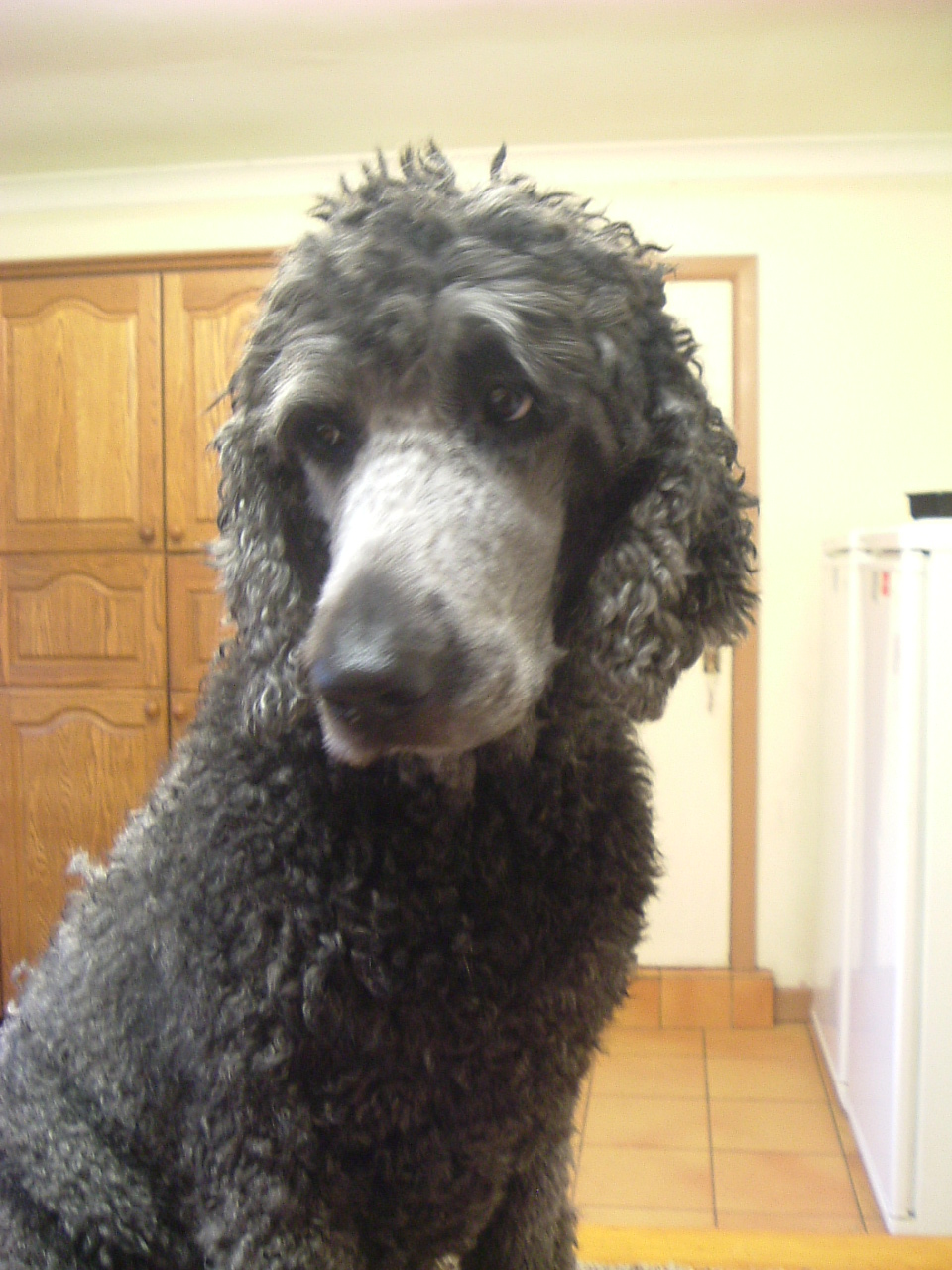
Enter the dog – she’s the fluffiest thing I have round here!
As readers of the blog you will have realised that the dog is a labradoodle – and a curly ‘poodle’ coated one at that. This means that every six to eight weeks she needs cutting if I don’t want a her to have a long knot-forming, mud-bedraggling, puddle-bringing coat and with the almost constant wet and mud we’ve had this year – No I DO NOT!
First up is to get her into the bath. If her coat is not clean then the dirt in the fur will wreck the sharpness of the blades in the clippers. I need to get this done early on a day that looks like it will be warm enough to get her completely dry as damp fur does not cut well.
The day I chose looked promising, however, as it turned out she wasn’t quite dry so the hairdryer had to be employed and neither of us like that much, then it’s up onto the table!
I am used to clipping our dogs, in the past we have had standard poodles (for the uninitiated these are the largest size of poodle) and I always did a ‘country clip’. No poms, no shearing down to the skin – just a nice even all-over cut. And it is a similar cut I use for the labradoodle – no leaving long whiskers or shaggy eyebrows.
I start with her face, before the clippers get warm and while she has maximum patience. Picture one has had the first few swipes at the fur on her nose done before I decided to record the trim, picture two is her nose all done.
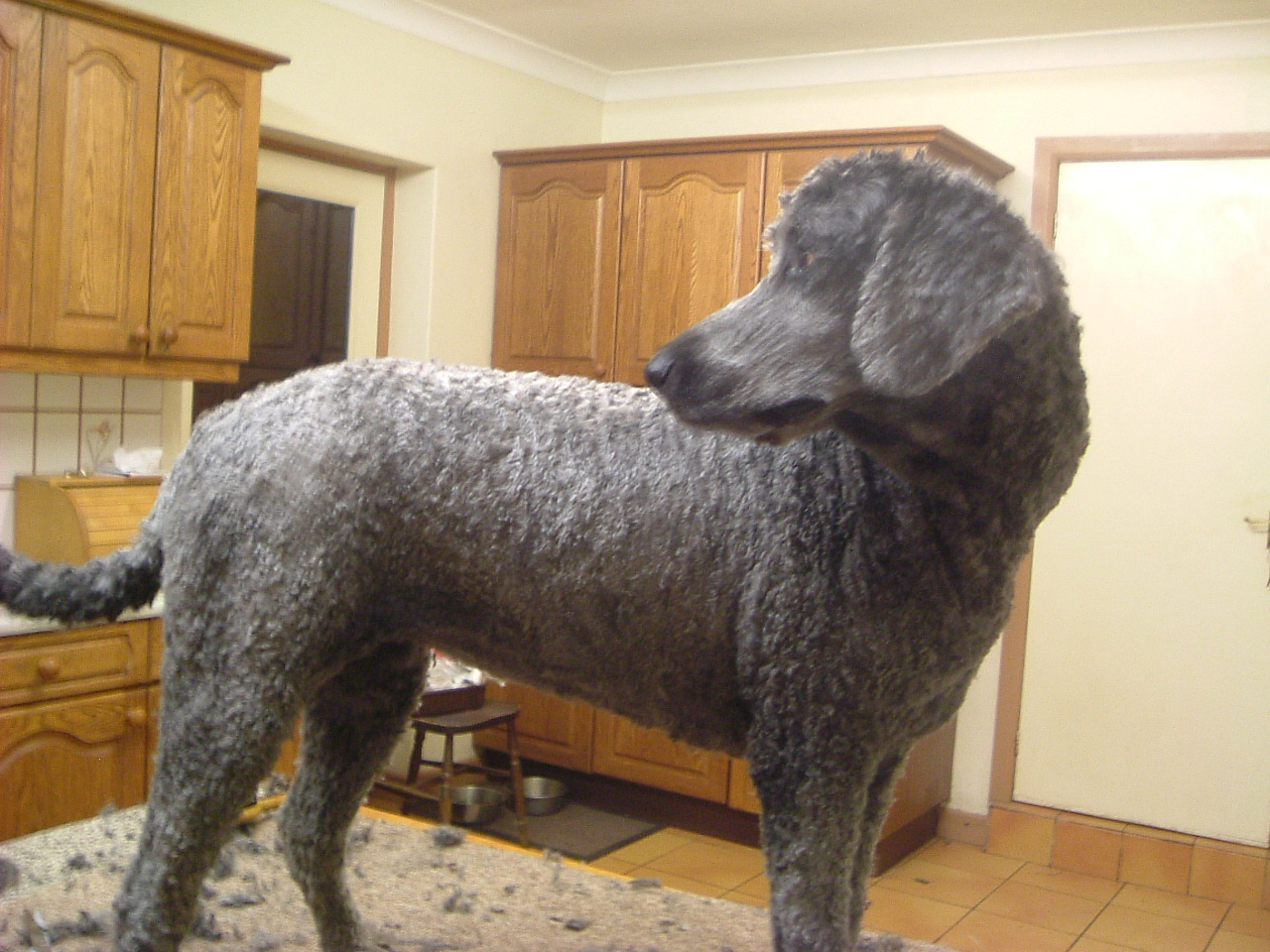
I then trim all down one side of her body. Then down the other side. She started by standing but then chose to lie down. Left picture below shows half clipped, right shows both sides clipped.
She chose to flop over on one side so I then trimmed her legs and tummy on that side. It was tricky getting her to roll over so I could do the other side though.
Then it is on to clipping her feet. I think these are ticklish as she does her best not to let me get at them, amazingly even tucking them back under her legs. There is fur between the pads that has to be trimmed out carefully. Then her tail needs trimming by scissors to a sensible length (As I also do with the hair on the ears and on top of her head this way).
All done – she stands for me to take off any little bits I’ve missed and brush her down.
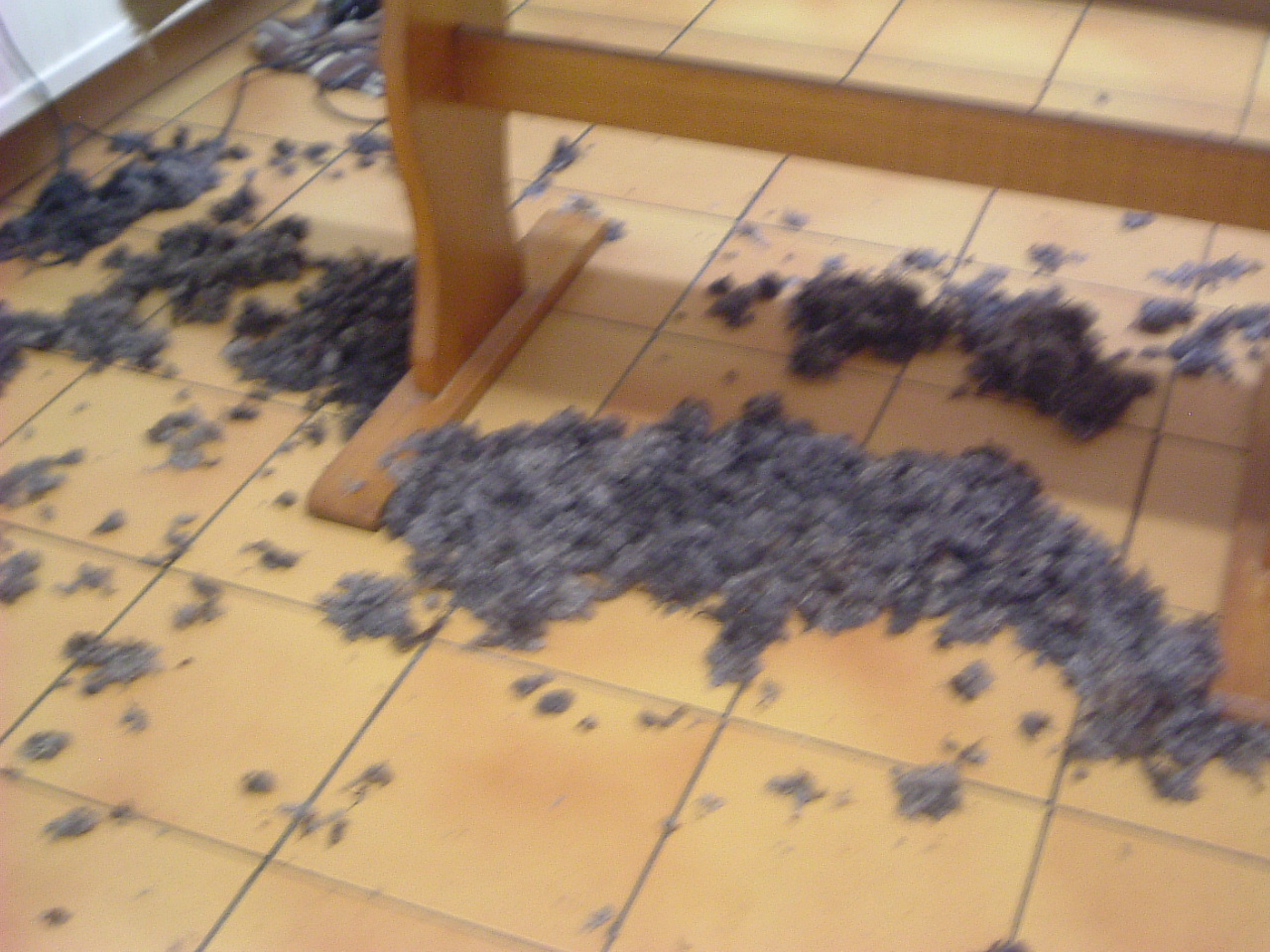
All that’s left then is to sweep up the clippings, wash the table and floor! What a lot of dog hair off one dog! It all goes on the compost heap – and if it is the spring it is often taken by small birds to line their nests!
So, here’s hoping this post isn’t too big and you all get to see it!
For my FWT cheerleaders – I am delighted to report a whole pound down. I know, I didn’t expect that so close to my target. Half a pound a week is fine at this level – so I am well pleased!
What pets do you have and how do you get on with their grooming? Is it a chore? Do you get it done by professionals?
Do share, I love to hear from you — and if you want to comment on the SLUGS – by all means drop down to that blog and let me know your thoughts on the collective noun for a group of slugs.
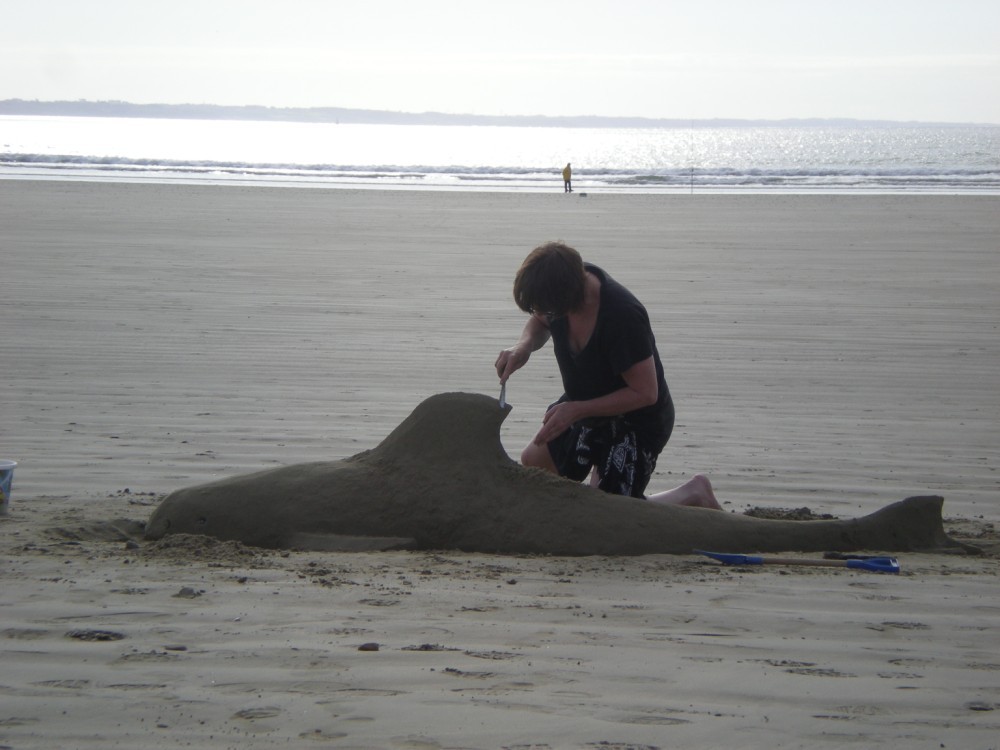
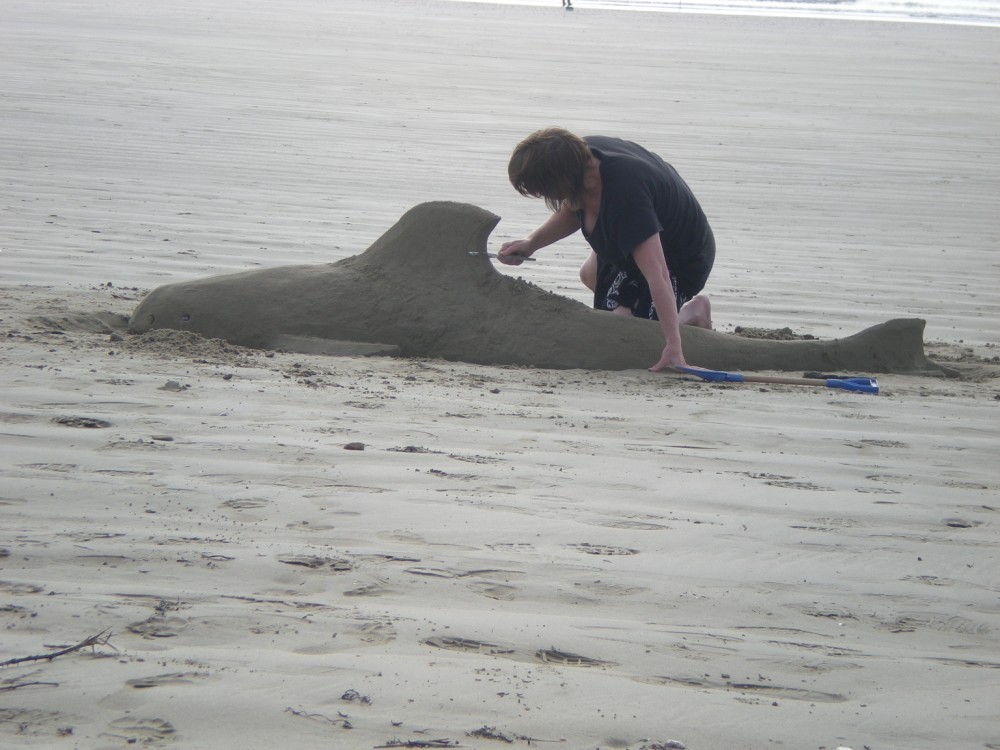
Ok, so if you haven’t read my other blogs on sand sculpture I need to explain the BTT (Between The Tides) As in – you are working with sea sand ( not the best – sand grains roll off each other as they dry so not as strong in sculpture) plus you have all the randoms (shells and bits of shell, seaweed, stones, rubbish) that may get into your sculpture sand, plus there is not time to stack and pack as the ‘professionals’ do as you only have the time between tides to work in (or less).
So there you are at the seaside with good sand and a collection of items to help you. A shovel or two, a knife and a spoon are pretty useful, a couple of brushes (cheap decorators paint brushes – one large one small – (about four inches and an inch) and at least one bucket.
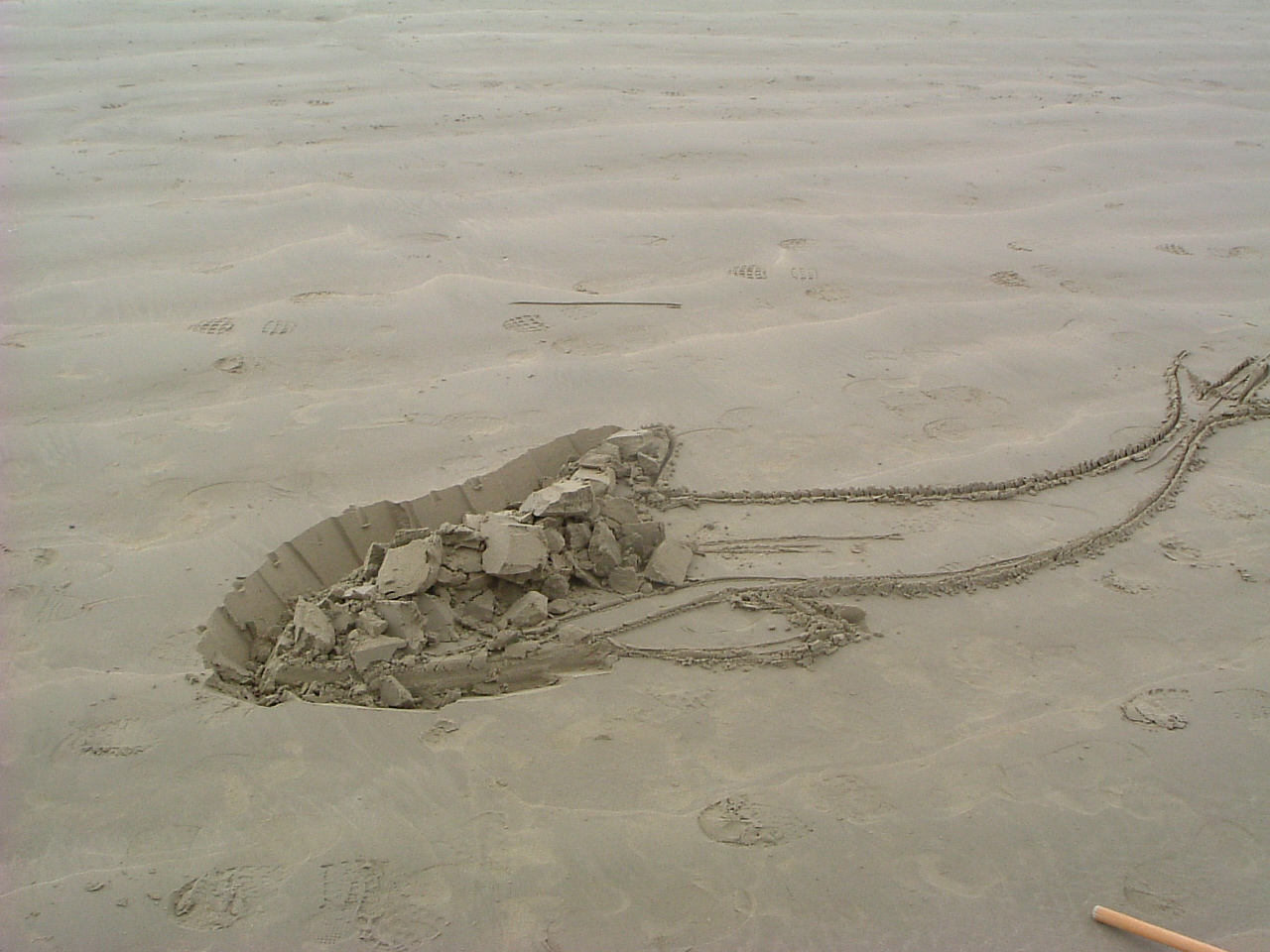
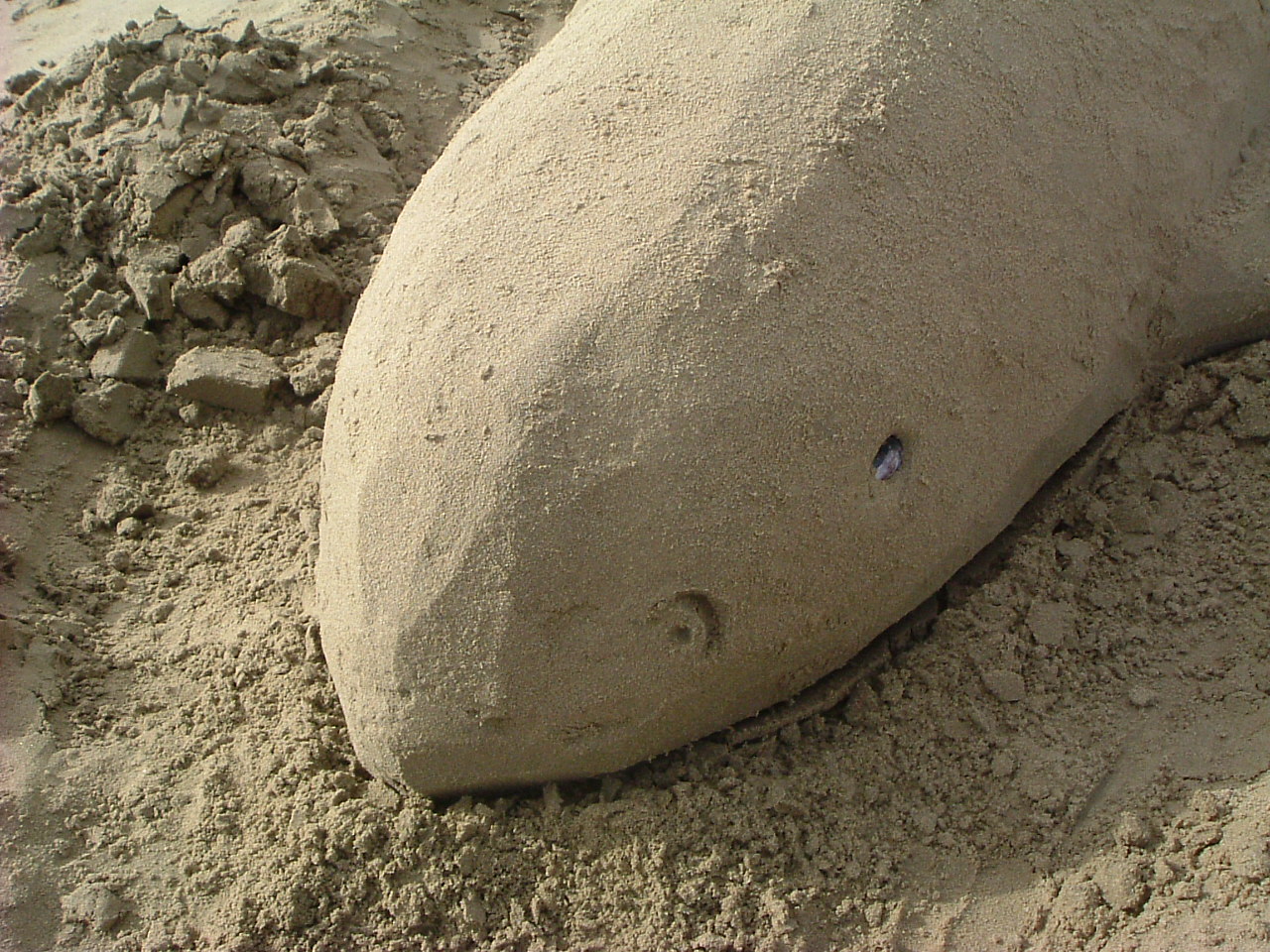
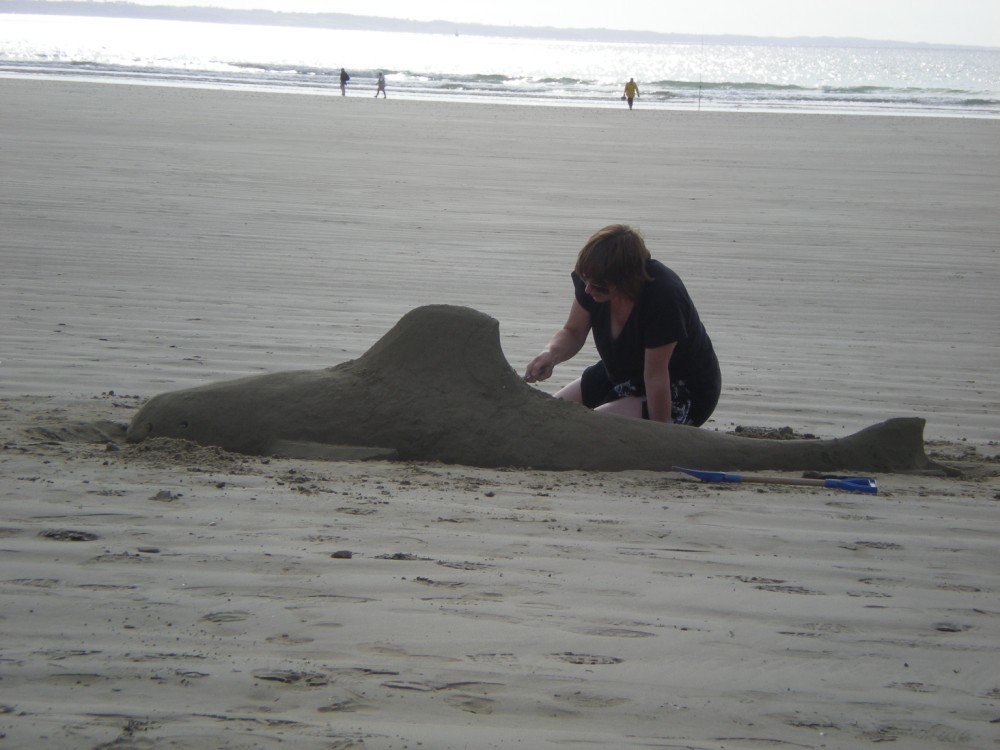
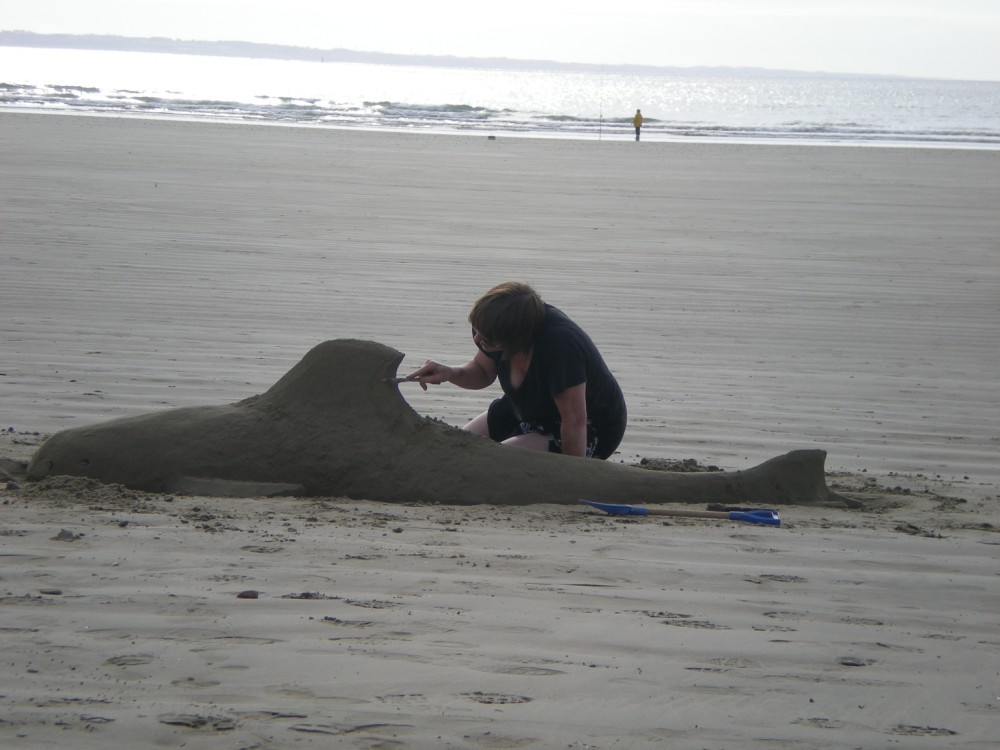
On this day I looked at the tide, it was coming in, but I thought I had time for a shark. [click on the pictures if you need to see details or the whole picture as the thumbnail size trims it down]
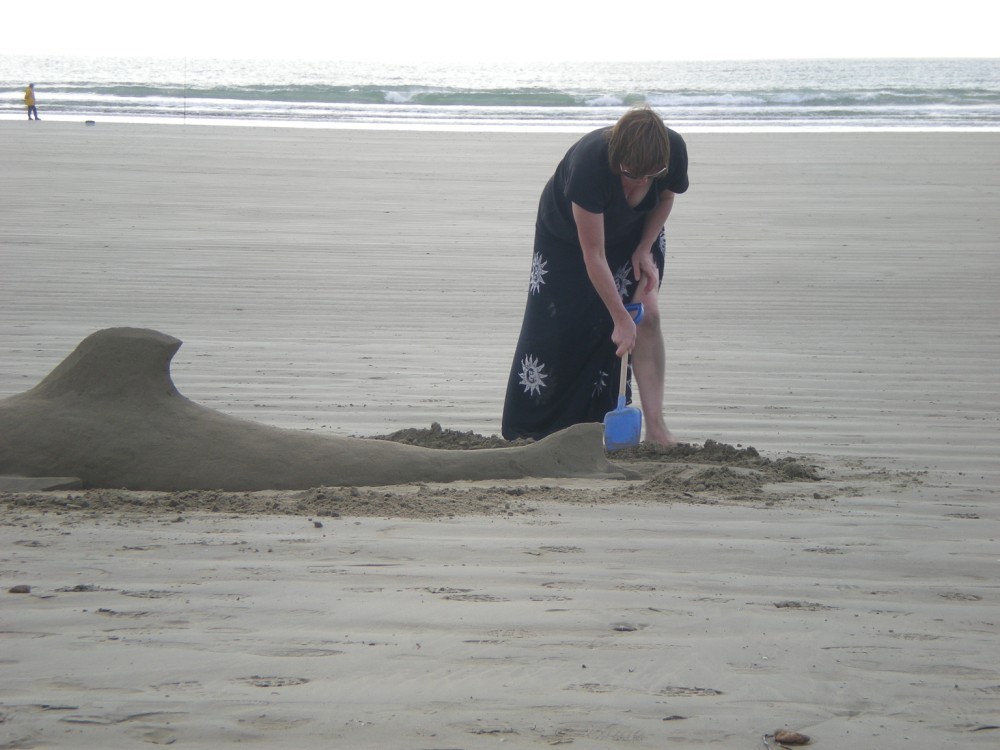
1, Mark out shark shape on the sand with the corner of the shovel – give it a bit of a wiggle to suggest movement, 2, Go round this line again, digging the shovel in deeper, 3, Dig all round the shape up to the line and tossing the waste in to the shape.
4, Continue doing this, digging from the outside towards the line and throwing the waste into the shape centre – consciously building up higher where it is needed. 5, Using your fingers knead the lumps of sand and using your hands roughly shape the mound into the approximate outline. 6, Pat it firmly into shape – using the back of a shovel to firm up the larger areas and hands for smaller areas like the tail. (Do not worry about the fin yet – but leave the fin areas rough – do not pat smooth)
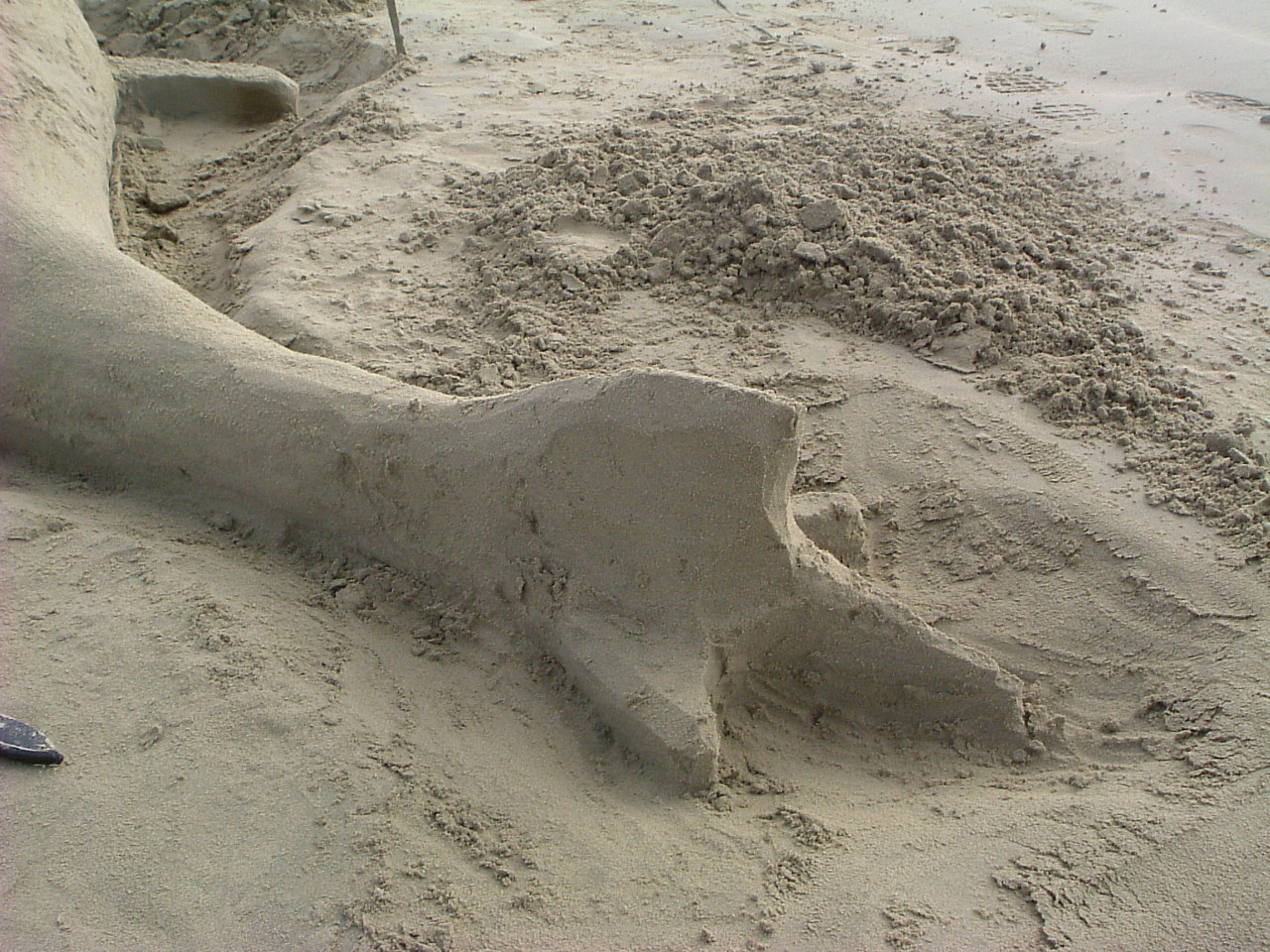
7, Start to build up the dorsal fin, it will be about six inches wide where it leaves the back of the shark, use loose damp sand that has come from the shaping and squeeze it up between your hands always leaving the top edge rough to take the next layer. 8, Work on a large wide curve, bringing the sand up thinner nearer the top. Using both hands, one to steady the fin, pat the sides to gently firm it. 9, Do the same for the tail (caudal) fin.(just about visible on this pic) Then leave both to ‘settle in’.
10, While the dorsal fins ‘settle in’ turn to the side (pectoral) fins, sweep away loose sand. 11, Use the knife and trim to shape – again removing loose sand. 12, Cut angles on the fins and slightly undercut both front and back to make them look thinner.
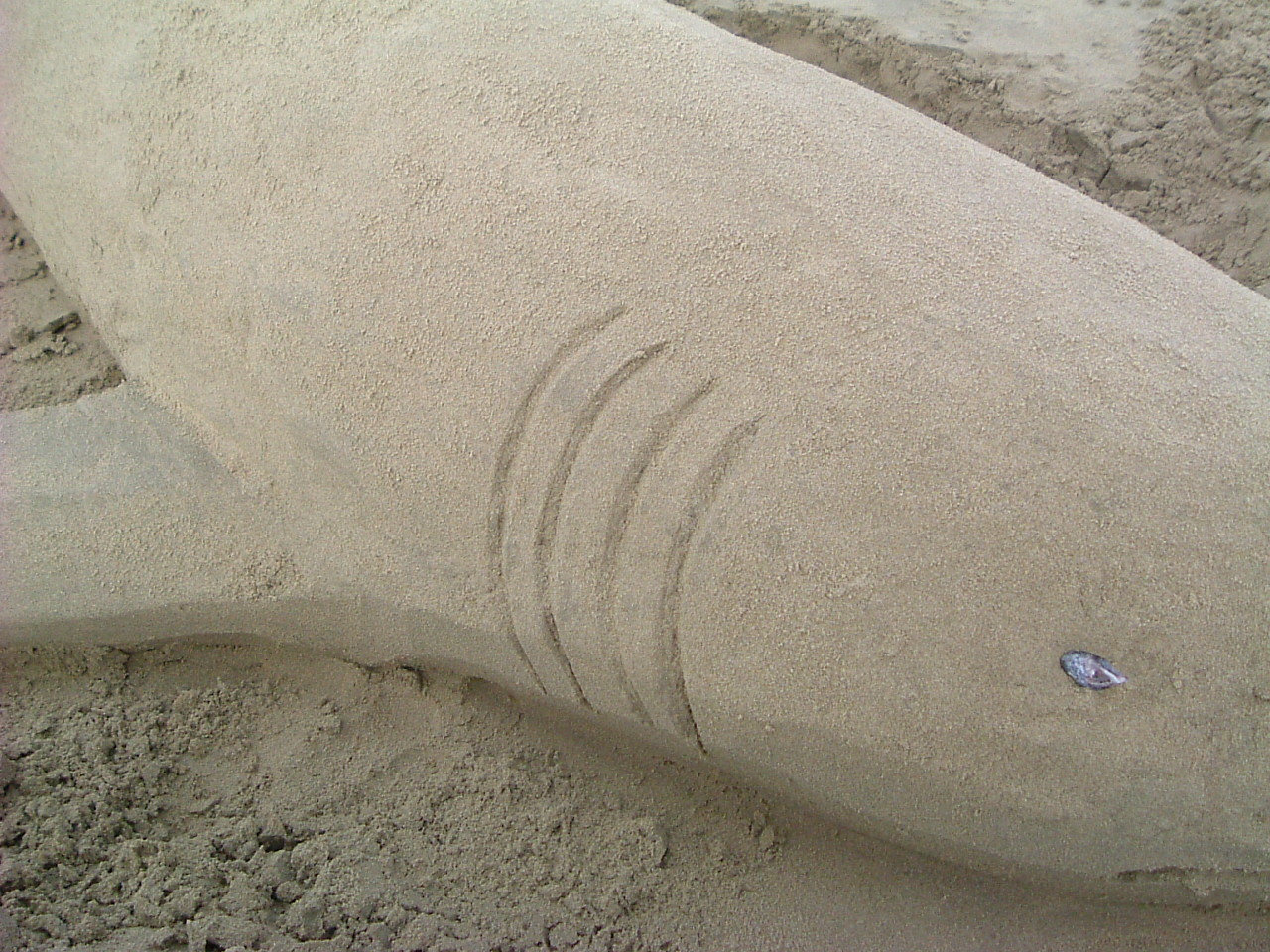
13, Gently pat and brush down the whole body of the shark until you are happy that it looks smooth enough. 14, Find a some suitable shells or pebbles to use for the shark’s eyes. Mussel shells, smooth clam shells or flat round grey pebbles are best. With a little rotational movement, site these either side of the head – taking care to have them even and 15, using the knife or tip of the spoon carve the nostrils.
16, Now return to the dorsal and caudal fins. For both of the fins start by marking out the curve that will make the characteristic shark fin look – draw it gently and evenly on both sides. 17, Do the caudal fin on the tail first – it will give you practice. 18, 19, 20 start to shave the sand away, cutting at an angle from one side then the other. 21, Thin out the top of the fin a little by shaving gently with the knife – brush down to remove loose sand. (most pictures show working on large dorsal fin)
22, Below the nose of the shark draw a line for the mouth, then draw another line just below that one – carefully cut out the wedge in between. Add some broken shells to make white teeth. 23, Draw the gills on either side of the head – again by making two cuts. 24, brush the cuts smooth to finish.
25, Tidy the area, pulling loose sand out to make an edge to frame the sculpture . 26, There is always something red in the flotsam on the beach – here a broken piece of plastic makes a good raw-meat look-alike for the shark to get its teeth into, 27, Final picture of the shark, 28, silhouette against the incoming tide.
Hope you have enjoyed watching me make a sand shark 🙂
and thanks to my friend Krissi for the shots where I am in them! And – it’s true – I must be a little mad – taking time to make such things that last such a short time before the tide takes them away. However, as we packed up and returned to our car, ours weren’t the only photographs that were taken of the shark – so it gave some pleasure to others too.
Latest info for my FWT cheerleaders is – a half pound down and I’m giving a talk on weight loss by using the method my sons and I worked out, at my WI on Wednesday – so that should be fun.
And I am still gearing up for the poetry workshop I am running at the Landulph Festival on Tuesday of next week – more about poetry then!
What do you like to do on the beach? Lie in the sun or do something active? Do share – I love to hear from you.
At last some sun.. even though we had to get almost three-quarters the way through July to get it! I’m going to start by letting you all know what the answer was to the picture quiz in last month’s Nature Notes. Here is the same spray now ….
The answer was Kiwi Fruit !! And I shall be sending ecopies of Some Kind of Synchrony to all three who guessed correctly! The fruit still have got quite a way to grow but you can see what they are already.
And if you are here looking for the results of my Win a Kindle draw (drawn 10th July) click Here
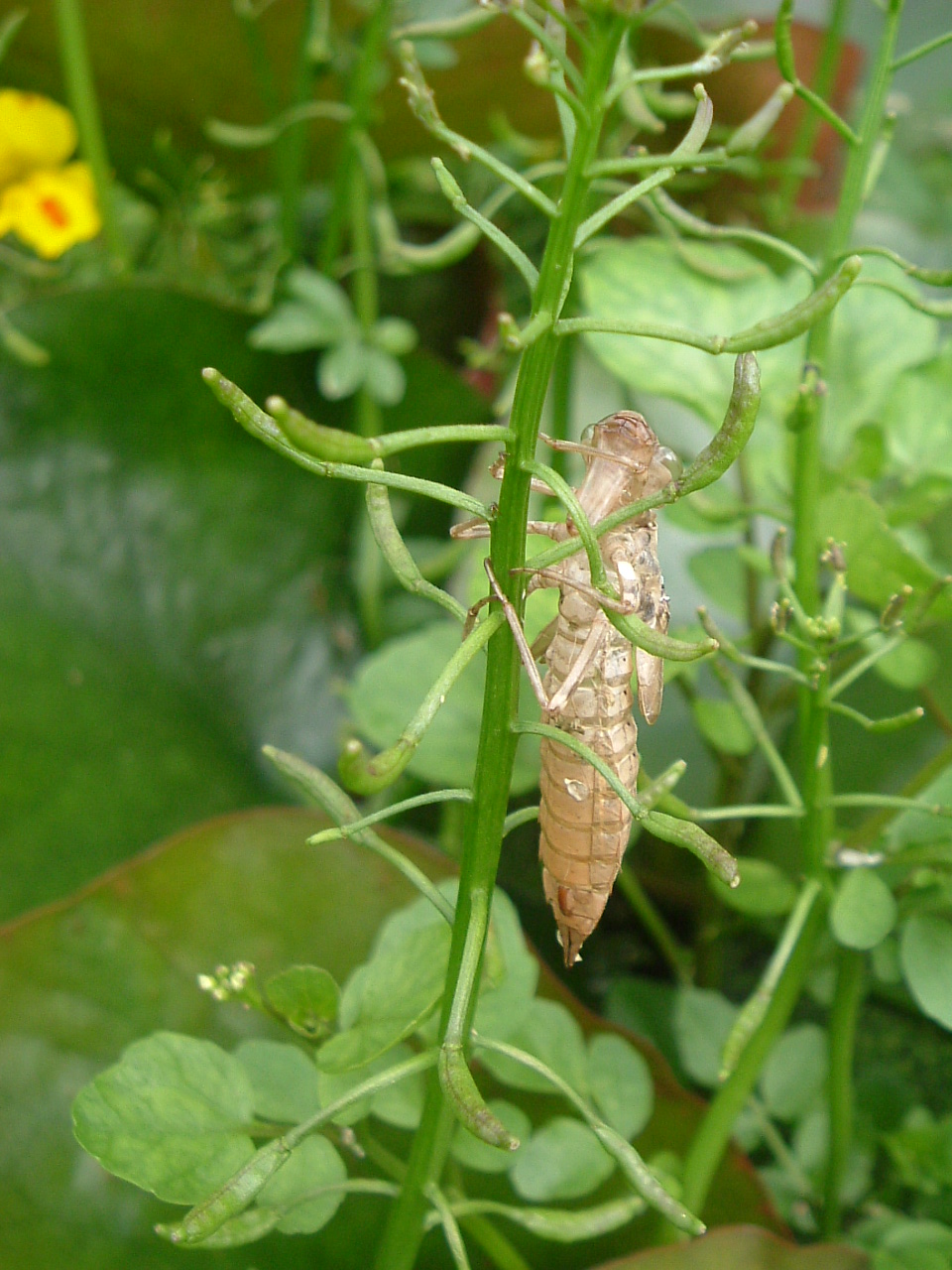
While back in the pond things have been stirring and the dragonfly larvae have been crawling out of the pond to breakout of their last larval skin and turn into dragonflies. I spotted this ‘case’ still clinging to the pond plant it climbed out on. The dragon fly larvae have been described as the ‘tiger of the pond’ as they are fierce predators taking down tadpoles and small fish. Some years there have been huge numbers in our pond but in recent years they have been few and far between. Perhaps this year is the start of another rise in population. Watch out tadpoles!
Meanwhile the more delicate cousins of the dragonflies, the damselflies, were making sure there would be other types of larvae in the pond too – here two of the common Large Red damsel fly, mating. You’ll really have to click on the picture to see them clearly in their attractive red livery.
You just have to see this! One morning I was called out to the patio with ‘Come and look in the dog’s bowl!’ The dog has a plastic water bowl out on the patio – to try to persuade her not the drink the water from the dishes under the patio pots (doesn’t work – she still prefers this water to clean fresh stuff) and, there, sitting in her half-full water bowl was …… a newt!
I guess he thought he’d found a nice personal little pond of his own. Now this is a good twenty metres from the main pond, needless to say he was transported to the pond in the bowl and released, before the dog came looking for a drink!
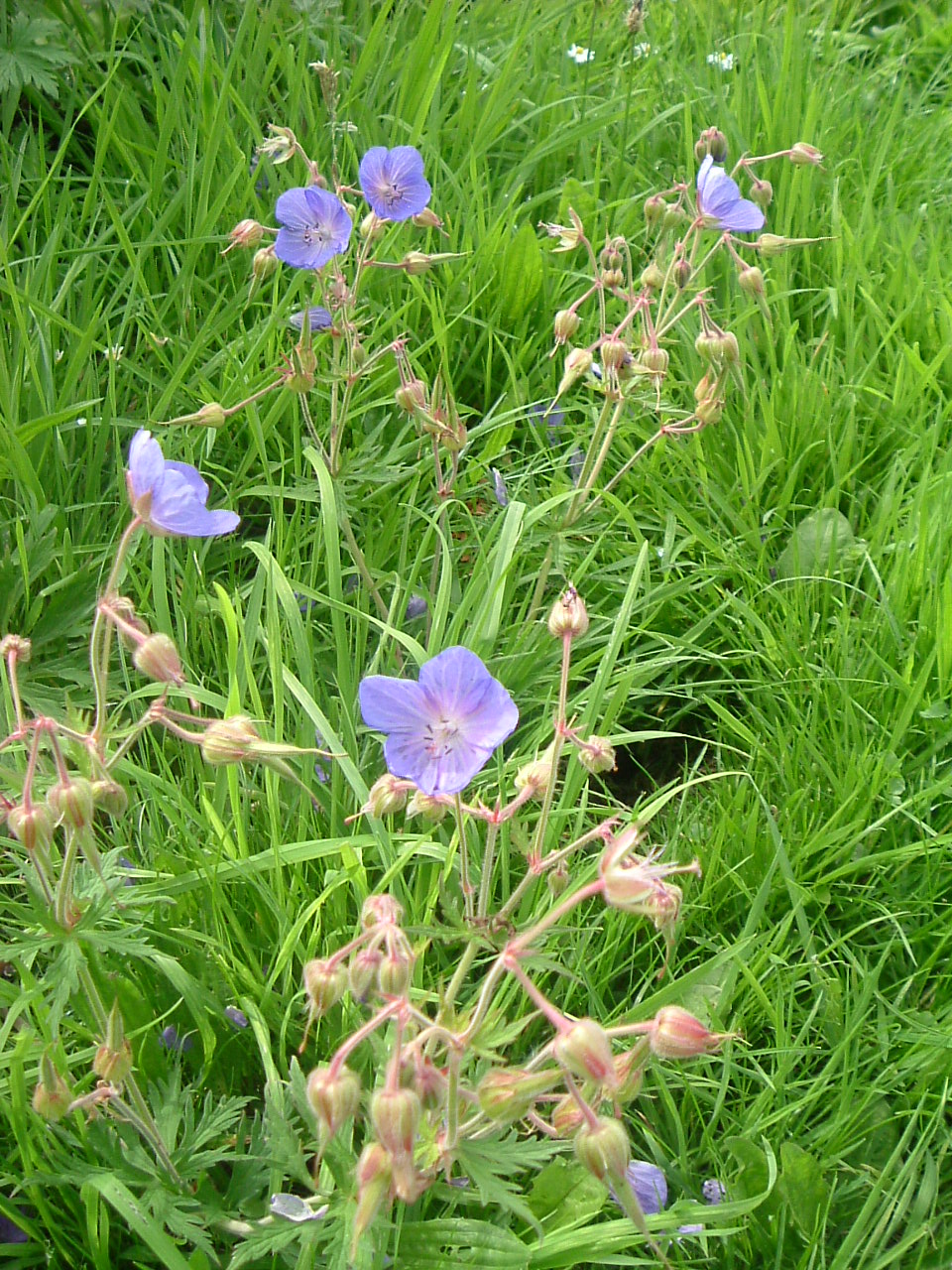
In the flora in July we’ve moved into some delicate purples, the meadow Cranesbill ( in the geranium family) and the Self-heal ( Prunella vulgaris). The latter small plant so called because it is used in herbal medicine as a poultice for wounds and abrasions and as an infusion for sore throats and more. This year it has grown in profusion looking quite pretty amongst the grass.
This week’s picture quiz is this ‘common’ beastie which I didn’t recognise who, along with his brothers and sisters, was destroying one of the perennial plants in our front border. Do you know what it is? First correct answer will win an ecopy of Nothing Ever Happens Here (as a pdf)
And for my FWT? cheerleaders – weight is now 9st. 11.5 lbs – yes – that’s down a whole pound this week! Full details on the drop-down for week 30
Lastly – a series of sunsets from one evening in July – not sure I’ve seen such a stripey sky before. How about you? do you just love sunsets – have to get the camera out to capture them? I love to hear from you !