Having a Jammy time …

DSCF7517The house is feeling empty; having been jam-full for the past five weeks. It has been a joy, this big old house and garden likes to be full of young people, from the very young (grandson #3 at 17 months) through his brothers (4 & 6) – right up to their Mum and Dad – all over from Malaysia, plus two other sons of ours, and a girlfriend, then after the ‘Malaysian’ contingent left, my second cousin and boyfriend (from Australia) .. it’s been great … and busy!

And now it is quiet and the soft-fruit needs picking and the jam stocks need replenishing.

It is blackcurrant time and ours have produced a good quantity. Most of this will go into the freezer – having been carefully ‘picked over’ to remove bits of stalk, so that jam making through the year will be easier. After all, who wants to be making jam when the sun is shining? It is also useful when you want a bit of extra flavour to sharpen up an apple crumble or similar, to know you can just pull a handful from the bag in the freezer and throw them into the mix knowing they are ready to cook with.

A new comment on my ‘recipes’ on the drop-down (above) made me think I ought to put my MW recipe for Blackcurrant jam into a blog as well as just on the recipes. If you are a regular reader you may have realised by now that I use my microwave for a lot of REAL cooking – and especially for jam as I find it faster, much less of a bother (no standing over steamy pot stirring to prevent burning or sticking) and less messy – easy cleaning of bowl as there is nothing burnt on.

My MW blackcurrant recipe has proved to be very popular – in fact Google Analytics shows me that over the last week alone 89 people came to view my microwave recipe for Blackcurrant jam (and 20 the MW Apricot jam one) and, judging by the average time spent on the page, many of them chose this recipe over other recipes available on the net.

So here goes:

My microwave Blackcurrant Jam recipe (makes 5lbs)

2lbs blackcurrants (picked over to remove stalks – if using frozen, make sure they are fully defrosted overnight, defrosting by MW seems to make the skins tougher
3 dessert-spoons water
3lbs sugar

1, Place blackcurrants and water in large* Pyrex or similarly heat proof microwave safe bowl, covered, 10 mins on high power to soften fruit and release pectin. (*large enough to hold at least twice the amount of fruit you are putting in it – mine holds 6 litres)
2, Add sugar and stir in well.
3, Lid off, bring up to the boil again in MW on high – about 6 mins.
4, Stir well and put back into MW to Simmer for 8 mins ( Simmer or med > low power)
5, Stir well, and put back into MW to simmer for 4 mins and check for set (place a teaspoon of jam mix on a cold plate – pop back in fridge – will show a set if the jam skin forms wrinkles and feels thick when finger is pushed though it when cool)
6, Into well washed jars pour about 1 cm (half an inch) of boiling water, place in microwave on full power for 3 – 4 mins until the water boils in the jars. Take care and tip them out well and stand to evaporate the last bit of water while you re-heat the jam mix
7, If a set is demonstrated by your test – return jam mix to microwave and heat until bubbles appear then remove from microwave and ladle into hot jars. (if no set then simmer for another 3 mins and retest, continue until a set is demonstrated)
8, Cover with clear jam-covers as per instructions with the packet, and label.
9, Enjoy!

DSCF7538DSCF7544


DSCF7542


This recipe makes a very intensely favoured Blackcurrant jam … which we also use to flavour our home-made yoghurt, just by stirring in a scant teaspoonful at the table – YUM!

Are you a jam maker?

Do you like to use your microwave to make jam or is this a new idea for you?

Do share – you know I love to hear from you.

6Oh – and if you are a Facebooker – there is a draw on Pendown Publishing’s page to enter where you can win a paperback copy of The Angel Bug  – please do pop over there and enter – you just Like the page and answer the fun question – ‘What genre would your life-story be?’ to enter. Thanks

Pavlova time! My ‘fool-proof’ recipe

Lovely sun, luscious strawberries … it’s the perfect time for pavlova!

Sweet, dessert, pudding, whatever you like to call it, is the topping-off of a good meal. Carefully chosen to balance the type of meal preceding it, it can be a delight … and so very, very tempting, because one thing they nearly all have in common is a high carbohydrate content.  Still, don’t you find that  no matter how filling the main meal was, there still seems to be room for the sweet treat? (in our pudding stomach ) 🙂 And my favourite – the Pavlova – is no exception so I offer it to you again.phpG50cumAM.jpg 2

DSCF5744
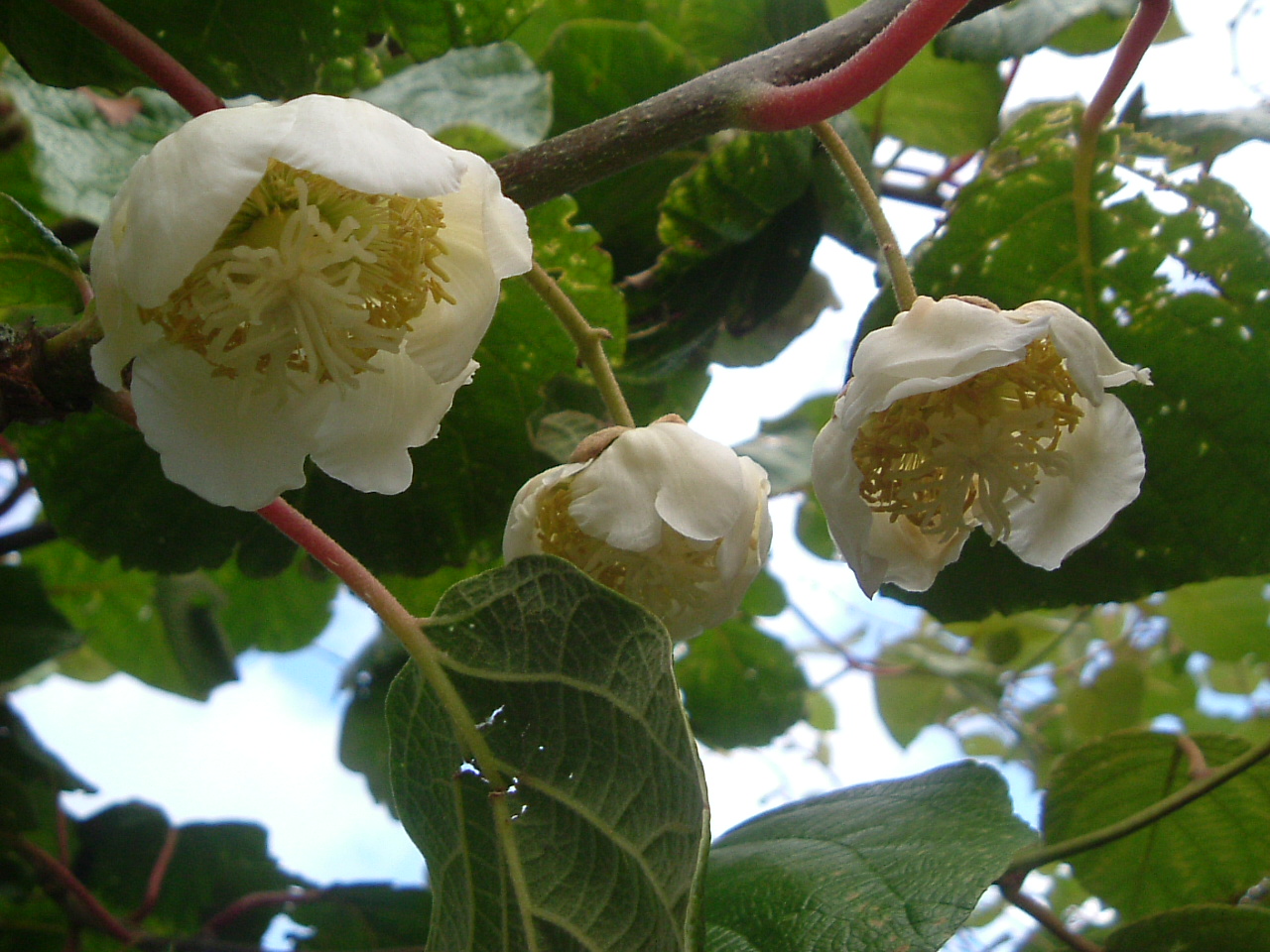
Kiwi Blossom on our plants

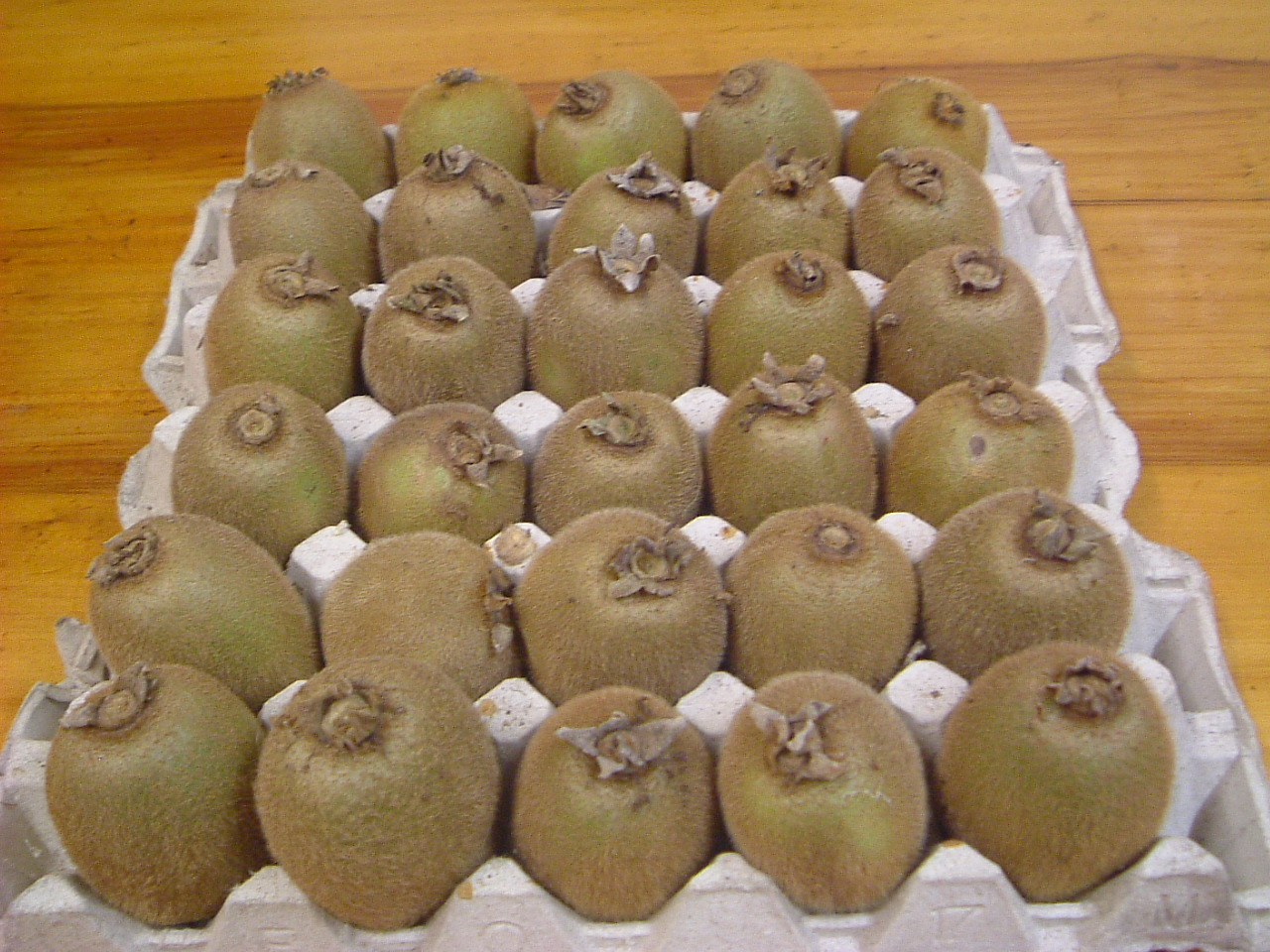
This one, made last week, was loaded-up with double cream, local strawberries and the very last of our own Kiwi fruit! Yes! Our own Cornwall-grown Kiwi fruit ... kept in an outdoor vermin-proof shed – 500 odd of them lined up in egg-trays – but these were the very last. There was one tray left – but the heat of the last couple of weeks had pushed most of them over the edge (too ripe). Not bad really, considering that the blossom is just opening on the kiwi plants!

It is believed that the dessert we know as the Pavlova was created in honour of the Russian ballet dancer Ann Pavlova when on a tour of New Zealand in the 1920s (though Australia hotly contests this, claiming to be the nation that hosted this culinary naming)

It is one of my favourite desserts and a long time ago I found a virtually fool-proof method of making them which has become much appreciated in the family as when I make them I usually make 3 bases at a time (well, if you have the oven on you may as well fill it up, and they do keep quite well in a sealed cake tub) and this means more than one meal-time gets this treat.  These Pavlovas are also brilliant for when you have a horde of people round – each one cutting into 8 generous servings. Best when the fruit is in season – so choose in-season brightly coloured soft or softish fruit when you can (hard fruit, like sliced apple, just doesn’t sit as well with this dessert)

Ann’s Pavlova ( or Vacherin  – not the cheese!)  

This  looks like meringue but it is really an adaptation I have made of a Vacherin – which is a type of meringue made with icing sugar (usually whisked once, but over hot water – my method seems to work just as well and be less of a bother)

Makes a 9 inch Pavlova base or 40 half mini meringues

2 egg whites
4 oz of sieved icing sugar.

Method

1, Whisk the egg whites until in stiff peaks.
2, Sieve the icing sugar and add to the whipped whites.
3, Whisk again until the mixture returns to stiff peaks
4, Either scoop into a piping bag and pipe small meringues onto a  greased baking sheet  (makes about 40 halves)
Or line the base of a 9” sandwich tin and grease the sides (or line a baking tray , draw a 9” diameter  circle, grease the sheet, spread or pipe the mixture over the area of the circle – adding a little more towards the rim).

Bake at 160 C or 140 C fan oven or Gas mk 3 (until palest fawn)

15- 20 mins for the small
1 ½  – 2 hours for Pavlova

Allow to cool gradually – I usually turn the oven off and allow it to cool before removing the pavlova bases.

To decorate use either 4 – 8 oz Cornish Clotted Cream or whip at least a quarter pint of Double Cream (taking care not to make too thick – nor runny) and spread evenly and thickly over the top.  Decorate with slices of soft / softish, fruits.

For mini-meringues. Whisk 1/4 pint double cream, place in piping tube with rosette nozzle. Pipe on one half – squeeze lightly as you stick the other half on.

Hope you find this recipe works well for you too!

Food is such an important part of our lives, it brings back memories, it can brighten our day or it can be a drudge and a scourge. How people eat and what they eat can help set scenes in novels too, can tell y0u a lot about the character without spelling it out. Take this excerpt from my novel Some Kind of Synchrony

The unexpected aroma of pizza, unmistakable in its amalgam of cooked cheese and oregano, stopped her for a moment, standing in her own hall, a rabbit poised for flight.  Then Andy appeared, filling the kitchen doorway.           

       ‘Thought I heard the door,’ he said and turned back into the kitchen.  Faith grabbed up the shopping bag and her handbag, pushed the door shut with the vigour it required, and followed him.  Two large size Pizzas stood on the table, one with the lid flopped back and a ragged wedge missing.  Andy held the remains of this piece in his fingers as he lounged against the worktop.  ‘Thought we’d have a pizza tonight – got the kids a video out too,’ he smiled, shoved the thick crust into his mouth and chewed contentedly, wiping his fingers on his jeans then folding his arms. 

I hope it’s painted a picture of Andy for you – to read the first three chapters of this book, and my others, free in PDF  just click here

What is your favourite dessert?

Are you enjoying the heat summer?

Do share – you know I love to hear from you and, fingers crossed, the glitches on the comments should be sorted out now – so i will know when you have written  🙂

Chip Chop – getting to grips with golf

As promised, I am addressing both the last two golf-lessons sessions together as I got carried away by my subconscious last week.

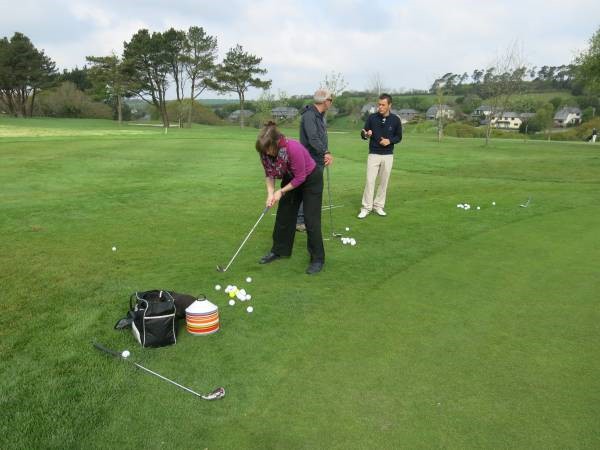
The second of the five lessons saw us gathered on the edge of the practice putting green and Jason introduced us to a new way to hold the golf club. This is a Pitching-wedge or a Wedge (with P or W written on it) and is used to ‘hop’ (my technical term*) or ‘pitch’ the golf ball from just outside the putting green, up onto it.  pitching wedge*Jason called it ‘chipping’

For this our hands had to be interlocked, the forefinger of the left hand (higher on the handle) trapped between the fourth (little) and the third finger, thumbs pointing down the handle. Initially I didn’t want to let go of this grip until my hands had learnt what it felt like – it was as if I wasn’t sure I’d get it quite right again if I did.

Next we had to lean forward from the hips, bend the knees slightly and draw the golf club in towards us so that it rested on the ground just behind the ball (set up on a tee). We then had to lean ourselves towards the left, the weight bearing more on that side, 70 / 30. Keeping our left arm straight and our wrists ‘locked’ we swung the club back past our right foot and forward, through the tee to the same distance the other side, ‘cutting’ the grass as we did so and – if we got it right – causing the ball to pitch upwards and forwards to land on the putting green and roll about the same distance the other side. Theoretically placing the ball in an convenient spot for a decent putt into the hole!

chipping Ann
More suitably attired this week

You know – it worked. it was great to see all of us popping the golf-balls up and onto the green. Some with more vigour than others, some less so, but all moving the ball in a neat hop off the slightly coarser grass onto the smooth sward of the green.  The whole of the rest of the hour was taken up with ‘perfecting’ these and either making our shots slightly longer or slightly shorter – depending what we were achieving initially.

Lesson three, and we did not head for the putting green – this time we were taken off to the driving range. Here we did a recap of the previous week first, as we were using the same clubs and the same grip (which I learnt later is the only grip we will need – apart from for putting)

driving range
Driving Range

The difference this week was in the distance we were trying to achieve. This time it was as if we were within sight of the putting green but not close enough to just pop it on.. we, therefore, had to lift the ball over the rougher grass but also send it a distance to try to get it to the green – or at least close enough for the type of shot learnt the previous week to be used.

To achieve this we needed to swing the club further… taking it way past horizontal and up into the air. This has to be very controlled, and uses wrist action to take it beyond the horizontal.

So, grip in place, we first repeated our stance… but this time the shoulder/weight lean of the body over the left leg is closer to 60 / 40. The arms are brought back for the swing, keeping the left arm basically straight, when on the horizontal the knuckles should be facing forward (away from the player) and then the wrists are turned so that the club raises up vertically. The swing is taken ‘cutting’ the grass and the ball is driven in a long shallow arc forward a long distance.

driving range view
View up the driving range

We spent the rest of the time trying to get this action right… it was so tempting to look at your arms, stance, club… anything except the ball… and yet (as Jason reminded us) the eye should always be on the ball.

Another interesting lesson – showing how the correct grip and stance can result in the ball being hit far more times than it was missed and a good proportion of those times it even went in the right direction and in the correct manner… though to  see the spread of the balls in the view down the driving range – you’d not think so 🙂

So far I am pleased to say that, should I ever find myself on a ‘pitch and putt’ course, I could now get the ball to go in something like the right direction – which is more than I could have managed three weeks ago!

Can’t wait for the next lesson – I wonder if we get to use the ‘big-headed’ (my technical term again 🙂 ) clubs next?

Only two more weeks to go on this 6 at 60 … I need to start sorting out the next challenge.

What type of challenges would you set for yourself?

What criteria would you use?  (mine is just that it has to be something I’ve never done before)

Do share, you know I love to hear from you

BTW I hope to get it fixed so that your comments will appear quicker – had problems ever since the spam was getting in and had to be re-filtered – my tech guy (#1 son) is coming to visit in a fortnight)

PS If you are around Liskeard in Cornwall at the weekend I shall be at the WORDS WORDS WORDS Author Event in Season’s Bistro from 10am – 1.30pm Saturday 17th May with my books, doing a short reading from them and signing and dedicating copies for customers – love to see you there 🙂

NEHH Winner + Blast from the past – bellydance post

NEHH_Design_Light* * * * * Congratulations * * * * *

…… to Eleanor Beavan as the winner of the signed ‘blog-launch’ copy of the new paperback of Nothing Ever Happens Here! 

Thank you all for your comments and support.


Blast From The Past

                          Belly dance post – What on earth should I wear?

… it has been a while … and posts do get well and truly buried … so when I was reminded of an very much earlier post this weekend (while talking to someone about joining our belly dance class and what she could wear) – I decided to reprise this post. I have been belly-dancing for about fourteen years now – still LOVING it – never bored with it (unlike exercise classes) yet it offers superb CORE MUSCLE exercise and muscle and joint flexibility with little impact stress.

Think of it like going to a fancy dress party, on a weekly basis, permission to dress up outlandishly in bright swishing colours and fabrics with rings, anklets, bracelets, and bells, and jingly coins – such fun, and that’s before the dancing. Oh, and if you think that this is normal for me, I need to explain that my usual wardrobe consists of, black (black and black) burgundy, cream and a little summer turquoise, jewellery: one wedding ring, one watch.

I know some dance groups are more focused on a ‘look’ than ours, but the eclectic look we have suits us well All sorts of colours and a lots of ‘bling’ and everything from purpose made kit to the opportunistic find at a charity shop or a bric-a-brac stall at the village fair. And it’s ‘Oooo that’s lovely, where did you find it? Or. ‘You been hitting ebay again?’ Or ‘How did you make that?’ when new items turn up in our friends attire.

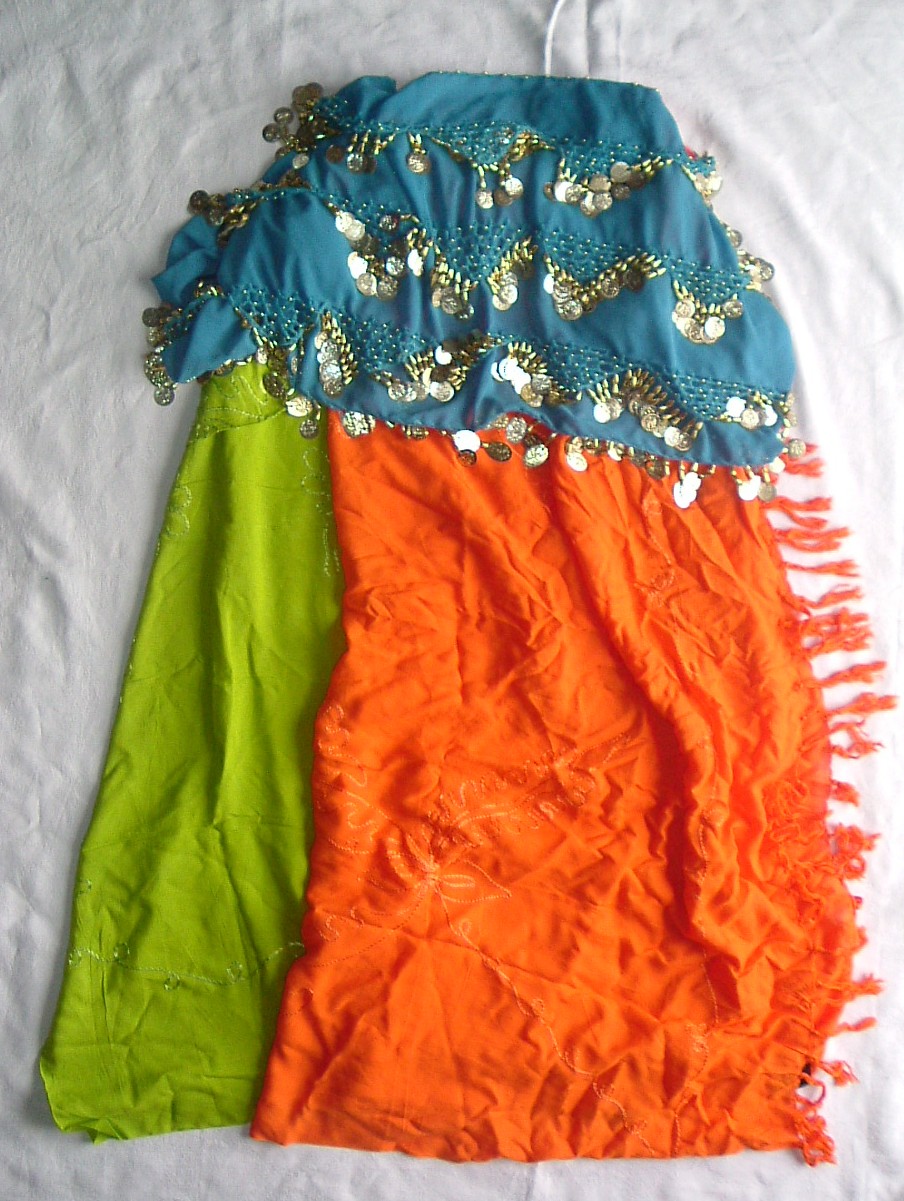
just a few of my coin beltstwo sarongs and a coin beltFor me, note – not for everyone, but for me the real essential is a coin belt, and for me, again, the jingle-jangly the better. I have amassed a fair number over the years, and my lovely daughter-in-law brought me a stunning range of new coin belts as a gift the last time they came over. Look for a belt that has plenty of overlapping coins on mesh-fabric or tassels that can move easily. Without the coin belt I am never sure of my shimmy, with it I know exactly how it is going!

These I usually wear over swishing long skirts or similar, with other layers of gauzy, sparkly or shiny materials tied around the hips. An interesting way to get a good look is to tie two sarongs (we all have those around don’t we?) one over the other in opposite directions, knotted on the hip (emphasising the hips is good!). Thus, movement on one sarong flashes the colour of the other and gives plenty of room for leg movement. Over this tie a gauzy layer, or just top with a coin-belt in contrasting colour.

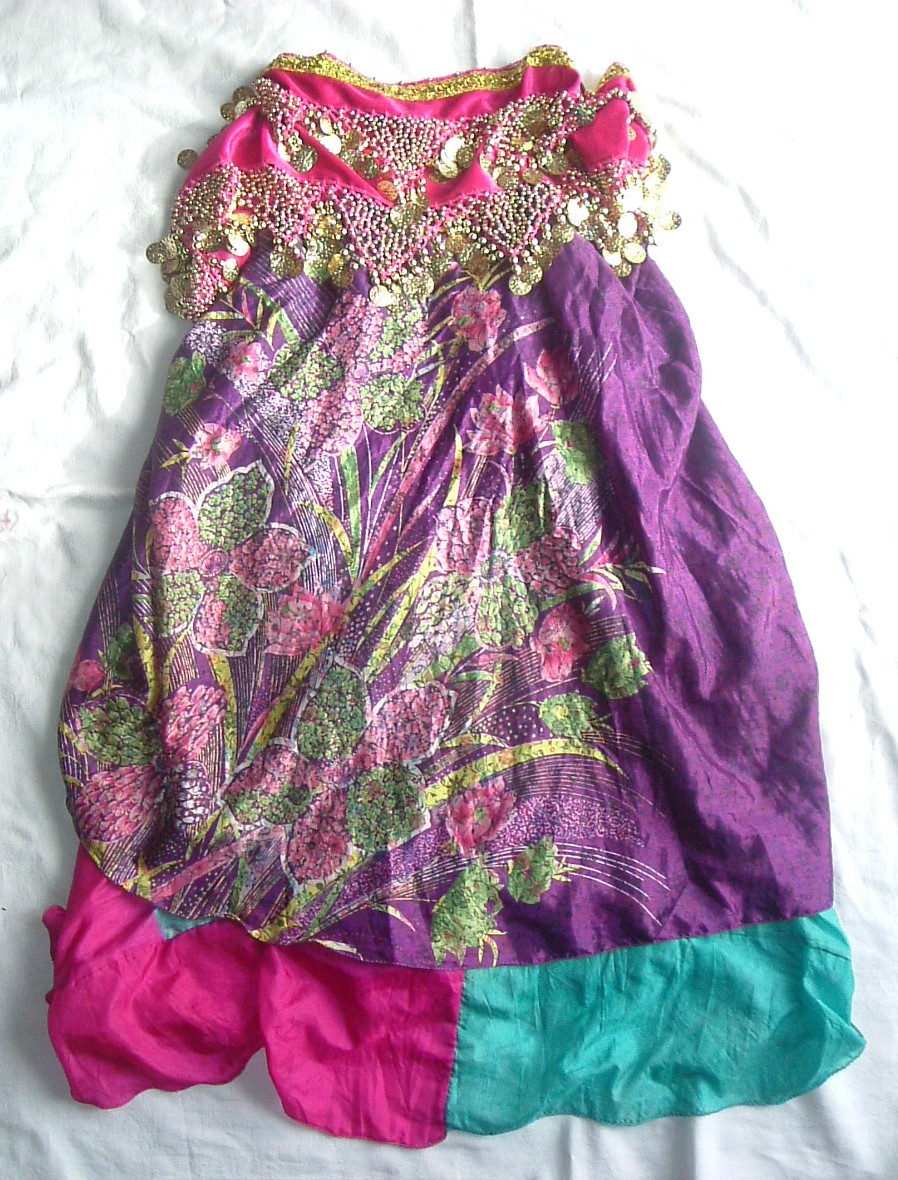
Handkerchief style skirts, double layers with lots of points and in pretty fabrics can work well over black leggings, again topped with a contrasting belt.silk skirt

My favourite, a two-tier silk skirt bought in a French street market, with contrasting coin belt, often with gauzy layer over too.

I tend to wear simple black tee-shirts with ¾ sleeves and add bracelets and anklets for any further decoration. Others have finds of sparkly shrugs, tops, and tee-shirts, ear-rings, necklaces and hair-clips.

So, there you have my guide to what to you can wear… easy to put together stuff or specialist. If you are attending your first belly dance evening your teacher will probably have coin belts or even swishy scarves you can borrow, or other members of the group – their bags stuffed with their extras – may offer to lend you the basics for the evening. Beware, collecting interesting belly dance clothes and bits and pieces can get addictive!

Are you a belly dancer?

If so – what are your essentials?

If not – are you tempted to find a class and have a go?

Do share – you know I love to hear from you

NEHH Paperback – out now – Win your copy here

Yes! It’s arrived, lovely glossy covered, real live heft of a paperback version of Nothing Ever Happens Here! And to celebrate I’m sending a signed copy to a randomly selected winner from anyone who comments on today’s blog! So, even if you do not usually, click on the title of the blog on your email so you are ready to write a comment to enter.

DSCF7454
Oh please do click on the photo to see the books in all their glory – the upload limit seems to fuzzy the pictures on the blog itself

The paperback is up on Amazon … with the usual crazy waiting time … this seems to be the case when it first goes on … but it is still exciting to see the Ann Foweraker stable of book-offerings grow.  And, of course it is on AnnMadeBooks too

A book is a book, right? So why does it feel more exciting to launch the paperback even though the ecopy has been out for a while now?

Have you already read NEHH … but still wouldn’t mind winning a paperback copy?

Do comment, you know I love to hear from you and maybe you’ll be the one …

NOW … let the comments commence!

NEHH draw rules:

I’m afraid this draw for a paperback is limited to readers in the UK. (please make sure you use a contactable email in the required box when sending your comment – this is not shown on the blog).

However, if you are one of my overseas readers I’m running a draw especially for you – but for an ebook copy – just add your country after your comment to enter this.

That’s it, enter before midnight Sunday 6th April – I’ll make the draw next Monday 🙂  Happy launch day 🙂

***

p.s. Can’t see a comment box?? – zip up to the top – just above the title to where it says how many comments – click – and the box will appear at the end of the blog

pps – Sorry, the comments are not coming up straight away (still) but only when I go in and individually approve them *sigh* .. however, I won’t miss any 🙂

The Trader of Saigon … and perfect timing

I may not have come across this book if it wasn’t for the fact that Lucy is a friend of my second son… and so he had Liked her Facebook post when her debut novel was published by Quercus – so I Liked her FB page too. Now, this is something else that authors do… they support other authors especially new and local authors. Not that you’d think this by some comments from a few traditionally published authors who seem to think that readers won’t read their book if they read a book by someone new to the scene, as is Lucy, or heaven forefend, someone Indie Published. Truth is, readers will read .. and the traditionally published old guard are the only ones the traditional publishers spend real money on advertising (and those new ones they have forked out some crazy advance for, in a bidding war) so all the rest need support and help to spread the word. The best way, perhaps the only way, is by word of mouth (or review/blog). I prefer to pick up and read a book that someone I know has told me they enjoyed – and I know I am not alone in this.

So, to Lucy Cruickshanks’ novel The Trader of Saigon.  untitled1

The book description:  From Hanoi to Saigon, a tale of one woman’s search for a better life – and a thriller that strikes to the merciless heart of post-civil war Vietnam. In the chaos and corruption of 1980s’ Vietnam, three seemingly unconnected lives are brought together by greed, fear and hope.As a US Army deserter, Alexander is a man without country; trapped in a life he no longer controls and embroiled in the dark business of trading women. His latest victim is Hanh, a rural girl who moved to Hanoi to escape inevitable poverty and who sees Alexander’s arrival as the answer to her prayers. Neither of them has ever met Phuc – a Vietnamese businessman who backed the wrong side in the war and is now unable to pay his financial and political debts to the Party. But his struggles are about to change both their lives.

Review: Very unlike my own locally-based novels, Lucy takes us to a world apart, Vietnam shortly after the disastrous civil war, a world where The Party keeps an eye on everyone and any white man is likely to be a Russian. Lucy skilfully weaves together the stories of three people, not all likable, but certainly interesting. The atmosphere of watchfulness, poverty, corruption, graft and menace is melded well into the heat, dirt and desperation of life in Vietnam at this time, and this is testament to Lucy’s writing skill and knowledge.

I found that I read this novel very quickly and when I finished I had to go and check on how many pages it had been (I was reading on kindle and so did not have the heft of a physical book to guide me) and it was a full length novel! Why do I comment on this – well, a full-length novel that passed so quickly tells me that it read swiftly and carried me along with its fast pace, even though I had been unaware of it at the time.

Lucy also uses some very effective imagery, like the ‘smiling lizard skeleton’ that I found myself thinking about at times when I was not even reading the novel. All in all a great debut novel and well worth reading.

PERFECT TIMING  

I wrote most of this blog in the middle of the week and when I went to grab the link today I saw that Lucy’s novel for Kindle is reduced from over £4, that I recall it was, to just £1.63. HOW LUCKY IS THAT?  Apparently this is  for a *limited period  (*so it says on Lucy’s FB, but, no, I don’t know how long – but might be quite short)  Here’s a link to The Trader of Saigon.

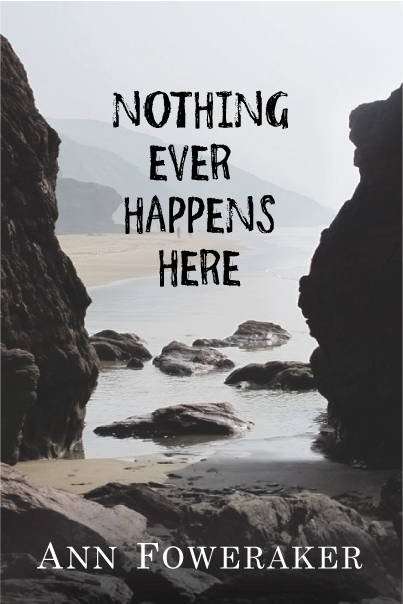
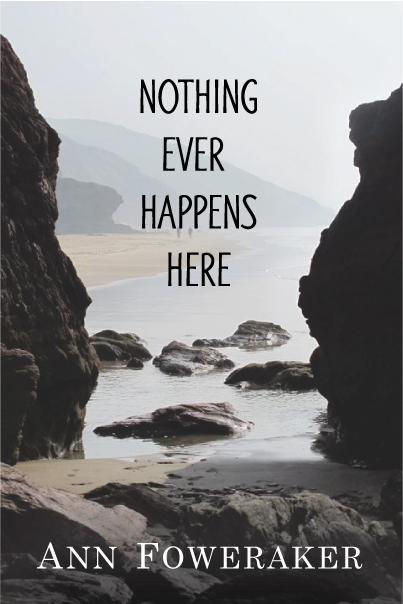
AND A BIG THANK YOU to all of you who commented on my cover dilemma. Your comments really helped and the cover we have chosen combines the handwritten (on a postcard) feel with a font that does not look ‘flippant’ and instead engenders a sense of urgency. So here is my COVER REVEAL  (it looks a bit blurry here but if you click on it it comes up clear) Hope you all like it as much as I do!

NEHH_Design_Light

How do you find new authors to read?

When you find a new author you like do you read through all their back list straight off, or eke them out between other books?

Do share, you know I love to hear from you (and apologies if your comments aren’t coming up straight away – wordpress playing up … but I’m looking into it – thanks for your comments and your patience!)

What’s in a font? Please let me know!

Time has been flying past and the preparations for Nothing Ever Happens Here to be released as  a paperback has been my major project.  Now, at last, we come to the final design for the cover. The original photograph used is still going to be the same. It was taken in the area that the book is set and says (to me) ‘a holiday on the coast … but with dark foreshadowing’.  So the changes are mainly to do with the lettering. My own name will be as it is on the Paperback version of  The Angel Bug…. so we are left with the words ‘Nothing Ever Happens Here’.

Here is the problem. Fonts speak. Just the mere shape, density, texture of a font can create a different feel, a different sense in the mind of the reader.

Here are the current three front runners to occupy the space on the front of the paperback. Please help me choose. (You can click on each picture to enlarge in a separate window)

To help you choose, if you haven’t read the novel already, here is the blurb ….

Crime, romance, smuggling and Cornwall all come together in this light thriller set in the early 1990s

Living in London suddenly becomes too uncomfortable for the attractive Jo Smart and her sixteen year-old son, Alex, after he is beaten up, so when they are offered the chance to take an immediate holiday in a peaceful Cornish town they jump at it. But not all is as peaceful as it seems as they become involved in a murder inquiry, drug raid and abduction.
DI Rick Whittington has also escaped from London and the reminders of the death of his wife and child, and through his investigations finds himself meeting Jo and being drawn into the events surrounding her.

1
ONE
2
TWO
3
THREE

So which font fits best, 1, 2, or 3?

Which ‘says’ the right thing to you?

How and why did you make your choice … which may just be a gut feeling?

Do help me out here, you know I love to hear from you … I need to hear from you … Thank YOU!

Hearing Voices and The Goldfinch

One thing that all good writers do is … READ. Yep, we read .. lots.  Often it is because we were avid readers that we are also writers.

Before I start writing a new book I go on a reading spree of books that give me background and information. These are usually non-fiction and, when about complicated subjects, they may be the  populist versions so I can ‘get a handle’  on the topic, and follow up with more in-depth studies if required. Sometimes the book isn’t exactly what I wanted or was expecting, but I always finish it because nuggets of information get stored away and can, and do, pop into a story somewhere or another, or even merely inform a character’s belief or thought processes.
Then, while I am writing, I am always looking things up for reference, to get things right. Oh, and this is where the internet is wonderful… such a range of information at our fingertips. When I wrote my first (released) novel the internet didn’t exist and any research had to be done via the library or by asking people I knew who happened to have the expertise or knowledge I needed.

Writers read for pleasure too, of course, but here is the problem. If I am writing at the same time as reading a novel I have to be very careful not to pick up the ‘voice’ of the author.

The Author’s Voice is one of the things that differentiates authors one from another, it is also, sometimes, why someone will like to read a particular author.

The publishing world talk about the author’s voice a lot … and so when you find your own you do not want to muddy it with echoes of another

goldfinch
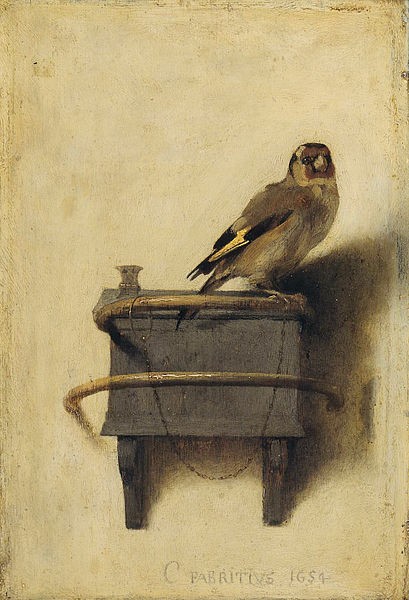
Th Goldfinch by Fabritius (courtesy Wikimedia Commons)

So, it was useful that I was taking a break from writing to do a final proof of Nothing Ever Happens Here, before it is released as a paperback, when I started reading Donna Tartt’s ‘The Goldfinch’ as I fear that Donna Tartt’s voice would have infiltrated my writing far too much.

No spoilers here.. I really dislike reviews that ‘tell the story’.  The author has told you all they want you to know before you read, on the back of the book or the online description (this because I read it on kindle) see below:

“Aged thirteen, Theo Decker, son of a devoted mother and a reckless, largely absent father, survives an accident that otherwise tears his life apart. Alone and rudderless in New York, he is taken in by the family of a wealthy friend. He is tormented by an unbearable longing for his mother, and down the years clings to the thing that most reminds him of her: a small, strangely captivating painting that ultimately draws him into the criminal underworld. As he grows up, Theo learns to glide between the drawing rooms of the rich and the dusty antiques store where he works. He is alienated and in love – and his talisman, the painting, places him at the centre of a narrowing, ever more dangerous circle.”

My review:  I found this a rich and intense read. There is so much description that progress is frequently very slow, but what rich, embroidered, gilt-edged, magnified, textured, illuminated description it is. I doubt any new authors would be permitted to let such a work reach the reader. Is it too much? Many of the other reviewers have found it so. I revelled in the descriptions, while acknowledging their draw-backs. (I am a closet describer – I’d love to ‘go off on one’ and use such language – but it does not suit my style or my voice and, I suspect, would not suit my readers.) It is also ‘referenced’ to many other written works in subtle, and some not so subtle, ways. (I like this as I am partial to doing similar with my characters’ names, though noticing it was not necessary it was a bit like ‘getting an in joke’.) Did I enjoy the book?. To be honest, not as a story, but as an experience, yes.  Perhaps the setting being in the US did not resonate with me? Perhaps the lifestyle of the main character, Theo, did not feel believable enough?  I note I was more in tune with him when he was learning how to help restore furniture than at any other time. At no time did I have hopes or fears for him (or any of the other characters) despite there being plenty of reasons to have hopes or fears. The ending, I felt was a bit too much tell not show, with a pulling together of the handkerchief corners of philosophy, experience, life and death all into a bundle and handed to us by Theo. As a bonus it has made me, like many others, look up the painting that is at the centre of the story and appreciate it.

Have you read The Goldfinch? What did you think?

I am thinking of doing occasional book-reviews as a regular feature? Would you like to see these here on my blog .. or not?

Do let me know … I’d  love to hear what you think.


Happy 2014 – and a gift for You…

As I write it is already New Year’s Eve … 2014 is almost upon us.  Along with just about every blogger I know I can’t help but glance back over the year. As an Author it has been a interesting year – with, at last, finishing The Angel Bug and getting it published! This meant that I had to get out there and do what I find difficult – blowing my own trumpet –  and get myself radio interviews and pieces in the local papers.

Then there was the next step of working with Pendown Publishing to get The Angel Bug released as a paperback – this was a whole new learning curve.

In the future we plan to publish each of the other full length novels as paperbacks too – as this has taught me how many people like to own the solid copy – even if they have already bought and read the ebook!!!

So lots to look forward to on the Author front and,  as time and the blog will reveal, also on the home front too…..

THANK YOU ALL for sticking with me and the blog all through 2013! It’s good to know that I am not just writing words into the ether! It has been great to read your comments, to get to know some of you a little better, to explore the things that trigger a memory or ring a bell with people from all over the world.

So as a New Year gift to you, my readers, I’m offering you an ecopy of Some Kind of Synchrony  cover

Just contact me via the contact-ann on annmade.co.uk (you just need to make sure you enter your email address really carefully – so that I have it accurately – and in the message say which version you need for your ereader – mobi for kindles, epub for most of the others, or pdf – if you are going to read on a computer)  That’s it – just ask for your free new year present before the 14th Jan – and I will email it to you – though, of course, when you’ve read it, I’d love a review posted on amazon!!

Here’s wishing You All a Happy, Prosperous and Peaceful 2014 filled with joy and plenty of time to read.

Weird Fruit

Have you ever eaten a Medlar?

DSCF7324 (2)
A plate of Medlars

I ate my first about six years ago … and then last year we planted a Medlar tree. This year we have fruit.

DSCF7327 (2)
Medlar – papery skin peeled off
DSCF7334
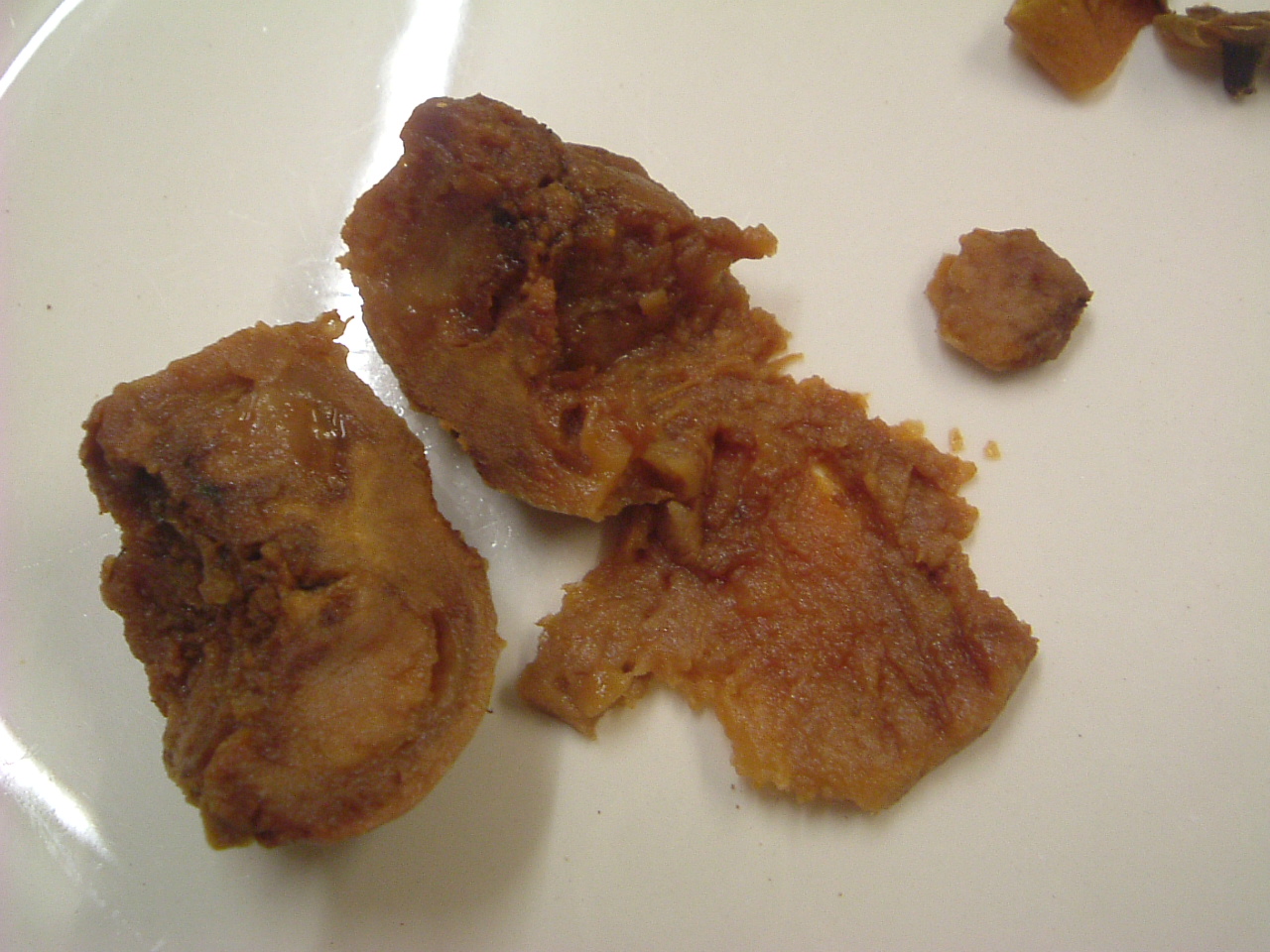
Medlar – cut in half – puree squashed, one seed removed – top right,

It is a weird fruit! It is a member of the rose family despite having the look of an apple about it, albeit with a rather large ‘flower end’ which has in medieval times given it the slang name of ‘open-arse’ .  To me it has associations with Elizabethan England though it is not a native tree and has been cultivated since Roman times. But it is not its appearance that is strange – this is a fruit that has to be ‘bletted’ a word from the French which means ‘softened’ and to do this it has to start to decay –  rather like some cheeses, it goes soft through maturation. Once soft the acidic pale fruit turns a rich brown and becomes paste-like.  Once the outer papery layer is peeled off it can be eaten, tasting like thick apple puree which has been flavoured with spices, perhaps cloves and cinnamon. They do have hard ‘pips’ or seeds’ within them too.

The second weird fruit we have just harvested is a rather late planting of Physalis peruviana or the Cape Gooseberry. DSCF7336 (2)This is the first time we have grown these in over thirty years. A friend gave us these plants, the first lot we grew in the first greenhouse we owned when we lived in Plymouth. Back then no-one had  seen them before – they were truly exotic … today they seem to adorn almost every dessert we have when we eat out* (* not that we eat out often – but these are always there)  However, there is something still a little magical about the golden ball of tart sweetness hidden within the delicate papery lantern.

The third fruit we have been harvesting is another ‘gooseberry’ the Chinese Gooseberry (see how I linked those last two) or as it is more commonly known – the Kiwi Fruit. ‘Well, they are not strange or weird’ I hear you say. DSCF7329 (2)Though I always think they are a little weird as fruit goes … the strange thing is that our crop is grown in Cornwall UK .. and our few plants, as in some other years, yielded 657 kiwi fruits! These we stand in egg trays in a cool vermin-proof shed, and bring one tray indoors at a time to ripen an soften ready to eat … they last us well into spring.

One unusual fruit that we have tried to grow but have not had any success with is the black Mulberry. Where I grew up we had an enormous and very ancient mulberry tree.  Quite possibly one of those planted in the 17 century when they were imported and planted in the hope of rearing silk worms to make silk on them. Unfotunately someone was misinformed, as the silk worms prefer the White Mulberry. I loved that fruit and really wanted to grow one here, but all types of propagation and buying of stock resulted in failure. To me, the taste of the mulberry is the taste of my childhood.

Have you ever eaten a medlar, nicely bletted?  What did you think it tasted of?

Do certain fruits bring back memories for you

Do share, you know I love to hear from you.

By the way … ‘The Angel Bug’  is now available in Paperback from AMAZON  all over the world, and to order from all good bookshops, everywhere.

error

Enjoyed this blog? Please share :)