Craft Fairs & Literary Festivals

It is THAT time of year – when people are thinking about  *whisper* Christmas shopping …  WP_20151105_15_26_11_Pro

… and my favourite place to shop is a proper local craft fair – where the goods are made in the area by the hugely talented lot of crafters we have in South East Cornwall (and around) There are two I always go to – and attend with my own books too – one is in my local church, which happened this weekend, the other is at the Parish Hall (for Linkinhorne) at Upton Cross which is also a treasure house of art as well as crafts … and happens on the first weekend of December – truly into the Christmas season!

Art and Craft … and books? It may seem strange to have books along at such events, but they fit in very well – what an art and what a craft, it is to create the worlds, characters, plots and lives held within the pages of a novel!  And they are local – in that the authors are local and are often present to sign or dedicate the books (though not ‘sitting behind the stall’ in either of these style of craft fair they can be found at certain times stewarding).

WP_20151107_11_12_51_ProToday, if you do not count on-line book sales, there are as many books sold through non-bookshop outlets as there are though bookshops. Every supermarket has books for sale, usually the most popular, the newest and the heavily discounted – but books that catch the casual shoppers eye – and get bought. To  have books at a craft fair therefore is no different in retailing terms – and a signed (and dedicated) novel can make a very special present.

However, it is the Literary Festival that holds up the book in the spotlight. Here the readers go to hear the stories behind the stories. How the authors come up with their plots. Where do they get inspiration from to create the characters? What are the trials and tribulations … and the highlights and triumphs. What was the hardest part to write, indeed, how do they write – most authors have their own way of working – finding out can be fun.

So it is with great pleasure that I can tell you, if you didn’t know, that I am invited along again to the Looe Literary Festival starting on the 12 of November – 15th.

SKOS

If you go to their website you can find the schedule – I am talking about Some Kind of Synchrony at 2.45 on Saturday 14th and would love to see you along there – and it is totally FREE. The venue is Upstairs @ Mama J’s  – which is down towards the sea in East Looe.  Scroll down the Full Schedule page to see a map.


Before me, at 1.30pm,  you will have the chance to hear my fellow Pendown Publishing author Sally Newton talk about what she learnt when researching her novel, the first of a trilogy, ‘Caradoc – The Defiant Prince’ set in iron-age Britain in AD25.Book launch poster y1

Not only that but, on Sunday at 11.30, you can catch me again with the rest of The Liskeard Poets with our set called ‘Festival’ – also at Mama J’s and also for free!

In fact this festival is so great because they have ensured that there is always something to be seen and heard, regardless of how deep your pockets are, and it is one of the most relaxed and inclusive literary festivals out there – turning the bucket-and-spade town into something completely different – a place where people wander from talk to talk with books tucked under their arms, eat and drink in the pubs, restaurants and cafes and enjoy the peace of being by a Cornish river and close to the sea, with authors, books and talks all around the town.

So – I hope to see some of you along at the weekend – if you read this blog do let me know when we meet!

Do you frequent Literary Festivals?

What do you like about them?

If not – here’s your chance! A laid-back friendly festival to try.

Here’s a question – all about style

I’m busy formatting a book.

It’s not something most people think about unless they are a writer or a publisher – and here’s the thing – STYLES CHANGE!  WP_20150922_11_25_22_Pro

I read only yesterday that the guide to use when formatting a book should be the Chicago Manual of Style (which is a paid-for online service) self designated as ‘recommendations on editorial style and publishing practices for the digital age’.

‘Recommendations’ … a style guru for the digital age of publishing that seems to be trying to be the go-to and one and only way to set-up a book.

Today I went to my book shelves and picked up a couple of books, one published in 1998 and one in 2012. What did I find?

The style of speech-marks – 1998 — all doubles “…”   –  the 2012  — all singles ‘…’ .  I did wonder if it was just the ‘House’ style – as the old book was Penguin and the new was Orion.

Not at all, I found a new Penguin on my shelf and that also had single speech-marks. WP_20150922_11_21_56_ProWP_20150922_11_18_51_Pro


(click on any picture to enlarge)
Then there is the ‘one gap after a full-stop (period) or two?’  This has just about reached the final stage – two seems to have been dropped – though you will still find people citing that it should be used in manuscripts. (Often difficult to tell – as the full-justification of pages evens out all the spaces making it look like two sometimes)

So publishing style is mutable and does mutate over time – and I, for one, am wondering why the idea that all speech should be indented still hangs on. I think, as a reader, that I am perfectly capable of reading the speech-marks and that, alone, telling me that someone is speaking.  I even find some novels with a lot of speech – all indented – annoying to read / look at. Especially the convention that has a line beginning indented but not with speech-marks … because a piece of speech is coming up. NOW that just looks like it is a new paragraph to begin with – and can actually be confusing when the speakers are in a full-flow conversation!

WP_20150922_11_41_08_Pro
from Some Kind of Synchrony

To Indent or not to Indent – that is the question
so … I’m doing something different – I’m missing these speech-indents out on my formatting. What do you think – does this make my books weird or just ahead of the game?

What are your thoughts on this?

Looking forward to your feedback.

Do share – you know I love to hear from you …

Memories to Memoirs

clock poplar
Clock with map showing the area of Poplar he grew up in

Are you always having to listen to tales of what happened in the ‘old days’ – what your parents did way back when? We are often too busy to stand and listen just when they have remembered something in particular, and as for the grandchildren listening …

I am in the process of creating a book from my fathers memories – for him.  He is eighty-nine and has really LIVED a LIFE and would like his grandchildren and great grandchildren to know something of ‘where they came from’. He is writing it all in longhand and we are getting it typed up – then I am putting it into sentences, paragraphs and chapters – as the memories are written down as one long narrative.

Here is part of the first chapter …

I was born on 12th June, 1926, in Harrap Street, Poplar, in the East End of London, the first child of my parents and what follows in this first chapter is what I was told by my parents and memories that nobody could have told me – because I was alone in hospital from the age of eighteen months until the age of four years.

The state of the economy was low and, though my father had a job, the wage was poor, as there were a lot of unemployed. It was a struggle to make ends meet. Consequently they were already in a bad nutritional state, and then the employers wanted to cut wages by a shilling a week. The miners called a national strike and evidently all the small employers locked their workers out, so my father lost the little income he had. Mum and Dad went to the relief office to ask for a bread voucher, and the officer said “Why don’t you send your wife out to work?” and Dad said she was not in a condition to work. The officer said “Bring her in and let’s have a look at her – is she crippled or something?” (nobody mentioned the word ‘pregnant’ in those days) When he saw Mum, he said “That’s not my fault, and if you can’t feed your wife, you should keep yourself to yourself, and not come here begging”.  Dad grabbed his shirt front and hauled him over the counter. Immediately the copper on duty took Dad to the magistrates who were sitting full-time. Dad explained what had happened, so the magistrate sent for the relief officer who came, full of self-importance, and was soon told his job was to issue tickets, not pass obnoxious comments on the applicant’s condition and to go back and do the job he was paid for. Then he told Dad to go back and get the ticket. Dad thanked him and said that if that was what it took to get a loaf of bread he would sooner starve.

The strike was soon over because of starvation and the employers took their shilling off the wages, and then I was born. My parents struggled on, and when I was slow to crawl they asked the older women in their street what they thought was wrong, and in my case it was obvious to them that the child was just lazy in one leg. The only health service at that time was a scheme called ‘The Panel’ which only applied to actively working people, not wives or children, but at the end of eighteen-months they realised that I could not and would not be able to walk. I crawled, but only dragging my left leg, or stood, by standing by a chair with my left leg hanging free. So my parents tightened their belts and took me to the GP, who watched me crawl along the floor, and, for one shilling and sixpence, told them that I had a congenitally dislocated hip – just a bald statement – and then left them to get on with it.

Now, to add to their troubles, they knew their first-born was a cripple, doomed to wearing a leg-iron for life, useless and dependant on relief. Remember there was no NHS at the time but I think Dad had always belonged to the HSA (Hospital Savings Association), which, for a subscription of about three pence a week would finance any serious hospital treatment, the full cost of which you paid back in weekly instalments. (My father was still paying this back when I reached eighteen)

I was taken to Guy’s Hospital where they started the attempt to rectify the problem. The ball joint now was above the pelvis and had grown in, so over many weeks it was loosened and, by a system of pulleys and weights, the leg was stretched until the ball was in line with its socket.

My parents said that they couldn’t visit much, as they couldn’t afford the fares, so would walk when the weather permitted. I was only aware of strange faces swarming in and out of my vision. When the doctors were satisfied with the alignment I was put in a plaster cast from lower ribs to ankles for four months (my parents did visit at this time at least once, for years later I was told I was almost unapproachable because of the stink). At the end of the four month period the plaster was removed and I was fitted with a corset to keep the hip in place until it became stronger, and I was removed to Shadwell Hospital, where the muscles in my leg were to be exercised and strengthened. Bearing in mind that I had never walked, it must have been very difficult for the nurses.

The life was very confusing for me at the time – apparently during this time I caught all the childhood complaints, and I understand at this time my mother became ill, and visits were even less often.

Eventually I reached the age of four, still not walking unaided, and was fitted with a leg iron for support. I went home, except I didn’t know it was home, and my mother was ‘Nurse’, and when Dad came home, pulling faces, trying to make me laugh, I would say ‘That funny man is here again, Nurse’.   9781909936904-Perfect_FINAL copy


NOW AVAILABLE!!

ebook  http://amzn.eu/9h313ER

paperback: http://www.pendownpublishing.co.uk/shop/non_fiction.html

How many other people should be getting their memories written down? What rich heritage are families losing if they do not? What rich heritage of everyday life is the country losing – for instance if the memories of being a midwife in the East End in the 1950s hadn’t been written down then we’d never have had ‘Call The Midwife’ for instance. We have plenty of the rich and famous lives of each era – but, perhaps, not enough of the everyday people.

Here’s a thought, if your parents have retired*, get them to use some of their time in writing it down. (yes – I know this means they may be still quite young – but it takes a long time to write up fifty / sixty / seventy years – Dad began writing his story when he was about 68!) You don’t have to ‘publish’ the book to get it in print – Create Space is a wonderful set-up that you can use almost for free and only get as many books as you want printed for the family by Print On Demand  POD  (rather than the old way of having to have a lot done all at once)
*or this may be YOU?

What did you think about this excerpt from my father’s memoirs?

Are you, or your parents, on this task right now?

Do share – you know I love to hear from you.

ps – the grandchildren – now in their twenties and thirties – are, at last, standing still long enough to listen – and I am sure they will love the completed books

NOW AVAILABLE!! ebook  http://amzn.eu/9h313ER

paperback: http://www.pendownpublishing.co.uk/shop/non_fiction.html

How to Give an Author Wings

Has your summer holiday provided you with that luxury of luxuries – time to read one book after another, to finish whole books rather than odd chapters before you have to do something important that keeps life on its usual tracks?WP_20150901_10_47_08_Pro

How many books have you read over the summer? One, three, half a dozen?

How many made you want to look for another by the same author?

I love finding an author whose way of writing I enjoy. Sometimes the quality of the writing will carry me even if the story seems mundane. Sometimes the story will carry me even if the writing is a bit clunky. Sometimes the quality of the writing and the story just take me away from where I am and immerse me in the new situation and place that the book is set in – and when I finish I feel withdrawal symptoms –  and that’s when I go hunting for other books by the author.

These books I take the time to pop over to Amazon or Goodreads and leave a review because it’s good to spread the love, let others know what works (despite the plot or the clunkiness) as well as that which transports. You see, I know that a review is worth writing, the author (unless they are mega mega) will read it, they will  take heart and write on.

Give your favourite Author wings

If the author is an Indie (not published by the Big Boys of the publishing world) or even one of those but just starting out, they will be so heartened, happy to see a positive review, that it will give their typing fingers wings and they’ll press on with their latest work in progress. It makes it all worth while.

Give Your Review – not a précis

I have heard some people say they ‘don’t leave reviews because they don’t want to take notes while they are reading’ – it is unfortunate that people have come to think that they have to write those type of reviews, you know the ones that summarise the whole plot – that is a précis; not a review – but has become quite a popular way of doing things – sadly.  Not to forget the ‘spoiler’ element of giving away the plot in this way of ‘reviewing’ – disastrous for a thriller / crime / mystery book!

A review should be the reader’s reaction to the book, how did it make them feel; excited? sad? emotional? enjoyed the ride? What sort of pace was the book ; a page-turner? a steady, building, read? a sorry to come to the end? type book. Would they read another by this Author? Was there something they liked about the writing? Did they learn/gain insight/experience something from reading the book? With a few examples of why the book made them feel that way – if they wish. That would cover it!

But what if the book was one of those that I didn’t like, didn’t get on with. First I remind myself that it may not be the book, it may be me. The most popular and biggest selling books in the world have hundreds of 1* reviews – you cannot please everybody and personal taste comes into this. Then, as an author, I tend not to write a review for anything I’d give less than a 4* or perhaps a 3 – it just feels like bad karma. So almost all my reviews will be those books I got on with fine – all except one which I have to admit to.

Whatever the book – I finish it – and it is the finishing it – that time spent – that drove me to that one 2-starred review. It was for Danielle Steel – yes, I know, well known, best selling author alive (according to Wikipedia), highly rated with tons of books on her list. I wrote my review and explained why I was giving it a low star rating, the points which spoilt the book for me (treating the reader as if they had no memory by repeating every key point multiple times; research-information dumps; dishonest head-hopping) It is the one review that I have written that has garnered likes… many likes. I seem to have hit the nail on the head for many other readers with this one  – but not the die-hard Steel fans – they continue to rave 5* wonderful reviews. Like I say – you cannot please everyone all the time.

It could become addictive.

Each notification of a ‘like’ for that review seems to vindicate my stated opinion, and I know this could become addictive. In fact if you look into two star and below ratings and see what else they have reviewed, you often find that the writer is locked into only giving out bad reviews – almost troll-like. I won’t be writing a low starred review again for a book – even though that author will probably never read it as she is mega mega – I feel bad for her. I know how even a 3* (my only one so far) made me feel – it did not make me think ‘I’ll show them!’ It made me hesitate and wonder if my writing is worthwhile at all – wonder if it is worth the incredibly long time and deep effort that it takes.  This does not make the writer write better or faster, it just builds a wall, of the type commonly known as writer’s block.

But what of potential readers? Surely reviews are to warn people of rubbish as well as to extol?  I agree, then the review needs to explain what it is that didn’t suit the reader in particular in specific terms without revealing the story – then other readers can judge properly whether they are likely to agree with the viewpoint or not. If you enjoyed the story and the way it was told but found errors, in punctuation for example, it doesn’t mean you have to de-star it drastically – even giving it a five-star as a story you can say what you liked about it and add your comment about the punctuation to show you noticed, to tell other potential readers and to alert the author for the future.

The Much Kinder Way would be to see if there is an author contact in the ‘About the Author’ in the back of the book or on Amazon (there often is – maybe as a link to a blog or a webpage) – this way you could start out as a critic and end up as a friend! The author would be happy to receive this privately as they could then make adjustments to the ecopy and the next edition in printing. If you comment  in a review it would remain there forever, even after the corrections were made.

The big boys and girls of the publishing world garner reviews easily – there is a lot of advertising power, and marketing to the big-name reviewers, behind them so they barely notice an actual review – though their publishers will note  the numbers and stars.

A review is worth a lot to the new and the Indie –  you can really make a difference here – so, if you liked the book, give your favourite Authors wings – Review 🙂

Did you have a great reading summer?

Do you review books?

Do share – you know I love to hear from you

So Excited … and a little terrified!

Some of you may know this already … but I just have to tell everyone!

The long over-due OFFICIAL Book Launch of Some Kind of Synchrony is going to happen on Friday the 15th of May ….

at WATERSTONES in Plymouth.


SKOS

Cue lots of preparations and negotiations.

I am now delighted to announce that Simon Parker, an editor with the Western Morning News and an author in his own right, will also be coming along. He will be asking me questions and also throwing light on why the branch of Waterstones, at 65 New George Street, Plymouth, is a great place to launch this particular book. (Not the one in the Mall!)

Now some of you, who have had to opportunity to get your hands on a pre-launch copy, (Yes, I have had them out and about – arranging the official launch took much longer than expected!) may be able to guess the reason, depending on your knowledge of Plymouth, but even then I am sure that Simon will be able to add colour to that black and white picture.

You, dear reader, are therefore cordially invited to come along to this book launch – where, at 6.30pm, we will have an entertaining Author interview followed by questions, bubbly (of one type or another) mingling and book signing and still leave you time to go on elsewhere for the rest of the evening (or home to recover)

Waterstones SKOS BOOK LAUNCH Friday 15th May back colour poster pic .doc

Have you been to other book launches before?

Do you live close enough? Are you coming? I’d love to see you along!

The more the merrier – do bring your friends too!

I love to hear from you – do share 🙂

… and please do share using Facebook – click the button below to like and then share – thank you

Famous friend and Fictional place

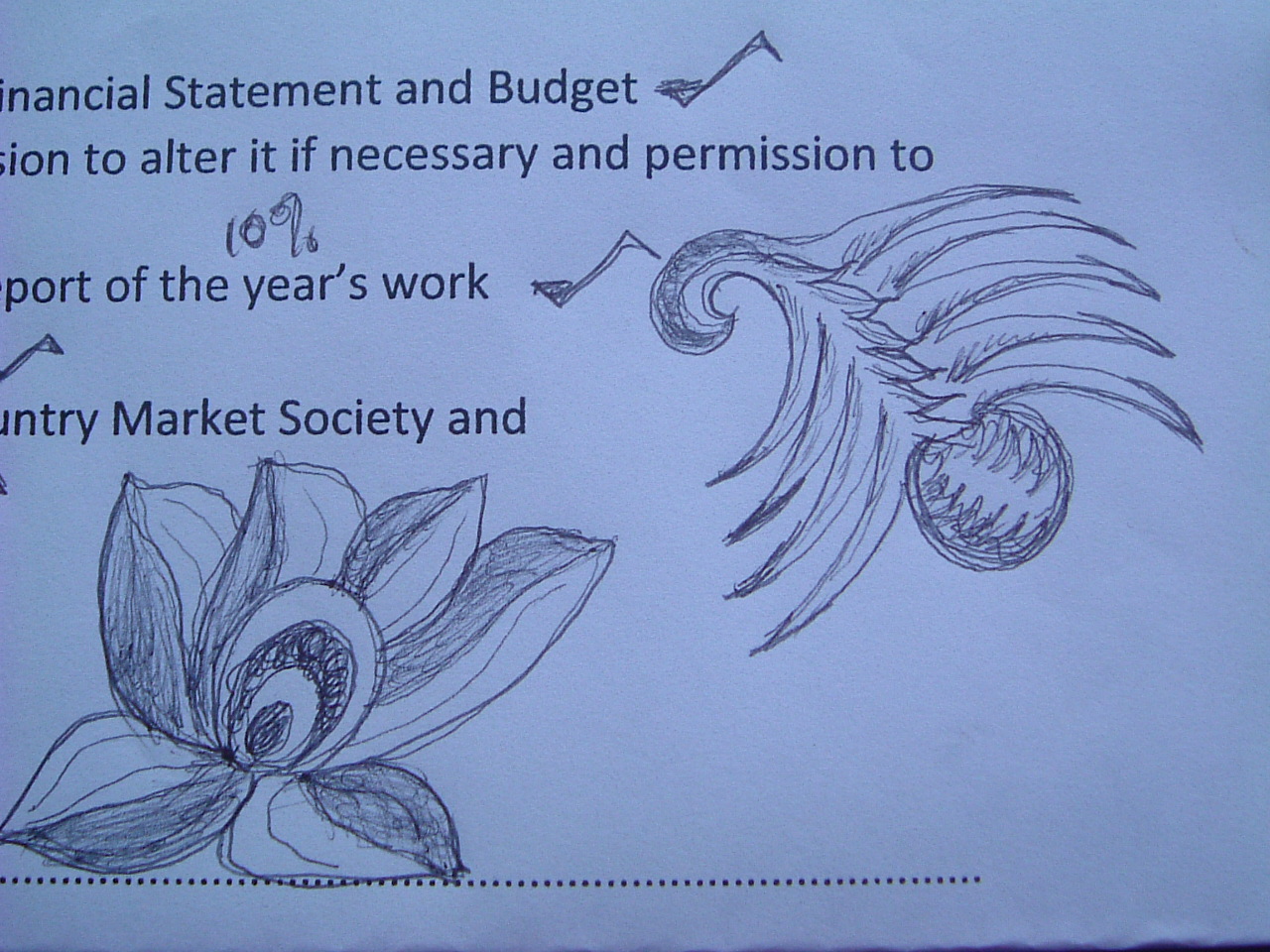
Have you been watching The Big Painting Challenge on BBC 1? (iplayer link HERE to first episode- runs out in 21 days) I have to say it has inspired me to think about my drawing and painting skills, long left to lie. Except when in meetings… I am an inveterate doodler – and when in meetings will doodle.

Some are of the opinion that doodling is akin to ignoring the meeting altogether. Not so! In fact it has been shown that those who doodle actually are taking in more than those who merely sit and listen. Even if I am chairing the meeting, I usually end up with a doodle or two – usually around the items on the agenda that cause most discussion. DSCF0133

Doodles, it is said, can also be interpreted, sharp angular ones indicating dissent, or difficulties, loose flowing ones indicating calm and non confrontational thought. I really can’t comment on this! Enough about doodles – on to some real Art!

If you have been watching The Big Painting Challenge you will, by now, be a little familiar with the contestants. Next time you watch please notice Anthea.  Anthea Lay exhibits her paintings at the same morning market that I mentioned last week, where I take my books as an opportunity to meet friends and the buying pubic, and has become a friend.

A long while ago I asked Anthea about painting a picture that I could use as a cover for my next book. At that time I had only just started writing but I knew my main protagonist was a woman who was very involved in art, and I felt a cover that was, and looked, like a painting, would be appropriate. Fast forward to this winter and I now know where my protagonist lives (in a fictional village near Kit Hill in the Tamar Valley) and much more about the story, so I commissioned Anthea to create this fictional scene.

To assist with the transition of my idea to her vision I gave her a photograph of a ‘wild’ sky I had taken over Caradon mast, another with Kit Hill in the background, saying the fictional village could be on the ridge by the valley full of trees you could see, a photograph of a converted chapel that I had in my mind’s eye for the home of the main character and a plan of the ‘village’ that I created to make sure my characters move around their landscape properly; and then asked if all the relevant details could be squished onto the right hand side of the painting as this would be the front cover. Tall order!? Not for Anthea!  ‘Landscapes’ are Anthea’s thing and she usually paints only from life but she had fun creating this new, imagined and ‘painterly’ landscape and I am delighted. IMG_1680 CroppedSo lucky to have such talented friends!

The sky is suitably ‘Turner-esque’ and though from a ‘real’ sky looks as if it could only exist in a painting, the salient points in the story-village are identifiable should you wish to do so, the whole countryside effect is perfect.

To be turned into a book cover it, obviously, has to have the title and author’s name across it.. and blurb and other info on the back – to give you all an idea I have just added the words to the front cover part (not done professionally – words will be better and properly spaced on the real thing) The whole painting will be used for the cover – running right through onto the back.

FRONT MOCK-UP  ARLWhat are your reactions to this book-cover idea?

Do you DOODLE?

Do share, you know I love to hear from you!

If you live in SE Cornwall or SW Devon you are lucky to be close enough to see some of Anthea’s work on exhibition and for sale at The Wharf, Tavistock; Compton Engine House cafe, Florence Road, Kelly Bray; Jane’s Florists and Art show room, the Pannier Market, Callington and The Public Rooms, Liskeard as well as the Wednesday morning Callington Country Market aforementioned, don’t miss your chance now that she is not only talented but also ‘famous’!

Which one did they win cabbages on?

So began an interlude when I turned up at the village shop the other day. ‘Was it Crackerjack?’ Mary asked.

‘Surely not, didn’t they win pencils on that?’ I replied, well and truly intrigued already (doesn’t take much – this is country-life after all)

Now, I have no idea how this conversation had started before I arrived, but I do know that Alan was already on the computer looking it up. ‘It was!’ he said, ‘but they didn’t win them they had to hold them.’  (he was referring to cabbages!)

Seems my memory was duff – they did win pencils with Crackerjack printed on them (certainly into BIG prizes back then!!) – and everyone shouted ‘Crackerjack’ … but the cabbages came in a part of the programme called ‘Double or Drop’ whereby for each right answer they were given a prize to hold and for each wrong answer the contestant was given a cabbage to hold. They were ‘out’ if they dropped anything … or were awarded their third cabbage!  (here follows a youtube clip – you need to be reading the original post rather than your email to see it) 

This began a trawling through of other ‘game shows of our childhood’ which drew in another customer who, despite having a few years on us, declared he wasn’t old enough to remember any of them!

I do recall Crackerjack, though I have to say it wasn’t something that I was desperate to watch. I was amazed to find out that it was on our screens  from 1956 through to 1984 with many incarnations of presenters and added sections to boost interest. As it was essentially aimed at children I suppose that my interest, such as it was, waned as I ‘grew out of it’.

The game show that left the biggest impression on me from the 60s would have to be ‘Opportunity Knocks’ a sort of talent show with (I always thought the slightly creepy) Hugie Green. This was soon displaced by The Generation Game with Bruce Forsyth when it arrived early in the 70s.

All in all I didn’t really like the ‘slap-stick’ and ‘crazy-fun’ sort of game shows. Anything that depended on people being made t0 look inadequate or silly I didn’t find funny then (or now). (here follows a youtube clip – you need to be reading the original post rather than your email to see it)

A game show I do recall and loved from the 60s and 70s was Call My Bluff – not aimed at children, but watched avidly in our house. I loved Frank Muir’s vocal antics as he describe the ‘true’ meaning of the words!  As an easy-to-put-on entertainment (not easy to prepare mind!) we had a session of Call My Bluff last month at our WI…. with ‘characters’ reading out the definitions and the audience choosing what they thought was the right answer – good fun was had by all… and we now refer to heavy rain here as ‘lumming it down’ 🙂

Perhaps this was my early and enduring love-affair with words.  It is hard as writer not to use any word in your own vocabulary as you write and I have sometimes been chastised for using words that I am told ‘many people’ would not understand. Now, as an author you really do not want anything to hold-up the flow of thought-transition, between words on the page and the imagination of the reader to form it into their personal ‘film-of-the-book’, but, as an educator, I rail against the ‘dumbing-down’ of language. So as an author I have to tread a fine-line between the two.

My OH tells me he uses his ‘dictionary’ function on his kindle fairly often. Such a great little tool, whereby you highlight the word and within seconds you have the full dictionary definition there before you, and great way to expand your own vocabulary!

Which brings me onto another conversation … with another book-aholic writer. She confessed to having been saying a word she had only ever read, never heard, in the way she thought it ought to be said .. for years.. until she was horrified to hear it used by someone who did know only to find she’d been saying the word incorrectly all the time. My confession followed, my faux-pas was the word hyperbole … which I had been rendering as hyper – bole in my head …. when I heard it and saw it at the same time to be hy-per-bo-le  I too was mortified   😮

Oh! Where a random conversation can lead you…

Do you have fond/cringing memories of the game shows of your youth?

What were the game shows of YOUR youth?

Do share – you know I love to hear from you.

Natural Dyeing – a Novel way to research

phpCJcHUjAM.jpg Small
Dried natural dye plant material

Well, when you SAY it as opposed to READ it it does cause confusion (and a little consternation if not concern) however, this is all soon put right when I explain  (waving hands about) that I mean dyeing – with COLOURS from natural plants.

A good friend of mine runs workshops from her beautifully converted small barn at Nine Acres near Callington, Cornwall. Workshops on all sorts of crafts. This one was on DYEING USING NATURAL PLANTS .

phpUR8YMgAM-1.jpg sm
Preparing the Weld
phpMVlMujAM.jpg s
The colour begins to come out – looking a bit green at this stage

So on  a chilly morning we met and after a welcoming cuppa went out into the garden to see some of these plants in their natural state. Now, as this was early winter most were as as stalks of dried out flower stems, or low growing base leaves, but it gave us the idea about the ones that were native or could be grown easily in the UK

Back in the barn we were shown a range of plant material we could work with, some harvested from Jane’s garden, some bought in, some native, some not.

There were eight of us and four work-stations and it was suggested we pair up and each pair work on a different dye in the morning, and yet a different one in the afternoon. Some people had come together, easy pairing. I was there for a very specific reason.

Jane had been to our WI and demonstrated dyeing using Woad, a native plant, and I wanted to know about dyeing using other native plants.

phpykD9kGAM.jpg s
The resultant colour from using dried Weld plant


I said ‘I want to dye with WELD,’ and immediately another guest said, ‘yes, me too!’ This is how Sally and I started working together.

As we gathered the ingredients together I confessed I wasn’t so much interested in dyeing for the product – but that I was researching for a book I want to write one day. Her response was ‘Me too. I’m researching for a book.’

RESEARCH

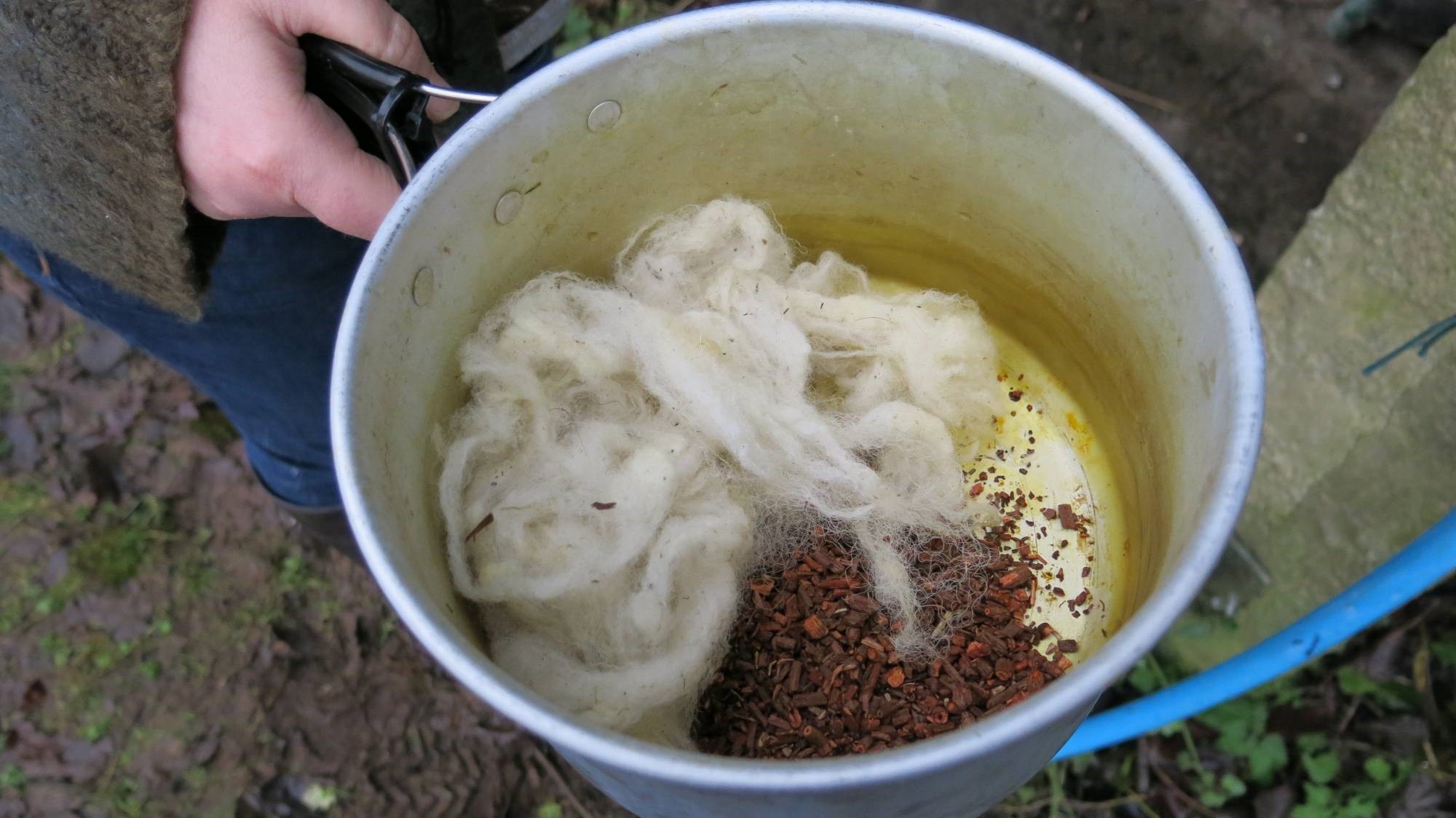
We worked on the WELD, producing a yellow dye which we then coloured some prepared sheep-wool with. As we worked so I learned of her Trilogy about the real historical figure, Caradoc, set in AD 25 onwards and I told her of my idea to write the legend (that doesn’t exist) to explain the naming of our church after an obscure Irish nun from the late 600s.  Both of us wanting to absorb the sights and smells that may permeate the backgrounds of our stories.

phpKrZeqvAM.jpg s
Dried Madder roots pieces put in together with the wool (before adding water)
php1eJsEyAM.jpg s
Picking out Madder roots bits from the dyed wool

Now when it comes to researching for novels it can often be done at a remove. You can find many things out now with a carefully worded internet search request and a few clicks of the button. I have also ‘flown’ myself to different parts of the world when researching as I mentioned  here  in another blog – where I wanted my main character Luke Adamson in  The Angel Bug to travel to a prison facility in the USA.

Then you can ‘pick the brains’ of people you know (policemen / doctors / engineers /whatever) for the bits that research cannot really tell you  – sounds, smells, pain-levels, consequences etc.

You can also ‘extrapolate’ from your own experiences. You take the feeling / physical experience from say, the scary experience when some idiot was overtaking and caused a near-miss situation … and develop that snap-shot gut-twist  into the feeling that your character has in a near-death situation.

phpHEe4K1AM.jpg s
From top Weld, Madder and Weld mix) Madder (un-soaked – so pale) and Woad (winter leaves so pale)

And then you can do some first hand work and absorb these sights, textures and smells yourself.

In the afternoon we worked with the third native natural dye – Madder, though the dried root we used was un-soaked, so did not give the deep ‘Beef-Eater Uniform’ red it should. The scent of under-simmering madder (you mustn’t let it boil) seemed sweet in comparison to the ‘cabbage smell’ of the weld, especially noticeable as we compared them directly.  Then at a whim we mixed the remaining Weld Dye with the left-over Madder liquid to produce a pleasant peachy colour.

I hope you’ve enjoyed this little peek at Authors researching and the world of workshop experiences. I am happy to say that Sally’s trilogy will be published by my partnership publisher (Pendown Publishing) so we’ll get to see more of each other as our books go out together into the market.

Do you enjoy going on workshops?

What is the best thing you have ever done on one?

Do share, you know I love to hear from you.

Radio, Newspaper, Lit Fest – it’s a Thriller!

I’ve had a busy week in the run-up to the new LOOE LITERARY FESTIVAL (13-16th Nov)  with both a piece in the newspaper and a live interview on BBC Radio Cornwall with Tiffany Truscott

When I read about the prospect of a NEW literary festival to be set up in Looe, back in April, I was delighted … as ‘Nothing Ever Happens Here’ is set in Looe, Cornwall AND it had just come out in Paperback. NEHH_Design_Light

This book is set in the early 1990s, and I have put it in the ‘thriller’ genre. Now you may be aware that I find writing to fit one genre very tricky. You see my muse doesn’t like to be formulaic in any way. My muse likes to take something that looks very much like real life and put a twist into it.

Before I realised that this novel was a light thriller (and I’ll come back to the ‘light’ bit) I never knew whether to call it a Romance .. or a Crime novel. Let me explain.

I always thought of it as a bit of a romance novel as we have three romantic threads going on throughout most of the book. Some of these are more intense than others, some of them are teenagers, some are in their thirties, some forties. So you can see that I would think this was a Romance. However, I am assured, that it is a book that men like to read as much as women, that it is not the sort of ‘romance’ that puts certain people off.. that the ‘romance’ seems to be just part of the life of these characters.

Then again, I thought, perhaps it was a Crime novel. It starts off with crimes, and follows a Detective Inspector as he transfers out of the Met down to Plymouth. It follows some of his cases, needless to say, involving Crime. Put this together with the criminal events that affect the other main characters and we have what I thought of as a Crime novel. Yet, if you were a die-hard Crime reader perhaps you would find too much real life getting in the way of first-and-foremost crime and detection.

Now I can tell you it is a Thriller (with Romance and Crime involved)…. And it is a ‘light’ thiller because it does not fit well with the ‘shoot-em-up, improbably car-chase, blood-n-gore, stop the end of the world’ … type of thriller that I think of as ‘American-style’ thrillers.

One of my reviewers put is this way. ‘Love a good ‘English’ thriller’. Now, I thought, that really sums it up. I love a good English Thriller too (Think Robert Goddard) … but if you live in Cornwall .. and write a book set in Cornwall … best not call it ‘English’ 😉   … So ‘light’ Thriller it is.

Here’s my chat with Tiffany Truscott on BBC Radio Cornwall a few days ago – in case you missed it…   (if you are looking at this on the email – click into the title at the top and this will take you to the blog and then you’ll be able to listen in – it’s on youtube and the link doesn’t show up on the email)

If you are local do come to the NEW LIT FEST in LOOE, there is plenty going on both paid for and for free – I’ll be part of the Liskeard Poets – reading in the Poetry Invaders event 11am on Saturday which is a free event.

Then I’d love to meet you at my Author Event on Saturday 15th, 1.30pm in The Old Boathouse Café. I’ll be reading a few excerpts, answering questions about the novels, writing or whatever you ask and doing a book-signing. This is a free event too and there will also be a free draw …. Oh! … and there will be cake ! See you there

My Latest Cover Up …

The saying goes ‘Don’t judge a book by its cover’ … but we all do, don’t we? And that goes for real books as much as new people and situations that the saying is really about.

So choosing a new cover for a book is one of the hardest non-writing things I have had to do as an Author. After all, I know the whole story inside the book, all the nuances that I would like to hint at, the twists and turns. A cover is just a snapshot of the idea, but it’s an image that has to do a great deal of work.

I have been reminded that I really can’t ‘tell the story’ through this one image, that it has also has to be ‘eye-catching’, ‘look right at the thumbnail size’ that many (most even?) people see a book as when looking for it (ie online) as well as interesting full size (ie on the shelf), ‘be alluring to pick-up’ to scroll down, or actually turn over, to read the back-blurb, and that has to ‘be informative but raise questions’ to instigate the flick through (or open the see-inside feature)

All this from the cover! No wonder it is so difficult.

Now when I placed my books online, before I even dreamt of paperback, when Amazon’s Kindle publishing was the only avenue open to me and they hadn’t got their ‘cover help’ going at all, I got my eldest son to help create the right (pixel) sized covers. He was only over from Malaysia for a short time and we had to work fast. I had a perfect picture for one of them, Nothing Ever Happenes Here, but the others had to be created.

So create we did …. We decided that as the one picture I was happy with had view through a gap between rocks we’d keep that sort of theme. So for Divining the Line I took a photograph between two standing stones and for Some Kind of Synchrony we took a picture of a skyscraper, reflected it and manipulated the second tower to look as if it were wavering, as if seen through rippled water. Well that was the idea… it never did look quite right and was certainly too clear and clean a picture for the type of book. Time ran out and Some Kind of Synchrony stayed under that cover.

It has now become the latest of my novels to move into paperback. I know I have been lapse with the blogging but I have been totally immersed in the world of Faith, Diane and The Story within Some Kind of Synchrony. Once bonus is that I’ve had the opportunity to finesse the ending. At this time space from my original I was able to choose a better arrangement of words to show what I saw in the end scene. That felt good. Then I had to work with my cover designer to create the cover that would do everything asked of it.

The paperback goes into print this week! I am really excited about this, it feels like a having a new release, that I’ve done the story justice at last by giving it a proper working cover and I hope readers, previously put off by the old cover, will be tempted by the new.

Here is the old one  cover

SKOS


…… and here is the new!  (looks fuzzy here – just click on it to see it clearly)


I feel we’ve hit the nail on the head … there’s gritty … there’s the element of real life and reflection … there’s a slightly retro feel, there’s … well you tell me! Whether you have read it already or not!

You know I love to hear from you!

error

Enjoyed this blog? Please share :)