Planning for fun …

I know it is still 2013… but I have one of those big birthdays coming up next year and have started planning something fun for myself.  I’m not the only one, a relative of mine hits the same number in the same year and is planning a treat – a trip to the Isle of Man TT races. (He’s into motorbikes)

I’m thinking I’d like to learn something new, perhaps something a bit different for someone hitting 60. A good friend of mine took up belly-dancing on that big one… but I have been belly dancing for YEARS. The husband was given a ‘fly a plane’ trip for his 60th last year, Which he thoroughly enjoyed, and I even had a go on the short return trip. I considered whether this would suit me, or a balloon trip.  On reflection I decided that these would always be one-off events and would not expand my skills, and as you know, if I can learn something new – I am a happy bunny.

Ann Bodyboard
Ann with body-board

I had been thinking about surfing lessons. I had even gone so far as to say to the Husband that  I was thinking of doing this, even though I had a lesson many years ago .. organised by the WI. Sadly I did not achieve the stand. I got to the one knee, one foot stage more times than you could imagine, and tipped off at the stand each time. I persevered until I felt sick with exhaustion (and the tightness of the wetsuit across my throat – I can’t bear any clothing touching my throat) and the three hour lesson ended.

As you may know I LOVE body boarding (or boogie-boarding as it seems to be known in other parts of the world) and have just returned from a week in Brittany where I was out riding the waves every day, come sea-mist, hot sun or wind with drizzle. (Alternating it with writing the first 8,000 words of my next novel)  Once in the water the adrenalin takes over and I do not care what it is like as long as the waves are good. And I do this sans wetsuit – and seem to stay in the water longer than my wet-suited contemporaries – though I am often the only person not wearing a wetsuit AND body-boarding.

NOW, this is how things happen. I was just coming out of the sea for a break, to have a drink of water and replenish the sunscreen on my shoulders, when I passed a lady walking down to the sea with what appeared to be an over-sized surf-board and carrying a long thin paddle. Sitting on my towel, I proceeded to watch as she reached the water, walked in until about knee deep, hitched her board to her knee with a tether and hopped up onto the board – standing. Within seconds she was paddling the board out through the breakers, riding each one, seemingly, effortlessly. Once out past the main breakers she waited (along with the surfers – she standing, them lying) The next big wave came and with a sweep of the paddle she was ahead of it as it broke and she surfed that wave right into the beach, turning the board with a sweep or two of her paddle and was heading out again, over-taking the surfers that had caught the wave, and was soon back out with those who had not managed to catch the wave at all and were still waiting.

She caught more waves and surfed in more than the surfers – and that’s what it’s about folks, not the hanging around waiting for the wave – it’s the buzz of riding the wave, being driven along and getting the best from every wave.

I was so interested that I practiced a phrase or two in French as I returned to the sea, determined to ask about what I recognised a paddle-boarding ( though I had never actually seen anyone doing it) .  When we had both caught the same wave and were in the shallows together I waded over and asked her.

She wasn’t French. (I should have guessed this as, in my experience; French women in general do not seem to go in for water sports, like surfing or even body-boarding, much)  She was, in fact, German, and had excellent English. (Though not French – as she apologised in English saying Sorry, I do not speak French)

After a conversation, where it transpired she had tried to learn how to surf (from her surfing instructor husband) for two years without success and had found paddle-boarding much better, my thoughts now changed to paddle boarding. When she also explained her ‘board’ was actually inflatable (you could not tell from touching it!) and that it therefore could be easily transported – I was hooked – and regaled the Husband with my new choice when I got back from the beach.

paddle board woman don debold
Photo via Creative Commons attribution Don DeBold

If you’ve not come across paddle-boarding – here’s a picture of what it can look like – now that looks really sedate compared to the surfing type! A good way to learn!

Next morning, as it happens, the husband (who’d not even heard of paddle-boarding before I’d come home enthused) told me of the  news that a man had paddle-boarded from Cuba to the USA – a journey of 111 miles (179 km)!

Since I’ve been back in the UK I’ve been looking up places to learn, prices of boards and lessons and finding I can also call it SUP-boarding. (Stand Up Paddle)  Only problem is….. I do not want to wait until next year – you never know what next year may bring.  I think I may find somewhere to have a few lessons before next year.. and then if I like it, treat myself to a board when that big day comes.

Any one out there already paddle-board? Any tips?

What did you do for your last BIG birthday? Or are planning for your next?

Do you like the challenge of learning something new?

Do share, you know I love to hear from you!
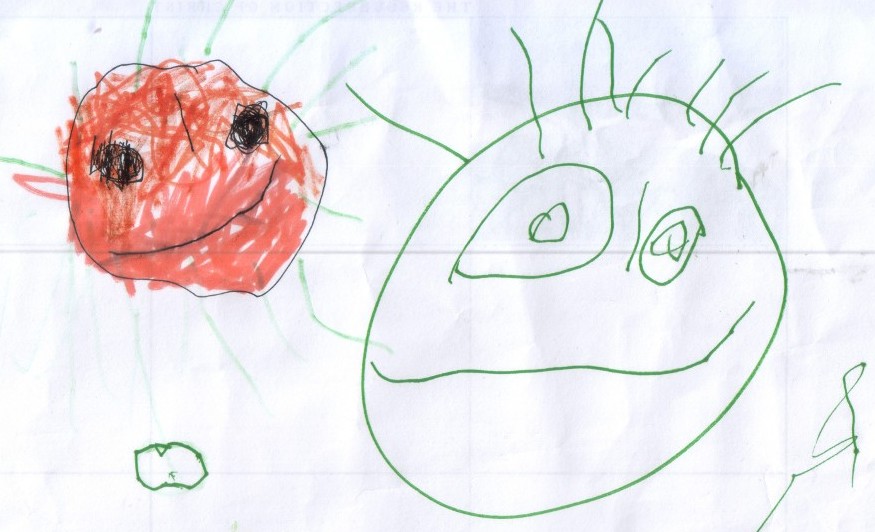
Reasons to be cheerful!

Scanned Document cropped
Smiley faces – courtesy of my grandson

I learnt some new stuff about personality last week and I am amazed!

Being on the slightly introverted side (though you’d never know as I tend to over-compensate) I also am a ‘bit of a worrier’. This shows itself in my tendency to want to organise things so that I know every ‘i’ has been dotted and every ‘t’ crossed.

Now, Michael Mosley (he of the ‘Fast Diet’-  borne from trying to ensure he doesn’t die early of being overweight and unhealthy) has turned his attention to Personality. Again, driven by his own ‘need’ and personality (after all a pessimist and a worrier would be the one to search for the way not to die early – wouldn’t they)

However, his anxiousness resulted in him also being an insomniac – which is NOT GOOD for anyone. Fortunately, I do not suffer from this ( but, hey, if I didn’t micromanage things – perhaps I would)

I have put a link to a youtube copy of this programme further down – the iplayer one will disappear too soon – so I hope this one gets left up – it is worth watching if you didn’t see it. (DON’T FORGET – YOU NEED TO GO TO THE TOP OF THE EMAIL AND CLICK INTO THE TITLE TO TAKE YOU TO THE BLOG TO SEE THE VIDEO)

I’ll not go through it step by step (you can watch it yourself) but I want to  bring out a couple of points that have interested me.

1, Our genes are not fixed! They can be turned on… and off.  Your environment (what happens in your life) therefore can change your personality – with the tantalising thought that a gene that was once turned on, say for depression, might be able to be turned off again.

2, That being an optimist can add 7 and a half years to the average lifespan. (This is almost double the extra that would be added if we found the cure for cancer) What’s not to like?

3, That you can literally ‘change your mind’ – you can redirect your thought patterns toward optimism – and towards a calmer reaction to stressful situations.

This is great news for many – as long as they are willing to put in the time —  10 minutes three times a week for the Cognitive Bias Modification (spent in front of a computer screen) for the thought patterns  and 10  rising to 20 minutes a day of meditation for the reactions to stress.  Doing it , however, is the same problem people have with doing exercises of any kind 🙂

Now that The Angel Bug is published, I am researching for my next novel and for part of this I am reading a book called, ”Born Liars – Why we can’t live without deceit’ where a chapter of the book is about placebos and the marvellous tricks our own minds can pull on us. (The placebos aren’t the bit I’m researching – but  I’m reading the whole book anyway)  The mind is an amazing thing, but what does it come to when you can’t trust your own mind! Yet what a marvel when it can provide a cure!

One thing they didn’t look at in the programme was the role of forgiveness. I believe that holding a grudge or feeling bad towards someone is the best way to create unhappy brain patterns and disturbed nights, whereas by forgiving you let go of that grudge. (I’m not saying this is possible for everyone to do in all circumstances – I can imagine some I couldn’t handle)  However, it would be interesting to see if forgiving is part of the mind’s method of dealing with stress.

http://youtu.be/rs046iOPlqM

Are you an optimist or a pessimist?

What makes you happy or anxious?

Do cute pictures of kittens really make everyone happy?

Do share your thoughts – you know I love to hear from you !


Putting the Fun in FUNd Raising!

There are many pluses to living in the countryside, and immediately we are all thinking of green fields, bird song, the lowing of cattle, fresh air, peace (not necessarily quiet – it can be a noisy place in unusual ways) and hedgerows bedecked with wild-flowers. However, here I am thinking of the simple pleasures that may be taken without the censorship of what is ‘cool’ or ‘in fashion’ because, somehow, these things just do not matter here.

DSCF5654
hedgerow bedecked with wild flowers


Maybe it is because we know we are blessed there is a lot of fundraising for good causes that goes on out here in the sticks. Not a week goes by when there is not one or even two fund-raisers for good causes within a five mile radius of where we live. These can be as parochial as the fabric of the local church (grade 1 listed building with parts dating back to 1259) or as far afield as a small locally run charity (Tamwed) to enable the rural poor in India to help themselves by growing foods with better nutritional values and supporting mobile health advice and care.

The events are usually the coffee morning, cream tea, pasty and pud, quiz night, craft-fair or bazaar / garden fete variety, and though people try to inject an element of ‘fun’ none of these are a patch on the Evening Meal with Pig Racing that we attended a few evenings ago.

The meal was the main focus of the evening … a chance to share, explore new flavours, and do a quiz that got everyone talking… however, it was the pig-racing that put the FUN into the evening.

So, here we have a short video clip from the evening – the people at the far end of the race-track are the ‘racing-pig ‘owners’ (for that race) They had the privilege of naming the pig and the chance to take home the race-pig owners prize … and the responsibility of catching the pig at the end of the race!

PLEASE NOTE – IF YOU ARE READING THIS ON THE EMAILED POST YOU WILL SEE NOTHING HERE. CLICK ON THE BLOG TITLE AND IT WILL TAKE YOU TO THE BLOG PROPER – WHERE THE VIDEO CAN BE SEEN!

What was the most FUN fundraiser you have ever been along to?

Do share (we are always looking for more ideas) and you know I love to hear from you!

Physical work as distraction therapy

So, that’s it.  The Angel Bug has been sent out to a number of readers for a read-through by fresh eyes, as both my proofreader and I have read it so often we can’t see what is there, what was there and what isn’t there anymore – editing can throw up errors you, yourself, just can’t see.

Now, some of these readers know my style of writing and like it, and some have not read any of my novels before, but are avid readers, and then there’s one in the USA.

The latter because in The Angel Bug one half of the story is told from the view point of an American, and at times he also interacts with other Americans in the USA. Now, I have tried to make sure that he thinks and talks in the right slang and idiom for an American, but what do I know? I’m UK born and bred! Anything ‘off-note’ however, should jump out at a bona fide American and then I should be able to remedy the problem before The Angel Bug is published.

Here’s a conundrum for you …

UK = ‘This is a herbal mixture’  USA = ‘This is an herbal mixture’ (said ‘This is an ‘erbal mixture’  the American using the original pronunciation of herbal – hence the required ‘an’ as indefinite article.)

So, how would you render this in a book that, hopefully, will be read both sides of the Atlantic? 

My solution – ‘an herbal’ when the words are in the mouth of an American, ‘a herbal’ when in the mouth of a Brit.  I’m hoping that this will make ultimate sense as it is read.

Now, I am sure you are thinking that you have read traditionally published books written by either Americans putting words into the mouths of Brits ( or visa versa), and they have been wrong, wrong, WRONG!  Or situations – like the ‘muffin shop’ in a Dartmoor village selling blueberry muffins, ( back at a time before the UK had heard of muffins that were made of cake  –  and not the traditional English Muffin – bread,  let alone had whole shops for them) – which particularly sticks in my mind along with the ‘Chalk pits on Dartmoor’ that the  American author also had. (They are  actually China clay)

However, any serious indie published novelist will have realised from reading the blogs on writing, publishing and reviews, readers are frequently far more critical of indie published works than they are of traditionally published works, and as a book can be bought via the internet anywhere in the world …  you ‘d better get that world and its use of language right.

Unfortunately, it is the self-publishing writers who slap their books up without even proofreading them that has brought this hyper-critical gaze to indie published works. Simple fact – no matter how good you are at spelling, grammar and use of the English language – you cannot proofread your own work. Your mind will always read what it expects to read. Hence those great but tricksy ‘can you read this’ lines that get sent around the internet with letters missed or replaced by numbers looking a bit like the letters .. and yes! You can still read it!   S1M1L4RLY,   Y0UR M1ND   15   R34D1NG   7H15   4U70M471C4LLY   W17H0U7   3V3N   7H1NK1NG   4B0U7   17.

So, why the title of today’s blog?  Physical work as distraction therapy.

Well, sending out your novel to new readers is a bit like sending your first child off to school for the first time…. a bit nerve wracking. So I find distraction and pleasure in physical work instead. (Strangely, housework is no good for this therapy – well, that’s my excuse!)

In this case making some beautiful reclaimed slate coasters, out of Delabole roofing slates that may have been on a roof for two hundred years or so … and now are transformed by cutting, filing and, the amazingly revelatory, rubbing down with wet and dry paper – that shows what time and the mineral content of the slate have made of it. Each one different. Each one attractive in its own way. Love them 🙂 Do click on the picture to see them better!

These are going to the St Dominick Craft Fair – I can’t sell them from my slate-ware website as they vary so much I’d have to photograph and put up a special box for each one!

And while I worked I did not think of  The Angel Bug, all alone, out there … but I did allow my mind to wander and to wonder, what next? To listen for the voice of my next narrator ….


Have you any favourite howlers from traditionally published novels?

How do you take your mind off things?

Do share – you know I love to hear from you … it takes my mind of things 🙂

At last … Spring’s sprung!

I’ve not actually been doing Nature Notes this year ( after all, one year can be much like the last in nature-watching) but over the weekend I really felt Spring had Sprung!

Friday was the first day the new kids went out on the grass and I wished I had my camera with me as they bounced and sprung all over the place – kicking up their heels so high they threatened to flip right over. A video of that would have been good!

It feels like the garden flowers have all started blooming at once, the large sweep of daffodils in the orchard have at last burst into bloom, and everywhere there are large clumps of primroses, celendines and, if you look in the right places, violets. And our first Swallow has returned …


On Saturday I went to the beach for the first time this year, along with two of my sons and their girlfriends (down from London for the weekend).  A few hardy people went in the sea swimming (sans wetsuits) others, with wet-suits on, were surfing, the sun was bright (though the wind a little chill) and the dog had a whale of a time. She appropriated a hole, dug previously, as her ‘nest’, enlarged it a bit to fit and spent time retrieving cuttle-fish bones ( of which there were many on the beach, and take them back to her den.


Finally,  just for a bit of fun… the dog kept scooting the sand back when she was digging her nest out more …  it looked a little like she was doing a moon walk .. only 7 seconds – but enjoy:)

What makes you feel like Spring has sprung?

Do share – you know I love to hear from you!

Long Distance Relationships

Today, Sunday, was my youngest grandson’s Christening – yeah that’s him (above) in his christening robe giving me a sermon on having missed it. And, how much I would have loved to be there with him, his mum, his dad (my eldest son) and his two older brothers (my only other grandchildren) but they all live in Kuala Lumpur, Malaysia, and I can’t get over there at the moment.

Really I am lucky as both the other boys were baptised here in the UK  in our local church where my son and his lovely wife were married. It was fortunate that both their Christenings could be arranged to coincide with long visits here.  This new event started me thinking about long distance relationships and how lucky most of us really are now.

When my parents moved some fifty-five miles from the East End of London out to a village near Maidenhead it was a HUGE move. At that time, 1954, they didn’t own a car and if they had, the journey would have taken far longer than the now estimated one hour fourteen minutes as the M4 had not been built even as far as Maidenhead. In fact, I can recall travelling up to see relations in London in the mini that we had by the time I was about nine and the M4 was open … it seemed an interminable journey even then!

My grandparents were known to me from the summer holiday when they would visit, and Christmas when we would go ‘up’ to visit relations in London (everyone else in our family).  Hence I remember odd things about each of them, the gran who taught me how to knit every time she visited more than once, leaving me a pair of knitting needles with a block and a half of a scarf started under her careful eye –  that I never finished. (I never did get on with knitting – which is strange as I’m into every other craft) The other gran who always seemed to wear a ‘traditional’ wrap-around pinny almost all day – which I found odd. One grandad always whistling a tune, the other always full of all sorts of information. In between visits they might talk on the phone with Mum and Dad … but I don’t ever remember talking to them on the phone.

image courtesy Ian Britton freefoto.com

My Aunt and her family moved to Australia in the early sixties. It might as well have been to the moon, back then. A phone call perhaps once a year – letters on birthdays with a photo slipped in with the card. The thought that they could fly back and visit was beyond imagining at that time.
When I went away to college – even though it was not very far away – the only contact my parents had with me during term time was the Sunday evening phone call, usually brief as there was frequently a queue at the hall of residence telephone box and it wasn’t done to keep others waiting forever!

Today, though my eldest son is in Malaysia, I see photographs of him and his family almost every week when they post them on facebook, and we have a skype video chat at the weekend, with the first and main portion being the grandchildren talking to granny! (and grandad when he’s around) They show me drawings, read to me, tell me how they are getting on at school, tease me, even try to tickle me … and I do similar mad stuff back. I have met and played with the boys, apart from the baby, and when we do meet every eighteen months or so, there isn’t that halting shyness as they’ve seen me every week. I am lucky, but I still miss the cuddles!

And then there’s my youngest son, also on the other side of the world, even where he is, on an island just off of Thailand, I am able to keep up-to-date with him via skype and facebook. We are so lucky!

And it is easy to think it is the same for everyone, but as I have been finding out from my niece on her blog (armywaglife.wordpress.com)  one group of people who do not enjoy such an easy long distance relationship via the internet are those overseas in our armed forces. Hard to believe in this day and age – but true – even in Germany. It’s a very new blog – but well worth the visit.

So, do you keep up a long distance relationship with family or friends?

Is it easier for you now than it used to be ?

Do you remember the days when you had to queue for a public phone to call someone? – and then they had to be at home!

You know I love to hear from you – please share your thoughts

Hot Cross Questions

Baking hot cross buns on Thursday so we could have them at breakfast on Good Friday morning set me thinking about how come, in our house, we eat this  ‘tea-time type’ bun for breakfast … and why, when supermarkets have them on the shelves for months, do we only eat them on Good Friday at home … and whether this was just a quirk of our family.

As with every question today, I was quickly on the internet to research it, however, as you will know, you need to choose your sources carefully. I am indebted to recipewise.co.uk for an excellent rendition of the whys and wherefores of the hot cross bun – from which I have extracted the core information I sought.

To start with, Hot Cross Buns for breakfast is not just a family quirk. (phew) It seems that the practice of eating the Hot Cross bun (also known as Good Friday buns) for breakfast goes back at least until the 1600s, with evidence from Pepys and. later, from Samuel Johnson in ‘The Life Of Samuel Johnson’, by James Boswell, published 1791: “On the 9th of April [1773], being Good Friday, I breakfasted with him on tea and cross-buns … On April 18 [1783], (being Good-Friday) I found him at breakfast, in his usual manner upon that day, drinking tea without milk, and eating a cross bun to prevent faintness”.

As to the history of the bun I am jumping ahead. Like the origins of Easter Eggs, the ‘spiced fruit bun’ probably evolved from the pre-christian celebration of the spring and dawn goddess Eastre where in Anglo-Saxon times ‘a bread dough was studded with dried fruits and baked in small loaves’. As Christianity spread these were ‘marked with a cross’ and linked to the crucifixion on Good Friday and so ‘absorbed or acquired’ by the Christian religion – and as they were within the Lenten season they were a real treat yet eating them was blessed.

Indeed the practice of marking all bread-doughs with a cross was widespread by the Middle-ages – particularly as it was thought that the sign helped ward off evil spirits and prevent the bread going mouldy or stale. However, with the rise of Puritanism, this widespread use of the cross was seen as  ‘superstitious’ and thus ‘Popery’ and was frowned upon and eventually only the sanctioned ‘Hot Cross Bun’ was permitted to have the cross marked on it, and only to be eaten on Good Friday in remembrance of the crucifixion.

By the early 1700s these delicacies were sold on the streets by baker’s boys and coster (barrow) boys and women (with baskets instead of barrows for this day) Their cry of ‘One a penny, two a penny, Hot Cross Buns’ is a rhyme that was also brought to mind and sung to myself as I baked our buns and is a popular Nursery Rhyme today.

Hot cross buns! Hot cross buns!
One a penny two a penny – Hot cross buns
If you have no daughters, give them to your sons
One a penny two a penny – Hot cross buns

The superstitions that were prevalent in the Middle-Ages started with the belief that the cross on the dough warded off the evil spirits lingered on. It is said that a hot cross bun all made and baked on Good Friday before sunrise will never go mouldy and if kept in the house will protect it from fire. Which reminds me of the famous pub The Widows Son where they used to hang a new Hot Cross bun from the ceiling each year on Good Friday. The story behind this being that a widow’s son was due home from sea on Good Friday, and she baked him Hot Cross Buns. However, he never made it and was never seen again. Every Good Friday she made him a special bun right until the day she died. Her cottage later became the pub and the tradition began of hanging the ‘widow’s son’s hot cross bun’ from the ceiling. Unfortunately – the ‘protection from fire’ part of the superstition wasn’t working well as part of the pub burned down in the 1980’s. However, they continue the ceremony today with a special bun placed in a net by the youngest of the local Navy Reserves who come to the pub for the occasion.

Who would have thought there was so much to know about a fruit bun! And if you’d like my recipe for Hot Cross Buns – go to the recipe drop-downs.

So – here come the Hot Cross Questions:

When do you eat your Hot Cross Buns? Tea time or Breakfast? Let’s take a poll here!

What do you think about the supermarket practice of having Hot Cross Buns available from before Shrove Tuesday to well after WhitSunday?

Do share your thoughts – you know I love to hear from you!

The pace of rural life ……

So you have been drumming your fingers on the desk and wondering what exactly was missing …  and then you realised … you hadn’t had your email from the practical hedgehog! And why.. because she’s had one busy weekend – where her fingers have not had time to hit the keys.

Rural life can be exceedingly busy if you throw yourself into local events and organisations. Take this weekend when we had the culmination of the Great Parish History Quiz.

No use just hitting the internet on this quiz –  all answers could be found without a computer – though only some were available online, and then only if you looked hard enough. The questions referred to our parish only, making it very specific. You needed your two weeks to visit places in the parish, to hunt out the interesting bits of information.. like ‘Who has a black memorial slab near the priest’s door in the church, and what is the symbol on it?  answer: Reverend Nicolas Sharsell and the symbol – skull and crossbones. (My boys always thought he must have been a pirate – where in truth he was a solemn minded man of the puritan cloth)

Final answers could be posted in the box up to 11am at the History coffee morning, for which I had spent the whole of Friday baking cakes and putting flowers in vases for the tables, to say nothing of the other times I had spent helping to create the quiz, making and distributing posters, road-side signs and quiz sheets. Not that I was alone, on the day a whole team of wonderful people turned out with cakes, raffle prizes and help to run the event!

And that’s part of what living in a rural village is all about – being part of the community, joining in, helping out, supporting events.  It brings people together and heightens the feeling of belonging. I have lived in a city and belonged to organisations there, but there each remained separate; living in a village is different. When you join in with things in a village you become linked to the whole village.

At eleven the answers were given out and, at the end, I took away the entries to mark. Which I could not do that day, as I had other errands to run, my car to load for a craft-stall the next day and a 60th birthday to attend in the evening.

Cards from prints of Jo Totterdell's botanical paintings (click to view)

Next morning, bright and early, with feet still a little sore from dancing to great 60s hits in high heeled shoes, I set off for an open garden event in aid of Hospice SW. I took with me my annmade slate-ware, local botanical artist Jo Totterdell’s card selection, to sell on her behalf, and the quiz sheets to mark.  I am pleased to take Jo’s work along as I think it is exquisite and so I’m also giving you a chance to look at some more of her lovely paintings here. You won’t find these on the internet anywhere either.

A weekend when different things I am involved in collide and make me over busy is a fairly frequent occurrence… I am told it is my own fault for trying to do too much.  There – that’s my excuses for a late blog – the pace of rural life 🙂

Is your life full of different clubs, groups and societies or do you go for the peaceful life?

Why are some of us, seemingly, programmed to ‘get involved’ while others are happy not to?

And do you feel more relaxed now that you’ve heard from me? 🙂

Do share your thoughts – you know I love to hear from you!


Happy Mothering Sunday – not ‘mother’s day’

Every year it gets more difficult to find a card for my mother which says

‘Happy Mothering Sunday’.

This year I scoured the card shops in our local town and found none – they all said Mother’s Day. (Though my brother (or his wife) – living in a larger town – did manage to find a ‘Mothering Sunday’ card so there are some still made)

Well, what’s the fuss? It just happens that my Mum likes the correct wording to reflect the history behind the day.

Indenture of 'poor child of the parish' John Roberts age 8 years, to learn 'Husbandry' 1797 (click to view)


From the sixteenth century Mothering Sunday used to be the only day that all the family could be together for families with children ‘in service’ as it was the only guaranteed day off.  This would affect  most families from yeoman class down.   Children as young as eight went into service, or went as an apprentice  in another household. Some went as maids of various levels, gardener’s boys, stable lads, and could work their way up through the hierarchy to cook, housekeeper, footmen, head gardener, etc.  Children of the ‘deserving poor’ were also placed in apprenticeships by the Parish Overseer’s of the Poor to learn things like Husbandry (looking after farm animals) or Housewifery (looking after the domestic duties of a farm-house – including things like cheese-making and milking)

Originally a church festival, and falling on the fourth Sunday of Lent, it was the day you returned to your ‘mother church’. Which, in much less mobile times, meant you went back to where your family lived. Along the way children would pick posies of wild flowers to give to their mothers, and some would be sent with a Simnel cake, to take home (if they were lucky)

I have spoken to elderly ladies from this village who remember picking primroses from the hedgerows to bunch and sell in the markets for Mothering Sunday – the money from this would buy them a dress for Easter (or, rather,  the fabric to make them a light-weight dress for Summer) This is a parish abundant in primroses even now.

Back to the history- so what happened to turn this ancient special day into Mother’s Day – was it just a short-hand way of saying it?

Afraid not- and this is why my Mum likes it to be known as Mothering Sunday. Mother’s Day is a different thing – created by an American lady in 1907 called Anna Jarvis in memory of her mother, Ann, a truly wonderful woman who set up Mothers’ Day Working Clubs in five cities to improve sanitary and health conditions. This new Mother’s Day is set on the second Sunday in May (closest to Ann Jarvis’ birthday) and was , later, to become known as International Mother’s Day.

In the UK observance of Mothering Sunday had lapsed by the time of the first world war, but, inspired by the success of Anna Jarvis in  the US, a revival of Mothering Sunday was brought about by Constance Penswick-Smith’s campaign called ‘The Mothering Sunday Movement’.  Businesses soon saw the potential and jumped in by promoting the day with cards and suggestions of gifts.

Confusion

Our Church's Mothering Sunday posy

After the second world war, what with many Americans over here, and international companies and communications, before long the two traditions got blended together – and now we have Mother’s Day promoted on Mothering Sunday in the UK. I heard on the radio yesterday that Mother’s Day / Mothering Sunday is worth £1.6 billion to UK retailers, so no wonder.

Our village church holds a Mothering Sunday service – at which posies are given to all mothers, or to their children of all ages to give to their mothers – though not primroses from the hedgerows, today they are more likely to be locally grown daffodils.

And how did I sort out my problem of not being able to find an appropriately named card … I chose a beautiful card by a local botanical artist, Jo Totterdell, and applied my own words with a silver pen! (see top pic)  Mum was happy ….

How do you feel about the commercialisation of such days?

Are you a ‘Mothering Sunday’ or a ‘Mother’s Day’ person?

How do you like to celebrate Mothering Sunday?

You know I love to hear from you – do share

Playground games anyone?

So there we were, standing in the market, miming throwing tennis balls against a wall and trying to remember the rhyme that went with it. Anyone watching us would have thought we had gone completely bonkers! (as opposed to just slightly bonkers – as they already know we are)

Hopscotch grid from Wiki Commons - by Paul Farmer

All this began with a song I’d heard on the car radio on the way in, it wasn’t one of those ‘game rhymes’ but it had triggered off one of in my mind – or rather a snatch of it and I asked Anthea if she knew what the rest of it was.

It wasn’t long before we were reminiscing about other playground games from our (long ago) youth. Unlike hopscotch, which is ‘institutionalised’  in primary schools by having neat grids painted on the playgrounds, ( where we’d had to find a stone that could scratched a line, or a nub of chalk) I suspect that many playground games that we played may have died out.

How about this one? Do you remember ‘ The big ship sails through the alley alley oo,  the alley alley oo, the alley alley oo, on the first day of September ‘ ? Played by a chain of children, one with her hand pressed up against a wall, the child at other end of the chain leads under the arm against the wall, then under the next pair, and so on until the whole group is knotted up, then to the continuing refrain, they un-sew themselves. (or all fall over – depending on where you came from)   Having looked it up since, I find it is thought to be one of the last survivors of the ancient ‘thread-the-needle’ dance games. I wonder if it still surviving?

Clapping games were also popular in our small rural primary school. The clapping game ‘Have you ever, ever, ever, in your long legged life seen a long legged sailor with a long legged wife?’ was the rhyme I was trying to remember, as we also played it as a ball game, juggling a pair of tennis balls, bouncing them off the wall and doing a ‘drop, spin, catch’ on every ‘long legged life’ part.

And I can’t go without mentioning skipping games – particularly the ‘long rope’ games requiring two ‘turners’, one at either end – and usually a queue of children ready to jump in at their turn. ‘Keep the kettle boiling, never let it stop’  – w here you must jump into the rope at ‘keep’ and out of the rope at ‘stop’ edging your way forward on the skips so that the next person has room to jump in. Anyone missing the beat takes the rope end.  Or  ‘Salt, Vinegar, Mustard, PEPPER’ – where the first 3 words have leisurely two jump skips and at ‘pepper’ the rope is spun really fast. When you trip up you take the rope end and the turner joins the skipping.

You know, we really did ‘make our own fun’ back then.  A long length of heavy rope, a few tennis balls or even just a wall and we could fill every playtime with fun.

What games do you remember?

How many do you know of that are still being played by the primary age children of today?

Do share – you know I love to hear from you all!

error

Enjoyed this blog? Please share :)