The first time I was in my forties, and I blame the WI. After all, if I hadn’t seen the day out in the County News I would never have decided to have-a-go.
Cheesewring, Cornwall – photo Ann Foweraker
So it was off to the wilds of Bodmin Moor – to the quarry at the foot of the famous Cheesewring. When I say, at the foot … if they had continued to quarry there would have been no famous Cheesewring left to see, as it hovers near the top edge of this defunct granite quarry.
We, a group of WI women from all over Cornwall, were gathered to have-a-go at Rock Climbing and Abseiling.
I have to say, it was an exhilarating experience, made all that more wonderful by the fact that you could almost palpably feel the goodwill driving you on to reach that next hand hold or edge of rock to rest your foot on, from the women below (and above) as you climbed the ‘sheer’ rock face. Okay, so it was a real ‘beginners rock face’ with plenty of hand holds once you knew what to look for, and the places to put your feet were substantial enough to suffice, even though we were all in conventional trainers.
Once we reached the top, yes all of us managed it, we had the opportunity to abseil down again. This was quite another thing.
Climbing, taken that you are roped and belayed, is relatively safe, you are also in control of your movements. The LOOK of abseiling sent my heart beating fast. It looked unsafe. It looked out of my control.
My turn came, the sound of my heart beating, in my head so loud I could barely hear the instructions. I stood on the cliff edge feeling sick and started to lean back over the abyss, the rope taking the strain, my grip on the rope, as it went through the rappel, tight.
It was magnificent! The bouncing off the cliff-face and landing further below; a new sort of freedom, and it finished all too soon.
That day was completed with a second, higher, climb and abseil and I exalted in it, enough to organise another event for other members of my own WI on Kit Hill the next year. However, that was it… until my boys, now very (read EXTREMELY) keen and good climbers started taking me with them on local sorties … and to the local climbing wall where they also have Bouldering. A giant ‘rock’ in the middle of the huge climbing barn, dotted with coloured holds, making routes of differing difficulties which you climb without ropes. And, though some routes can be a struggle (for me) the sense of achievement when you reach the top on your second / third / fourth go! ZIPPP!
And I am hooked. I am thinking of buying climbing shoes (rather than hiring them) and, in true WI style, making my own (very individual) chalk-bag 😉 My only grievances: – my fingers are not very strong, and though this will improve, I suspect over-sixty is not the best age to grow new finger-strength – watching youngsters fly up the holds, their lithe, lightweight bodies scrambling like spiders, and wishing I’d done it back at that age – and finally, time – it is hard enough to fit everything I want to into a day as it is!!
Here’s a lovely video of a baby to show you just how easy it is really 🙂
Clock with map showing the area of Poplar he grew up in
Are you always having to listen to tales of what happened in the ‘old days’ – what your parents did way back when? We are often too busy to stand and listen just when they have remembered something in particular, and as for the grandchildren listening …
I am in the process of creating a book from my fathers memories – for him. He is eighty-nine and has really LIVED a LIFE and would like his grandchildren and great grandchildren to know something of ‘where they came from’. He is writing it all in longhand and we are getting it typed up – then I am putting it into sentences, paragraphs and chapters – as the memories are written down as one long narrative.
Here is part of the first chapter …
I was born on 12th June, 1926, in Harrap Street, Poplar, in the East End of London, the first child of my parents and what follows in this first chapter is what I was told by my parents and memories that nobody could have told me – because I was alone in hospital from the age of eighteen months until the age of four years.
The state of the economy was low and, though my father had a job, the wage was poor, as there were a lot of unemployed. It was a struggle to make ends meet. Consequently they were already in a bad nutritional state, and then the employers wanted to cut wages by a shilling a week. The miners called a national strike and evidently all the small employers locked their workers out, so my father lost the little income he had. Mum and Dad went to the relief office to ask for a bread voucher, and the officer said “Why don’t you send your wife out to work?” and Dad said she was not in a condition to work. The officer said “Bring her in and let’s have a look at her – is she crippled or something?” (nobody mentioned the word ‘pregnant’ in those days) When he saw Mum, he said “That’s not my fault, and if you can’t feed your wife, you should keep yourself to yourself, and not come here begging”. Dad grabbed his shirt front and hauled him over the counter. Immediately the copper on duty took Dad to the magistrates who were sitting full-time. Dad explained what had happened, so the magistrate sent for the relief officer who came, full of self-importance, and was soon told his job was to issue tickets, not pass obnoxious comments on the applicant’s condition and to go back and do the job he was paid for. Then he told Dad to go back and get the ticket. Dad thanked him and said that if that was what it took to get a loaf of bread he would sooner starve.
The strike was soon over because of starvation and the employers took their shilling off the wages, and then I was born. My parents struggled on, and when I was slow to crawl they asked the older women in their street what they thought was wrong, and in my case it was obvious to them that the child was just lazy in one leg. The only health service at that time was a scheme called ‘The Panel’ which only applied to actively working people, not wives or children, but at the end of eighteen-months they realised that I could not and would not be able to walk. I crawled, but only dragging my left leg, or stood, by standing by a chair with my left leg hanging free. So my parents tightened their belts and took me to the GP, who watched me crawl along the floor, and, for one shilling and sixpence, told them that I had a congenitally dislocated hip – just a bald statement – and then left them to get on with it.
Now, to add to their troubles, they knew their first-born was a cripple, doomed to wearing a leg-iron for life, useless and dependant on relief. Remember there was no NHS at the time but I think Dad had always belonged to the HSA (Hospital Savings Association), which, for a subscription of about three pence a week would finance any serious hospital treatment, the full cost of which you paid back in weekly instalments. (My father was still paying this back when I reached eighteen)
I was taken to Guy’s Hospital where they started the attempt to rectify the problem. The ball joint now was above the pelvis and had grown in, so over many weeks it was loosened and, by a system of pulleys and weights, the leg was stretched until the ball was in line with its socket.
My parents said that they couldn’t visit much, as they couldn’t afford the fares, so would walk when the weather permitted. I was only aware of strange faces swarming in and out of my vision. When the doctors were satisfied with the alignment I was put in a plaster cast from lower ribs to ankles for four months (my parents did visit at this time at least once, for years later I was told I was almost unapproachable because of the stink). At the end of the four month period the plaster was removed and I was fitted with a corset to keep the hip in place until it became stronger, and I was removed to Shadwell Hospital, where the muscles in my leg were to be exercised and strengthened. Bearing in mind that I had never walked, it must have been very difficult for the nurses.
The life was very confusing for me at the time – apparently during this time I caught all the childhood complaints, and I understand at this time my mother became ill, and visits were even less often.
Eventually I reached the age of four, still not walking unaided, and was fitted with a leg iron for support. I went home, except I didn’t know it was home, and my mother was ‘Nurse’, and when Dad came home, pulling faces, trying to make me laugh, I would say ‘That funny man is here again, Nurse’.
How many other people should be getting their memories written down? What rich heritage are families losing if they do not? What rich heritage of everyday life is the country losing – for instance if the memories of being a midwife in the East End in the 1950s hadn’t been written down then we’d never have had ‘Call The Midwife’ for instance. We have plenty of the rich and famous lives of each era – but, perhaps, not enough of the everyday people.
Here’s a thought, if your parents have retired*, get them to use some of their time in writing it down. (yes – I know this means they may be still quite young – but it takes a long time to write up fifty / sixty / seventy years – Dad began writing his story when he was about 68!) You don’t have to ‘publish’ the book to get it in print – Create Space is a wonderful set-up that you can use almost for free and only get as many books as you want printed for the family by Print On Demand POD (rather than the old way of having to have a lot done all at once)
*or this may be YOU?
What did you think about this excerpt from my father’s memoirs?
Are you, or your parents, on this task right now?
Do share – you know I love to hear from you.
ps – the grandchildren – now in their twenties and thirties – are, at last, standing still long enough to listen – and I am sure they will love the completed books
Members of Dumnonika with Sally at her book-launch
Oh? Yes! It’s me, I guess you’d forgotten about this blog… it looked like I had, but I hadn’t. Life had just got in the way, but this time pleasant life.
We are fortunate enough to have been off to Malaysia to visit our eldest son, wife and their three sons – our grandsons. So Good to see them at their home!
I won’t give you my travelogue here, but when I came home it was the weather that struck me most of all. Apart from the feeling that you are living the the perfectly moderated air-con environment when outside (this lasts for a day) it becomes abundantly noticeable why the British are obsessed by the weather.
It is for a good reason that one of the most popular opening gambits in a British conversation, with both friends and strangers, is a comment about the weather.
No one seems to talk about the weather when it is 36 degrees and very humid everyday when you wake (to a sunrise at the same time everyday of the year) followed by more of the same until late afternoon/ early evening when the wind will get up, the sky darken, lightning flash, thunder crash and the rain will sheet down like a waterfall for about ten to fifteen minutes before the sky clears and everything quickly steams dry again before nightfall swiftly arrives at the same time as it always does, around eight.
What is there to say? ‘Looks like the weather will be the same today?’
So home; the first day cloudy when we arrived, turning to bright sunshine that lasted into a late evening.
Second day; started dry but overcast and quite cold over the morning, brightened into hot by late afternoon and into the evening.
Third day; rained and drizzled all day.
Fourth day; a day of blazing heat and beautiful sunshine – and I know because I spend this day outdoors with the lovely Sally Newton at the launch of her novel ‘Caradoc – The Defiant Prince’ – set AD25 – where we were accompanied by Dumnonika – an Iron-Age re-enactment group for the first day of the Upton Cross Art and Craft Exhibition and Sale.
In fact it was such good weather and it was so hot it wasn’t really the best day to draw in the crowds … though rain would have proved even more difficult for an outside event like our part of the day. As it was, hordes headed to the beaches, though a good sunburn could be had where we were too, and we had small groups of interested and engaged people instead – perfect. This made for a very successful launch of Sally’s novel which is the first of a trilogy covering the life of Caradoc, a real historic figure of the Iron-Age.
If you live in SE Cornwall (or SW Devon even) and would like to see the Art and Craft Exhibition and Sale at Upton Cross it runs until 6pm on the 16th August and is well worth a look, but though signed copies of my books, and Sally’s, are on the Pendown Publishing stand I’m afraid we will not be there, nor will Dumnonika – but if you want to know more about them go to their website at Dumnonika.com.
Have you ever been away and then found the simple things of home more pleasing?
Do you like historical novels, Iron-Age anyone?
Do share, you know I’ve missed you 😉
[p.s. – seems I will be there on Friday afternoon – helping out – so if you want a book dedicated just ask at the door where to find me 🙂 ]
Yesterday I went with a friend to see an exhibition of paintings by another mutual friend (what a lot of friends) Let’s call them Krissi and Anthea. Yes, that Anthea – Anthea Lay! – the one who was on the Big Painting Challenge on BBC1 earlier in the year.
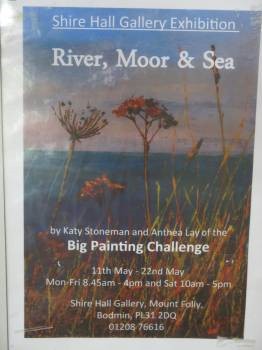
Paintings were displayed across the top of the grand staircase as we arrived, as well as this lovely poster, the background being a painting by Anthea’s co-exhibitor the equally talented Katy Stoneman.
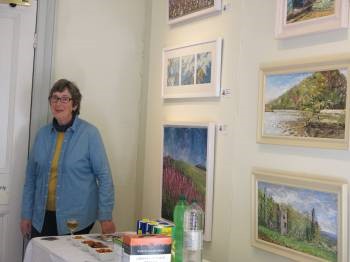
The exhibition was in a delightful space atop the visitors centre in Bodmin. Inside it was on a sort of indoor balcony, as you can see, with wonderful light.
The balcony went around half the top of the visitors centre – here is Anthea alongside paintings at the other end of the balcony to the previous photograph.
As you will know I am really excited that I managed to commission Anthea to paint me a picture that will become the cover for my work in progress set in a fictional village in the Tamar Valley.
However, that has to wait! First I have the official Book Launch of Some Kind of Synchrony coming up this Friday – and in preparation I went down to Truro to talk to Tiffany Truscott on BBC Radio Cornwall again. As always she was a delight to talk to as we looked at the triggers that got me writing this book when I did. Listen again (for next 21 days) HERE
And it is still not too late to come and join us at Waterstones – 65 New George St. Plymouth [UK 😉 ] at 6.30pm on Friday 15th May, where I am lucky to be joined by Simon Parker, editor at the Western Morning News, author and publisher, who will be conducting my author interview and shedding light on the choice of venue.
After which we’ll have a well deserved glass of something bubbly, mingling and book signing.
I look forward to seeing you there.
In the meantime – if you are around Bodmin between now and the 22nd DO go to Anthea and Katy’s exhibition at the visitors centre in Shire Hall – I am sure you will enjoy it!
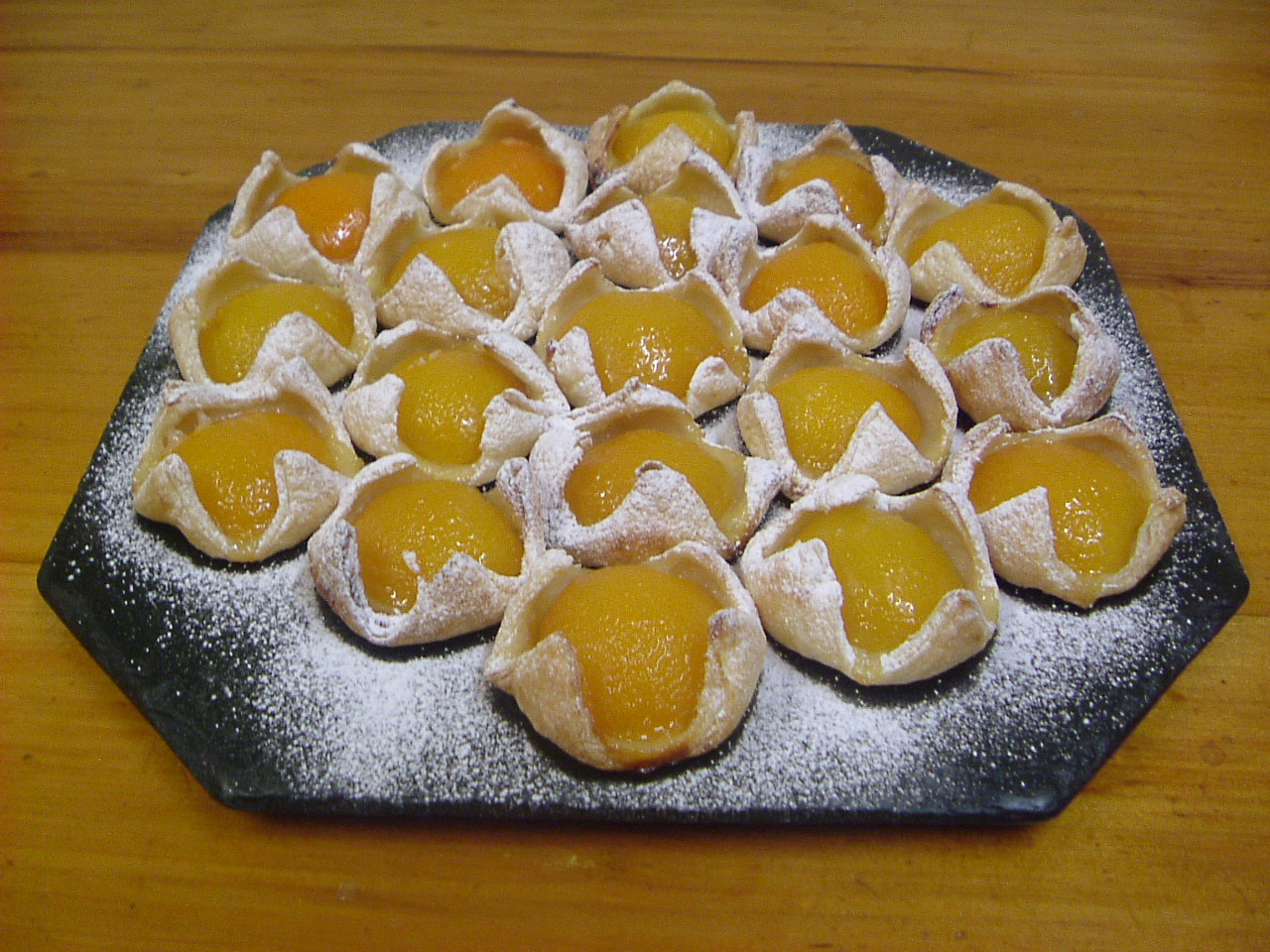
Earlier this month I did a demo for our local WI on making these and two other finger-buffet desserts – and now I am going to share another one of them with you.
These finger-buffet desserts are also ‘cheats’ in that they are really quite easy – but look and taste as if they have taken ages to achieve!
This one, like the apricot crowns, uses all-butter puff pastry. I use the ready made – not because I cannot make puff pastry but because this is one thing that I think the machines do better – besides I do not have all day – and making puff pastry properly Takes All Day!
I also use ready-rolled puff pastry – not because I cannot roll my own – but because our local branch of Tesco (as in this is the only one of the two local supermarkets that does the All-Butter puff pastry at all – and I do want butter) – does not do the blocks … only the ready rolled!
So here goes! To make Mini Mille Feuille:
Mini Mille-feuille – makes 48
1 pack All Butter Puff pastry (ready rolled)
Half pint double cream – whipped
Half jar of seedless raspberry jam
Top and base – two halves of same rectangle of puff pastry
Method:
Take out puff-pastry – roll to flatten only.
Measure – trim to discard wavy edges – you should be able to make 48 rectangles of 2” x 1” from the sheet at 12″ x 8″
Cut with a sharp knife and place on greased baking tray in hot oven (200 degrees C fan – 220 standard)
Bake for 10 mins or until risen and golden.
Remove from oven – slice open sideways, tipping tops to one side, return to oven for 2 mins to crisp soft pastry.
Remove and leave to cool.
When cool spread a little jam on the base of each one.
Using a piping bag with insert but no piping nozzle, pipe along inside of top section.
Place on top of the jammed base and set onto serving dish
Finely dust with icing sugar when all completed – YUM!
Mini-Mille-feuille
Two bites and they are gone!
Ideal if you are having a party, the pastry pieces can be made up well before (even frozen if a long, long time before) and just finished off in the afternoon (they’ll keep well enough in the fridge til the evening) Great if you’ve been asked to ‘bring a pud’ to a finger-buffet – as they look stunning and soon get snapped up!
Has anyone tried the Apricot Crowns already? How did it go?
Do you have a favourite dessert that you always like to make?
It is odd that today I came across not one, but two examples of the ‘super-‘bug’ MRSA being defeated, or at the least severely dented, by ‘old recipes’ for fighting disease.
The first was a report in NEW SCIENTIST that scientists from the University of Nottingham have worked on a recipe to cure styes, laid out in a 1000 year-old Anglo-Saxon medical recipes book called Bald’s Leechbook . (article here)
It sounds like the three witches in Macbeth, ‘Take cropleek and garlic, of both equal quantities, pound them well together… take wine and bullocks gall, mix with the leek… let it stand nine days in the brass vessel…’ But this is exactly what the scientists did.. though they made sure everything was sterile, and had controls set up, and had each element set up separately too (to see if only one would work – none did on their own)
The result: ‘The potion was tested on scraps of skin taken from mice infected with Methicillin-ResistantStaphylococcus Aureus. This is an antibiotic-resistant version of the bacteria that causes styes, more commonly known as the hospital super-bug MRSA. The potion killed 90 per cent of the bacteria. Vancomycin, the antibiotic generally used for MRSA, killed about the same proportion when it was added to the skin scraps’.
Just imagine how long and how much experimentation had to have taken place in ancient times to come up with this particular mixture of herbs and the vessel to use to make it in, made up so carefully (another ‘try’ with this recipe by a US university in 2005 resulted in ‘a loathsome, odorous slime‘ that did not work,) and left for that particular length of time to discover it worked, that it cured styes (for that is what the recipe was for – and as styes are caused by Staphylococcus aureus – this is why the scientists were trying it)
This method has been peer tested by Dr Kendra Rumbaugh, of Texas Tech University in the US, who was asked to replicate the findings. She said that the salve performed ‘good if not better’ than traditional antibiotics at tackling the superbug. The findings were presented at the Annual Conference of the Society for General Microbiology in Birmingham which runs from March 30 this year.
The second MRSA attacker I heard about on the radio — my ears pricked up when I heard the goats (we used to keep goats) and they were the source of this other unexpected beater of MRSA. It is a long story – but the goats had initially been kept to help with their son’s asthma (this is well documented that Goat’s milk is a less antagonistic to bronchial conditions than cows milk.) They also found that it helped clear up his eczema when made into a cream and a soap.
Now, eczema is an auto-immune disease and many auto-immune diseases appear to be triggered in the gut. By making a fermented product from the goat’s milk, called kefir, they found they had something that seemed to help many auto-immune gut related conditions. Kefir is a powerful probiotic that has been made for hundreds of years in Russia, though the name is possibly Turkish (from keif meaning good feeling).
Then, after surgery, the husband contracted MRSA from the hospital. The wound wasn’t healing, worse, the MRSA was attacking the skin and flesh and making the wound larger and worse and, despite treatment, would not go away. Having read of the curative powers of kefir and having seen how it had helped their son with both asthma and eczema, the wife started treating her husband with kefir by getting him to drink it. She also read-up on essential oils and, believe it or not, the bubonic plague and a bunch of perfumiers who didn’t catch it, and created her own blend of essential oils which she used to bathe his skin, after which she used the kefir on his skin too. In two weeks his skin was testing negative for MRSA and soon healed. The blend of essential oils has since been lab-tested to show it is effective against a whole bunch of pathogenic bacteria, and they are currently working with Swansea university on the effects of kefir and the essential oils (read an article here)
Now these are concoctions that have been ‘known’ about in the western world for hundreds of years – and we are still only just realising how nature works, how our bodies work and how they can work together – or against each other. If this is the state we are in with cures and remedies we already ‘know’ about – how many more cures are out there in nature, especially in the most bio-diverse regions like the rain-forests that man seems set on destroying? It makes you think! (Yes, I did quite get into all this while I was writing ‘The Angel Bug’ as one of the main characters was deeply concerned for the rain-forest and its bio-diversity – does it show?
Had you picked up on these stories in the recent media?
What are your thoughts?
Are you fed up with the general election (UK) ALREADY?
I’ve told you that I was going along to see why I couldn’t sing – despite loving to sing. I set off expecting to be asked to hit a few notes, perhaps played on a piano or something for me to repeat, or a trilling ‘lalala’ to copy, perhaps even a rendition of “Doe a deer a female deer, ray a drop of golden sun, me … ” from the sound of music or just a ..me-me-me-me-me…Hmmm?
None of it, well not for a long time. My dear and lovely friend, (this is why I felt safe even though still vulnerable) made us both a nice cuppa and we sat. ‘Why do you think you cannot sing?’ she asked, without having heard the evidence (ie, me trying to sing.) ‘When, in fact, did you first think you could not sing?’ I did tell you before that she is of the belief that everyone can sing! Did I mention she is also a beautiful singer and ex speech-therapist?
Picture credit to Gryffindor
As it happens the first time I realised I could not sing is etched in my memory. I must have been about nine – as I was in Mrs Snow’s class. I can see the room, the double desks on cast iron frames, the ink-wells set in them. Mrs Snow was choosing people for some sort of special choir. The actual reason is, for me, lost in time. I suspect it was something to do with the church, as our school was a C of E and we trooped next door to the church for various events.
‘All those who would like to be in the choir put your hand up.’ Me, me, me, my hand up and waving. She picked out about a dozen, maybe fifteen, hand-wavers. Pointed at me and said, ‘Not You,’ then also to a contemporary sitting two desks away. This was a lad whose voice I had heard often in our ‘Singing Together’ lessons (A lesson broadcast on the radio and followed in class with special booklets of the songs) as he sat quite close to me and, I thought, sang like a frog. He was a keen joiner-in though so had his hand up for the choir too, finally a ‘Not you,’ for one other child, over towards the back of the classroom. Everyone else who wanted to sing was chosen.
It was obvious to me then … I knew the lad couldn’t sing .. so I must sing like a frog too.
Sadly that was not the only time I was deterred from singing, my dear OH wonders aloud ‘if I am ill’ if he hears me singing loudly in the kitchen (as he often does – as I love to sing along to the radio) and I was even asked to mime at the end of an Am Dram panto as I was ‘putting the others off in the last big chorus.’
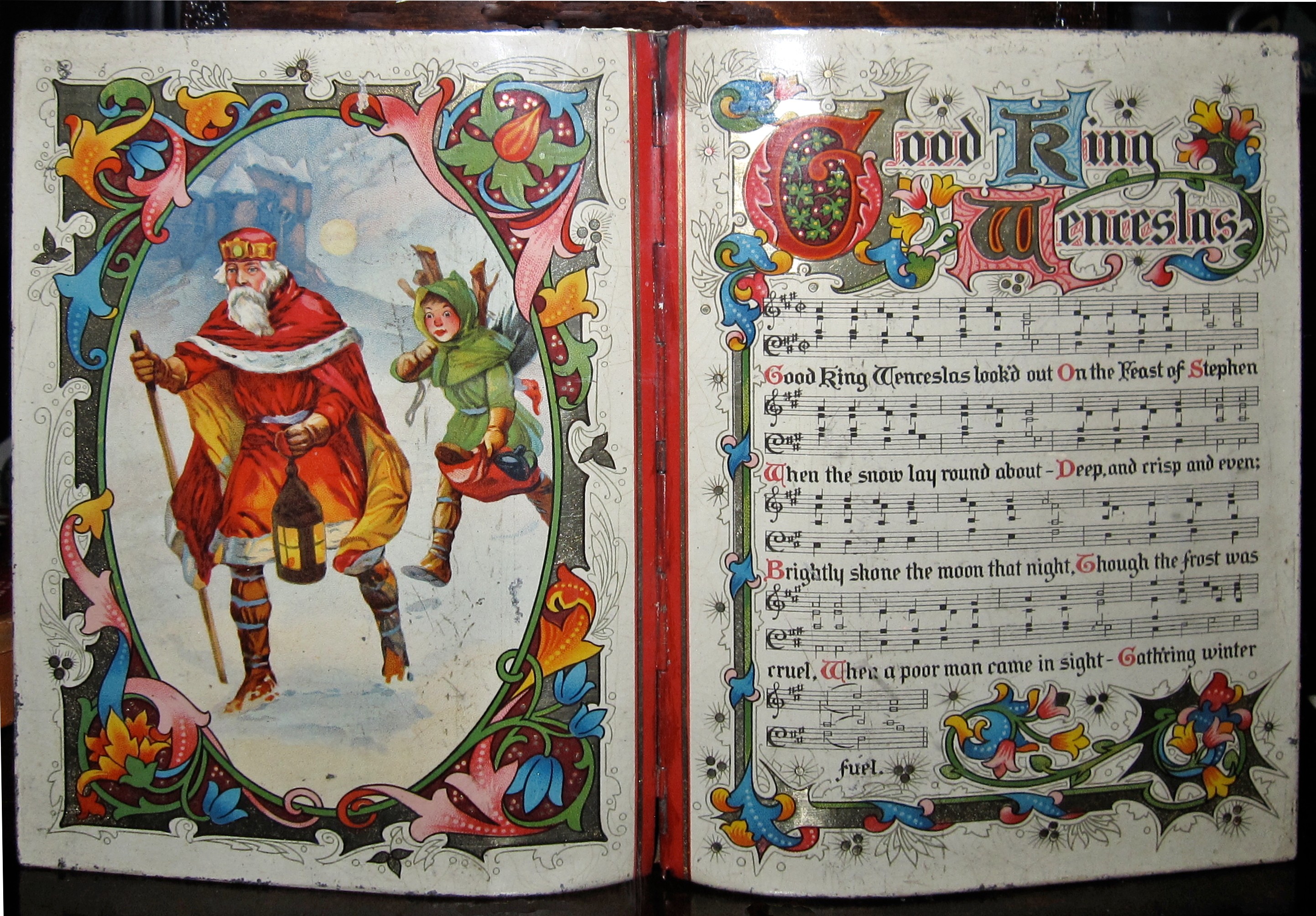
So, after an hour of chat and probing about my memories of singing, which included the times I liked to sing, happier memories of singing and the like, she gets out the words to Good King Wenceslas. ‘Lets have a go at this,’ she says, ‘but as you sing I want you to swing your arms from side to side.’
And so we did. We sang the first verse together.
‘Perfectly in tune,’ she says. ‘Next verse you sing ‘the King’ I’ll sing ‘the page’.
‘Great – perfect. Next verse, together..’
Well I was right in the swing of it now I thought (arms swinging away rhythmically too, to help distract me from thinking too much – I think) ….. but when we came to the second half of the verse my voice went to pot…… ‘Ah HA!’ she said, ‘You tried to sing that high when it didn’t need it and it went everywhere!’
And so it had.
‘You could be as low as a tenor,’ she said, ‘or at least second Alto. And if you sang naturally low even as a child you may have not blended in with the high voices of the rest, so that Mrs Snow wouldn’t want a low voice mixed in with the general high voices. You sing low – but not out of tune and not like a frog!’
‘I suspect that you try to sing like others around you, but the melody line is frequently out of your range so your notes go all over the place – which explains why even in later life you have been told not to sing.’
WOW
So, like the Page I follow, placing my feet in the footprints as we ‘siren’ swooping from high to low and back up high – and higher. Good vocal stretching, silly noises that are not singing but may extend my range. I am to practise.
We are going to have another meeting. None of this is to teach me to sing… but I now know that it is not without hope. If I choose I can find my voice – perhaps have some singing lessons, perhaps join a choir that needs low voices… exciting or what? Certainly something to sing about!
Do you remember ‘Singing Together’?
Have you ever been told not to sing?
Is it possible that it is only a misplaced voice?
Can we really all sing??
What do you think – do share, you know I love to hear from you.
It must be a sign of the unseasonable warm weather we’ve been having in the UK, it’s nearly December and only now are the spiders making their annual autumn invasion of the house. Now you have to understand that our house is a spider’s heaven, having been built in stages from the 1500s onward to the late 1600s it has lots of beams, to make webs between and the ceiling, hundreds of nooks and crannies, nice places to sneak away into to hide, and a housekeeper (me) who, 1, quite likes spiders and doesn’t want to harm them and 2, likes important things to be clean (kitchen, bathroom) but is not overly anxious about a few cobwebs here and there – especially there.
Now when I say I like spiders I have to qualify that with I like some spiders more than others. I am not fond of the very dark short-legged varieties and on the infrequent occasions when they do arrive I arrange their safe and harmless transition to the great outdoors (clear plastic cup and sheet of paper work best for me)
Spiders (arachnophobes look away now – pictures coming up)
tegenaria from the workshop
My favourite house spider is the Tegenaria gigantea . (It maybe that the ones in my house are actually Tegenaria saeva which is very similar and found more often here in the SW of England) These are the large beasties with equally large legs and beautifully chevron marked abdomens. If it sat in a dessert-spoon its legs would reach or overlap the edges. It is often spotted as it makes a mad dash across the room, pauses, then runs on! The females are quite long lived and can live a number of years as adults and, as is usual in the spider-world are larger than the males. They make quite small webs (so not too much of a nuisance) We used to have one that lived behind a large larder cupboard, where the cupboard didn’t quite fit tight against the wall (not one of the walls in our house is straight). She would come out in the evenings, sitting boldly at the edge of her small web. The boys used to drop flies they’d swatted into this web during the day for her to find later. After about two years she just disappeared.
The one pictured is fairly small, as they go, and lives in the workshop, high up above the racks that hold the tools etc, for size reference the base of the jar she is sitting in is a good 3″ or 7cm across.
The next and the most prevalent spider in this house is a thin cylindrical bodied, long thin legged variety that I call the cobweb trembler. It makes annoying strandy cobwebs all over the place and hangs in this mess waiting, so while I tolerate these I am not keen on them. If you disturb the cobwebs it trembles violently shaking back and forth over as much as ten centimetres, so that it is hard to catch (if I were a bird or something) If you touch the spider itself it drops, suddenly, to the ground…. and scurries off inefficiently on its spindly legs.
These belong to the Pholcidae and are probably phalangioides but I am not sure. They manage to raise armies of young and so each year, twice a year, I brace myself and armed with the vacuum cleaner, try to remove as many as I can from the building. I often wonder if they survive the vacuum treatment, I hope they do and immediately go and empty the cleaner out on the compost heap (it doesn’t have a bag so the dust and stuff doesn’t get compacted at all) – in the hope that if they have survived the suction and having landed in the body of the cleaner they have curled up and waited until release.
Along with many others I find beauty in the cobweb made by the orb spider and many orb spiders are beautiful in themselves with interesting colours (saw a bright lime green one this past Summer) and patterns. When these decide to make a web across an open window it is with great regret that I destroy the web just to close the window (making sure the spider is safely outside before closing) I really don’t like the thought of hurting them.. maybe growing up with the ‘If you wish to live and thrive, let the spider run alive’ rhyme?
Spiders aren’t the only creepy crawlies that I have a soft spot for. Many, many years ago when at teacher training college I did my biology thesis on Lepisma saccharina (the small primitive insect known as the silverfish)
A harmless creature (except if they get into old libraries in numbers – they eat the sizing and glues on books) I had always seen them around but could find very little out about them. After eighteen months keeping them, studying their life cycle, behaviour patterns, preferences for diet, humidity, light, temperature conditions and nearly four hundred pages later, which included sheet after sheet of hand-drawn and coloured graphs (pre-computers!), I think I knew more about them that most entomologists back then, but not now . I was particularly curious as to what the ones that live in the bathroom ate, (as the only information available at the time suggested they ate carbohydrates and sugars – not often found in bathrooms) and discovered that among other things, they eat up all the shed scales of skin we leave behind as we dress and undress – so they are actually doing a good job there 🙂 . In fact, if they did not get certain levels of protein from this or moulds then they lost their shine. I was awarded a high grade for my research and hence, in this house, these creatures are always rescued from the bath.
Enough of creepy crawlies for now….. I think these have to go under ‘Other passions’.
Anyone else like spiders and other creepy crawlies?
Let me say from the start – I’ve been a member of the WI since I was 15 – excepting my years at college, and five living in a city – no WI branches allowed in universities or cities back then, as they are now. (It’s good to see how well they are developing in these places now and how many young women are joining them!) This came about because my mum was going off to her WI meeting ON my 15th birthday… and, as that happened to be the age that you were allowed to join our branch of the WI back then .. I went along. (NB for insurance purposes, apparently, the joining age is now 18)
Now the WI (Women’s Institute) has developed an unfortunate image over the years – emphasised by almost every press report and slanted so that we appear to be jam-making fuddy-duddys and of the pearl and cardie-wearing, tory-voting brigade to boot. Even my Aunt thought this (when she moved from a town in Essex to our Cornish village she expressed this view – despite the fact that I, my mum and another Aunt belonged – none of whom fitted that description in any way whatsoever – except the jam-making part).
‘Jam and Jerusalem’, the papers say, in a disparaging way. Well, yes our rousing ‘song’ is Jerusalem, by William Blake, and I find the ‘bring me my bow of burning gold, bring me my arrows of desire,’ quite stirring 😉 though we do not sing it at our usual meetings nowadays. And as for Jam making – that was effortful war work. What other war work is disparaged?
In nearly a hundred years of being an organisation, the WI has made a huge difference. Though started to help rural women, for education and support, it has taken up the cause in many aspects of life. Some of these then grew into themselves as separate organisations, which still acknowledge their links to their inspiration and formation. Like the Keep Britain Tidy group… an idea and movement initiated by the WI in 1954 and, though now a national organisation, often the people on the ground in villages doing the organisation will still be from the local WI.
Each year we have a resolution and our National arm campaigns on these resolutions. Not just on that year’s one but on any that we have passed over time. They have our mandate; that is the mandate of 212,000 women, to campaign on these issues. Over the past five years these have included ‘No-more violence against women’ ‘SOS Honeybees’ ‘The need for more Midwives’ ‘Care not Custody – for people with mental health issues’ and ‘Time to Talk – about Organ Donation’. It educates, it campaigns and is listened to.
Yet still the WI is disparaged, though now we are also the ‘calendar girls’ (a doubtful accolade) where some potential members are as wary of being asked to strip off… as much as to run a cake stall (or should that be buns?)
So, when one of our members on the UnOfficial WI FB page, a page for WI members to chat and share (not the Official WI FB page which is more for National WI matters) suggested we each took a photo of ourselves holding a sign with the words I AM WI written on it – I thought this a great idea – for, though you know I like making Jam (in my microwave), I also think I am a typical (but NOT-STEREOTYPICAL) WI member! Active in my own life and in the community, busy and enjoying life to the full.
All of which explains the photo of me and my paddleboard at the top of this blog 🙂
You may have missed me ( or not) but I have been away and had not got my act together sufficiently to have blogs up and ready to post. I had been a very good girl earlier when I knew I was going to be busy and had prepared posts for your delectation. However, in the afterglow of being visited by my ‘long-missed’ grandchildren I did not get more in hand for when I went away. Enough waffle! (or perhaps not … that might mean the end of the whole blog if I say that!)
Now I am not here to suggest that you learn how to take hostage hapless yachts as they sail round the world, or to pirate music, or (worse still) ebooks. No, being a pirate is what I was having such fun doing when my grandchildren visited for a while. As they live on the other side of the world and I hadn’t seen them in the flesh for two years, you can imagine I was excited.
The youngest was just 17 months (and I had not even cuddled him) the other two, one nearly five – the other nearly 7 – and all boys! I was a granny prepared. I had collected bits and pieces and put them in boxes – different boxes to spark different games or activities. So on a nice dry day when we opened one box in it they found scarves (triangular) red or mostly red, a couple of pirate plastic swords, some black and gold strips of cloth to make belts with, a pirate sticker-book and some squashy pirate figures (for the little one)
Boys on the ‘ship’
Now we are lucky.. we have a big garden .. and the type of washing line that is hauled up a steel post – renamed ‘the mast’. This made building a pirate ship easier. We headed off to the ‘old wood’ shed and collected lots of pieces of wood that had come from taking old pallets apart. Even the 17month carried planks. And we ‘constructed’ a ship around the ‘mast’, in outline, with planks across to sit on for a deck, a plank to walk (of course) pointing out from the ship. The finding of an old piece of flue trunking made a great cannon. A heavy lump of metal ( U shaped) was chosen to be an anchor and duly tied to the ship with binder-twine. The sail (an old sheet with skull and crossbones drawn on by gran and shaded in by the boys) was tied to garden canes and thence to the washing line… this meant it could be raised and lowered using the line mechanism, and an old plastic lid was nailed to a piece of wood and hammered into the lawn to make a steering wheel. All that was needed now was good imaginations 🙂
The dog served very well as a sea monster too, sharking’ her way around the lawn… and duly jumping on me when I was made to walk the plank and fell into the ‘sea’.
So the first day of pirating went well, with the rowing of totally imaginary rowing boats to islands (trees and their patch of shade on the lawn) and general taking in turns to be captain and making the others walk the plank and chasing around the place.
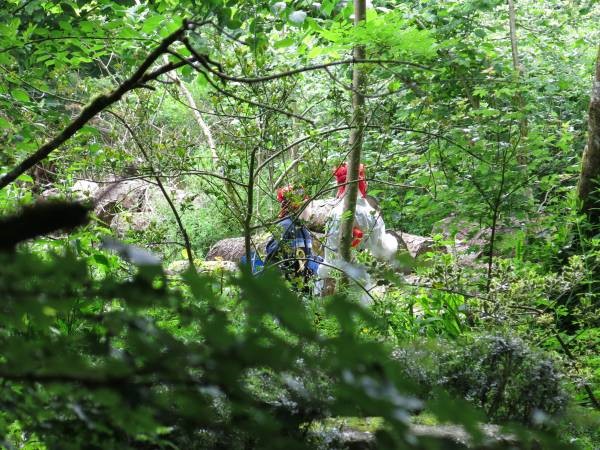
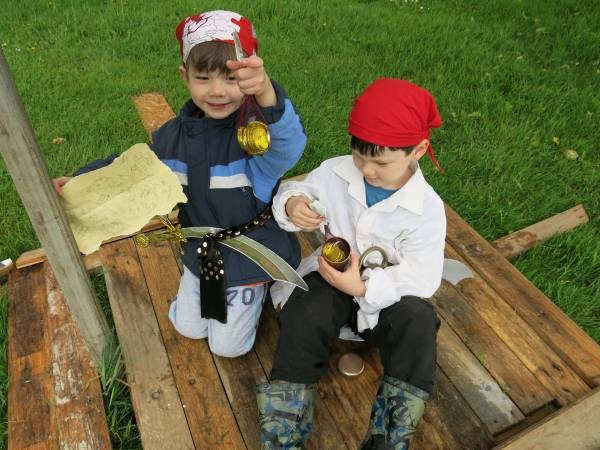
boys find treasure map
Pirate Day two: Granny prepared again I had filled a cannister with small bags of money (5ps and 10ps that their great aunt had collected from her loose change for them) and some lovely bright shiny glass cabochons (that you can put in the bottom of vases etc) to be jewels, and had sneaked out and buried it under the leaf-litter in the woodland garden. In another cannister I had hidden a Pirate map .. with the features of the garden all given new piratical names – hence the pond became Dragon Lake… and a stone bench became ‘the lookout point’ etc… Of course, on the map X marked the spot… and after hiding the treasure I had marked the spot with an X made of sticks… just as well as it turned out 🙂
boys treasure hunting
I informed the boys that I had heard that there was pirate treasure on the island nearest the ship… so we all ‘rowed’ to the island and searched it. No treasure but the cannister with the map was found. We then rowed back to the ship and read the treasure map, worked out we needed to row to land, collect some shovels and set off on the journey……..
What fun! Carefully they made their way, finding the features as we went… but not just running straight to where the X should be … eventually I had to focus their search on where the X might be in relation to all the other things they had found…and that was when I asked them how they’d know where the treasure was buried. ‘There will be an X on the ground’ – I was told, with certainty!
The X was found … dug up .. and the treasure taken back to the ship… *sigh* We had so much fun!
Back on the ship – opening the treasure (2)
Later we decided to visit the post office as I thought that they could buy something with their treasure money … the oldest was a bit worried that the money might not be real (after all he’s used to ringgits)
The lovely lady who runs the post office entered in to the spirit of things and matched her real money with the pirate money, which showed them it was real.. and they bought themselves a small treat!
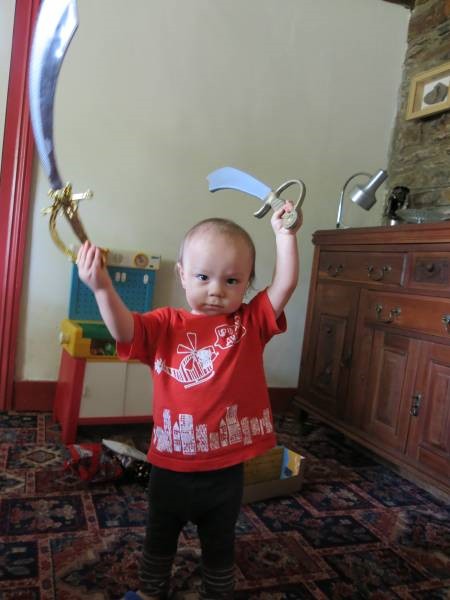
I can be a pirate too!
The ship was in use day after day(until grandad wanted to mow the grass) – with the boys playing their own games .. and a second map was found on a different day sending them on a different treasure hunt – this time with some chocolate gold coins in the treasure cannister!) Pirates was only one of our games – we also played other games (with different things in a different box to kick it off)
Are you a granny who loves to play?
Do you believe imagination is the best toy?
Do share – you know I love to hear from you
Addendum:
On the anniversary – 100 years since ‘the war to end all wars’ began
How to Grow Poppies
For flowers in abundance
row after row, whole
landscapes turned crimson, first
turn the soil.
Digging trenches works well.
Poppies thrive in open spaces,
the removal of trees and other shade
is recommended.
Fertilize well, blood and bone is best.
Water in, a long winter of rain at least,
and leave … nature will do the rest.