Talking Toilets

No, NO, not actually TALKING toilets – though I am sure they have them somewhere in the world – Oh! They do – in Japan. Lid down

No, this started because of a jokey photo that my niece, who is just moving into a ‘mixed’ shared household,  posted on Facebook – showing a toilet seat with a sticker and the words ‘Put Me Down’ on the underside of the seat, and tagged it with her male friend’s names.

Now, I think there is nothing more controversial for men and women moving into the same house than the Loo Seat UP or the Loo Seat DOWN question  – as, for a fact, there are preferences and there is always the ‘women should stop whining about it’ factor too.

I had to comment on her FB post, essentially ‘The label is stuck on the wrong bit – it ought to be on the LID’ … and actually in the centre of the underside of the lid so it can be seen even when the seat is up.

I have known this for a long, long time, and am lucky enough to live with a man who thinks the same way, and always puts the LID down, so no arguments here about it. (Sadly, boys who were brought up to put the lid down, lost this ability when they went off to University and now need reminding when they visit)

WHY PUT THE LID DOWN – why the FUSS ??

If you didn’t know then here goes… When you flush a toilet an aerosol of fine particles from the toilet bowl are propelled up and out into the room – carrying bacteria and viruses. *The study showed that significant quantities of fæcal microbes floated around the bathroom for at least two hours after each flush. This aerosol spreads a long way from the toilet bowl and lands on everything in the room: this will include your toothbrush, towel, flannel, wash basin, loo-roll, etc etc

Yes – your toothbrush… yuk.  And don’t think about blowing your nose on loo-roll…

Easy way to prevent this ‘plume’ of toilet excreta going everywhere … PUT THE LID DOWN – yeah – you have to touch it to do that – but then … you wash your hands! 🙂

Mind you – Dr Gerba also found that 95 percent of people say they wash their hands after using a public bathroom, but only 67 percent actually wash their hands. Only 33 percent of those who do wash their hands use soap. And only 16 percent really wash their hands thoroughly.

Umm .. . and this thought for some who do not put the lid down and stay to watch  … what do you think happens to this ‘mucky mist’ if you stop and watch the ‘flush’?

The advice for public toilets where they have decided not to have a lid, which includes some hospitals, is to Flush and RUN!

The best design seems to be the ones like they have on some ferries, where the flush button is ‘hidden’ behind the lid, therefore you have to put the lid down to be able to flush.. and yes, you would know where to find it as the previous person would have put the lid down to flush it!

*No, I haven’t done the research – Dr Gerba of Arizona University HAS – extensively, and reported on it as long ago as 1975 (which is about when I heard of it). And if you want up-to-date UK based research – then Leeds University  has done similar looking at hospital toilets, with basically the same result.

On a lighter side… and if you are not convinced by the science   –   there is –  FENG SHUI

In Feng-shui – a toilet LID left up is an energy drain on your house, water has ‘drawing power’  and can draw away the good energies you want to keep circulating in your home, says Alice Inoue,  Conversely, putting the lid down sets the intent that you want to keep the “wealth, prosperity and other good stuff” in your home. Control what you want to keep or let go of by closing the toilet lid to avoid drawing the good energy down into a vortex of waste. Send the message that “all good energy and wealth stays in my home.”

So, what happens in your household?

Is there a ‘stand-off’ between Men and Women in your household … when the real answer is LID DOWN?

Do you Feng Shui your bathroom?

Do share your thoughts – you know I love to hear from you … and feel free to share this blog with anyone you think might like to know this stuff 🙂

Wow! I’ve done it ….

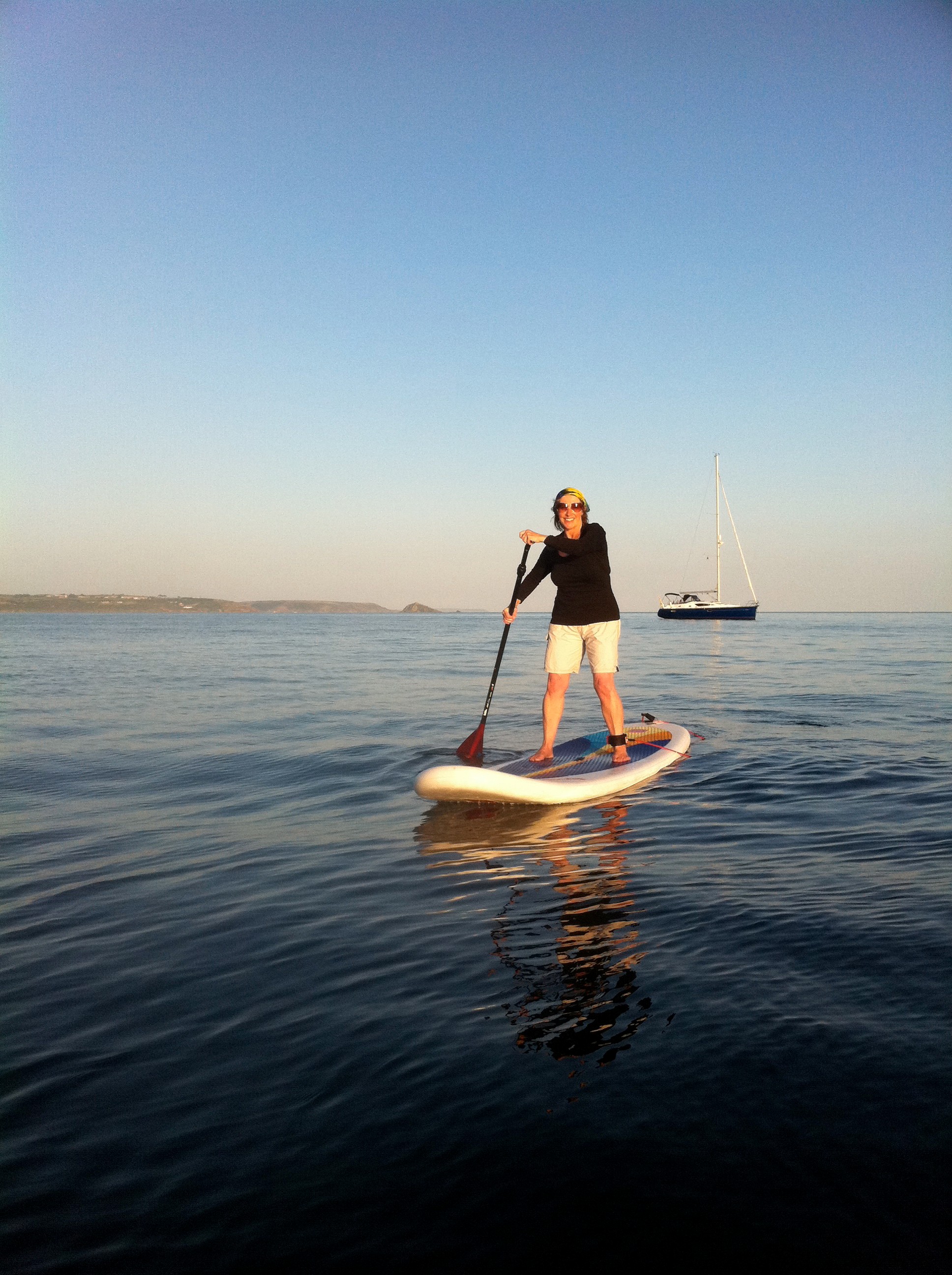
I took up my own challenge and went PADDLE BOARDING! YAY!paddleboarding 1

Now, the nice German lady paddle-boarder I had spoken to (see blog post) said that it was best to learn on a lake.  So when I returned to the UK I searched the local lakes that do water sports for Paddle boarding – but, to my surprise,  none of those did it.  So I searched generally and found SUP Rental based in Cornwall near Cawsand.

paddleboarding 2I contacted them and Lucy (of SUP Rental ) said I could ‘choose’ my weather to pick a calm day with little wind and plenty of sun 🙂 As you can see the sea was pretty calm!

She also said early and late the wind tended to drop and would be less windy. Well, as you may know, I am not a lark – so it was the later spot for me. I watched the weather forecasts and found a slot that coincided with free time and good weather and booked. Lucy had a group just before but we set a time of quarter past six and I met her on the beach at Cawsand. (parking free from 4pm too 🙂  useful!) paddleboarding 3

After a check-list for safety, asking if I was confident in the water and a run through on land of the basic strokes, we waded into the sea – to just less than knee deep.

It was almost high tide, the waves lapping gently and the sun shining – perfect. I hopped up onto the board, on to both knees and central and began to paddle. Following Lucy’s instructions, we paddled out and along the coast, getting the feel of the board, after a while we turned back and it was time to try getting to my feet.

paddleboarding 4aAfter a few wobbles I was on my feet, planted wide, centrally, knees bent and the feeling that my toes were trying to dig themselves in.

Now the paddle strokes came into it play and we got a bit more momentum going.

That FALLING feeling.

A particularly deep sweep of the paddle knocked my balance, but I dropped to my knees and all was well: balance was restored. Once the wake from a motorboat had subsided I got speed up again and got back on my feet. paddleboarding 5

We paddled along the coast, quite a bit out from the cliff, and round to the end of the cove* (see photo below – *just beyond point on right) before turning and, having been taught a new variation on the paddle stroke, practising this as we worked our way out into the bay and back towards the beach.

Though an active sport, it isn’t (or needn’t) be exhausting and we could easily talk as we paddled.

Drawing close to the beach we dropped back down to our knees and paddling with the waves brought the nose of the paddleboard up onto the edge of the shingle and hopped off into the knee deep water again.

(photos of me taken by Lucy – click on to enlarge)

IT WAS BRILLIANT! And I didn’t even get wet so it didn’t matter that I didn’t have a wet suit!

Lucy had started me off on one of the larger boards for added stability. I’m booking another lesson to try out different size boards to see which one really suits me (The large one is very stable but a long way to reach across for the paddle stroke)

So that was my mini-adventure! What was even better was the next day I didn’t suffer from any aches or pains in arms or legs  even though I thought I might – perhaps because of the exercises I do to keep my muscles strong and therefore my weight down.

cawsand leaving
Leaving Cawsand (right) after paddle-boarding, the moon rising.

Now to keep up to date with their Supboarding magazine (online) and keep my eye out for equipment.

If you think you’d like to have a go, the online magazine also has a page that shows you where the closest place to paddle-board is.


Have you challenged yourself to do anything new lately?

How did you get on?

Do share. You know I love to hear from you!!

Who’d be a YoYo?

Apparently, millions of us!

The Men Who Made Us Thin  is the latest BBC documentary by Jacques Peretti – who did The Men Who Made Us Fat series. (Watch on YOUTUBE at the named link)

photo via creative commons by rjp zimpenfish

My brief summary, however, would go something like this:

The university of Minnesota’s research showed that the amount lost by dieting and kept off over 2 – 5 years averages 1kg (2.2lbs) with one to two-thirds actually putting more back on. This appalling failure-rate shocked even the researchers!

Peretti shows that the ‘average healthy weights’ were originally set in the 1940s by an insurance analyst  – not a medical one, and that this gave no lee-way for age or build – and ‘made’ lots of average weight people into ‘overweight’ – thus driving a route towards the emerging diet industry.

A GOOD TIP – avoid any diet that claims huge losses in a short time! It is a recipe for disaster and yoyo dieting – and is a sure sign of a fad diet.

Findings by Dr Hirsch, as long ago as fifty years, showed that ‘diets’, especially calorie restrictive diets, don’t work in the long term – a  fact has been totally ignored. So much so that the fact that ANY diet will work in the short term, meaning that people will lose weight – put it back on .. then return to the diet ‘solution’ again, is a business model that works.

Weight Watchers own figures say that 2 years after reaching goal weight only 20% are still there and after 5 years only 16%. I have a ‘blog friend’ who has lost weight this way and kept it off! So I suspect she took the sensible eating to heart and had enough will-power to be her own support group. I have other friends who have lost a LOT of weight with this, put it back on, lost a lot with it, put it back on … yoyoing.

The former Finance director of Weight Watchers admitted that the business model of a weight loss system that WORKED would be a failure – that Weight Watchers (and by implication all the other supported weight loss programmes) is one whereby people lose weight.. go on to regain over time … come back to lose etc (on the basis of ‘well, I lost weight with it before’)

The fact that almost all the major ‘diet’ companies are now owned and run by FOOD manufacturers speak volumes – for them it is win: win. They win when you eat, they win when you ‘diet’ using their systems and their specialist foods. It’s almost hilarious!

Peretti also looks at the Atkins diet.  I read all about this one.. and used it – modifying it a bit as I really did not think that his early weeks of NO vegetables was a good idea -ever. It worked, mainly because it was high protein and lower-carb than the conventional way of eating. However, it was not very sustainable, it meant eating in a totally different way to those around you. It was difficult and pricey to do for a whole family. The Dukan diet is very similar.

Much as nowadays, I really like the look of the Paleo diet … lots of aspects make sense. I can see how well this would work for single people, but for families.. hmm? Life doesn’t quite work like that.

What I do know – about both of these diets, is that the emphasis on LOWER CARBS is right, and the emphasis on avoiding insulin spikes is right. What seems to be missing is sustainability for everyday family life and everyday family shopping.

Here’s my plug – the book I am working on gives guidelines to help you eat a lower amount of carbohydrates and better fats and proteins to keep you feeling full and satisfied, without being prescriptive. It is designed by a busy family woman for real life, making it ultimately more sustainable and it doesn’t ban any one food completely. It is using these guidelines as an everyday, easy to follow, way of eating that can suit everyone in the family, that means this way of eating can be followed easily for life, whereas a ‘diet’ just can’t.

This works alongside the less-than-15-mins-a-day workout, which you do at home, to build lean muscle. Something about this combination seems to reset your body-weight distribution and loss patterns to those of your younger self.

What are your experiences of ‘diets’, good, bad or indifferent?

Have you ever found one that is easily sustainable in the long term?

Do share, you know I love to hear from you.

Planning for fun …

I know it is still 2013… but I have one of those big birthdays coming up next year and have started planning something fun for myself.  I’m not the only one, a relative of mine hits the same number in the same year and is planning a treat – a trip to the Isle of Man TT races. (He’s into motorbikes)

I’m thinking I’d like to learn something new, perhaps something a bit different for someone hitting 60. A good friend of mine took up belly-dancing on that big one… but I have been belly dancing for YEARS. The husband was given a ‘fly a plane’ trip for his 60th last year, Which he thoroughly enjoyed, and I even had a go on the short return trip. I considered whether this would suit me, or a balloon trip.  On reflection I decided that these would always be one-off events and would not expand my skills, and as you know, if I can learn something new – I am a happy bunny.

Ann Bodyboard
Ann with body-board

I had been thinking about surfing lessons. I had even gone so far as to say to the Husband that  I was thinking of doing this, even though I had a lesson many years ago .. organised by the WI. Sadly I did not achieve the stand. I got to the one knee, one foot stage more times than you could imagine, and tipped off at the stand each time. I persevered until I felt sick with exhaustion (and the tightness of the wetsuit across my throat – I can’t bear any clothing touching my throat) and the three hour lesson ended.

As you may know I LOVE body boarding (or boogie-boarding as it seems to be known in other parts of the world) and have just returned from a week in Brittany where I was out riding the waves every day, come sea-mist, hot sun or wind with drizzle. (Alternating it with writing the first 8,000 words of my next novel)  Once in the water the adrenalin takes over and I do not care what it is like as long as the waves are good. And I do this sans wetsuit – and seem to stay in the water longer than my wet-suited contemporaries – though I am often the only person not wearing a wetsuit AND body-boarding.

NOW, this is how things happen. I was just coming out of the sea for a break, to have a drink of water and replenish the sunscreen on my shoulders, when I passed a lady walking down to the sea with what appeared to be an over-sized surf-board and carrying a long thin paddle. Sitting on my towel, I proceeded to watch as she reached the water, walked in until about knee deep, hitched her board to her knee with a tether and hopped up onto the board – standing. Within seconds she was paddling the board out through the breakers, riding each one, seemingly, effortlessly. Once out past the main breakers she waited (along with the surfers – she standing, them lying) The next big wave came and with a sweep of the paddle she was ahead of it as it broke and she surfed that wave right into the beach, turning the board with a sweep or two of her paddle and was heading out again, over-taking the surfers that had caught the wave, and was soon back out with those who had not managed to catch the wave at all and were still waiting.

She caught more waves and surfed in more than the surfers – and that’s what it’s about folks, not the hanging around waiting for the wave – it’s the buzz of riding the wave, being driven along and getting the best from every wave.

I was so interested that I practiced a phrase or two in French as I returned to the sea, determined to ask about what I recognised a paddle-boarding ( though I had never actually seen anyone doing it) .  When we had both caught the same wave and were in the shallows together I waded over and asked her.

She wasn’t French. (I should have guessed this as, in my experience; French women in general do not seem to go in for water sports, like surfing or even body-boarding, much)  She was, in fact, German, and had excellent English. (Though not French – as she apologised in English saying Sorry, I do not speak French)

After a conversation, where it transpired she had tried to learn how to surf (from her surfing instructor husband) for two years without success and had found paddle-boarding much better, my thoughts now changed to paddle boarding. When she also explained her ‘board’ was actually inflatable (you could not tell from touching it!) and that it therefore could be easily transported – I was hooked – and regaled the Husband with my new choice when I got back from the beach.

paddle board woman don debold
Photo via Creative Commons attribution Don DeBold

If you’ve not come across paddle-boarding – here’s a picture of what it can look like – now that looks really sedate compared to the surfing type! A good way to learn!

Next morning, as it happens, the husband (who’d not even heard of paddle-boarding before I’d come home enthused) told me of the  news that a man had paddle-boarded from Cuba to the USA – a journey of 111 miles (179 km)!

Since I’ve been back in the UK I’ve been looking up places to learn, prices of boards and lessons and finding I can also call it SUP-boarding. (Stand Up Paddle)  Only problem is….. I do not want to wait until next year – you never know what next year may bring.  I think I may find somewhere to have a few lessons before next year.. and then if I like it, treat myself to a board when that big day comes.

Any one out there already paddle-board? Any tips?

What did you do for your last BIG birthday? Or are planning for your next?

Do you like the challenge of learning something new?

Do share, you know I love to hear from you!

Summer like it used to be…

Well, here we are – enjoying a bit of summer as it used to be. ‘Lazy, hazy, crazy days of summer’ DOG patio water

Why is it that the dog, when thirsty, prefers to drink the water from the dishes under the patio pots instead of her own water bowl brimming with fresh spring water (note – we are on a spring – I do not buy bottled water to give the dog LOL)  (Email-readers there’s a video here – please click into the blog title to see the 7sec video)

This unaccustomed heat has had the memories rolling. I recall days (well they felt like days) playing over the fields. The field next to where I lived usually flooded in the spring – meaning that the wheat didn’t grow in certain areas. In these ‘blank’ places the wildflowers grew. There would be whole large patches filled with poppies, dog daisies and cornflowers, and you could walk (carefully, so as not to damage any wheat) along the tracks to end up in them, hidden from view.

Then, later, after harvest, there were the straw bales to turn into castles and forts, for imaginative play.

There was the small stream half way between our village and the next, where it would be good to take a ‘picnic’ (anything we could scrounge to eat or drink from our respective parents). We’d sit on the two-plank bridge and dangle hot feet in the trickling water, eating whatever and talking nonsense.

My memories are of a country life, living on the edge of a small village in Berkshire – how different they might have been if my parents had not moved out of the east end of London when I was on the way!

What memories do you have of childhood summer days?

Do you think the weather has really changed that much over your lifetime?

What did you get up to?

Do share – you know I love to hear from you !

Reasons to be cheerful!

Scanned Document cropped
Smiley faces – courtesy of my grandson

I learnt some new stuff about personality last week and I am amazed!

Being on the slightly introverted side (though you’d never know as I tend to over-compensate) I also am a ‘bit of a worrier’. This shows itself in my tendency to want to organise things so that I know every ‘i’ has been dotted and every ‘t’ crossed.

Now, Michael Mosley (he of the ‘Fast Diet’-  borne from trying to ensure he doesn’t die early of being overweight and unhealthy) has turned his attention to Personality. Again, driven by his own ‘need’ and personality (after all a pessimist and a worrier would be the one to search for the way not to die early – wouldn’t they)

However, his anxiousness resulted in him also being an insomniac – which is NOT GOOD for anyone. Fortunately, I do not suffer from this ( but, hey, if I didn’t micromanage things – perhaps I would)

I have put a link to a youtube copy of this programme further down – the iplayer one will disappear too soon – so I hope this one gets left up – it is worth watching if you didn’t see it. (DON’T FORGET – YOU NEED TO GO TO THE TOP OF THE EMAIL AND CLICK INTO THE TITLE TO TAKE YOU TO THE BLOG TO SEE THE VIDEO)

I’ll not go through it step by step (you can watch it yourself) but I want to  bring out a couple of points that have interested me.

1, Our genes are not fixed! They can be turned on… and off.  Your environment (what happens in your life) therefore can change your personality – with the tantalising thought that a gene that was once turned on, say for depression, might be able to be turned off again.

2, That being an optimist can add 7 and a half years to the average lifespan. (This is almost double the extra that would be added if we found the cure for cancer) What’s not to like?

3, That you can literally ‘change your mind’ – you can redirect your thought patterns toward optimism – and towards a calmer reaction to stressful situations.

This is great news for many – as long as they are willing to put in the time —  10 minutes three times a week for the Cognitive Bias Modification (spent in front of a computer screen) for the thought patterns  and 10  rising to 20 minutes a day of meditation for the reactions to stress.  Doing it , however, is the same problem people have with doing exercises of any kind 🙂

Now that The Angel Bug is published, I am researching for my next novel and for part of this I am reading a book called, ”Born Liars – Why we can’t live without deceit’ where a chapter of the book is about placebos and the marvellous tricks our own minds can pull on us. (The placebos aren’t the bit I’m researching – but  I’m reading the whole book anyway)  The mind is an amazing thing, but what does it come to when you can’t trust your own mind! Yet what a marvel when it can provide a cure!

One thing they didn’t look at in the programme was the role of forgiveness. I believe that holding a grudge or feeling bad towards someone is the best way to create unhappy brain patterns and disturbed nights, whereas by forgiving you let go of that grudge. (I’m not saying this is possible for everyone to do in all circumstances – I can imagine some I couldn’t handle)  However, it would be interesting to see if forgiving is part of the mind’s method of dealing with stress.

http://youtu.be/rs046iOPlqM

Are you an optimist or a pessimist?

What makes you happy or anxious?

Do cute pictures of kittens really make everyone happy?

Do share your thoughts – you know I love to hear from you !


Three ‘new-fangled-electronicals’ I never thought I’d love so much

1, We’ve just been up country to celebrate a friend’s 60th birthday. This meant a round journey of 480 miles in one day.  Arriving home at around quarter to one in the morning I was blessing the ‘dear-old sat-nav’ for a problem-free journey.

Yes, a sat-nav! Yes, I am praising that much maligned steerer of artic lorries into winding, too-narrow lanes and jammer of large trucks around tight corners!

As over time our eyesight changed, being the navigator was becoming fraught with difficulties, what with the swapping between pair of specs to read the map and / or specs to read the road signs.  So our first use of a sat-nav was a real eye-opener. DSCF6972

We first used a (borrowed) sat-nav a number of years ago when taking #3 son to University in Brighton. This meant a long journey across the south coast of Britain, in and around town after town after city, after town. A long journey of roundabouts and bypasses. It worked like a dream … only suggesting a ‘off-course’ route along a piece of road we know so well we had no compunction in ignoring it , and when it gave up trying to turn us round, it soon recalculated and ‘got with us’ again.

Now, I would always like to have a map of the route handy, and to have looked at it before setting off – just because it is wise to know where you are heading in case you get an ‘odd order’ from the sat-nav [Drivers of Large Lorries please note !].  On the last trip the odd order was ‘at the roundabout go straight across and take the first exit’. The first exit was a turning left  immediately upon entering the roundabout (hardly ‘straight-across’) .. straight across was the only other turning and had the benefit of being into the village we were heading for.

So, Saturday, even with a navigator available, the sat-nav took away the stress, but with no navigator on hand – the sat- nav is a perfect god-send and one of those electronic items I never thought I’d love .. but do!

2, It seems this next is called a PVR (Personal Video Recorder) or DVR (Digital Video Recorder). Whatever it is called and whatever version you have, it is that thing that records the programmes you would otherwise have to miss – so you can watch them when you have time (and there isn’t anything else worth watching anyway) and does a few other very useful tricks besides.

You  may have gathered that I tend to be a bit busy… and that I also go to a number of different groups and clubs (plus committee meetings for some ) and so the few items I  actually want to watch are often on the wrong time for me to be there to watch them.

So to have something that will record them… and more to the point, be programmable so that I can set it to record them in advance (before I even know that I am going to be unavailable to watch them) is another great gadget that I really didn’t think I was too bothered about .. but find that I am! Add to that the facility to save time by skipping the ads when viewing, and to ‘pause’ live programmes when interrupted (as happens more often that you’d think) and I’m in love.

DSCF6969

3, The last one probably won’t come as much of a surprise to you all. It is my ereader.  I, like a lot of people I know, LIKE BOOKS.. and I do mean I like real paper books, but I LOVE my ereader. OK, so mine is a kindle – but they are all essentially the same – a way to carry hundreds of  books in a slim, light-weight package, that slips into the back of your handbag (so it is always handy when you find you have the odd ten minutes to read) or so you can carry all your possible holiday reading easily and read the fattest and heaviest of tomes without making your hand ache with holding it!

What is more – I have mine set on a larger font (and sideways) so that I do not have to find my specs to read!! YAY! Another blessing ! I love my ereader!

Do you have all or any of these gadgets? Do you hate them or love them?

What ‘new-fangled-electronicals’ have you fallen for despite early misgivings?

Come on, don’t be shy .. do share – you know we all want to know 🙂


Long Distance Relationships

Today, Sunday, was my youngest grandson’s Christening – yeah that’s him (above) in his christening robe giving me a sermon on having missed it. And, how much I would have loved to be there with him, his mum, his dad (my eldest son) and his two older brothers (my only other grandchildren) but they all live in Kuala Lumpur, Malaysia, and I can’t get over there at the moment.

Really I am lucky as both the other boys were baptised here in the UK  in our local church where my son and his lovely wife were married. It was fortunate that both their Christenings could be arranged to coincide with long visits here.  This new event started me thinking about long distance relationships and how lucky most of us really are now.

When my parents moved some fifty-five miles from the East End of London out to a village near Maidenhead it was a HUGE move. At that time, 1954, they didn’t own a car and if they had, the journey would have taken far longer than the now estimated one hour fourteen minutes as the M4 had not been built even as far as Maidenhead. In fact, I can recall travelling up to see relations in London in the mini that we had by the time I was about nine and the M4 was open … it seemed an interminable journey even then!

My grandparents were known to me from the summer holiday when they would visit, and Christmas when we would go ‘up’ to visit relations in London (everyone else in our family).  Hence I remember odd things about each of them, the gran who taught me how to knit every time she visited more than once, leaving me a pair of knitting needles with a block and a half of a scarf started under her careful eye –  that I never finished. (I never did get on with knitting – which is strange as I’m into every other craft) The other gran who always seemed to wear a ‘traditional’ wrap-around pinny almost all day – which I found odd. One grandad always whistling a tune, the other always full of all sorts of information. In between visits they might talk on the phone with Mum and Dad … but I don’t ever remember talking to them on the phone.

image courtesy Ian Britton freefoto.com

My Aunt and her family moved to Australia in the early sixties. It might as well have been to the moon, back then. A phone call perhaps once a year – letters on birthdays with a photo slipped in with the card. The thought that they could fly back and visit was beyond imagining at that time.
When I went away to college – even though it was not very far away – the only contact my parents had with me during term time was the Sunday evening phone call, usually brief as there was frequently a queue at the hall of residence telephone box and it wasn’t done to keep others waiting forever!

Today, though my eldest son is in Malaysia, I see photographs of him and his family almost every week when they post them on facebook, and we have a skype video chat at the weekend, with the first and main portion being the grandchildren talking to granny! (and grandad when he’s around) They show me drawings, read to me, tell me how they are getting on at school, tease me, even try to tickle me … and I do similar mad stuff back. I have met and played with the boys, apart from the baby, and when we do meet every eighteen months or so, there isn’t that halting shyness as they’ve seen me every week. I am lucky, but I still miss the cuddles!

And then there’s my youngest son, also on the other side of the world, even where he is, on an island just off of Thailand, I am able to keep up-to-date with him via skype and facebook. We are so lucky!

And it is easy to think it is the same for everyone, but as I have been finding out from my niece on her blog (armywaglife.wordpress.com)  one group of people who do not enjoy such an easy long distance relationship via the internet are those overseas in our armed forces. Hard to believe in this day and age – but true – even in Germany. It’s a very new blog – but well worth the visit.

So, do you keep up a long distance relationship with family or friends?

Is it easier for you now than it used to be ?

Do you remember the days when you had to queue for a public phone to call someone? – and then they had to be at home!

You know I love to hear from you – please share your thoughts

Hot Cross Questions

Baking hot cross buns on Thursday so we could have them at breakfast on Good Friday morning set me thinking about how come, in our house, we eat this  ‘tea-time type’ bun for breakfast … and why, when supermarkets have them on the shelves for months, do we only eat them on Good Friday at home … and whether this was just a quirk of our family.

As with every question today, I was quickly on the internet to research it, however, as you will know, you need to choose your sources carefully. I am indebted to recipewise.co.uk for an excellent rendition of the whys and wherefores of the hot cross bun – from which I have extracted the core information I sought.

To start with, Hot Cross Buns for breakfast is not just a family quirk. (phew) It seems that the practice of eating the Hot Cross bun (also known as Good Friday buns) for breakfast goes back at least until the 1600s, with evidence from Pepys and. later, from Samuel Johnson in ‘The Life Of Samuel Johnson’, by James Boswell, published 1791: “On the 9th of April [1773], being Good Friday, I breakfasted with him on tea and cross-buns … On April 18 [1783], (being Good-Friday) I found him at breakfast, in his usual manner upon that day, drinking tea without milk, and eating a cross bun to prevent faintness”.

As to the history of the bun I am jumping ahead. Like the origins of Easter Eggs, the ‘spiced fruit bun’ probably evolved from the pre-christian celebration of the spring and dawn goddess Eastre where in Anglo-Saxon times ‘a bread dough was studded with dried fruits and baked in small loaves’. As Christianity spread these were ‘marked with a cross’ and linked to the crucifixion on Good Friday and so ‘absorbed or acquired’ by the Christian religion – and as they were within the Lenten season they were a real treat yet eating them was blessed.

Indeed the practice of marking all bread-doughs with a cross was widespread by the Middle-ages – particularly as it was thought that the sign helped ward off evil spirits and prevent the bread going mouldy or stale. However, with the rise of Puritanism, this widespread use of the cross was seen as  ‘superstitious’ and thus ‘Popery’ and was frowned upon and eventually only the sanctioned ‘Hot Cross Bun’ was permitted to have the cross marked on it, and only to be eaten on Good Friday in remembrance of the crucifixion.

By the early 1700s these delicacies were sold on the streets by baker’s boys and coster (barrow) boys and women (with baskets instead of barrows for this day) Their cry of ‘One a penny, two a penny, Hot Cross Buns’ is a rhyme that was also brought to mind and sung to myself as I baked our buns and is a popular Nursery Rhyme today.

Hot cross buns! Hot cross buns!
One a penny two a penny – Hot cross buns
If you have no daughters, give them to your sons
One a penny two a penny – Hot cross buns

The superstitions that were prevalent in the Middle-Ages started with the belief that the cross on the dough warded off the evil spirits lingered on. It is said that a hot cross bun all made and baked on Good Friday before sunrise will never go mouldy and if kept in the house will protect it from fire. Which reminds me of the famous pub The Widows Son where they used to hang a new Hot Cross bun from the ceiling each year on Good Friday. The story behind this being that a widow’s son was due home from sea on Good Friday, and she baked him Hot Cross Buns. However, he never made it and was never seen again. Every Good Friday she made him a special bun right until the day she died. Her cottage later became the pub and the tradition began of hanging the ‘widow’s son’s hot cross bun’ from the ceiling. Unfortunately – the ‘protection from fire’ part of the superstition wasn’t working well as part of the pub burned down in the 1980’s. However, they continue the ceremony today with a special bun placed in a net by the youngest of the local Navy Reserves who come to the pub for the occasion.

Who would have thought there was so much to know about a fruit bun! And if you’d like my recipe for Hot Cross Buns – go to the recipe drop-downs.

So – here come the Hot Cross Questions:

When do you eat your Hot Cross Buns? Tea time or Breakfast? Let’s take a poll here!

What do you think about the supermarket practice of having Hot Cross Buns available from before Shrove Tuesday to well after WhitSunday?

Do share your thoughts – you know I love to hear from you!

One in 5.5 percent

This weekend we celebrated an event that it is said only one in 5.5 percent of couples achieve.

It was my parents’ Diamond Anniversary – 60 years married.

We were commenting on how difficult it was to find Diamond Anniversary cards and my husband said that it was no wonder as it seems that only 5.5 percent of all couples that marry get to celebrate their Diamond Anniversary. (And the card manufacturers weren’t going to have a large range for such a small percentage) Anyway – this got me wondering about the other 94.5%.

When you think of the troubled times that many who could have achieved this milestone have lived through then it is, perhaps, not so surprising that so few do.  My parents married in 1953  when my father was 26 and my mother 22. Many, not much older than them, would have met and married during the war – and of those, many men never came home, and quite a few women were killed in air-raids etc. That my generation have not been involved in a war that called up conscripted men and women must have increased the number likely to survive to reach their Diamond in the future.

Health can also take its toll of one or other partner. As a simple example, we are fortunate to live in a time and country where women are less likely to die in childbirth than they were even 60 years ago.  As health care has improved so more people are living longer – making it more likely that  both partners will be around come that 60th married year.

Against this we have to put the larger number of marriage breakdowns. With divorce becoming easier in the time since my parents wed, for better or worse, there are many more splits than there used to be.

And in the future?  Well, the trend for people to marry later in life will mean that those couples will have to achieve an even greater age to reach that Diamond number. Will that affect the percentage?

It’s strange that each of the first 10 years get a ‘material name’ yet when you reach the other end it is ten year gaps. Is any one year worth celebrating more than another?

Do you think that the percentage of people celebrating their Diamond Anniversary will rise or fall over the next twenty five years ( picking a number out of the air)?

So, what do you think ? You know I love to hear from you – do share your thoughts!

error

Enjoyed this blog? Please share :)